#100 – CONCLUSIONS (EPISODE 100)
Blake also announces he’ll be taking an extended hiatus after episode 100 to work on a book about the history of technology and invention — one that, he promises, tangentially touches on ancient aliens. The show will return.
🧬 A Geneticist’s Career in DNA
Dr. Sykes traces his path from a boyhood love of butterflies and natural history to a professional career that unfolded alongside the DNA revolution itself. He notes that analyses which would have taken twenty years when he started can now be completed in days — though he wryly observes that modern computational genetics, with its massive datasets and papers listing two hundred authors, has lost some of its “magic” for a self-described field worker. His books on human genetic history — 📚 The Seven Daughters of Eve 💵, 📚 Adam’s Curse 💵, 📚 Blood of the Isles 💵, and 📚 DNA USA 💵 — all grew from the same conviction: that staying connected to the people (and creatures) behind the samples matters as much as the computational analysis.
The conversation briefly touches on race and genetics, prompted by DNA USA’s findings that virtually every African-American volunteer carried some European DNA, and many white Southerners carried African DNA — evidence, Sykes argues, that genetic definitions of race are “hopelessly confusing” and that race as a biological category collapses under scrutiny. “If there’s any message from the DNA,” he says, “it’s that we are all part of one big family.”
🦶 The Bigfoot and Yeti DNA Project
Sykes explains that his interest in Bigfoot, Yeti, and related creatures grew from a long-standing question in human evolutionary biology: why is there only one species of human alive today, and could any archaic relatives — Neanderthals or otherwise — have survived in remote corners of the world? He designed a rigorous, peer-reviewable protocol for analyzing hair and other organic samples, publishing the results in the Proceedings of the Royal Society B.
He received substantial cooperation from the cryptozoological community — including assistance from Jeff Meldrum at Idaho State University and Rettman Mullis in Washington State — and was even able to extract DNA from slides prepared by the late primatologist Dr. Henner Fahrenbach, whose fixative had been feared to have destroyed the material. The answer from every sample: no anomalous primate. Sykes is careful to note that this proves only that the samples he tested were not unknown hominids — not that such creatures definitively don’t exist.
A key methodological point: the project used forensic hair-decontamination protocols developed with colleague Terry Melton to strip surface contamination before extracting mitochondrial DNA. Without that step, Sykes argues, many prior analyses in this field have simply sequenced contaminant DNA rather than the original animal’s.
🏔️ The Pangboche Finger and a Himalayan Whodunit
One of the book’s best stories involves the Pangboche finger — a mummified relic long kept at Pangboche monastery in Nepal and associated with the Yeti. A 2011 BBC documentary had already established via analysis by Dr. Rob Ogden in Edinburgh that the finger’s DNA was human, not an unknown primate. Sykes went further: using mitochondrial DNA sequences Ogden shared with him, he determined the DNA was not indigenous to the Himalayan region — and then matched it to a known individual connected to the finger’s colorful acquisition history, which involves Hollywood stars, smuggling, and anatomist William Osman Hill arranging a covert substitution of a human finger for the monastery’s relic in the 1950s. The finger now resides at the Royal College of Surgeons in London.
🏔️ Zana: The Wild Woman of Abkhazia
The episode’s most scientifically provocative segment concerns Zana, a woman reportedly captured in the Caucasus in the late nineteenth century, held for decades, and described by eyewitnesses interviewed in the 1970s by Russian researchers Boris Porshnev and Igor Burtsev as enormously tall (around 6’6″), massively muscular, apparently non-verbal, and apparently cold-resistant — sleeping outdoors year-round, even in snow. Some Russian researchers had theorized she was a surviving Neanderthal.
Sykes obtained a tooth from the skull of Zana’s son Khwit, exhumed by Burtsev, and extracted mitochondrial DNA — which, because mitochondria are maternally inherited, reflects Zana’s own lineage. The result was not Neanderthal. It was most closely related to sub-Saharan African DNA, something not found in any other individual Sykes tested from the region. Sykes then analyzed nuclear DNA from six of Zana’s known descendants (great-grandchildren, mainly), isolating chromosomal segments of identifiably African origin that were absent in local comparison populations — and that appeared in each descendant at approximately the right proportion to derive from a single common African ancestor.
Two hypotheses follow. The more prosaic: Zana was an escaped African slave (African slaves did exist in Abkhazia, though rarely). The more remarkable possibility Sykes is currently investigating: that her African DNA does not belong to the main Homo sapiens out-of-Africa migration (~100,000 years ago) but to an earlier, distinct exodus — one that might explain her unusual physical description. Sykes is working to computationally isolate the African chromosomal segments from her descendants’ genomes and compare them against the full spectrum of modern African populations to see whether they cluster within known variation or fall outside it. He specifically invited listeners with the relevant computational genetics expertise to contact him.
🐻 The Polar Bear Hypothesis
Two Himalayan samples in the study returned an unexpected result: their closest genetic match in the mammalian reference database was the polar bear. Polar bears and brown bears are known to hybridize, and their evolutionary relationship is complex — but polar bears are not known to inhabit the Himalayas. Sykes reported the finding without over-interpreting it, noting that the DNA segment analyzed was short and that more data are needed. Some computational colleagues subsequently published alternative explanations; Sykes is skeptical of their reach but agrees the right answer is to collect better samples. An expedition to the Himalayas was planned for the following summer to attempt to capture and properly sample one of these animals.
🎙️ 100 Favorite Monsters: The Listener Roll Call
Blake compiled more than 75 audio contributions from listeners naming their favorite monsters — edited together into a lively community portrait. Represented creatures included Bigfoot and the Abominable Snowman; the Alien xenomorph; Roswell aliens; the Babadook; Gelatinous Cubes and Beholders from Dungeons & Dragons; Weeping Angels and the Master from Doctor Who; Gremlins; the Bunyip; La Bête du Gévaudan; the Nandi Bear; the Wendigo; the Borametz (Vegetable Lamb); Spring-Heeled Jack; Mothman; Frankenstein’s creature; Godzilla; the Ogopogo; Chupacabra; Shoggoths and Cthulhu; the Hydra; Ouroboros; Hellboy; werewolves; vampires; and Romero-style zombies. One listener nominated the Poismort — a one-eyed, one-armed, acid-saliva-equipped forest giant from the folklore of the Udmurt people of central Russia. Another, perhaps most practically, nominated the homicidal computer.
📚 Further Reading
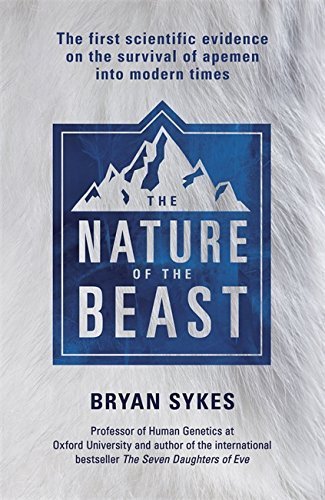
– 📚 The Nature of the Beast 💵 by Bryan Sykes
– 📚 The Seven Daughters of Eve 💵 by Bryan Sykes
– 📚 Adam’s Curse 💵 by Bryan Sykes
– 📚 Blood of the Isles 💵 by Bryan Sykes
– 📚 DNA USA 💵 by Bryan Sykes
🔗 Related Links
– Bryan Sykes — Wikipedia
– The Pangboche Hand and Finger
– Zana, the Wild Woman of Abkhazia
– Denisovans — archaic human relatives
– Neanderthals
–
AFTER 100 EPISODES of MonsterTalk, what is left to be said about science and monsters? Probably a lot. In this episode, we are joined by author and researcher Dr. Bryan Sykes, whose landmark examination of the DNA and physical evidence for Bigfoot and Yeti form the basis of his newest book, The Nature of the Beast. We also hear from many listeners about their own favorite monsters.
If you have relevant scientific expertise and would like to help Dr. Sykes with his Zana research, you can reach him at [email protected].
Thanks to everyone who contributed to this episode of MonsterTalk!
Other Works by Dr. Bryan Sykes
Top 10 Most Popular Episodes of MonsterTalk
Click a title below to read detailed episode notes and listen to the 10 most popular episodes of MonsterTalk, starting with our most popular episode on ancient alien astronauts:
Dr. Ken Feder, author of Frauds, Myths, and Mysteries, on ancient alien astronauts
Robert M. Price on the life of H.P. Lovecraft, the history of the Cthulhu Mythos, religious beliefs and racism; plus PZ Myers on the biology and physiology of cephalopods
Dr. Todd Disotell on his various appearances on cryptozoology television shows as the DNA expert
The Columbus Poltergeist (featuring James Randi)
James “The Amazing” Randi on the story of Tina Resch and the paranormal phenomena known as a poltergeist
Scott Herriott, host of The Bigfoot Show, on his personal quest to find Bigfoot—and the people he’s met in that search
Dr. Todd Disotell on Melba Ketchum’s Sasquatch DNA research
Joe Nickell and Steven Novella on the story of Ed and Lorraine Warren and demonic forces in Rhode Island
Robert M. Price on the biggest and most well known villain in Western culture: Satan
Dr. Scott Poole on the history of monsters from colonial America to modern times
Fangs That Go Bump in the Night
Richard Sugg on his fascinating research into historic vampire cases
Music
- Monstertalk Theme: Monster by Peach Stealing Monkeys