Regular Episode
#092 – FANGS THAT GO BUMP IN THE NIGHT
🧛 What Actually Made a Vampire
Richard traces the origins of folk vampire belief to two interlocking mechanisms, both with recognizable medical underpinnings. The first is the vampire as social scapegoat: when a contagious disease killed one family member and then spread to others, communities would exhume the first to die and examine the body for signs of continued life. Decomposition in cold winter ground is slow, and the signs villagers interpreted as evidence of vampirism — bloating, reddened skin, apparent blood at the lips — are entirely consistent with normal post-mortem taphonomic processes.
The second mechanism is sleep paralysis. During REM sleep, the brain routinely paralyzes the body to prevent acting out dreams; if a sleeper becomes conscious during this state, the result can be a profoundly terrifying experience of immobility, auditory hallucinations, and a crushing sense of a malevolent presence on the chest — a presence that feels, even to modern materialists, as though it is after one’s soul rather than merely one’s life. Richard notes that the brain appears to reach for whatever culturally available template fits the experience: in vampire country, the intruder is a vampire; in witch country, a witch; in contemporary North America, an alien abductor. Both Richard and Blake share personal sleep paralysis experiences, and Karen traces her own to a documentary featuring Michael Shermer of Skeptic Magazine, whose explanation finally named what she had experienced.
Richard estimates that 20–30% of people experience sleep paralysis at some point, though he suspects the true figure is poorly captured because sufferers frequently avoid disclosing it — even to physicians, who have sometimes referred patients to psychiatrists rather than explaining the phenomenon directly.
🌍 Vampires Across Cultures: Less Dracula, More Bloat
Richard draws a sharp contrast between the stylized vampire of cinema — Christopher Lee, Bela Lugosi, the chiseled aristocrat — and the folk vampire actually feared in Greece, Romania, Bulgaria, and the Ukraine. The folk vampire needed no coffin to sleep in, could walk in daylight, and in Greek tradition neither drank blood nor recoiled from sunlight. Greek vampires might subsist on goat’s milk, or be identified by apples, nuts, and grapes found in the grave. They looked, unsurprisingly, like a decomposing corpse: bloated, reddened, shabby. The redness was taken as proof that the circulation had not stopped — that the thing was not truly dead.
He also traces the parallel between the vampire and the witch as twin scapegoat figures: both “attacked life,” both were blamed for failed crops, sick livestock, and epidemic disease. In some Eastern European cases as late as the 19th century, Polish peasants exhumed corpses specifically to account for hard frosts. Richard notes, wryly, that vampire accusations may actually have spared some living people who might otherwise have been tried as witches.
⚰️ Premature Burial and the Hazards of Getting Out
One of the more harrowing threads in the conversation is the intersection of vampire belief with the very real historical problem of premature burial. Because some cultures buried bodies quickly — while still warm — to forestall vampirism, the risk of burying the living alive was non-trivial. Richard recounts two documented cases: a Bulgarian child in a village near Varna in the 1860s, reported by British army officers Brophy and Sinclair, who was exhumed alive by its mother only to be condemned by a village council and killed as a vampire; and a Greek island case in which a person sat up in an open coffin during their own funeral and was stoned to death by the mourners.
The 18th-century response to premature burial anxieties in Western Europe produced safety coffins — including Dr. Johann Baptist Gutsmuth’s patented bell-and-cord designs — as well as grimmer expedients, such as thrusting red-hot needles under the toenails of the presumed corpse to see whether it reacted. The cruel irony of vampire belief, as Blake observes, is that a person who successfully clawed their way out of a grave would be greeted not with relief but with execution, and would likely be even more suspect if they wandered to a neighboring village — especially in grave clothes.
🧿 From Folk Terror to Vampotainment
Richard traces the cultural evolution of the vampire from peasant scapegoat to aristocratic erotic fantasy. The transformation begins in the 18th century, when accounts of Eastern European vampire panics reached educated, Enlightenment-era France and England. These readers didn’t believe the stories, but found them entertaining — a “consumption of other people’s terror at a distance,” in Richard’s phrase.
The literary lineage runs from John Polidori‘s 📚 The Vampyre 💵 (1819, often mistakenly attributed to Byron, and deliberately so) through Sheridan Le Fanu‘s lesbian vampire novella Carmilla (1872) to Bram Stoker‘s Dracula (1897), which Richard notes features what amounts to a ménage-à-quatre between Jonathan Harker and three female vampires. The vampire, he argues, gave Victorian writers a supernatural screen through which socially impermissible desires could be expressed. He also briefly discusses modern self-identified vampires — ranging from consensual blood-drinkers with sterilized needles to a notorious California case involving a man who attacked his girlfriend shortly after seeing the film adaptation of Anne Rice‘s 🎬 Interview with the Vampire 💵 — and is skeptical that any genuine physiological need underlies the blood-drinking community’s claims.
👻 The Vampire–Poltergeist Connection
The episode’s most distinctive contribution is Richard’s account of a recurring pattern he noticed while reading primary source accounts of vampire outbreaks — reliable reports by clergymen, officers, and local officials — that he had been mentally “throwing into a waste bin”: hammering noises, flashing lights, objects thrown across rooms, strange smells, apports. These phenomena, which he initially bracketed as implausible distractions, turn out to match the phenomenology of poltergeist cases with striking consistency, from the 1590s through the 1920s, across Greece, Romania, Bulgaria, and the Ukraine.
Richard’s working hypothesis links poltergeist activity to a “poltergeist agent” — typically a young person (often between 8 and 25) under significant emotional stress — whose unexpressed trauma releases as physical phenomena. He notes that cases often resolve when the agent leaves the location, and that the phenomena follow the agent rather than the building. He cites Matthew Manning and Uri Geller as examples of people around whom poltergeist events clustered, and notes that both reportedly suffered severe electric shocks before the age of ten. He also cites researcher William Roll, who documented a distance-decay curve in a Florida poltergeist case — phenomena diminishing the farther one got from the presumed agent — and connects this to the 1700 Mykonos vampire panic documented by French botanist Tournefort, who noted that the French consul’s household (occupied by skeptical outsiders with no fear of vampires) was the only one left alone.
Richard presents two intriguing edge cases that don’t fit neatly into the agent hypothesis. The 1841 Clewer case near Windsor, England — with knocking heard 500 yards away, investigated by a London scientist, a police officer, Lord Clement Hill, and a reverend, and ceasing only when the family departed — he reads as a probable case of a servant girl as unwitting agent. And a brief, violent event at Tolstoy Chaloy on the Isle of Lewis in January 1938, during intense solar storms visible as far south as Sussex, in which crockery shattered spontaneously and a ball of wool crumbled like ash, he tentatively associates with geomagnetic disturbance rather than any human agent. He also mentions the ongoing and well-documented Canneto di Caronia case in Sicily, where spontaneous fires and anomalous electrical behavior have recurred since 2004 and prompted multiple official investigations.
Physicist Barry Colvin‘s acoustic analysis of poltergeist rappings — finding a distinctive waveform signature that cannot be replicated by conventional knocking — is cited as one of the more objectively interesting threads, especially when set alongside a 19th-century account from Muchelney in which witnesses independently noted that the rappings, though deafeningly loud, produced no echo — and confirmed this by firing a gun and comparing the results.
😱 Terror as Mechanism: From Conversion Disorder to Voodoo Death
Richard proposes that fear itself is the energetic medium connecting vampire outbreaks to poltergeist events. He describes a continuum running from conversion disorder — psychosomatic blindness, deafness, or paralysis well-attested in magical cultures — through to what he calls “voodoo death“: cases in which belief in a lethal threat, sufficiently intense, produces actual death within one to three days. He cites the 18th-century Hungarian case of a young woman named Stanoka (variant spelling: Stanowska), who suffered sleep paralysis nightmares of a named vampire throttling her, refused food and water, and died within three days. He draws a parallel to documented cases of patients misdiagnosed with terminal cancer who die on the predicted schedule — dying, in effect, of belief in the authority of science rather than of the disease itself.
📚 Further Reading
– 📚 Mummies, Cannibals and Vampires 💵 by Richard Sugg
– 📚 The Vampyre 💵 by John Polidori (1819)
– 📚 Food for the Dead: On the Trail of New England’s Vampires 💵 by Michael E. Bell
– 📚 American Vampires: Fans, Victims, Practitioners 💵 by Norine Dresser
🔗 Related Links
– Sleep Paralysis (Wikipedia)
– Vampire Folklore by Region (Wikipedia)
– Premature Burial (Wikipedia)
– Safety Coffin (Wikipedia)
– Poltergeist (Wikipedia)
– William Roll, parapsychologist (Wikipedia)
– Matthew Manning (Wikipedia)
– Canneto di Caronia Fires (Wikipedia)
– Voodoo Death (Wikipedia)
– Conversion Disorder (Wikipedia)
– Joseph Pitton de Tournefort, botanist and Mykonos eyewitness (Wikipedia)
Note: ads inserted into the distributed audio alter the timestamps in unpredictable ways, so timing references in these notes are approximate.
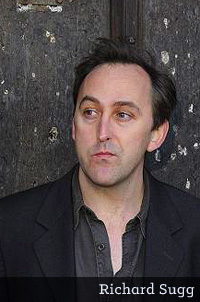
WE’VE ALL SEEN THE VAMPIRES of cinema and pop culture. Caped aristocrats, sparkling teens, monstrous revenants—which of these best corresponds to the real legends of vampires? Richard Sugg returns to talk about his fascinating research into historic vampire cases. He’s uncovered a recurring relationship between outbreaks of vampirism and poltergeist activity, which will be the subject of his next book.
Media Links
Music
- Monstertalk Theme: Monster by Peach Stealing Monkeys
- Introduction Music: Gravel by All India Radio
MTArchivist
0