#072 – THE WARREN OMISSION
Ed Warren died in 2006; Lorraine remained active as a lecturer and media personality until her own death in 2019. The Warrens’ self-styled careers as demonologist and clairvoyant touched dozens of high-profile cases — and left a paper trail that repays close reading.
👻 How the Warrens Got to Amityville (and What Actually Happened There)
In archival audio, Ed Warren explains that Marvin Scott of WPIX Channel 5 invited them to the Amityville house to participate in a Halloween-season séance special. Scott’s own account, preserved in a documentary clip, is decidedly anticlimactic: his crew left disappointed, hungry, and asking when the sandwiches were coming out. Lorraine, however, conducted a separate candlelight séance upstairs and — despite Scott’s “brief chill” being attributable to February weather — emerged with a legend she’d recount for the rest of her life.
Joe Nickell lays out the judicial record: the Amityville story was fabricated by the Lutzes and attorney William Weber (defense counsel for killer Ronald “Butch” DeFeo Jr.) over, as Weber publicly admitted, several bottles of wine. Weber hoped a demonic-possession angle might reopen DeFeo’s case. Physical inconsistencies — no snow on the ground on the night “devil’s tracks” were reported; original door hardware and varnish intact throughout, contradicting claims of doors ripped off hinges — were confirmed to Nickell by Barbara Cromerty, who purchased the house after the Lutzes and eventually sued over the false stories.
🎬 The Conjuring Case: What the Film Left Out
The film presents the Perron family of Harrisville, Rhode Island as having sought out the Warrens for help. According to Joe Nickell — who read both available volumes of Andrea Perron‘s self-published trilogy — the father, Roger Perron, never invited the Warrens. They simply showed up, as they often did, in the period before Halloween. Roger considered them charlatans from the start; his wife Carolyn was more receptive.
The film’s dramatic centerpiece — Carolyn’s chair levitating and flipping upside down — is, per the books’ own account, more likely Carolyn scooting her chair backward and tipping over. When Roger rushed to help her and Ed Warren tried to physically restrain him, Roger punched Warren in the nose. The family’s notes and sketches, lent to Lorraine Warren in confidence, were never returned. The Warrens also disclosed the family’s location in public lectures, resulting in strangers turning up at the isolated farmhouse — an outcome Carolyn had explicitly wanted to avoid.
📝 Ray Garton and the Making of a “True” Story
Horror novelist Ray Garton was hired by the Warrens to write the book that became 📚 In a Dark Place 💵, the basis for the film A Haunting in Connecticut. Garton recorded hours of interviews with the Snedeker family and the Warrens, but found that the Snedekers’ accounts kept contradicting themselves. When he brought this to Ed Warren, the response was blunt: “They’re crazy. All the people who come to us are crazy — that’s why they come to us. Just use what you can and make the rest up. That’s why we hired you. You’re a horror writer.” Garton has since publicly distanced himself from the book’s “based on a true story” marketing.
🔬 The New England Skeptical Society Investigates
Dr. Steven Novella recounts how the New England Skeptical Society (founded in 1996 by Novella, the late Perry DeAngelis, and colleagues, after noticing Connecticut had no local skeptics group listed in Skeptical Inquirer) decided to investigate the Warrens — the biggest paranormal names in their region. They had built up the Warrens in their minds as formidable opponents. The reality was deflating.
Ed showed the group his collection of ghost photographs — standard photographic artifacts (lens flare, camera strap, double exposure) with no attempt to rule out mundane explanations. His website advised using a bright flash to capture ghost images because, he believed, spirits “psychically project” themselves onto film — without noticing the obvious implication that the flash itself was producing the effect. After Novella’s group pointed this out, the page quietly disappeared from the site with no acknowledgment.
Ed’s self-proclaimed “best single piece of evidence” was a blurry VHS clip of the White Lady of Union Cemetery in Easton, Connecticut — conveniently too distant and low-resolution to rule out a person in a sheet. His second key piece of evidence — a tape showing a student apparently “dematerializing” in a doorway — was submitted by an associate (Ed himself never handed over evidence directly). Analysis on a professional editing deck revealed: a person standing next to the camera (contradicting Ed’s insistence nobody was nearby); audio and video discontinuities — including abruptly stopping echoes and a candle flame that jumped — all clustered at the same frame boundary; and a cut occurring cleanly between two complete frames, exactly as would happen if someone stopped and restarted the tape, not at all as would happen if a person spontaneously vanished mid-scan. Ed’s response: the kid dematerialized. Full stop.
The Warrens ultimately refused to allow the group on a live investigation, citing the members’ atheism as a spiritual safety concern. Ed’s parting worry, according to Novella, was: “You’re going to make me look like a chump, aren’t ya?”
🧠 The Warren Method: A Pattern of Practice
Joe Nickell identifies what he calls the Warrens’ modus operandi across their career: seek out cases already in the news as ghost or poltergeist incidents (frequently around Halloween); present themselves as credentialed experts to families who have no framework to evaluate those claims; steer the narrative toward demonic infestation — a framing rooted in their intensely traditional Catholic worldview; bring in a ghostwriter to “punch up” the story for publication; and let Hollywood punch it up further still. The families involved were, in Nickell’s observation, consistently Catholic — an audience already primed for the demonic framework the Warrens offered.
Novella adds that the Warrens ran a self-sustaining ecosystem: college lectures led to classes (held at a local restaurant), classes led to investigations, investigations led to disillusioned former students who — recognizing that no special knowledge was required — would break away to form their own ghost-hunting groups. Dozens of New England paranormal investigation groups trace a lineage back to the Warrens in exactly this way.
🪆 The Occult Museum and the Annabelle Doll
The Warrens maintained a museum of allegedly cursed and demonically possessed objects in their home basement, which they opened to visitors. In archival footage, Ed identifies a mass-market paperback — the Simon Necronomicon, a well-known literary hoax first published in 1977 — as an original medieval Book of Shadows. It is neither. Books of Shadows are spell books associated with modern Wicca, not medieval Catholicism; the Simon Necronomicon’s Sumerian-sounding incantations are a modern fabrication. The museum also contained, per Novella, a copy of the Unearthed Arcana — a Dungeons & Dragons supplement.
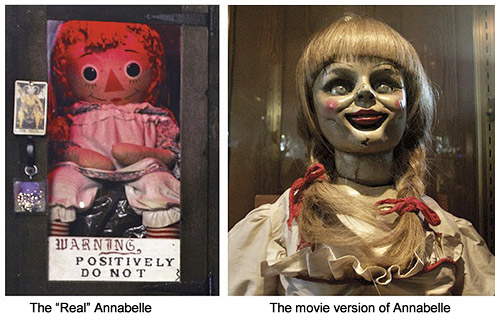
The museum’s prize exhibit was a Raggedy Ann doll kept in a glass case — the real-life Annabelle, rendered in The Conjuring as a grotesque porcelain figure (a change driven partly by copyright, and, as Blake notes, partly because Raggedy Ann’s lack of fingers would have complicated the plot). Ed warned the NESS investigators not to go near it, adding that the last person who mocked the doll died in a motorcycle accident an hour later. The NESS members spent the unsupervised time in the basement touching everything they could find. All survived.
📚 Further Reading
– 📚 The Demonologist: The Extraordinary Career of Ed and Lorraine Warren 💵 by Gerald Brittle (sympathetic account)
– 📚 In a Dark Place 💵 by Ray Garton
– 📚 The Science of Ghosts: Searching for Spirits of the Dead 💵 by Joe Nickell
🔗 Related Links
– New England Skeptical Society — Investigation of the Warrens (by Steve Novella and Perry DeAngelis)
– Joe Nickell — “Demons in Connecticut”, Skeptical Inquirer
– Amityville Horror — Hoax claims (Wikipedia)
– Annabelle doll (Wikipedia)
– Simon Necronomicon (Wikipedia)
– Marjoe (1972 documentary on faith-healing stagecraft, recommended by Joe Nickell)
– 📺 Marvin Scott / WPIX on Amityville — Part 1
– 📺 Marvin Scott / WPIX on Amityville — Part 2
Note: ads inserted into the distributed audio alter the timestamps in unpredictable ways, so timing references in these notes are approximate.
WAS THE STORY OF The Conjuring the true story of how Ed and Lorraine Warren fought demonic forces in Rhode Island? In this special episode of MonsterTalk, we hear a different side to the story of America’s first family of ghost hunting. Features interviews with investigators Joe Nickell and Steven Novella.
Interviewed for this episode
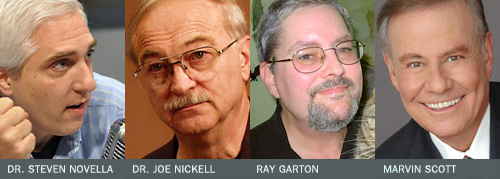
Dr. Steven Novella is a neurologist and notable skeptical activist, a founder of the New England Skeptics Society, and the host of The Skeptic’s Guide to the Universe.
Dr. Joe Nickell is a researcher and scientific paranormal investigator, and author of numerous books and articles related to the field.
Ray Garton is an author of many horror books, including In a Dark Place, the novel based on the allegedly real-life events behind The Haunting in Connecticut. He has distanced himself from that marketing approach, and now says that he had to make up much of the story at the behest of the Warrens.
Marvin Scott is a senior reporter for WPIX, New York. He brought the Warrens to the site of The Amityville Horror and says that nothing noteworthy took place. Ed and Lorraine claim that it was one of the most traumatic events in their lives. (We interviewed Martin Scott but the resulting audio was too poor for inclusion in the episode.)
Articles
- The New England Skeptics Society—an investigation into the Warrens
- Joe Nickell—Demons in Connecticut
- Rocky Mountain Paranormal interviews Lorraine Warren
- A highly critical look at the Warren’s involvement with the Amityville case
- The town of Dudley is besieged by ghost hunters after a write up by the Warrens
Books
- The Demonologist: The Extraordinary Career of Ed and Lorraine Warren, an unskeptical look at The Warren, by Gerald Brittle
- The Science of Ghosts: Searching for Spirits of the Dead, by Joe Nickell
Videos
- The Sally Jesse Raphael show about The Haunting in Connecticut
- Ed Warren claimed in a video that the Simon Necronomicon is a book of shadows of the occult. (It isn’t.) (Note: YouTube has closed the account of the original poster of the VHS tour of Ed’s museum.)
- Marvin Scott interviews Hans Holzer about The Amityville Horror:
Music
- Monstertalk Theme: Monster by Peach Stealing Monkeys