Regular Episode
038 – Ancient Alien Astronauts: Interview with Ken Feder
The episode doubles as an informal primer on how archaeology actually works — how researchers distinguish a technology developed in place from one introduced from outside — with the ancient astronaut literature serving as a useful foil for illustrating what real archaeological evidence looks like.
🛸 From Morning of the Magicians to Ancient Aliens: A Brief History of the Genre
Ken traces his own introduction to the topic to a chance encounter at a unisex hair salon in 1969, when a stylist asked the freshman archaeology student what he thought about “the guy who says spacemen built the pyramids.” A late-night radio review of 📚 Chariots of the Gods 💵 confirmed the book was real. Ken went back and reread The Morning of the Magicians by Louis Pauwels and Jacques Bergier — popular in Europe in the early 1960s and translated into English by the mid-to-late 60s — and noticed that Erich von Däniken had borrowed heavily from it without credit. As Ken drily notes, the pattern is consistent: von Däniken didn’t credit the ancient Egyptians for building the pyramids either.
By 1977, when Ken was assigned to teach an open-topic introductory course, students were still asking about ancient astronauts. He read all of von Däniken’s books systematically and extracted what he identifies as three core hypotheses. The Ancient Aliens series on cable television has more recently renewed public interest — Ken was invited to participate and declined to appear after informing the producer that he considered the ancient astronaut hypothesis “execrable bullshit.”
👽 The Three Hypotheses (As Identified by Feder)
Ken lays out the logical skeleton of von Däniken’s claims:
– The “Horny Astronaut” Hypothesis: Extraterrestrials mated with early hominids — including creatures resembling Australopithecus (“Lucy”) — and each subsequent mating event produced the next stage of human evolution. Carl Sagan observed that a human would have better reproductive luck with a petunia, since at least both evolved on the same planet.
– The Inkblot Hypothesis: Cave paintings and ancient art that could plausibly depict animals, spirits, or costumed shamans are reinterpreted — through what Ken calls a Rorschach-style projection — as direct records of our ancestors witnessing extraterrestrial landings. The caption is always “alien” regardless of what the image actually resembles.
– The “Our Ancestors Were Dummies” Hypothesis: (named by anthropologist John Omohundro) Ancient peoples were simply incapable of developing agriculture, metallurgy, mathematics, calendars, or monumental architecture on their own, and required an “extraterrestrial Peace Corps” to civilize them. Ken considers this the most intellectually offensive of the three.
Ken’s surveys across American, British, and Canadian universities since the mid-1980s consistently find roughly a third of respondents agreeing (strongly or mildly) that extraterrestrials helped ancient humans — a proportion that had been slowly declining as von Däniken’s books faded from popularity, but which Ken expects the Ancient Aliens series to reverse.
🔺 The Pyramids: A Case Study in Indigenous Development
The bulk of the conversation turns on Egypt’s pyramid-building sequence as a textbook illustration of how archaeologists distinguish indigenously developed technology from introduced technology. Ken’s rule of thumb: if you see halting, trial-and-error steps leading to a mature technology, it developed locally; if it appears fully formed with no antecedents, look for an outside source.
The Egyptian record shows exactly the former:
– Early pharaohs were buried in single-story brick structures called mastabas, which gradually grew larger over time.
– Pharaoh Djoser (Third Dynasty) commissioned the Step Pyramid at Saqqara — essentially stacked mastabas — as the first monumental royal tomb.
– The next attempt, the Collapsed Pyramid at Meidum, was built at a reckless 70-degree angle and was abandoned when internal cracks formed.
– The Bent Pyramid at Dahshur started at 55 degrees; when a corner built on sand began to sink and the structure cracked, engineers changed the angle of the upper third mid-construction — producing the distinctive “bent” profile visible today.
– Only then, starting at the stable ~45-degree angle that the Bent Pyramid’s upper section had demonstrated, did the Red Pyramid succeed — establishing the template for all subsequent Egyptian pyramids, including those at Giza.
The entire learning curve spans roughly four to five generations — close to 100 years. As Ken puts it: these are beings who could reportedly traverse the galaxy, and they couldn’t figure out how to stack rocks without them falling down?
🔍 “Anachronistic” Artifacts, Examined
The hosts run through several objects frequently cited as evidence of ancient advanced technology or extraterrestrial contact:
– Antikythera Mechanism: Ken is unmoved. The Greeks calculated the circumference of the Earth, proposed atomic theory, and figured out that the world was round. A sophisticated geared astronomical calculator is entirely consistent with what we know of Greek intellectual achievement. Calling it extraterrestrial requires ignoring everything else we know about Greek science.
– Baghdad Battery: Ken’s students have built replicas in his experimental archaeology class with negligible results. Even granting the object could produce a small electrical current: where are the light bulbs? The copper wire? The artistic depictions of electric illumination? The archaeological context simply isn’t there. MythBusters managed weak electroplating at best.
– Saqqara Bird and the gold “airplanes” from Colombia: Occam’s razor applies. The hypothesis that they are stylized bird carvings — made by people who observed birds — requires no additional assumptions. The hypothesis that they are model aircraft requires unsupported assertions about extraterrestrial visitors who apparently still needed wings on their spacecraft.
– Crystal Skulls: Microscopic examination reveals lapidary wheel marks and evidence of modern power tools. Every examined skull has been shown to be a 19th-century fabrication. Ken recommends Archaeology magazine’s post-🎬 Indiana Jones and the Kingdom of the Crystal Skull 💵 coverage as a thorough debunking.
– The sarcophagus lid of Maya King Pakal (Palenque, 7th century AD): Von Däniken reads the elaborately carved lid as depicting an astronaut at the controls of a rocket. Mayanists read it as Pakal wearing the feathered headdress common in Maya royal iconography — and Ken notes that even the alleged “communication antenna” looks less impressive than technology we have already surpassed. If these aliens could cross the galaxy, why did their comm gear still need external antennas?
⛏️ What Archaeology Actually Is
Ken offers a frank account of the discipline. The distinguishing marker of an indigenously developed technology is the visible archaeological record of mistakes: failed experiments, abandoned structures, iterative improvement. The pyramids, Maya calendrical mathematics, bronze metallurgy (beginning with accidental impurities in smelted copper), and pottery traditions all show exactly this pattern when you look at the stratigraphic record.
The deeper offense of the ancient astronaut hypothesis, Ken argues, is its implicit racism: the consistent framing that “primitive” peoples in Africa, Mesoamerica, or South Asia could not have achieved what they demonstrably did achieve. The Maya developed the concept of zero and a base-20 number system with a calendar whose incremental development is visible in the archaeological record — no alien assistance required.
On the Venus of Willendorf and similar Upper Paleolithic figurines: Ken surveys the competing interpretations — fertility symbols, paleo-pornography, self-portraiture by women — and reaches the archaeologically honest conclusion that we may never know which is correct.
Ken is also working on a forthcoming travel guide to 50 publicly accessible archaeological sites in the United States — a project that has taken him to Cahokia (whose largest mound is the fifth-largest pyramid by volume in the world), Mesa Verde, Etowah, Moundville, and Kolomoki Mounds, among others.
📚 Further Reading
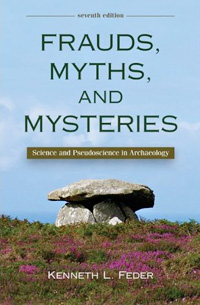
– 📚 Frauds, Myths, and Mysteries: Science and Pseudoscience in Archaeology 💵 by Kenneth Feder
– 📚 Chariots of the Gods 💵 by Erich von Däniken (the primary text under discussion)
– 📚 The Morning of the Magicians 💵 by Louis Pauwels and Jacques Bergier
– 📚 The Demon-Haunted World 💵 by Carl Sagan
– 📚 Tracking the Chupacabra 💵 by Benjamin Radford (mentioned by Ken as having definitively “killed” his interest in the chupacabra)
🔗 Related Links
– Ancient Astronauts (Wikipedia overview)
– Erich von Däniken
– Giorgio A. Tsoukalos
– Panspermia (the distinct, scientifically discussed hypothesis briefly contrasted with ancient astronaut claims)
– Step Pyramid of Djoser, Saqqara
– Bent Pyramid, Dahshur
– Cahokia Mounds
– Giovanni Battista Belzoni (circus strongman turned pioneer Egyptologist, mentioned by Ken as a historical parallel to Tsoukalos)
Note: ads inserted into the distributed audio alter the timestamps in unpredictable ways, so timing references in these notes are approximate.
DID ANCIENT HUMANS gain their technological achievements through the assistance of creatures from other planets? This week on MonsterTalk, Dr. Feder, an archaeology professor who has taught a course on the topic, shares his thoughts. Feder is the author of Frauds, Myths and Mysteries—a book with more good scientific content on the cover than most TV shows have in an entire season.
In this episode
- The Morning of the Magicians
- Chariots of the Gods
- The claims people commonly make
about ancient aliens - The History Channel’s
Ancient Aliens series - A brief overview of some of the more popular “anachronistic” evidence
- The Antikythera mechanism
- The Baghdad Battery
- The Saqqara Bird & gold “airplanes” found in South America
- The Crystal Skulls
- How archaeologists test “ancient astronaut” theories
- How archaeology works
- Is the Venus of Willendorf porn?
Music
- Monstertalk Theme: Monster
by Peach Stealing Monkeys
MTArchivist
0