Regular Episode
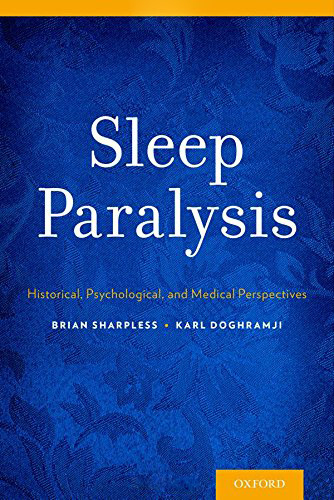
#099 – LET’S GET THIS OFF OUR CHEST
The episode title says it all: this one gets personal. Blake recounts the sleep paralysis episodes that — combined with a later encounter with Michael Shermer‘s skeptical commentary — essentially launched MonsterTalk into existence. Karen, two weeks postpartum at the time of recording, reflects on her own pregnancy-related sleep disturbances. And Dr. Sharpless, who has been studying the phenomenon since his 2008 postdoc, cheerfully admits he has never experienced it himself.
🧠 What Is Sleep Paralysis?
Sleep paralysis occurs during the transition into or out of sleep, when a person regains conscious awareness but the body’s REM atonia — the motor suppression that normally keeps us from acting out our dreams — remains active. The result: you are awake, you can move your eyes, you can breathe, but you cannot move your body. Roughly 90% of episodes involve hallucinations, because REM dream imagery bleeds into wakefulness.
Dr. Sharpless conducted a large meta-analytic study combining 35 other studies for a total sample of 36,000 people. Key prevalence figures from that research:
– About 8% of the general population has experienced sleep paralysis at least once.
– Rates climb to roughly 28% among students and 32% among psychiatric patients.
– Disrupted sleep — from shift work, jet lag, alcohol use, or the academic lifestyle — is among the strongest predisposing factors.
– Other risk factors include anxiety sensitivity, high death anxiety, dissociation, trauma history (PTSD), proneness to paranormal belief, fantasy-proneness, and higher BMI.
– Sleeping supine (on one’s back) markedly increases the likelihood of an episode; sleeping on one’s side is among the simplest preventive measures.
A colleague of Dr. Sharpless at the University of Sheffield, Dan Denis, has conducted genetic research suggesting at least a partial heritable component to sleep paralysis susceptibility.
👻 A Global Phenomenon with Local Monsters
Sleep paralysis has been documented in writing since at least ancient Greece, and Dr. Sharpless has compiled a list of roughly 108 cultural terms for the experience across different times and places. The labels vary; the core experience — paralysis, crushing chest pressure, a malevolent presence — stays remarkably consistent. A sampling:
– In Cambodia: “the ghost that pushes you down.”
– In ancient Greece: Pan Ephialtes — Pan, the god, leaping upon you.
– In Zanzibar: the Popobawa, a giant black bat (a case previously discussed on MonsterTalk by Joe Nickell).
– In Turkey: “the dark presser.”
– In Mexico: “a dead body that climbed on top of you.”
The original meaning of the word nightmare mapped almost exactly onto sleep paralysis — paralysis, chest pressure, overwhelming dread — rather than merely a frightening dream. That semantic shift seems to have occurred sometime in the 19th or 20th century.
Medieval texts such as the Malleus Maleficarum and the Compendium Maleficarum are rich sources of incubus and succubus lore. Blake and Dr. Sharpless share an appreciation for the Montague Summers translation of the Malleus, marveling at the scholastic precision applied to questions like whether incubi could impregnate human women (the book’s answer: not directly, but via a succubus-as-intermediary relay system, elaborated across approximately 20 pages).
🧛 Vampires, Tuberculosis, and Visitations
Dr. Sharpless argues that sleep paralysis is a meaningful piece — not the entire puzzle — in understanding how intelligent, observant people historically arrived at belief in vampires, demons, and fairies. The connection to vampire mythology is especially tight: European vampire attacks occur at night, victims are paralyzed, and in some traditions vampires can paralyze with their gaze (the “glamour,” a word that even made it into the Twilight films).
He references the work of researcher Paul Barber (author of 📚 Vampires, Burial, and Death 💵), who linked vampire panics to tuberculosis outbreaks. TB fills the lungs with fluid, causes bloody coughing at night, and severely disrupts sleep — all factors that increase the likelihood of sleep paralysis. A surviving family member, already at elevated TB risk, would be primed for a sleep paralysis episode and, in that state, might hallucinate a recently deceased relative. Dr. Sharpless notes from his own research that college students disproportionately report seeing recently deceased grandparents in their hallucinations — which, combined with a cultural framework of vampirism, would be more than enough to trigger a village panic.
The abduction-at-night motif also connects sleep paralysis to fairy lore, ghost traditions, and modern alien abduction narratives. One of the three hallucination types in sleep paralysis involves sensed bodily movement — a limb being moved, or the entire body being transported — which maps neatly onto abduction narratives. Research by Richard McNally and Susan Clancy using the Deese–Roediger–McDermott paradigm suggested self-identified abductees may show elevated false-memory formation, though a replication attempt by Chris French did not reproduce the finding.
🌙 Pregnancy, Parasomnias, and Local Sleep
Sleep paralysis belongs to the broader category of parasomnias — unwanted or distressing events occurring during transitions into, within, or out of sleep. Most parasomnias decrease in frequency during pregnancy; sleep paralysis is the notable exception. After a slight reduction in the first trimester, rates increase in the second and third trimesters, making it uniquely prevalent among pregnant people at a time when sleep disruption is already common.
The neurological mechanism underlying sleep paralysis involves what researchers call local sleep — different regions of the brain can be simultaneously asleep and awake. A cortical EEG during an episode may look like wakefulness, while subcortical regions remain in REM states. Fully testing this requires invasive subcortical EEG procedures that are difficult to conduct in practice. Japanese researchers have managed to capture episodes in the lab, and at least one other researcher induced sleep paralysis experimentally by repeatedly interrupting subjects just as they were falling asleep.
💥 Exploding Head Syndrome and Targeted Individuals
Dr. Sharpless also studies exploding head syndrome — another parasomnia in which a person is jolted awake by an intensely loud sound (described as a bomb or gunshot inside the head) that has no external source. Like sleep paralysis, it is a transition-state phenomenon and is entirely benign, yet also like sleep paralysis, it attracts supernatural and conspiratorial interpretations. Dr. Sharpless describes receiving calls from people who attribute the experience to government directed-energy weapons or smart utility meters — individuals who identify as “targeted individuals.” A notable feature of exploding head syndrome treatment: simply being told the experience has a name, is common, and is harmless has itself been shown to reduce episode frequency.
🎬 The Nightmare on Screen
Dr. Sharpless mentions that documentary filmmaker Rodney Asher — director of 🎬 Room 237 💵 — was about to premiere a new documentary following eight chronic sleep paralysis sufferers. That film, 🎬 The Nightmare 💵, presents their experiences in a horror-documentary style, with dramatic re-enactments of the hallucinations. Dr. Sharpless planned to review it for the Oxford University Press blog.
📚 Further Reading
– 📚 Sleep Paralysis: Historical, Psychological, and Medical Perspectives 💵 by Brian Sharpless and Karl Doghramji
– 📚 Vampires, Burial, and Death 💵 by Paul Barber
– 📚 Predictably Irrational 💵 by Dan Ariely (referenced in the conversation on human rationality)
🔗 Related Links
– Sleep Paralysis — Wikipedia
– Exploding Head Syndrome — Wikipedia
– Incubus (supernatural entity) — Wikipedia
– Succubus — Wikipedia
– Old Hag (folklore) — Wikipedia
– Malleus Maleficarum — Wikipedia
– Popobawa — Wikipedia
– Parasomnia — Wikipedia
– Local Sleep — Wikipedia
– Deese–Roediger–McDermott Paradigm — Wikipedia
Note: ads inserted into the distributed audio alter the timestamps in unpredictable ways, so timing references in these notes are approximate.
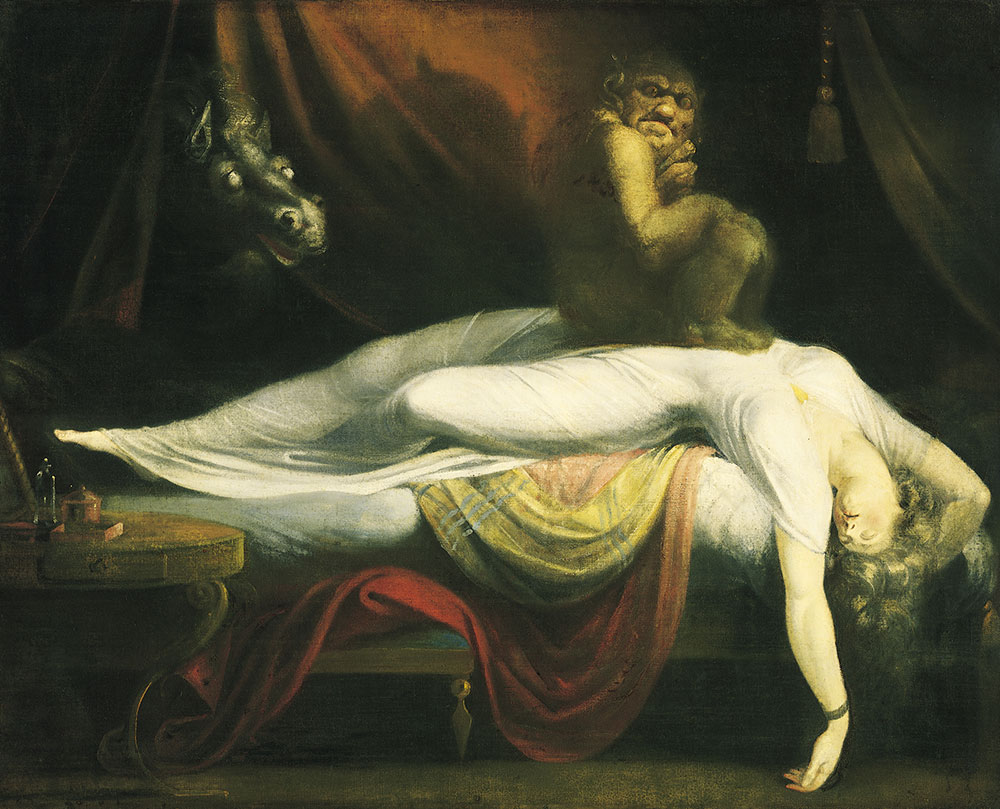
The Nightmare, by John Henry Füseli (Public domain, via Wikimedia Commons)

THE INCUBUS, THE SUCCUBUS, the old hag and many other monster stories focus on strange attacks that come in the night. An entity, sometimes beautiful, sometimes hideous, sits on the chest of the victim and sucks out their life force. Science has an explanation for this global phenomena, and in this episode we talk with the co-author of a new book on the topic. Dr. Brian Sharpless joins us to talk about his new book, Sleep Paralysis: Historical, Psychological, and Medical Perspectives.
Music
- Monstertalk Theme: Monster by Peach Stealing Monkeys
MTArchivist
0