Regular Episode
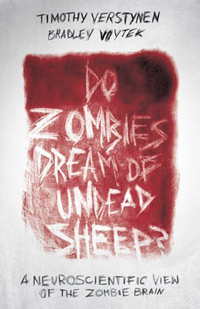
#087 – MORE BRAINSSSS
The book grew out of a running joke the two had been pulling at the annual Society for Neuroscience conference (35,000 attendees strong): showing up with unauthorized “guerrilla neuroscience” posters on topics like the zombie brain and the RoboCop neuroprosthetics. When security guards started stopping to read the posters, they knew they were onto something.
🧠 What We Actually Know About the Brain (Spoiler: Not Much)
Brad and Tim offer a brisk, humbling tour of the current state of neuroscience. The dominant metaphor has evolved from “the brain is a computer” to “the brain is a network” — more like the internet than a single processor. Their mentor Robert Knight, Brad’s PhD advisor at UC Berkeley, put it memorably: at a family reunion 20 years ago he estimated we knew about 1% of how the brain works. Asked again 20 years later, he said we’d doubled it.
One persistent conceptual trap the authors flag is dualism — even neuroscientists accidentally slip into talking about “the mind” as if it floats free of the brain. They call this “chasing the homunculus“: every time you identify a brain region that seems to be “in charge,” you have to ask what tells that region what to do, and so on until you end up back at the eyeball. Decades of lesion studies have confirmed there is no single executive decision-making spot in the brain.
They also push back against what some have called “technicolor phrenology” in neuroimaging — the tendency to see a brain region “light up” and conclude it is the seat of some behavior. A famous example: a 2011 New York Times op-ed that argued people are “in love” with their iPhones because the insula activated when viewing them — ignoring that the insula activates in roughly one-third of all neuroimaging experiments regardless of task, a point documented by neuroscientist Russ Poldrack‘s large-scale OpenFMRI database.
🧟 Forensic Neuroscience: Diagnosing the Zombie Brain
Without a real zombie to slide into an MRI scanner, Voytek and Verstynen use what they call “forensic neuroscience” — systematically observing stereotyped zombie behaviors in film and working backward to plausible neurological damage patterns, the same methodology a skilled pre-imaging-era clinician would use at the bedside.
Key behavioral clues they examine:
– The slow, shuffling, small-stepped gait points to damage in motor-coordination circuits distinct from outright paralysis.
– The famous “brains” utterance of Tar Man in 🎬 Return of the Living Dead 💵 is actually a textbook example of telegraphia, a symptom of Broca’s aphasia: the speaker can convey the essential noun but cannot wrap it in fluent syntactic structure — the same pattern seen in children acquiring language.
– Big Daddy from 🎬 Land of the Dead 💵 retains procedural memories (how to do things) while losing explicit memories (facts and events) — a distinction that maps onto real dissociations between memory systems in the brain.
– The hyper-aggression of the infected in 🎬 28 Days Later 💵 fits a model of failed neocortical regulation of fight-or-flight responses: without that suppression, the authors note, a zombie should be just as easily spooked as it is dangerous.
🌿 The Very Real Science of Brain Hijacking
The book’s final section pivots to real-world “zombification.” Two cases that came up in the conversation:
– Cordyceps fungi (Ophiocordyceps unilateralis) and the jewel wasp, which surgically disables a cockroach’s escape reflex and converts it into a living larder, are discussed as nature’s own proof-of-concept for behavioral hijacking.
– Toxoplasma gondii, the single-celled organism that lives in cat feces and can only sexually reproduce in a cat’s gut, appears to modulate fear responses in infected rodents — making them attracted to cat odor rather than repelled by it, thereby completing the parasite’s life cycle. Growing evidence suggests chronic human infection is associated with elevated risk-taking behavior. Brad credits neuroscientist Patrick House (who did his PhD with Robert Sapolsky at Stanford studying toxoplasmosis) with the darkly comic observation that the zombie apocalypse may have already happened in ancient Egypt — where humans began worshipping cats.
🇭🇹 Haitian Zombis and the Neuroscience of Tetrodotoxin
The book devotes a chapter to the historical Haitian vodou zombie tradition — spelled zombi without the final E throughout, to underline that these are real people subjected to what amounts to an underground slave trade. The discussion draws heavily on Wade Davis‘s 📚 The Serpent and the Rainbow 💵, which proposed that tetrodotoxin (TTX) — the sodium-channel blocker responsible for fatalities from improperly prepared fugu pufferfish — induces a state of apparent death. Post-“resurrection,” Davis argued, a bokor (vodou sorcerer) administers datura (containing scopolamine, atropine, and hyoscine) to maintain a dissociated, compliant mental state. The neuroscientific hook: TTX’s mechanism is a perfect entry point for explaining sodium channels and action potentials — the same material that glazes students’ eyes in Neuroscience 101.
Davis’s ethnobiological claims have attracted significant skepticism regarding whether the doses involved could reliably produce the described effects, but Voytek and Verstynen note it remains the most scientifically grounded framework for an implausible scenario.
🌐 Culture, Memetics, and the Socially Shaped Brain
The conversation takes an unexpected detour into how culture shapes neurobiology. Verstynen references the work of Lisa Feldman Barrett, whose research suggests the organization of a person’s social network — number of close contacts, density of social roles — predicts structural features of the amygdala and its connectivity with the cortex. Socioeconomic status, too, correlates with the integrity of white-matter connections.
This leads to a discussion of 📚 Crazy Like Us: The Globalization of the American Psyche 💵 — which argues that certain mental-illness presentations, including anorexia, were essentially absent in some populations until mass-media coverage of Western diagnostic categories introduced the cultural script. Blake connects this to memetics (Richard Dawkins’s concept from The Selfish Gene) and to the film 🎬 Pontypool 💵, which literalizes the idea: in that movie, the zombie contagion spreads through language itself — a memetic virus broadcast over a radio station.
📚 Further Reading
– 📚 Do Zombies Dream of Undead Sheep? A Neuroscientific View of the Zombie Brain 💵 by Timothy Verstynen and Bradley Voytek
– 📚 The Serpent and the Rainbow 💵 by Wade Davis
– 📚 Crazy Like Us: The Globalization of the American Psyche 💵 by Ethan Watters
– 🎬 Return of the Living Dead 💵
– 🎬 Land of the Dead 💵
– 🎬 28 Days Later 💵
– 🎬 Pontypool 💵
🔗 Related Links
– Broca’s Area and Wernicke’s Area — the language regions discussed in the zombie aphasia analysis
– Anosognosia — the inability to recognize one’s own neurological deficit (the “don’t know they’re paralyzed” phenomenon)
– Confabulation — the brain’s habit of generating plausible-sounding false narratives without intent to deceive
– Capgras Delusion — the belief that familiar people have been replaced by impostors (cited in connection with The Thing)
– Ophiocordyceps unilateralis — the “zombie ant” fungus
– Toxoplasma gondii — the cat-feces parasite implicated in risk-taking behavior
– Neuroplasticity — the brain’s capacity to reorganize, including the repurposing of visual cortex for echolocation in congenitally blind individuals
– Lisa Feldman Barrett — psychologist and neuroscientist whose work on social structure and brain morphology is referenced
– Brad Voytek’s blog and Tim Verstynen’s Psychology Today column are linked in the original show notes
Note: ads inserted into the distributed audio alter the timestamps in unpredictable ways, so timing references in these notes are approximate.
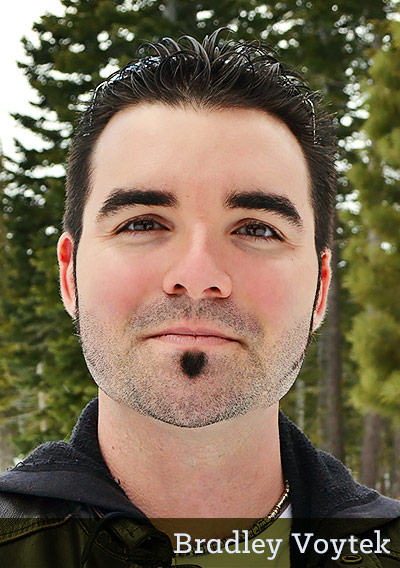
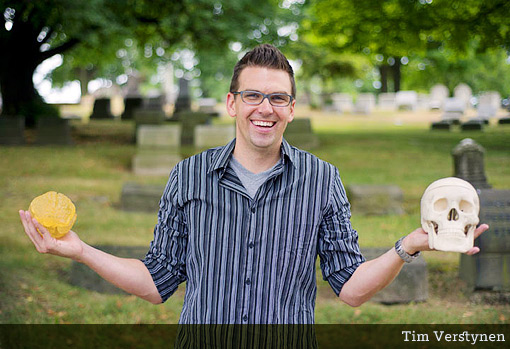
WHAT CAN A SHAMBLING ZOMBIE TEACH US about the human brain? According to Brad Voytek and Tim Verstynen, quite a lot. Their new book is called Do Zombies Dream of Undead Sheep? and in this episode of MonsterTalk we’ll be talking “Brainssss…”
Further Reading
Additional Media
- TEDx zombie neuroscience video
- Crazy Like Us: The Globalization of the American Psyche
- Return of the Living Dead
- Land of the Dead
- Pontypool
- The Serpent and the Rainbow: A Harvard Scientist’s Astonishing Journey into the Secret Societies of Haitian Voodoo, Zombis, and Magic
- John Carpenter’s The Thing rather obscure Donald Pleasance Easter-egg
Previous Episodes Referenced
Music
- Monstertalk Theme: Monster by Peach Stealing Monkeys
MTArchivist
0