Regular Episode
066 – THE ZOMBIE ANTPOCALYPSE
Their guest is David Hughes, then an assistant professor of entomology at Penn State University and a specialist in parasite manipulation of host behavior — a field whose findings read like folklore but are rigorously peer-reviewed. The conversation ranges from the chemical democracy of ant colonies to a fungus that turns carpenter ants into guided missiles, to a protozoan that may be quietly rewiring human brains right now.
🐜 Ant Society 101
Before getting to the parasites, Hughes walks the hosts through the basics of ant biology, because the horror lands harder once you understand what’s being subverted. A few highlights:
– Every forager, soldier, and nurse ant you have ever seen is female. The colony is, as Hughes puts it, built on female activities.
– Communication is almost entirely chemical. Trail pheromones paint invisible highways; individual chemical signatures function like gang tattoos, telling every ant exactly who belongs and who doesn’t.
– Death is announced chemically too — a rise in oleic acid off a corpse triggers nest-mates to carry it to the refuse pile.
– The queen’s chemical signature on her eggs is the pacemaker of the whole colony. Remove it and the society begins to collapse within days.
– Ants in aggregate outweigh all other animal biomass in a rainforest — jaguars included.
Hughes also confirms the old field trick of applying colony-scent chemicals to glass beads: workers encountering the beads concluded that foragers were already out and went back inside — an experiment he attributes to myrmecologist Deborah Gordon.
🍄 Ophiocordyceps and the Zombie Ant
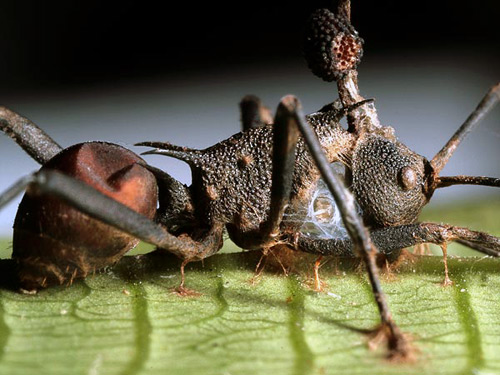
The star of the episode is Ophiocordyceps unilateralis — a parasitic fungus whose name Hughes helpfully unpacks: ophio (snake, for the snake-shaped spores) and unilateralis (one-sided). The organism was first collected by Alfred Russel Wallace in Sulawesi in 1859 — the same year Darwin published On the Origin of Species — but its behavioral manipulation went largely unstudied until Hughes’s group began working on it.
The life cycle is grim and precise:
– Foraging ants pick up fungal spores from the forest floor and carry the infection back into the nest.
– The fungus replicates inside the ant’s body over several days.
– At the moment it needs to sporulate, it compels the ant to abandon the colony — overriding the ant’s entire social identity — and wander into the forest understory.
– The ant bites down onto the underside of a leaf vein at a very specific height off the ground, a specific orientation, and almost always around solar noon.
– The mandible muscles — roughly 60% of the ant’s head — are progressively destroyed, producing a rigor-mortis-like locked jaw that keeps the ant clamped in place even after death. Hughes compares the mechanism to the muscle atrophy seen in carpal tunnel syndrome or spinal cord injury.
– The fungus then slowly consumes the body over weeks, eventually erupting a spore-bearing stalk from the back of the ant’s head, raining infectious spores onto the forest floor below — near the nest’s foraging trails, where new ants will encounter them.
Hughes notes, with some amusement, that nearly every photograph published of zombie ants shows them upside down — editors flip the image so the ant appears on top of the leaf. In reality the ant always hangs from the underside. Ophiocordyceps belongs to the same broader fungal group as ergot — the source of LSD — suggesting that the behavioral control probably involves some genuinely exotic neurochemistry, though Hughes’s lab had not yet isolated the specific compounds at the time of recording.
🌾 Ergot, Witch Trials, and Mass Hallucinations
The ergot connection prompts a brief but rich digression. Karen raises the theory — first systematically argued by historian Linnda Caporael in the 1970s — that the Salem witch trials were triggered by ergot-contaminated rye. Hughes considers it “undoubtedly a viable suggestion” and cites a more recent and better-documented case: a 1951 incident in Pont-Saint-Esprit, France, where a baker knowingly sold ergot-infected bread, resulting in mass hallucinations and violent episodes including, Hughes says, twelve-year-olds attempting to attack their parents. He traces similar events across European history.
🐀 Toxoplasma, Rats, and Possibly You
Broadening out from ants, Hughes introduces Toxoplasma gondii, a protozoan parasite (related to the malaria agent) whose life cycle requires rats to be eaten by cats. To accomplish this, it infiltrates the rat’s brain and, in work by Joanne Webster and colleagues, apparently transforms the rat’s fear of cats into something resembling sexual attraction — a phenomenon Hughes deadpans as “Fatal Feline Attraction.” The mechanism involves the parasite sequestering dopamine in cysts inside the limbic system and then releasing it in violent pulses, producing impulsive, schizophrenia-like behavior.
The human implications are not trivial. Infection rates run from roughly 13% in the US to 60–65% in France. Research by Jaroslav Flegr (Czech Republic) found that infected individuals are approximately two and a half times more likely to be involved in a car accident, owing to impaired reaction times and elevated impulsivity. There is no known cure; the parasite persists for life. Hughes’s dry advice: “I don’t think the problem is whether you have it. I think the problem is whether your airline pilot has it.”
🪱 Other Behavior-Modifying Parasites
Hughes surveys the broader landscape of parasitic mind control:
– Hairworms and nematodes that cause ants to leap into water or present themselves to birds as fake fruit, in order to continue their own life cycles.
– Lancet liver flukes (Dicrocoelium dendriticum) — trematodes that migrate to an ant’s brain and compel it to climb grass stems, making it easy for grazing cattle to ingest.
– Rabies virus: perhaps the most familiar example of a parasite engineering its own transmission by inducing aggression and hypersalivation in mammals — including humans — to optimize bite-route spread.
– Dracunculus medinensis (guinea worm, or Draculensis — “plagued by little devils”): migrates to the host’s lower limbs after a year inside the body, then causes intense pain that drives the host to immerse the affected limb in water — exactly where the parasite needs to release its larvae. Hughes notes, with the resigned affection of a natural historian, that Jimmy Carter‘s eradication campaign was within two or three countries of eliminating the species entirely at the time of recording.
💊 Medicinal Applications and the World’s Most Expensive Fungus
The same Ophiocordyceps family that zombifies ants has been used in traditional Chinese medicine for roughly 1,500 years, and modern pharmacology has since validated many of those uses. The fungi produce powerful antibiotics — a necessity, since after killing a host they must defend the food source from competing microorganisms. Related compounds have demonstrated anti-malarial, anti-tuberculosis, and anti-tumor properties in laboratory settings.
The most sought-after species, Ophiocordyceps sinensis (the caterpillar fungus of the Tibetan plateau), was trading at around $90,000 per kilogram at the time of recording, driven by overexploitation of its high-altitude grassland habitat.
🎮 From Lab to Screen: World War Z, The Last of Us
In a segment that has aged remarkably well, Hughes mentions that he was serving as a scientific consultant on the then-in-production 🎬 World War Z 💵 and had also been advising Sony on a new video game built around Ophiocordyceps unilateralis: The Last of Us 💵. He also references filmmaker Matt Reeves developing a script around behavior-eliminating parasites. Hughes expresses genuine enthusiasm for Hollywood’s increasing willingness to hire science consultants and build fictional outbreaks on real parasitological mechanisms — specifically the concept of virulence, the suite of traits (speed of killing, behavioral modification, transmission route) that natural selection acts upon in host-parasite systems.
He also name-checks E.O. Wilson, whose novel and New Yorker essay imagined the perspective of a dying ant colony — the only literary treatment Hughes knew of that had tried to capture what a queen’s death actually means for the thousands of workers left behind.
📚 Further Reading
– 🎬 White Zombie 💵 (1932) — the film sampled in the episode’s cold open
– 🎬 28 Days Later 💵 — David Hughes’s stated favorite monster film
– 🎬 World War Z 💵 — Hughes served as a scientific consultant
– The Last of Us 💵 — Sony/Naughty Dog game built around Ophiocordyceps unilateralis, for which Hughes consulted
🔗 Related Links
– Ophiocordyceps unilateralis — Wikipedia
– Toxoplasma gondii — Wikipedia
– Dracunculiasis (Guinea worm disease) — Wikipedia
– Ergot — Wikipedia
– Linnda Caporael and the ergot-Salem hypothesis — Wikipedia
– Deborah Gordon (myrmecologist) — Wikipedia
– E.O. Wilson — Wikipedia
– Carter Center Guinea Worm Eradication Program
Note: ads inserted into the distributed audio alter the timestamps in unpredictable ways, so timing references in these notes are approximate.
WHAT IF YOUR WILL WERE NOT YOUR OWN? What if your mind were being controlled by something other than your own volition? This isn’t an imaginary scenario. Real lifeforms here on earth can profoundly influence the behavior of other lifeforms, turning them into helpless zombies, forced to do the bidding of their emotionless masters. In this episode of MonsterTalk, we interview entomologist David Hughes about host behavior modification by parasitic organisms.
For more information on David’s work, visit Hughes Lab, part of the Center for Infectious Disease Dynamics and The Huck Institute for Life Science at Pennsylvania State University.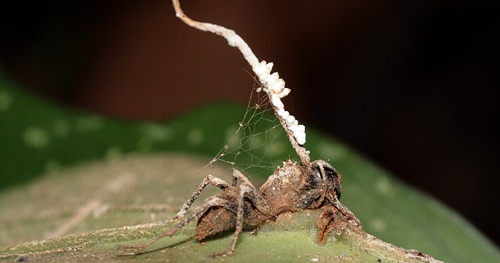
zombie ant
Music
- Monstertalk Theme: Monster by Peach Stealing Monkeys
MTArchivist
0