Regular Episode
#088 – CITY LION, COUNTRY LION
🎥 The Video That Started It All
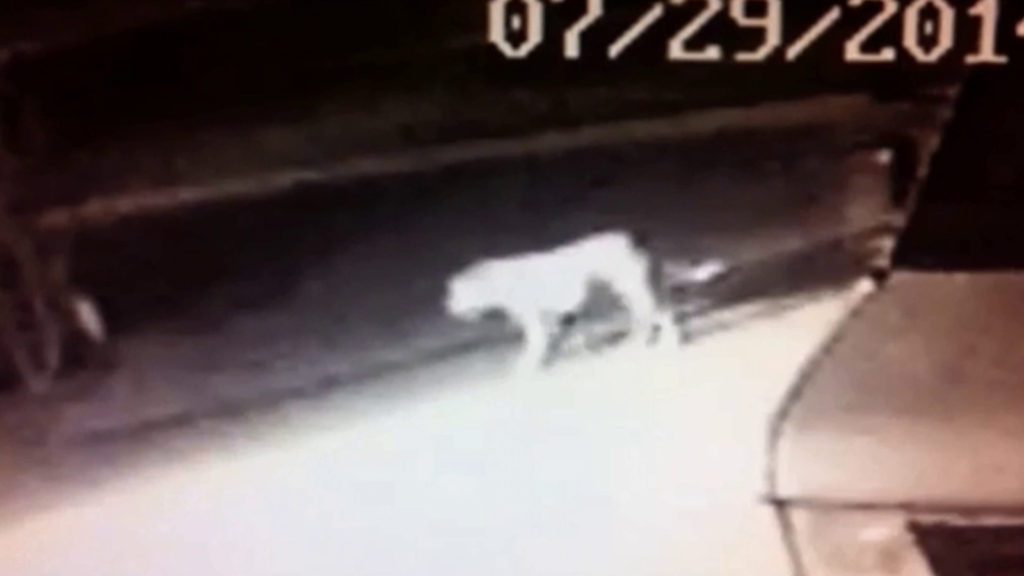
On July 29, 2014, a security camera in the Los Angeles suburb of Norwalk captured an animal moving along a sidewalk. The footage was ambiguous enough that someone posted it to the city of Norwalk’s Facebook page flagging a possible mountain lion. Local affiliates for Fox, CBS, and ABC, plus the Los Angeles Times and others, ran with the story. Some commenters escalated the claim further: this didn’t look like a mountain lion, they said — it looked like an African lion. A big cat biologist quoted by Time agreed it looked more like an African lion than a cougar. Excitement spread accordingly.
Blake’s first instinct going in was to expect a house cat — misidentified-size errors fuel many alien big cat reports in Britain. But in this case, the animal really did appear to be something large and feline. So he kept digging.
⏩ The Half-Speed Problem
The most important discovery in the investigation had nothing to do with zoology. Blake tracked down the best available copy of the footage and noticed something easy to miss: the date-stamp display on the monitor revealed that every news outlet had been broadcasting the clip at half speed. The video being replayed on a monitor had been recorded at 50% of normal playback speed, and no one in the media had caught — or mentioned — this.
Blake corrected the playback to normal speed and posted the result to YouTube (linked in the show notes below). At natural speed, the slow, deliberate, vaguely regal feline stride that had everyone convinced of a big cat evaporated. The animal’s movement suddenly looked far more familiar.
🦁 The Expert’s Leading Question
Blake tracked down one of the lion experts the media had quoted and asked how he had been approached. The answer was telling. The expert had been shown the footage — at half speed, without being told that — and was asked not “what animal is this?” but rather “does this look more like a cougar or an African lion?” Presented with slow, graceful movement and a binary choice, he chose the option that looked less wrong. When Blake showed him the footage at normal speed, his answer changed: it looked like a dog.
This is a textbook example of how expert testimony can be shaped by the framing of the question and the quality of the evidence provided — issues familiar to anyone who follows eyewitness reliability research.
🐕 Buddy the Dog
While Blake was awaiting a response from the Independent Investigations Group (IIG) — whom he had asked to visit the site and identify landmarks for scale — a follow-up story broke. A family in the neighborhood came forward to report that their dog, Buddy, had escaped that same night. Buddy was run through the same security camera under similar conditions, and matched the mystery animal in shape and size. The IIG analysis confirmed the animal’s dimensions were consistent with a large dog.
Blake notes with some exasperation that even the news story reporting Buddy’s existence as the probable culprit still hedged at the end: “Only the animal in the video knows for sure.” The media, it seems, could not quite bring themselves to fully close the case they had gleefully opened.
One popular argument for “lion, not dog” had been the animal’s gait — many viewers were convinced cats and dogs walk in fundamentally different ways. Blake looked into the biomechanics and found this to be a myth: both cats and dogs use the same basic lateral-sequence walking gait. The feline-seeming stride was an artifact of slow motion, not species.
🔍 A Sidebar on Mystery Mongering: The Arkansas Lions
Blake takes a detour to examine a related claim raised by Loren Coleman — cryptozoologist, founder of the International Cryptozoology Museum, and formerly of Cryptomundo — in Coleman’s commentary on the Norwalk Lion. Coleman pointed to two lions shot in Arkansas in September 2002 as possible evidence of mysterious maned felids, raising the specter of Panthera atrox — the American lion, extinct for roughly 10,000 years and about 25% larger than modern African lions.
A quick search by Blake revealed that the Arkansas lions were almost certainly escaped or dumped animals from a nearby private exotic animal operation. The AP press release explaining this was, awkwardly, hosted on laurencoleman.com itself. A neighbor of the operator’s Safari Unlimited preserve — which housed eleven African lions, thirty tigers, five mountain lions, and a lynx on an only partially fenced 44-acre property — was quoted expressing disbelief that anyone could accept the operator’s claim that the shot lions weren’t his. Arkansas subsequently passed legislation in 2005 restricting private ownership of lions, tigers, and bears.
Blake is careful to note he owns several of Coleman’s books and reads his work with genuine interest — but this style of writing, presenting a solved case as still mysterious, has a name: mystery mongering. When a reasonable, plausible explanation exists, invoking a 10,000-year-old extinct megafauna as an alternative is a rhetorical move, not an investigative one.
🧠 The Broader Lesson
The Norwalk Lion is, in miniature, a demonstration of several recurring problems in anomaly investigation:
– Footage shown without proper context (playback speed, scale reference) is nearly useless for identification.
– Expert opinion elicited via a binary leading question reflects the question more than the evidence.
– Human pattern recognition for quadruped identification is genuinely poor without training, especially from a single angle on grainy video — the same cognitive tendency that generates chupacabra sightings from mange-afflicted coyotes.
– Media incentives favor sustaining a mystery over closing one.
Blake’s suggestion: if animal identification interests you, study biology. Formal training in morphology and locomotion changes what you see.
📚 Further Reading
– Loren Coleman — Wikipedia entry on the cryptozoologist discussed in this episode
🔗 Related Links
– Norwalk, California — location of the sighting
– Mountain Lion (Cougar) — the species initially suspected
– Panthera atrox (American Lion) — the extinct species Coleman raised as a possibility
– Alien Big Cats — the broader phenomenon of mystery big cat sightings, especially in Britain
– Chupacabra — a parallel case of misidentified animals (often mangy coyotes or dogs)
– Independent Investigations Group (IIG) — the Los Angeles–based skeptical investigation group Blake consulted
– Skeptic Magazine / Skeptic Society — official home of the MonsterTalk podcast
Note: ads inserted into the distributed audio alter the timestamps in unpredictable ways, so timing references in these notes are approximate.
WAS AN AFRICAN LION WANDERING the streets of Los Angeles? The case of the Norwalk Lion is solved beyond reasonable doubt—yet why do questions linger?
Additional Reading
- Video of Norwalk Lion at normal speed
- KTLA Story
- LA Times has height for frame of reference at 2 feet.
- How Do Dogs Walk
- MonsterTalk Facebook Discussion
- Loren Coleman’s take on the lion sighting
- The Arkansas Lion from Coleman’s website
- USA Today coverage of Arkansas Lions
- Arkansas passes exotic pet legislation
- Norwalk Lion is Dog
- The Independent Investigations Group (IIG)
Music
- Monstertalk Theme: Monster by Peach Stealing Monkeys
MTArchivist
0