Regular Episode
053 – ONAN THE JAR BURYING
Fair warning from the hosts: this episode covers some of the more solitary aspects of human reproductive biology in considerable historical detail. You’ve been warned.
🧪 What Is a Homunculus?
The word homunculus gets used today to describe neurological body-mapping models, but that’s not what this episode is about. The medieval homunculus was a fully artificial human being — created, in most versions of the recipe, from human semen alone, without female contribution. Newman traces the concept back to its earliest identifiable form: a story from late antiquity or the early Islamic period called the Story of Solomon and Absal, in which a mythical king (possibly identified with Hermes Trismegistus) wishes to produce a child while remaining celibate. He masturbates, places the semen in a hollow mandrake root, and a court advisor named Caliculus incubates it until a child — Solomon — emerges. No demons. No dark magic. Just a remarkably hands-on approach to parenthood.
⚗️ Paracelsus and the Recipe
By the 16th century, the homunculus had acquired a distinctly more mystical flavor. A work published in 1572 under the name of Paracelsus — though Newman is clear this Pseudo-Paracelsus text, On the Nature of Things, is almost certainly not by the historical Paracelsus — provides a complete recipe: seal human semen in a flask, incubate for 40 days and 40 nights, feed the resulting being the “arcanum of human blood” (apparently some form of blood combined with a mineral acid), and you’ll have a small prophetic figure capable of foretelling the future and helping its owner win battles.
The theological wrinkle: because Aristotelian reproductive theory held that female menstrual blood supplied the matter of a new human being while male semen supplied the form, a homunculus created from semen alone would be a being unweighed by material existence — almost celestial. The genuine Paracelsus, meanwhile, had his own anxieties on the subject: he warned extensively that retained semen would spontaneously generate homunculi inside the body, causing horrible ailments. His suggested remedies were, shall we say, fairly drastic.
📜 The Theological Debate: Does It Have a Soul?
The homunculus wasn’t just an alchemical curiosity — it was a focal point for serious medieval ethical and theological argument. A treatise falsely ascribed to Thomas Aquinas, probably written in the 14th century and titled On the Essence of Essences, argues that the homunculus can sense and respond to the world but can never possess a rational mind — meaning it can never be fully human. The key question: can a human being create another ensouled individual, or is that God’s exclusive domain?
Newman notes this debate maps directly onto modern bioethics: if a homunculus lacks a rational soul, it’s ethically acceptable to dissect it and use its organs medicinally — an argument that anticipates stem-cell and embryo-research debates by several centuries. He also draws a line from these discussions to Leon Kass and the President’s Council on Bioethics under George W. Bush, which made Nathaniel Hawthorne‘s story The Birthmark required reading — Hawthorne’s alchemist protagonist kills his wife while trying to perfect her. Newman argues the “yuck factor” Kass invoked is learned, not innate, and has medieval alchemical roots most people never suspect.
🐍 The Basilisk Connection (and Misogyny in a Flask)
The same Pseudo-Paracelsus text that gives the homunculus recipe also tells you how to make a basilisk: seal female menstrual blood in a flask for 40 days and 40 nights. Newman points out the ideological symmetry — and the obvious misogyny. The “pure male” product is a wondrous prophetic helper. The “pure female” product is a lethal monster whose gaze kills. This mirrors a broader folk belief that a menstruating woman could supposedly cloud a mirror or sour wine simply by looking at them; the basilisk is that supposed power magnified to its lethal extreme.
📖 The Book of the Cow and Organotherapy
Among the stranger texts Newman discusses is the Book of the Cow, an Arabic manuscript (surviving only in Latin translation) that describes creating a homunculus explicitly to be dissected. The resulting bodily fluids are assigned various magical properties — anointing your feet with its blood supposedly allows you to walk on water, for instance. This sits within a broader medieval tradition Newman calls organotherapy (also known as Dreck-Apotheke, or “filth pharmacy”): the idea that consuming or applying specific human body parts could cure corresponding ailments. It was considered a form of natural magic — sympathetic correspondence — rather than demonic sorcery.
🤖 The Homunculus and the Golem: Related but Distinct
The obvious comparison is to the golem tradition, but Newman draws a sharp distinction. The golem is created through verbal magic — specifically the power of Hebrew letters, most famously the word emet (truth) inscribed on its forehead, erasing the first letter to spell met (death) and destroying it. (One 16th-century version ends with the golem collapsing on its maker because he didn’t step back in time.) The homunculus, by contrast, is a wet, biological, chemical process — semen, flasks, incubation. Two entirely different metaphysical traditions, Newman insists, despite their superficial similarity as artificial-life stories.
Newman also notes that various medieval theologians interpreted the Huns as a race produced by succubi collecting nocturnal emissions and transferring them to human women — a homuncular origin story for an entire ethnicity. Merlin received a similar treatment in some traditions.
🔬 From Alchemy to Newton: The Chemistry Underneath
Newman pushes back against the pop-history reduction of alchemy to gold-chasing fantasy. By the 16th and 17th centuries, “alchemy” encompassed what we’d now call technical chemistry: distillation, sublimation, pigment manufacture, pharmaceuticals. Isaac Newton spent roughly 30 years on alchemical research — his laboratory notebooks survive — as did Robert Boyle and John Locke. Newman’s ongoing scholarly project, The Chymistry of Isaac Newton, is editing and publishing Newton’s approximately one million words of alchemical writing — including a treatise on the “vegetability of metals” in which Newton interprets crystallization and dendritic growth as literally living processes.
On the homunculus specifically: Newman observes that the texts don’t usually claim “I made one.” They give you the recipe. That’s a significant distinction — and, as he drily notes, the experiment is technically a testable hypothesis that any man with a jar and 40 days of patience could attempt. Whether anyone ever reported results is another matter.
📚 Further Reading
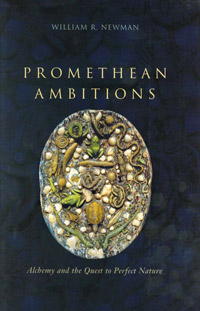
– 📚 Promethean Ambitions: Alchemy and the Quest to Perfect Nature 💵 by William R. Newman
🔗 Related Links
– The Chymistry of Isaac Newton — Prof. Newman’s project editing Newton’s alchemical manuscripts, with video clips of alchemical processes
– Homunculus (Wikipedia)
– Paracelsus (Wikipedia)
– Jabir ibn Hayyan — the 8th-century Arabic alchemist whose (largely pseudepigraphical) corpus includes artificial-generation texts
– Golem (Wikipedia)
– Mandrake (Wikipedia)
– Basilisk (Wikipedia)
– Organotherapy (Wikipedia)
– Bride of Frankenstein (1935) — features a scene with miniature homunculi in jars, credited to actor Ernest Thesiger as Dr. Pretorius
Note: ads inserted into the distributed audio alter the timestamps in unpredictable ways, so timing references in these notes are approximate.
In modern science the homunculus refers to various models of the human mind, but in medieval times it was something quite different. Join us for a fascinating interview with professor William R. Newman, of Indiana University’s Department of History and Philosophy of Science. He is the author of seven books, including Promethean Ambitions: Alchemy and the Quest to Perfect Nature—a book which provides much insight into the seedy back-story of this strange creature.
Links of interest
Music
- Intro Music: Jar Cell by Pedway
- Monstertalk Theme: Monster by Peach Stealing Monkeys
MTArchivist
0