S05E29 – Science of the Supernatural with Melissa MaffeoS05E29
🎙️ Episode Summary
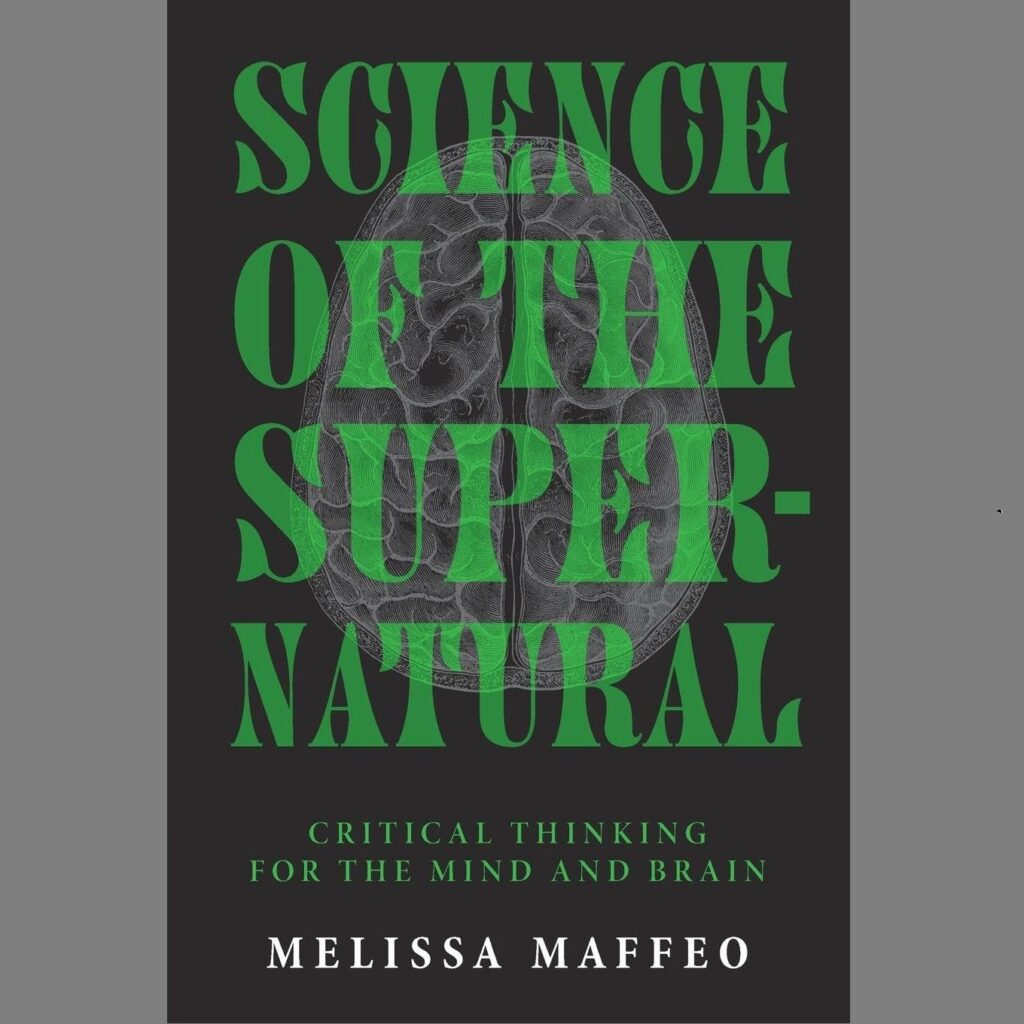
Neuroscientist Dr. Melissa Maffeo joins Blake and Karen to discuss her new book Science of the Supernatural: Critical Thinking for the Mind and Brain (Cambridge University Press, 2026). Melissa is an associate teaching professor of psychology at Wake Forest University, where she also serves as Associate Director of the Neuroscience Program.
In this episode, Melissa talks about using paranormal topics as an accessible entry point for teaching psychology and neuroscience, and shares her view that most supernatural experiences can likely be explained by what’s happening in our brains – even if we don’t yet have all the answers. The conversation covers a wide range of topics from the book, including the God Helmet experiments, the neuroscience of out-of-body experiences, how parasites can hijack behavior, and whether prior belief shapes what we experience.
🧠 Topics Discussed
Anomalistic Psychology vs. Parapsychology – Melissa explains the key difference: parapsychology begins with the assumption that supernatural phenomena exist and seeks to study them, while anomalistic psychology follows the scientific method and looks for what might poke holes in the hypothesis.
The God Helmet – The conversation digs into Michael Persinger‘s God Helmet experiments, which used magnetic stimulation of the temporal lobes to try to induce mystical experiences. Melissa discusses the temporal parietal junction (TPJ) and its likely role in our sense of self and embodiment – and what happens when something goes wrong there, including a fascinating case study of a patient who experienced an increasingly menacing shadow figure as stimulation increased.
Chris French’s Haunted Room – Melissa discusses former MonsterTalk guest Chris French‘s experiment in which he built a “haunted room” at his university lab, varying electromagnetic frequencies and infrasound. The result? The biggest predictor of supernatural experiences wasn’t EMF or infrasound – it was prior belief in the paranormal. (Hear our earlier conversation with Prof. French: “The Science of Weird Shit”)
The Australian Sheep-Goat Scale – The “Australian Sheep-Goat Scale” sounds like agricultural trivia, but it is actually a cornerstone of parapsychological research. Developed by Michael Thalbourne, the name borrows a biblical metaphor from Matthew 25:32, which describes a shepherd separating the “sheep from the goats” at the Last Judgment. In research terms, “Sheep” are those who believe in the possibility of paranormal phenomena, while “Goats” are the skeptics who reject them. This distinction was popularized by psychologist Gertrude Schmeidler in the 1940s to study the “Sheep-Goat Effect” – the observation that a person’s pre-existing belief or disbelief in the supernatural can actually influence their performance in experimental tests of those very phenomena. Melissa discusses how scores on this 18-item scale strongly correlate with Persinger’s temporal lobe sensitivity scale – a finding she’s replicated with her own students.
The “Haunted” Theater Experiment – Melissa describes a 1997 experiment by James Houran and Rense Lange, titled “Context-induced paranormal experiences.” By taking two groups through the same dilapidated theater but only telling one group it was “haunted,” researchers demonstrated that our brains are incredibly efficient at “filling in the blanks.” The group primed for ghosts reported significantly more chills, drafts, and “sensed presences” than the control group. This highlights a psychological phenomenon known as demand characteristics: when people are put in a specific context (like a “haunted” building or a religious trial), they subconsciously look for – and often find – the sensations that match the expectations of that environment.
Zombies, Parasites, and Behavior – The chapter on zombies (subtitled “Rabie, Baby” – named by Melissa’s daughter) explores how rabies, cordyceps fungus, and parasites can hijack host behavior. Melissa highlights the emerald cockroach wasp, which performs a kind of brain surgery on cockroaches to enslave them. The discussion also touches on toxoplasmosis and the growing research on the gut-brain connection. Melissa also recommends the book This Is Your Brain on Parasites by Kathleen McAuliffe.
Perception, Reality, and The Dress – The conversation touches on optical illusions and the blue/gold dress viral phenomenon as demonstrations that our perception is constructed by our brains – and that “just because you believe something doesn’t make it true.”
Favorite Monster – Melissa’s pick: extraterrestrials who abduct humans as part of a massive government cover-up. She’s fascinated by the cognitive processes behind abduction experiences – the confabulation, the consistency of the narratives across cultures – even though she doesn’t believe aliens are actually snatching people from their bedrooms.
📚 Books Mentioned
– Science of the Supernatural: Critical Thinking for the Mind and Brain by Melissa Maffeo (Cambridge University Press, 2026)
– This Is Your Brain on Parasites: How Tiny Creatures Manipulate Our Behavior and Shape Society by Kathleen McAuliffe
🔗 Related MonsterTalk Episodes
– The Science of Weird Shit – with Prof. Chris French
– Paranormality, Psychic Dogs, Ghosts and Silly Voices – an Interview with Richard Wiseman
🔬 About Our Guest
Dr. Melissa Maffeo is a neuroscientist and associate teaching professor of psychology at Wake Forest University in Winston-Salem, North Carolina, where she also serves as Associate Director of the Neuroscience Program. She earned her PhD in neuroscience from Florida State University, is known for innovative teaching methods, and co-founded a neuroscience teaching conference. Science of the Supernatural is her first book.
SEO Transcript
This is not a fully accurate transcript, and was machine generated. It’s here for helping search engines find the episode but not intended to be a faithful transcript of the episode. (But it’s not AWFUL.) Some of the material in this transcript only exists in the Patreon/Premium edition of the show and was excised for the commercial version.
———————
Monster House presents…
This is the ad-supported version of Monster Talk.
We’re dependent upon the revenue from these ads and from the support of our patrons at patreon.com forward slash monster talk to continue making this show.
As a disclaimer, your hosts are unable to control what ads you will hear, and while we have done what we can to avoid ads that are divisive, the system that injects them sometimes ignores our preferences and always seems to ignore our efforts to not interrupt the conversational flow.
While we understand this can be disruptive, we’re trying our best.
Patreon remains the best way to enjoy commercial-free listening to our content.
Plus, you generally get extended coverage of the subject.
We’re working on other ways to consume our content as well, so please stay tuned.
It’s actually quite unlike anything we’ve ever seen before.
A giant, hairy creature.
Part ape, part man.
In Loch Ness, a 24 mile long bottomless lake in the highlands of Scotland.
It’s a creature known as the Loch Ness Monster.
Monster Talk.
Welcome to Monster Talk, the science show about monsters.
I’m Blake Smith.
And I’m Karen Stollznow.
For most people, it’s easier to believe that there’s an intangible magical thing called a soul bopping around inside our bodies than to believe that the complex and amazing experiences of being human are all created in the lump of mushy organs we collectively refer to as the brain.
The concept of the soul as some kind of explanation for human experience is so widespread that not believing in it makes you a weirdo at best and a dangerous blasphemer at worst.
Melissa Maffeo’s new book, The Science of the Supernatural, does a fine job of introducing how the brain can generate many of the peculiar phenomena that we call supernatural.
I’m not trying to spoil the book.
Far from it.
I read a lot of books about brains, psychology, psychiatry, neurology, entirely because I want to better understand my own experiences in a scientific framework.
I can definitely enjoy a garden without having to populate its bottom with fairies.
And it’s been my experience that knowing a peculiar occurrence was generated by a brain is no more disappointing than discovering mundane but exalted experiences are as well.
The opposite, actually.
I get to intellectually savor experiences like love and hunger and satiation without diminishing their visceral significance, while at the same time being able to contextualize things like deja vu and synchronicity and, you know, nocturnal visits of shadow people, which can help those odd but natural moments feel a little less frightening, dangerous, or mystically significant.
but that’s just me and that’s how I like to live.
I can’t say that if you read Melissa’s book, it will turn you into a materialist, but I can say that if you’ve got an exalted opinion of the specialness of paranormal experiences as lying outside the walls of scientific explanation,
that her book, Science of the Supernatural, should help you at least entertain the notion that maybe a lot of what we think of as impossible supernatural experience isn’t a hoax or a miracle, but is derived from the complex interaction of that aforementioned brain, combined with our insatiable need to create stories about what it’s told us.
The philosopher Emo Phillips once said something back in 1987 that seems apt here.
He said, I used to think that the human brain was the most fascinating part of the body, but then I realized what was telling me that.
You can find links to Melissa’s book, Science of the Supernatural, Critical Thinking for the Mind and Brain, in our show notes.
But right now, let’s get to some Monster Talk.
So Dr. Melissa Maffeo is a neuroscientist and associate teaching professor of psychology at Wake Forest University in Winston-Salem, North Carolina, where she also serves as associate director of the neuroscience program.
She is known for innovative teaching methods and co-founded a neuroscience teaching conference.
Her new book, Science of the Supernatural, Critical Thinking for the Mind and Brain, was published by Cambridge University Press in March 2026.
In it, she uses topics like ghosts, zombies, and extraterrestrials as a lens for exploring how the brain distinguishes facts from fantasy, blending pop culture with cutting-edge research to examine paranormal and extraordinary claims through a scientific lens.
Welcome to Monster Talk.
Thank you, Blake.
That was a really nice introduction.
This is a fantastic book, and I think it’s a book that really needed to be written.
And I think a lot of people have been kind of talking about this topic and these issues, but I’m really glad to see that someone’s put this together.
And it looks like a lot of research, a lot of hard work.
Thank you for saying that.
You know, I piggybacked off of a lot of there’s a handful of UK researchers that have done some of this.
But I think what I really tried to bring in was the neuroscience angle, because I think that there is neuroscience work out there.
But I tried to really synthesize all of it so that we can examine supernatural experiences through the lens of psychology and neuroscience.
But I also really wanted to use it as a teaching tool for my students because I teach psychology and neuroscience classes.
And I just think it’s a really fun, creative, accessible way to get students interested in the course content.
Clever to go the textbook route.
It’s written in a style that I think will be very accessible, but it also goes deeper than a pop science book.
So I appreciate that very much.
It’s not a long book, but it covers a lot of really cool material.
And I think, first of all, I’m very interested in the human mind and how it works.
I think listeners will know I have a lot of obsessions, but one of them is this whole, how do you approach…
the human experience, because if you just say psychology, you’re missing the chemical side, psychiatry, you’re missing the, you know, neurological structures of the brain.
There’s so much, there’s a, it’s one of those elephants.
It may take more than 10 blind men to really understand, I guess.
But I think.
Correct me if I’m wrong, but it seems like maybe the subtext of your book is that you’re supporting the concept of a purely materialistic interpretation of anomalous phenomena, that everything that we experience could be explained by psychology or neuroscience.
I think so.
I am reluctant to make that claim completely because I don’t have the evidence to back it up.
But that is my personal belief.
It’s a strong hunch for me, too.
Yeah.
And so that’s I mean, that was kind of one of the goals of the book.
One of the goals of the book was not to debunk any kind of paranormal or supernatural belief, but rather to offer alternative explanations that people that have not had a neuroscience or psychology class might not know about.
So I do personally think that most of the things that we experience can be explained by science, even if we don’t at the moment have that explanation.
Do you think that being a materialist necessarily closes the door on other explanations?
I think that’s something we’re often accused of as skeptics is being close-minded because you already have a hunch that it’s happening in the brain.
Are you still open to other explanations?
You know, that is such a good question.
And I truly, I want to say yes.
I very badly want to say yes.
And what I kind of joke around when I tell people is I want to have an experience that I can’t explain.
And I have been in situations where I’ve been around people while they are having experiences that they interpret as supernatural, but I interpret them as a coincidence.
And I use it as a teaching moment, you know, but my students are always like, but Dr. Maffeo, you’re just as biased as the other side is.
And I’m like, yeah, I mean, I kind of am.
What would it take for me to really start believing in something?
I really don’t know.
I was down in Tampa, Florida a couple of years ago with my sister and her husband, and we were going to go kayaking.
And we were in this really backwards like sandwich shop.
And I saw some guys there and they had these really excellent tattoos and some of them were of Harry Potter.
So I had to go compliment the Harry Potter tattoos and sort of chit chatting with the guys.
And it turned out they were paranormal investigators.
Oh, wow.
We have to sit down and have our sandwiches together.
And so I told them, you know, and I was still working, was working on this book, you know, so I’m really trying to do a lot of research and talk to as many people as I can.
Um,
And he was like, yeah, I used to be a skeptic too and I didn’t believe anything, but then I had an experience that I couldn’t explain.
And I said, well, what was your experience?
And he told me that he was at a haunted location and he was sitting at a table with his friend and they had their cell phones out on the table.
And then just all of a sudden from nowhere, the cell phones just flew across the room.
And he couldn’t explain it, except that, you know, a ghost had picked it up and thrown it.
I wasn’t there.
I have no idea what that looked like.
So I can’t say anything about it.
But I would love to experience something like that.
And if I did experience something like that, I don’t know if I would search for some kind of natural explanation.
Like maybe there was some really crazy, weird magnetic flux in the earth underneath me.
I don’t know.
I don’t know what it would take to make me believe.
Yeah, it is very difficult when someone’s had a personal experience and you can’t replicate that to be able to.
And certainly if they really buy into the idea that it is paranormal, it’s very hard to falsify.
But we have talked a lot over the years, Blake, haven’t we, about skeptics who’ve had paranormal-like experiences.
Sure.
But we’ve found that a lot of sceptics have had these experiences and we just attribute a natural explanation to them rather than a paranormal or supernatural explanation.
But, yeah, I’m curious about your students.
Are they predominantly sceptics or are they…
I believe, is there a mix?
They’re a mix.
They’re definitely a mix.
The classes I teach, it probably depends on the classes.
Right now, I’m teaching introductory psychology.
And I would say that the students are flat in the middle of everything.
Some of them are complete skeptics.
Some of them are very extreme believers.
Most of them are in the I’m not going to shut it out, but I don’t necessarily believe it kind of camp.
I’m actually I’m really trying to collect some empirical data on them this semester because, like I said, I am interested on this.
And for pedagogical reasons, I want to know if.
teaching psychology through this lens really does enhance any kind of motivation to learn psychology or critical thinking.
So I’m really, really curious to see the data when it comes back at the end of the semester.
So I’ll have to let you know when I have that out.
Yeah, keep us posted.
Definitely.
We’re way off script here, but you make me wonder, when you consider the history of psychology itself,
and the role of people like James, and then the rise of parapsychology, it used to be that it feels like that the world of psychology was much more open to these things.
And I guess I am actually leading into a question I did have prepared, which is the difference between anomalistic psychology and parapsychology.
But I’m also curious about, has the field of psychology itself changed
divorce itself from these questions because of respectability or because they feel like they’ve adequately solved the mysteries and therefore don’t need to dwell upon them anymore?
Because I’m really not sure what the drive is.
This is all assuming that I’m correct, that there has been that divorce away from covering of this kind of material.
What is that?
That is a really complex question.
So I’ll start with the easy part, the difference between anomalistic and parapsychology.
And I think that that’ll lead into a bigger answer.
So parapsychology operates under the assumption that supernatural things exist and they want to study that.
It’s like starting an experiment and saying, I know that my hypothesis is right, but that’s not what the scientific method teaches us to do.
And anomalistic psychologists more try to follow the scientific method.
So what we want to do is set up the experiment that will not support our hypothesis, actually, what’s going to poke holes in our theory.
So I think in the field of psychology,
Anomalistic psychology really isn’t so divorced from the field.
I think that anomalistic psychologists very much fall in line with, you know, historical psychology.
I think that as our understanding of
really complex things, like the concept of the self, like the concept of consciousness, those are not inherently supernatural.
But I think, you know, 100 years ago, 200 years ago, we had more supernatural or religious explanations for those types of things.
But a lot of these questions…
Do ghosts exist?
Are there extraterrestrials that come to Earth and pick up humans?
Those aren’t falsifiable.
We can’t measure them with the tools that we have today.
Some of the anomalistic psychologists do their best to measure them.
One of the really famous studies that was done by Chris French in London set up what he called a haunted room in his own laboratory at the university where he had participants come in and he varied electromagnetic frequencies and he varied infrasound.
And he had the participants kind of walk around this like kind of small room and just note whether or not they had noticed anything weird or anomalous.
And what they ended up finding was that there was no relationship to whether
The EMF or the infrasounds was related to any kind of supernatural experience, but what was related to supernatural experience was a prior belief in the paranormal.
So I think it’s hard to do experiments like that because we can’t possibly do a ghost condition and a no ghost condition, right?
And people like Chris French have done the best that they can to replicate that or to have that.
I think that psychologists would study this, were we able to.
But I think that we can’t design the experiments that would really answer the deep questions that we have.
Well, it’s the filter problem, replicability of the phenomenon itself, not just the results of the test.
I mean, we usually talk about science replication issues.
We’re talking about being able to reproduce a result.
But here, the phenomenon itself is resistant to replicability, which is a little tricky to study.
It is tricky to study.
And there are lots and lots of parapsychologists in the world that have documented experiences, right?
Like I have files on my computer that were given to me by paranormal investigators that have sound and lights and things like that, that are absolutely anomalous.
But the problem is, like you said, we can’t replicate that experience and we can’t
do the types of tests that we need to do and i do believe um you know people who are experts in i don’t know video editing and things like that have looked at some of these videos and said they haven’t been tampered with
I personally don’t know enough about videography to know what sorts of things will cause reflections of the lights to look anomalous.
The parapsychologists claim that they haven’t been altered in any way, and I believe that, but I also don’t necessarily believe that it was a ghost that was caught on camera.
Well, I wanted to dig into the book a little bit, and you delve into so many interesting studies and topics.
One of them that I…
know a little bit about, but I’ve always wondered about, I’m really, really interested in your opinion about the pursing is God helmet.
And I know some sceptics who think it’s silly, it’s ridiculous.
And then some people who think it’s the common ground for sceptics and believers, this is scientific.
So I’m wondering if you can tell us a little bit about this, the experiments and what your findings are.
I love this topic.
And he’s got some, you know, YouTube videos that I always show my students.
And we always talk about, would you put the helmet on?
You know, what would you experience?
So this God helmet is a sports helmet that’s been fit with electrodes that are going to deliver stimulation to the temporal lobe of the brain.
So the temporal lobe is kind of like right behind where the ear is.
And the idea, Persinger’s original research…
was that if you deliver this stimulation at the right level, it will induce a mystical experience.
And he’s got published accounts of people that he’s brought into his lab that put on the helmet that have these really anomalous, intense experiences of…
having other figures in there talking to him when no one else in the room can see any of these figures.
So Persinger’s idea was this area of our temporal lobe, which is the junction between the temporal lobe and the parietal lobe.
So we call it the temporal parietal junction or the TPJ.
His idea was that that’s kind of where our neural basis of God lives in our brain.
Some people have tried to replicate his findings and have been unable to.
So that’s something I’ve never personally tried to replicate it.
However, and I cited these studies in the book, there are a number of different case studies where patients have been evaluated for temporal lobe epilepsy.
And one of the treatments for epilepsy is to go into the brain and remove those epileptic areas, those pathological areas that are just hyperactive if that patient’s not responding to more traditional medications.
Okay.
So as they’re going in and doing these evaluations, sometimes that involves applying a little bit of current to different parts of the cerebral cortex, the outermost part of the brain.
And there are several case studies that suggest that…
current applied to the temporal parietal junction will induce an experience.
And sometimes people experience that as an out-of-body experience.
Sometimes people experience that as having another figure with you.
The first case study that…
came across was evaluating a 22 year old woman for this surgery and when they applied stimulation she had this experience of this illusory shadow figure and at low at low voltages this shadow figure was just kind of following her and mimicking her movements but then as the current got turned up
She had the experience that this shadow figure was now a male and was wrapping his arms around her in a really uncomfortable, unpleasant way for her.
And then even trying to interfere with some of the tasks that she was trying to do.
So what does that mean?
I don’t know.
And I am really interested in this.
We believe that the temporal parietal junction is probably part of the neural basis of our sense of self and sense of embodiment.
I have this sense of myself living inside my own body, but that’s generated by my brain, probably with my TPJ in conversations with other parts of my brain, like my hippocampus.
But if something is going awry there,
it’s possible that I could experience myself outside of my own body.
And indeed, people do.
Out-of-body experiences are not uncommon.
Sometimes they’re a result of sleep paralysis.
They might be a result of maybe a temporal lobe seizure.
It also can be a result of lack of oxygen to the brain.
In fighter pilots that go through extreme G-force, they sometimes have this syndrome that can manifest as out-of-body experiences.
So you’ve talked about the TPJ and the hippocampus.
What is your position on paranormal centers of the brain?
Is there anything like that for…
in terms of experience and belief?
To answer your question, I don’t know.
I think the answers to all of the questions are, I don’t know.
Sure, that’s the safe position.
So one of the things I’m really interested in learning more about is this temporal lobe.
We know that people who have temporal lobe epilepsy can sometimes have supernatural experiences.
Like, for example, people, scholars now believe that Joan of Arc might have had epilepsy and many of her visions were a result of a seizure.
And there’s been lots of cases like that.
There is a scale that Persinger uses in his research called the temporal lobe sign scale.
It’s part of a larger scale that actually does measure behavioral and subjective signs of temporal lobe epilepsy.
But there’s a subsection of that scale that supposedly measures the, quote, lability of your temporal lobe.
And it has questions like, I can’t remember all of them, like sometimes I smell smells that don’t really exist in the world right now.
They don’t have a source.
Sometimes when I’m driving over a bumpy road, I lose track of where I’m going, like questions like that.
And what that supposedly relates to is temporal lobe lability.
I haven’t seen anything that really shows its validity for that.
So I would love to see that if it exists.
I’m not aware of it.
But one of the things that does exist is a very strong correlation between temporal lobe lability as predicted by that scale and belief in the paranormal.
That’s been shown many times in research.
I’ve shown that with my own students many times when I survey them.
So it’s a really interesting correlation.
And, you know, we say in psychology, correlation does not equal causation.
This doesn’t mean anything, but it makes me raise an eyebrow.
And I think one of the questions is maybe there are some people that are a little bit more sensitive to natural things that go on in the earth.
Maybe some people do have more magnetic receptors in the brain than others.
And to be honest, we’ve never found a magnetic receptor in the brain in any animal, I believe.
So we certainly don’t know if they’re there in humans, but we do know that some animals can absolutely detect the magnetic pulls of the earth and they use them for migration.
But we don’t have a mechanism for that.
So I’m sure that there’s something in our brain that we have yet to understand that
that might make a human more susceptible to maybe a magnetic force.
And with the lack of any scientific knowledge of knowing what kind of magnetic force is out there that you’re experiencing, kind of the next logical step is say, oh, I just experienced something paranormal.
Chris French’s research in the haunted room does kind of negate that a little bit.
So I would love to see more people replicate that.
And also I would love to see a wider variety of EMF and infrared sounds that he used.
Maybe it’s something that’s outside of the stimulus range that he used that people are sensitive to.
And I don’t know that answer.
It’s fascinating.
It is.
I think, I guess one of the challenges is that,
To some extent, we know that people are susceptible to contagion of ideas and especially in groups.
And, you know, that’s been studied in psychology through priming.
And I don’t know if there’s an entire field about expectation psychology, but it certainly seems to be really relevant to this kind of work.
My background is actually more in the humanities.
I was an English major.
And I’ve come to believe that because we use language to share ideas and stories, that the narrative component to this stuff is also super important.
And I started talking about this idea of a culturally available template for explaining phenomena that you don’t understand.
But I’m really interested in…
this idea of contagion and how ideas are transmitted and how that is actually relevant to perception and the shared experiences.
And I know it’s got to be really tough to make experiments around that because the very thing you’re wanting to study is also going to be contaminated as people talk about their experiences.
So I know there’s a big blob of concepts, but would you like to talk about how you approach that aspect of this phenomena?
And that’s one of the big takeaways that I really want my students to get out of this class is do we experience the world simply as a result of our own experiences, right?
Are we creating our own cage, our own limits of our life?
And, I mean, I think the answer to that is largely yes.
I do think that.
There was a study that was done, I think, in the late 90s.
And what the researchers did was they took participants to an old movie theater that was in disrepair and it was no longer being used.
And some of the participants, they said, okay, we’re going to walk through this theater, but there are some reports of it being haunted, but don’t worry, it’s probably fine.
And then the other group…
They were just told, it’s just this old rundown theater that we’re not using anymore.
We just want you to walk through and just notice stuff.
And then the results are exactly what you would expect them to be.
The people that were told to expect something supernatural had more supernatural experiences and reported more weird things.
This haunted theater experiment study was a 1997 experiment by James Hurin and Rince Lang titled Context-Induced Paranormal Experiences.
By taking two groups through the same dilapidated theater but only telling one group it was haunted, researchers demonstrated that our brains are incredibly efficient at filling in the blanks.
The group primed for ghosts reported significantly more chills, draft, and sensed presences than the control group.
This highlights a psychological phenomenon known as demand characteristics.
When people are put in a specific context, like a haunted building or religious trial, they subconsciously look for and often find the sensations that match the expectations of that environment.
So I love showing that.
That’s actually, in my intro psych class, that’s the very first empirical research article we read over the course of the semester because we’re talking about research methods and, you know, how to form a hypothesis and how to test a hypothesis.
But I think that that priming, that suggestibility and that expectation plays a huge, huge role in what we’re able to experience.
You know, I was raised.
um, in a, we, we didn’t really talk about supernatural stuff.
We, we loved it.
You know, uh, my parents love reading Stephen King and I was raised on Stephen King and the X-Files and I love that stuff, but like very rarely in my life will I have an experience that I’m like, oh, that was definitely something supernatural.
And part of it is just our own ability to perceive.
You know, we have our primary five senses, but we have a whole lot of other senses that don’t fall within that five that no one really ever talks about.
So sometimes you can detect something that you don’t really know that you’re detecting.
And because you don’t know what it is, we’re going to try to find an explanation that suits you.
And that explanation for some people is going to be a paranormal explanation.
Right.
Well, there are so many other things that we could talk about.
And we’ll have to bring you on, I think, at a later stage so we can talk about more of these really interesting topics.
But I think I’m going to be the one lumbered.
If you can’t tell already, I’m Australian by birth.
So I’m going to be the one who’s lumbered to ask you about the Australian sheep goat scale.
And I didn’t know anything about this.
So can you tell us a bit about this?
Yeah, that is the scale that measures paranormal belief.
That is a widely used, highly reliable, valid scale.
I forget how many items are on it.
Not very many.
18.
I was going to say 15 or 16.
According to my research.
It’s very important.
Yeah, and you know what?
I actually…
don’t know where that name came from.
It is a very funny name for a scale and when you read it so many times and you abbreviate it so many times it kind of just like floods right past you and you don’t even notice it anymore.
Quick insert on the sheep-goat scale.
The Australian sheep-goat scale sounds like agricultural trivia, but it’s actually a cornerstone of parapsychological research.
Developed by Michael Falborn, the name borrows a biblical metaphor from Matthew 25-32, which describes a shepherd separating the sheep from the goats at the Last Judgment.
In research terms, sheep are those who believe in the possibility of paranormal phenomena, while goats are the skeptics who reject them.
This distinction was popularized by psychologist Gertrude Schmeidler in the 1940s to study the sheep-goat effect, the observation that a person’s pre-existing belief or disbelief in the supernatural can actually influence their performance in experimental tests of those very phenomena.
I do remember first reading about it, God, years ago, I think in some of Chris French’s work, probably, and being like, what?
But I don’t know where the namesake came from.
Yeah, that’s an interesting one.
All right.
It is, but so it’s sheep are believers and goats are disbelievers.
Is that right?
Yeah.
I have my notes.
I can’t find them on the page.
I found them.
Okay.
Yeah.
So that’s so strange.
I mean, I mean, it’s just random.
I mean, I don’t, I, I, I’ve been around goats and sheep and I can’t really tell who is actually the more gullible or susceptible to these ideas.
Yeah.
Yes, so it is an 18-item scale that is designed to measure people’s belief in the paranormal.
So they tried to get at all different levels of it because paranormal, supernatural can be a whole lot of different things depending on what you believe are.
So it doesn’t necessarily…
require that you have seen a ghost in real life to score high on this.
It’s even a little bit of a belief that some people can experience some precognition, maybe know something before you technically should have known it, or maybe had a dream that might slightly foretell the future, things like that.
That’s the scale that is highly correlated with the temporal lobe lability scale.
And that’s the scale that I use in my classroom.
Yeah, the students are always like, what are you giving us?
And I’m like, it’s science.
Don’t worry.
Trust me.
Well, one of the chapters you covered zombies.
And I want to just be clear, we’re zipping through these things.
I believe I told Karen before we did this, I believe any chapter in here would make a whole episode easily because there’s so much to talk about and unpack.
So and I think, you know, listeners or many of our listeners are also readers.
I think they’re going to dig this.
But you talked a little bit about rabies and zombies.
And obviously one of the big takeaways is don’t get rabies.
And you talked about fungus, the cordyceps fungus.
Everybody knows from The Last of Us.
So what do you think the lesson is when it comes to how these external factors can modify our behavior and perception?
Are our minds more powerful than our brains or are our brains more powerful than our minds?
If I can make that distinction.
That’s a very compelling question.
I love this stuff.
I did not want to stop writing this chapter.
I was geeking out doing this research.
And my daughter, I have to give her a shout out.
She was the one that named the subtitle Raby Baby.
And it was after a ghost story that she made up.
So I love it.
Yes, she’s very on point.
She was probably about seven or eight when she named that.
So she’s pretty good.
My kids hear a lot about rabies in my house.
But with all of these viruses, bacteria, parasites, fungi, there are so many examples of them that take over the behavior of the host.
Um, there’s a book, I can’t remember the name of the author.
It’s called, um, your brain on parasites.
And it is such a good book.
So I definitely recommend it.
Um, yeah, it’s, it’s really, really good.
And it’s kind of crazy to think about how easy it is for a, you know, a parasite to take over your behavior and your cognition.
But that’s what we see.
And to be fair, we don’t see it quite so much in humans, but maybe we do when we don’t know it.
One of my favorite parasites that I didn’t talk about in this book is the emerald cockroach wasp that basically does brain surgery on a cockroach.
And keeps the cockroach alive, but then enslaves the cockroach to bend to the will of the wasp.
Well, I think that these are really, really interesting questions in animal behavior.
And just the mere fact that the wasp can do this based on just touch alone, it can just feel around inside the ganglia in the nervous system of the cockroach and just…
feel when it’s in the right brain area.
And it just zaps its venom into the motivation brain area of the cockroach, which is just fascinating to me on so many levels.
But then when we bring it back to humans, there is some evidence that things like toxoplasmosis might impact our opinions of cats and things like that, or the scent of cat urine.
Why is it that we don’t see this as much in humans?
I suspect it’s because our brains are much more complex.
I suspect that we have more networks that are involved in complex behaviors that we do, but also maybe we do see it in humans and we just don’t know it because we don’t know how to ask for it.
There is a growing huge field in psychology and neuroscience about the mind-gut connection.
We know that the majority of the serotonin that is produced in our body is produced in our gut.
We know that we need to keep the bacteria in our gut very happy.
And if they’re not, we are not going to feel well.
More and more, that’s getting linked to behavior and mental health.
We don’t know how, we don’t know a mechanism here, but it’s kind of the same idea.
We have these little teeny tiny microscopic animals that are taking over our brain and behavior.
Well, it’s tricky, too, because with animal models, you can look at neurochemical information.
But with people, we wrap everything in narratives.
And the narratives that we tell don’t necessarily have any relationship to what’s actually going on.
The more I deal with people with mental illness, which sadly is not a small amount lately, the amount of things that you can see as a, let’s say, not mentally ill person, whatever that means.
Is that anyone?
The amount of things that like I have someone in my family who has a mental illness that anyone who visits them knows they have really quickly.
And it is impossible to demonstrate that to them.
Like they’re literally blind to the problem.
And it’s just very frustrating because they cannot see it, which in our world of investigating the paranormal, there’s so many things that I’m not seeing people who see these things are crazy at all or mad or even mentally ill.
But it tells you something about the scope of how much we have to.
consider that everything we experience is filtered through our brains as a processor.
And it’s just, it’s not as reliable as we want to believe.
We’ll tell ourselves it is, but getting that outside perspective or trying to find hard evidence kind of undermines the concrete belief that a lot of people have in these things, I think.
So, yeah.
That’s another takeaway that I want my students to get just because you believe something doesn’t make it true.
We do demos all the time to show them that sort of thing.
There’s the easy demos like optical illusions and that blue and gold dress that went viral.
My students and I talk about the neuroscience behind color perception, but then also color expectancy.
Some of us expect to see different colors and then we do see different colors.
So it really is like, again, like what we were talking about before, our reality is just shaped by our beliefs and our experiences.
That doesn’t make it any less real.
You know, just if someone has a paranormal experience and they label it as paranormal, that was their experience.
So I don’t want to take that away from anybody.
But also my brain is not wired to experience anything like that.
Mm hmm.
That’s a possibility.
As someone who’s been on both sides of that, you know, now… And I’ve actually had people in the comments on our show complain that I’m closed-minded because I’ve admitted that if something really profoundly supernatural happened to me, I would still be disinclined to believe it as the immediate response.
Yeah.
I’m much more open now to saying I don’t know.
Like, I’m much more comfortable with that in a way that maybe I wouldn’t have been before we started doing this show.
Well, that’s what a good academic does.
That’s…
Being honest that maybe you can’t know.
Not even that I don’t know, but I can’t know.
It’s not unknowable.
Yeah, yeah.
Things that happened in the past, particularly, how do you, you know, we’re not there anymore.
That moment’s gone.
I can’t explain it.
But still, I just have to live with it.
And other people, when I tell them such stories, clearly that’s supernatural.
But is it?
I don’t know.
Maybe there’s something else going on.
I think we need to wrap things up, unfortunately, even though there’s so much more that we could talk about.
So, again, we’ll have to bring you back on the show at some point when you’re ready.
But we have a final question, a signature question that we like to ask all of our guests.
And it’s a tough one, isn’t it?
It’s a tricky one.
Often.
For monster lovers.
So, Melissa, what is your favourite monster?
That is such a good question.
And I would have to say that my favorite monster are extraterrestrials that come to Earth and abduct humans.
And obviously the government knows about them and we do experiments about them.
Everyone knows it’s a giant cover-up.
I think that those are my favorite monster.
For, oh, God, so many reasons.
And maybe it’s because I am really interested in what actually is beyond our solar system and what possibilities are outside of our solar system.
And I think that there is some compelling evidence to suggest that there is life beyond our solar system.
I think that there probably is life beyond our solar system.
I don’t necessarily believe that it has truly come to Earth and hoodwinked a whole globe of people to abduct a couple of people from their bedrooms.
I don’t necessarily believe that piece of it.
But I think it’s really interesting, and I think it’s really interesting how so many people
have had an experience that they interpret as an abduction of that quality.
And I’m just so profoundly interested in, in the cognition that’s behind that and the confabulation that’s behind that.
And I just can’t imagine what that would feel like.
No, I’m sensing your next book.
Well, Melissa, thank you so much for writing this book and for taking the time to talk with us and our audience about it today.
Thank you so much for having me on.
I really appreciate it.
I believe our audience is the right audience for this.
So I think they’re going to have a good time with this.
So for sure.
Is there anywhere in particular you want them to go to look for the book?
Well, it is on Amazon, but probably buying it from the publisher.
So Cambridge University Press.
But it should be available online wherever books are sold.
Well, thanks so much.
Have a great night.
Yeah.
Thank you, Melissa.
Thank you so much.
You just heard an interview with Melissa Maffeo about her new book, Science of the Supernatural.
If you’re a longtime fan of Monster Talk, I think this one’s going to really be a favorite.
It hits on so many topics that we’ve covered on the show and apply scientific theory and academic rigor to them without dismissing them or their importance.
Grab a copy using the affiliate link in our show notes or demand it at your local book purveyor of choice.
We hope you’ve enjoyed this episode of Monster Talk.
Each episode, we strive to bring you the very best in monster-related content with a focus on bringing scientific skepticism into the conversation.
If you enjoy Monster Talk, we now have a variety of ways to support the show, all with convenient links at monstertalk.org forward slash support.
That’s monstertalk.org forward slash support.
We have links there to our Patreon page as well as a donation button.
Another great way to support the show is to buy books from our Amazon Monster Talk wishlist, which directly helps us with our research.
We love used books very much, so don’t feel compelled to buy new ones.
And we love Kindle so we can share our digital libraries with each other.
And finally, without spending any money at all, you can support us by leaving a positive review at iTunes or wherever you get your podcasts.
Positive reviews help keep us visible in iTunes, which is a great way to help us find new listeners.
And please share our show on your favorite social media platforms.
Monster Talk theme music is by Pete Stealing Monkeys.
Of all the podcasts and all the platforms in all the world, he has streamed mine.
If you liked what you heard here, you can play it again or check out our extensive back catalog.
Thank you for your time and your attention.