S05E28 The Cottingley Fairies
Hosts: Karen Stollznow, Blake Smith
Guest: Matt Baxter
In this episode, the MonsterTalk crew tackles one of the most famous photographic hoaxes in history – the Cottingley Fairies. In 1917, two young cousins in West Yorkshire produced five photographs that appeared to show real fairies dancing in the garden behind their home. What began as a bit of childhood mischief spiraled into a worldwide sensation when Sir Arthur Conan Doyle and the Theosophical Society championed the images as proof of the supernatural. The team explores how layers of credibility – authentic negatives, expert validation, retouched reproductions, and celebrity endorsement – created a blueprint for how misinformation gains legitimacy. More than a debunking, this is a story about two girls swept up in forces far beyond their control, and the adults who used them.
🧚 The Five Photographs
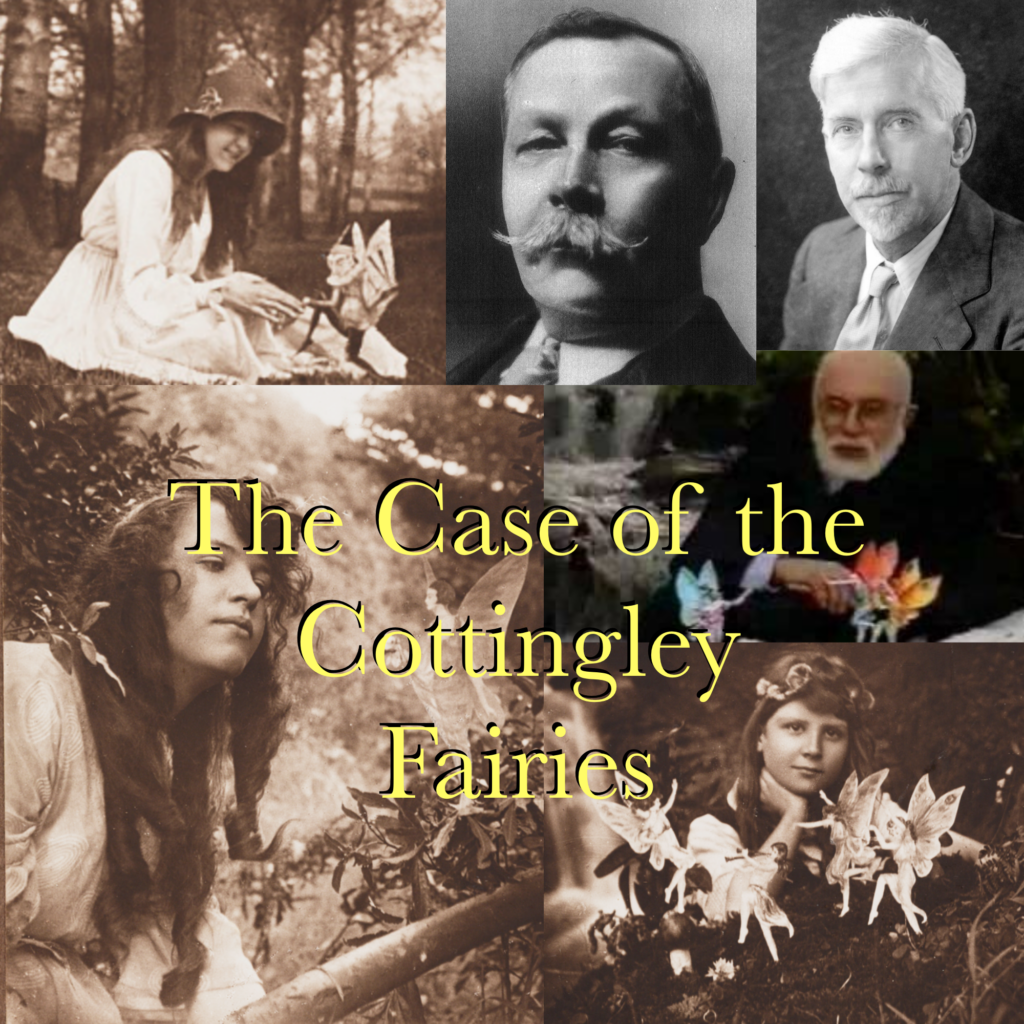
1. Frances and the Dancing Fairies (July 1917) – The iconic first image. Frances gazes past four dancing fairies, one playing a pipe.
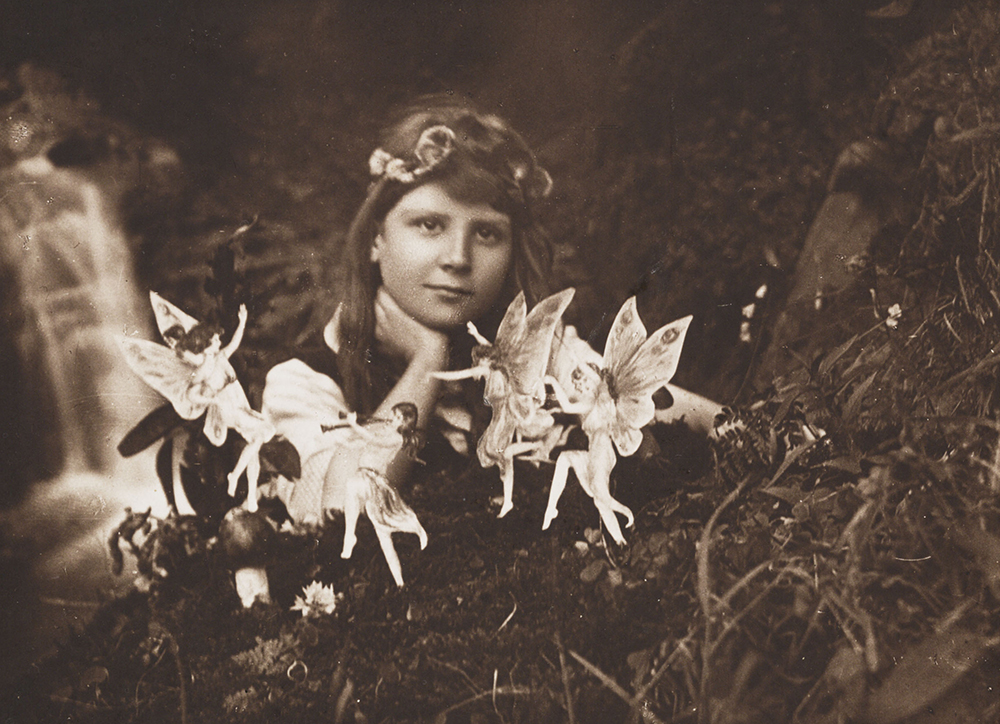
2. Elsie and the Gnome (September 1917) – Elsie reaches toward a gnome who looks suspiciously like Rowan Atkinson.
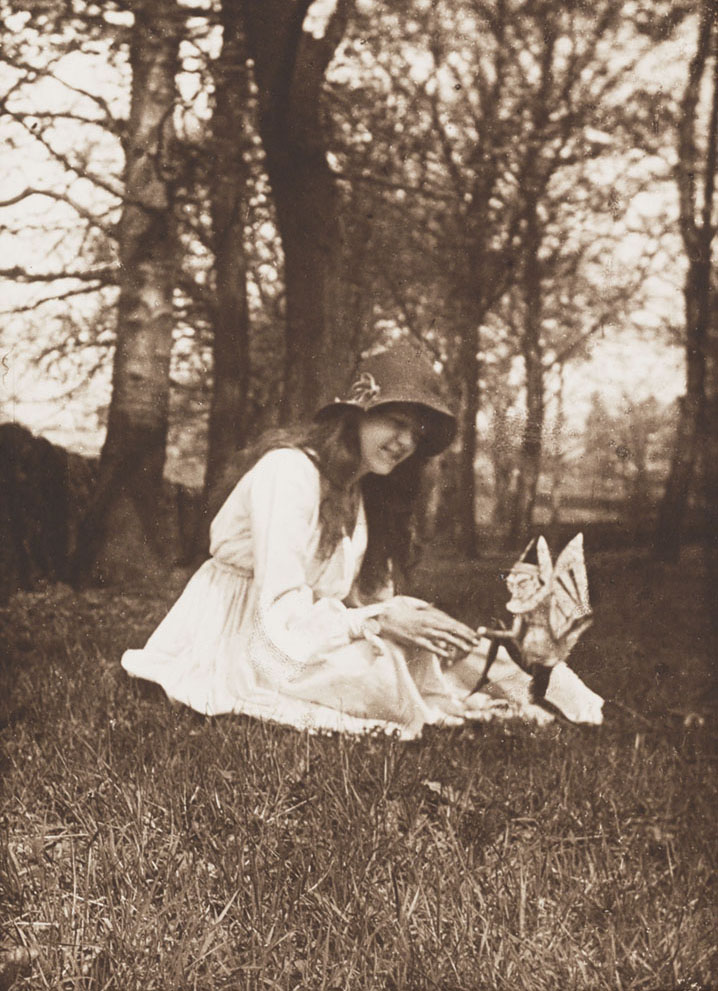
3. Frances and the Leaping Fairy (August 1920) – Taken with the new Cameo cameras and marked plates provided by Gardner.
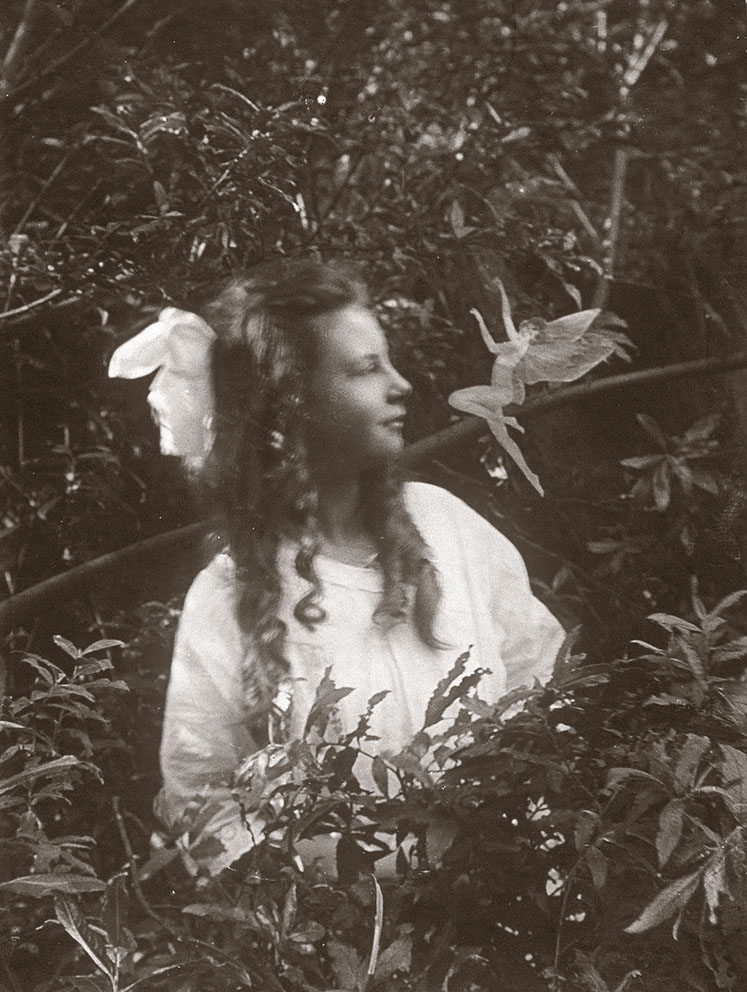
4. A Fairy Offering a Posy of Harebells to Elsie (August 1920) – Featuring a fairy with a very fashionable 1920s bob haircut.
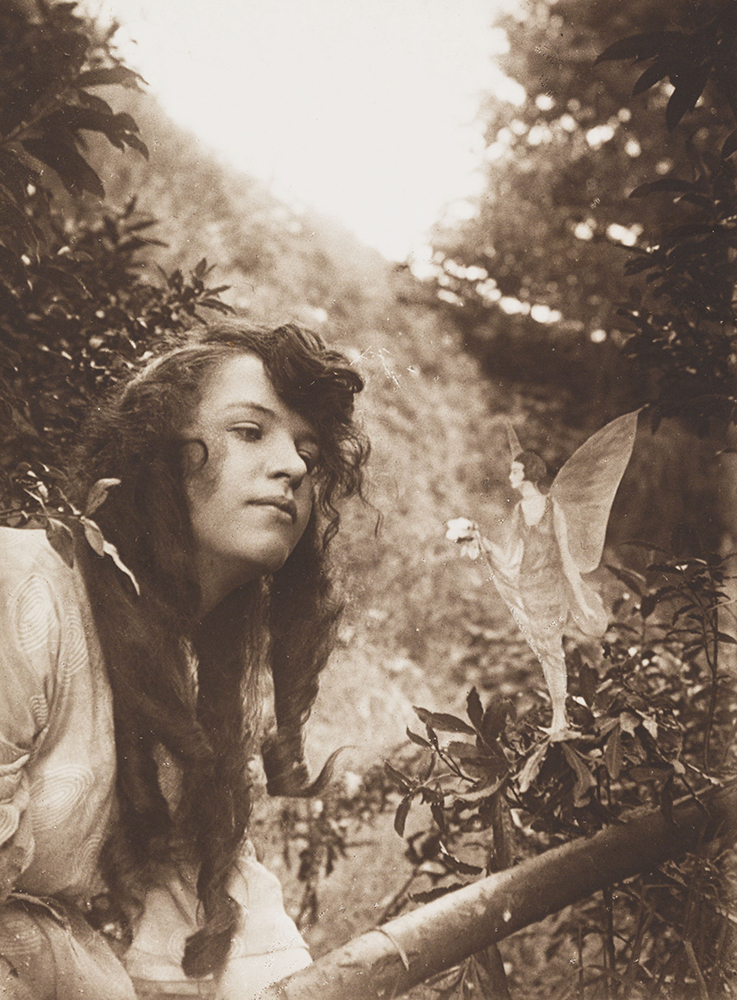
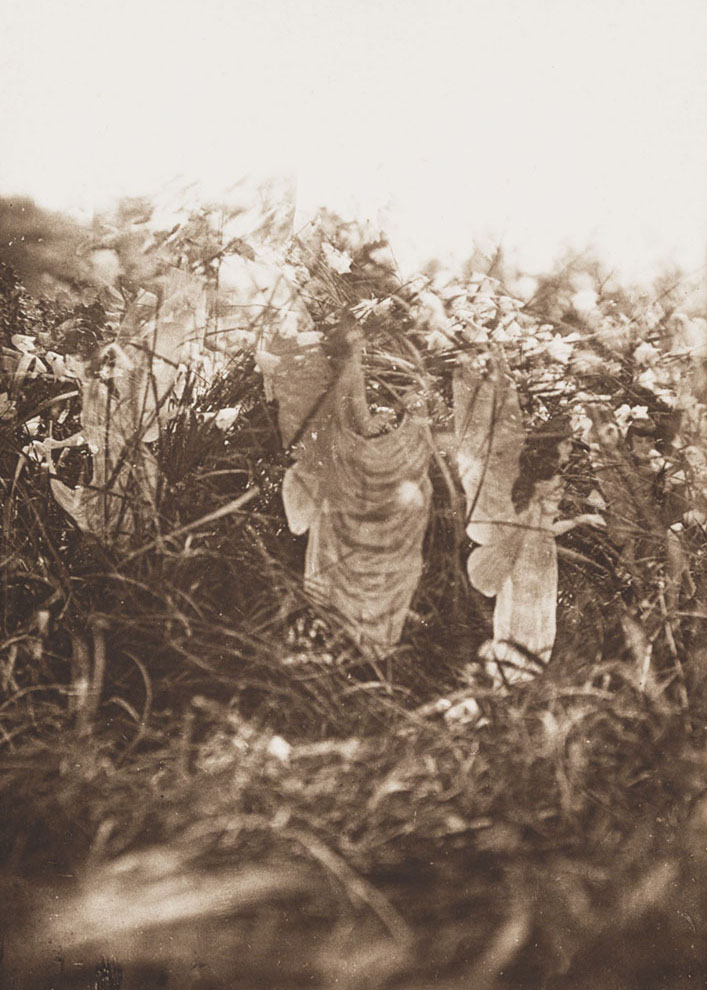
5. Fairies and Their Sun Bath (August 1920) – The most blurred and “ethereal” looking image. Frances maintained to her death that this one was genuine. Matt suspects the camera simply wasn’t stable.
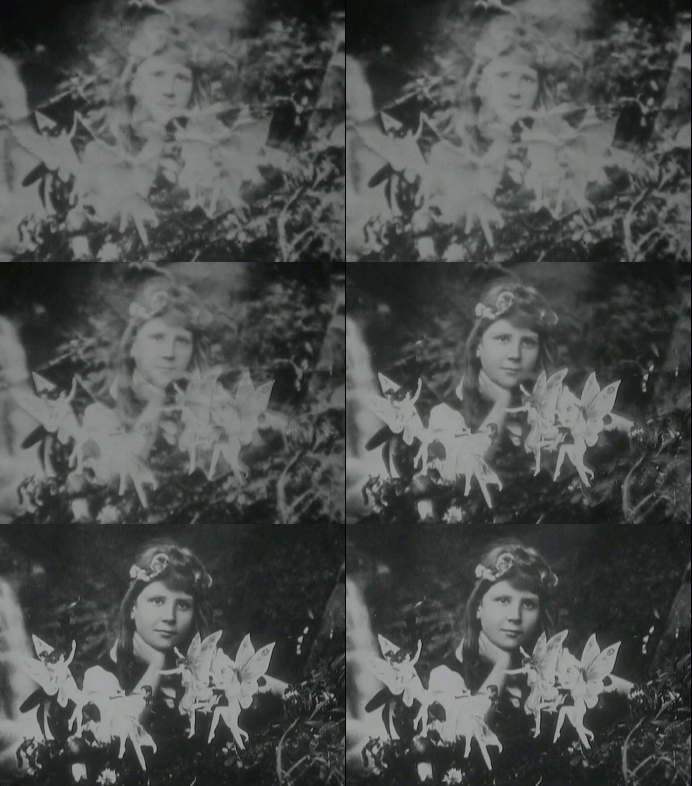
Arthur C. Clarke’s World of Strange Powers included this visual that showed how the photos were enhanced before distribution
🔍 The Story in Brief
In the summer of 1917, cousins Elsie Wright (15, turning 16) and Frances Griffiths (9) were living together at 31 Main Street, Cottingley, West Yorkshire. Frances and her mother had returned to the UK from South Africa because Frances’s father, Arthur Griffiths, had gone to serve on the Western Front. The girls played constantly at the beck (stream) behind the house, and when scolded for getting wet, claimed they went there to see fairies.
To prove it, they borrowed Elsie’s father Arthur Wright’s Midg quarter-plate camera – a glass-plate camera from around 1912 – and returned within the hour with one of the most iconic images in paranormal history: Frances gazing past a group of four dancing fairies, one playing a pipe. A second photograph followed – Elsie with a gnome (who, Karen notes, bears a striking resemblance to Rowan Atkinson).
Elsie’s father Arthur, a keen amateur photographer with his own darkroom, immediately suspected a prank. But Elsie’s mother Polly believed the photographs were genuine. In 1919, Polly attended a lecture on “Fairy Life” at the Bradford Theosophical Society and shared the images. That brought them to the attention of Edward Gardner, president of the London lodge of the Theosophical Society, and eventually Sir Arthur Conan Doyle, who was already writing an article on fairies for The Strand Magazine.
Gardner had the negatives examined by photographic expert Harold Snelling, who declared them “genuine” with “no trace of studio work” – technically true, since the trick was all done in-camera with cardboard cutouts and hatpins, not in a studio. Snelling then produced enhanced copies from the original negatives for publication – transforming evidence into what Matt calls “presentation artifacts,” though they continued to trade on that original credibility claim.
In 1920, Gardner returned to Cottingley with two Cameo cameras and secretly marked photographic plates. The girls produced three more photographs: Frances and the Leaping Fairy, A Fairy Offering a Posy of Harebells to Elsie (featuring a conspicuously fashionable 1920s-bobbed fairy), and Fairies and Their Sun Bath. These were again sent to Snelling for enhancement before publication.
Both Kodak and Ilford examined the photographs. Kodak found no proof of fakery but refused to certify them as genuine, noting that fairies aren’t real. Ilford said they were fake. Believers interpreted the ambiguity as validation.
Doyle published his article in the Christmas 1920 Strand, and followed it with The Coming of the Fairies in 1922. The reaction was brutal – the creator of Sherlock Holmes was widely mocked. Gardner sold prints at lectures, and the rights became tied to the Theosophical movement. The girls and their families received little or no money.
In 1921, Gardner returned to Cottingley with more cameras and an occultist named Geoffrey Hodson. The girls were no longer present – both had moved overseas and married. No new photographs were produced, but Hodson claimed to see fairies everywhere.
The case languished for decades until 1978, when it was attacked from multiple angles at once. Fred Gettings – a prolific British author of some 59 books on art, occultism, astrology, tarot, and esoteric symbolism – was researching early illustration for his book Ghosts in Photographs: The Extraordinary Story of Spirit Photography (Harmony Books, 1978) when he stumbled across fairy drawings in Princess Mary’s Gift Book (1915, illustrating a poem by Alfred Noyes called “A Spell for a Fairy”) and recognized the unmistakable similarity to the Cottingley fairies. James Randi noted in Flim-Flam!, is that Gettings was himself an avowed believer in spiritualism and spirit photography – Gettings wasn’t looking to debunk anything. He was simply honest enough to publish what he found. The single most damning piece of evidence against the Cottingley photos came not from a skeptic but from a believer.
That same year, Randi enlisted Robert Sheaffer – a skeptic experienced in investigating UFO claims – and William Spaulding of Ground Saucer Watch in Phoenix, Arizona, to perform computer-enhanced image analysis on the photographs. Spaulding’s scanning technology, originally developed for analyzing satellite and UFO photographs, confirmed the fairy figures were flat (exactly what you’d expect of paper cutouts) and turned up what appeared to be a thread support in photo number four. Randi initially reported these findings and promoted the “string” theory of how the fairies were supported. According to at least two independent sources, Elsie Wright – by then in her late seventies and still not confessing – responded via New Scientist, sarcastically asking what part of the sky the strings were supposed to be attached to. By the time Randi wrote up the case in chapter 2 of Flim-Flam! (1980), titled “Fairies at the Foot of the Garden,” he had reconsidered: he captioned the computer enhancement image as “doubtful evidence” and wrote that no support was even necessary for the figures. Randi included Gettings’s Princess Mary’s Gift Book discovery in the chapter but disappointingly did not provide a proper citation for Ghosts in Photographs.
The hoax remained officially unresolved until the early 1980s, when pressure mounted from two directions simultaneously. Journalist Joe Cooper, who had been working directly with both women for years, secured Elsie’s first public confession for The Unexplained magazine in 1982. Concurrently, Geoffrey Crawley, editor of the British Journal of Photography, was publishing a thorough ten-part forensic investigation titled “That Astonishing Affair of the Cottingley Fairies” (1982-1983). Crawley’s work prompted Elsie to write him a detailed confession letter dated 17 February 1983, now held at the National Science and Media Museum in Bradford. The combined weight of Cooper’s journalism and Crawley’s photographic analysis finally brought the truth out after more than sixty years: the fairies were cardboard cutouts drawn by Elsie, copied from illustrations by Claude Shepperson in Princess Mary’s Gift Book (1914), with wings added by the girls. They were held upright in the grass with hatpins – the very mechanism that Randi’s string theory had tried and failed to identify. Frances maintained to her death that the fifth photograph – Fairies and Their Sun Bath – was genuine.
📸 Key Observations from Matt
Matt emphasizes that this is not simply a debunking story – it’s a story about two children who got swept up in adults’ belief systems to the point that they couldn’t back out. He draws a parallel to his own childhood experience of pranking his mother on April Fool’s Day and being punished for it, noting the Edwardian-era pressure on children who humiliated adults. He also shares his own experience with Fact or Faked producers who asked him to create increasingly “real” paranormal evidence for television – a modern echo of what happened to the girls.
On the photography itself, Matt notes that the strongest evidence against the photographs’ authenticity isn’t strings or wires – it’s the fact that the fairies, supposedly dancing and fluttering, are perfectly sharp in images where the background is blurred. With the slow exposure times required by the Midg camera, anything truly moving would have been a blur. The sharp-edged fairies are clearly two-dimensional objects holding still.
Matt frames the case as a “blueprint for how misinformation gains legitimacy” through layered credibility: authentic negatives (true but misleading), expert validation (technically correct but contextually wrong), enhanced reproduction (quietly altered perception), and authority endorsement (emotionally amplifying everything).
📚 The Princess Mary Gift Book Connection
Blake tracked down a first edition of Princess Mary’s Gift Book (1914), the source of the fairy illustrations that Elsie copied. He discovered two things: first, the original illustrations by Claude Shepperson don’t have wings – the girls added those. Second, and deliciously ironic, Arthur Conan Doyle himself has a story published in the very same book. Blake eventually gifted his copy to Ken Feder, archaeologist, friend of the show, and Sherlock Holmes enthusiast. [See Ken’s new Holme’s Mystery! (2026)]
🎭 A Note on All the Arthurs
This story has a confusing abundance of Arthurs. Both girls’ fathers were named Arthur (Arthur Wright and Arthur Griffiths). The author who championed the photographs was Arthur Conan Doyle. And the television host who later covered the debunking was Arthur C. Clarke. Keep your Arthurs straight!
🕊️ Context: War, Grief, and Belief
Karen highlights that Frances originally described seeing not fairies but tiny troops marching in the brook – imagining what her father might be seeing on the Western Front. The fairy photographs emerged as a coping mechanism during wartime. Doyle’s involvement is often attributed to the death of his son Kingsley in 1918, though his engagement with spiritualism actually predates his son’s death by over thirty years – he attended his first seance in 1881 and declared himself a spiritualist in 1887. What the war did was turn him from a private believer into a public evangelist. Karen also draws parallels to the Fox Sisters, the Enfield Poltergeist, and the Guyra Ghost – all cases involving children whose pranks were amplified by adult belief systems.
🔗 Links and Resources
Primary Sources:
Arthur Conan Doyle, The Coming of the Fairies (1922) – Full text at Project Gutenberg
Cottingley Fairies – Wikipedia
Rose Fyleman – Wikipedia (author of “There Are Fairies at the Bottom of Our Garden,” 1917)
Rose Fyleman, “Fairies” (1917) – Full poem at All Poetry
The Fairy Census – Dr. Simon Young’s survey of modern fairy experiences
Museum Collection:
The Midg Camera used for the first two fairy photographs – Science Museum Group Collection
Video – Archival and Documentary:
📺 BBC Nationwide (1976): “Cottingley Fairies: Fact or Fantasy?” – BBC Archive on YouTube – The BBC interview with Elsie Wright, still maintaining her story nearly 60 years later.
📺 Arthur C. Clarke’s World of Strange Powers, Ep. 7: “Fairies, Phantoms and Fantastic Photographs” (1985) – Full episode on YouTube – The episode Blake remembers, featuring the debunking of the Cottingley photographs.
📺 Antiques Roadshow – Cottingley Fairies segment (BBC One, January 2009) – Frances’s daughter Christine Lynch appears with the original photographs and one of the cameras given to the girls by Doyle. Items appraised at £25,000-£30,000.
📺 “The Cottingley Fairies: A Study in Deception” – Dr. Merrick Burrow, Leeds University Library (2021) – The excellent lecture Karen and Blake recommend, covering the deception with fairness to all involved.
📺 “How the Cottingley Fairies Photographs Were Made” – National Science and Media Museum (2020)
Podcasts:
🎙️ Cautionary Tales with Tim Harford: “Photographing Fairies” – Explores how the girls wanted to come clean but kept delaying out of consideration for the feelings of the adults they’d fooled.
Further Reading:
Princess Mary’s Gift Book (1914) – Wikipedia – The source of the fairy illustrations, featuring artwork by Claude Shepperson – and, ironically, a story by Arthur Conan Doyle.
Princess Mary’s Gift Book – Full text at Project Gutenberg – Read the original book online, including the fairy illustrations by Claude Shepperson.
The Cottingley Fairies – Historic UK
Edward Gardner – Wikipedia (the Theosophist who drove the investigation on the ground)
Joe Cooper, The Case of the Cottingley Fairies (1990) – Amazon – The definitive account by the journalist who worked with both women for six years and secured Elsie’s first public confession in 1982.
Fred Gettings, Ghosts in Photographs: The Extraordinary Story of Spirit Photography (1978) – Amazon – The book in which a believer in spirit photography inadvertently discovered the Princess Mary’s Gift Book source of the Cottingley fairy cutouts.
James Randi, Flim-Flam! Psychics, ESP, Unicorns and Other Delusions (1980) – Amazon – Chapter 2, “Fairies at the Foot of the Garden,” covers the Cottingley case in detail, including the computer enhancement analysis and Gettings’s discovery.
💬 Memorable Quotes
“Two village girls and a brilliant man like Conan Doyle – well, we could only keep quiet.” – Elsie Wright
“I never even thought of it as being a fraud. It was just Elsie and I having a bit of fun, and I can’t understand to this day why they were taken in. They wanted to be taken in.” – Frances Griffiths
“This case isn’t just about fake photos. It’s about layers of credibility… It’s a blueprint for how misinformation gains legitimacy.” – Matt Baxter
“Are you saying that there’s a Gardner at the bottom of the fairies?” – Blake Smith 🌱
SEO Transcript
This is not a fully accurate transcript, and was machine generated. It’s here for helping search engines find the episode but not intended to be a faithful transcript of the episode. (But it’s not AWFUL.) Some of the material in this transcript only exists in the Patreon/Premium edition of the show and was excised for the commercial version.
———————
Monster House Presents
This is the ad-supported version of Monster Talk.
We’re dependent upon the revenue from these ads and from the support of our patrons at patreon.com forward slash monster talk to continue making this show.
As a disclaimer, your hosts are unable to control what ads you will hear.
And while we have done what we can to avoid ads that are divisive, the system that injects them sometimes ignores our preferences and always seems to ignore our efforts to not interrupt the conversational flow.
While we understand this can be disruptive, we’re trying our best.
Patreon remains the best way to enjoy commercial-free listening to our content, plus you generally get extended coverage of the subject.
We’re working on other ways to consume our content as well, so please stay tuned.
Fairies by Rose Fyleman There are fairies at the bottom of our garden.
It’s not so very, very far away.
You pass the gardener’s shed and you just keep straight ahead.
I do so hope they’ve really come to stay.
There’s a little wood with moss in it and beetles and a little stream that quietly runs through.
You wouldn’t think they’d dare to come merrymaking there.
Well, they do.
There are fairies at the bottom of our garden.
They often have a dance on summer nights.
The butterflies and breeze make a lovely little breeze and the rabbits stand about and hold the lights.
Did you know that they could sit upon the moonbeams and pick a little star to make a fan and dance away up there in the middle of the air?
Well, they can.
There are fairies at the bottom of our garden.
You cannot think how beautiful they are.
They all stand up and sing when the fairy queen and king come gently floating down upon their car.
The king is very proud and very handsome.
The queen, now you can guess who that could be.
She’s a little girl all day, but at night she steals away?
Well, it’s me.
MUSIC PLAYS
It’s actually quite unlike anything we’ve ever seen before.
A giant hairy creature, part ape, part man.
In Loch Ness, a 24 mile long bottomless lake in the highlands of Scotland, it’s a creature known as the Loch Ness Monster.
Monster Talk.
Welcome to Monster Talk, the science show about monsters.
I’m Blake Smith.
And I’m Karen Stollznow.
That lovely intro was the poem Fairies by Rose Fyleman.
The reading was by Rachel Lackey, who is the co-host of Rachel Watches Star Trek and is a frequent reader on another show I love, Strange Studies of Strange Stories.
Links to those shows will be in the show notes.
And thank you so much to Rachel and her husband, Chris Lackey, for helping with this episode.
It’s almost inevitable that when you hear the story of the Cottingley Fairies, this particular poem’s line about fairies at the bottom of the garden comes up.
Fyleman’s poem was published in Punch magazine in May of 1917.
The first Cottingley photo was taken in July of 1917.
There’s no evidence of any direct connection between the two, no evidence the girls had read the poem, no evidence Fyleman had heard about the girls.
They’re independent events that happened to occur weeks apart in the same country during the same cultural moment.
But the coincidence is almost supernaturally perfect.
Fahlman’s poem describes fairies at the bottom of a garden, near a little stream that quietly runs through, which is an eerily precise description of the Cottingley Beck at the bottom of the Wright family garden.
The poem was a massive hit, reprinted over 20 times in the next 10 years.
And by the time Arthur Conan Doyle published the fairy photographs in The Strand in December of 1920, the phrase, there are fairies at the bottom of our garden, was a well-known one in British culture.
It gave the Cottingley story a ready-made tagline.
And there’s another connection which will be revealed at the end of this episode, one whose linguistic aptness was so stunning that I couldn’t believe no one had made the connection before, but as near as I can tell, you’ll hear it here first.
A lot of coincidences swirled around our coverage of this episode, and it led me to making a lot of inserts into the show, which I hope will make what can be a somewhat convoluted story much clearer.
At a minimum, if you’ve only had a tenuous exposure to the tale of the Cottingley Fairies, you should be well informed by the end of this episode.
Monster Talk.
Welcome to Monster Talk, everyone.
We have Matt joining us again.
Oh, boy, Matt.
Sorry, I stepped on you already.
That didn’t take long.
But we’re going to talk about a topic that I think is very near and dear to our hearts, the three of us, and yet it’s a topic that we should have spoken about before and have touched upon many times but haven’t dedicated…
a full episode too.
And that’s the Cottingley Fairies, very famous story.
And Matt and I were watching an old BBC video dating back to 1976 on YouTube, and it was about the Cottingley Fairies.
So at that point, a lot of people still believed in the stories behind the hoax.
And I guess to this day, people still do, even though it has been debunked multiple times.
But we thought,
it’s more than time that we should delve into this topic a bit more on monster talk.
So that’s why we’re here today.
Yeah.
I’m excited about this.
I don’t, you don’t recall when I first came across these, it was probably in a book, not a TV show, but the first TV show I remember seeing about it was Arthur C. Clark’s.
He did a show.
He did multiple series.
So every time he did a different season, they would like rename the show.
So I think it was the world of strange world, strange powers.
Yeah.
Yeah.
And they actually had on important people from this story to reveal the shocking truth.
I mean, shocking.
uh if you’re from the past i think by the time it came on television in the 80s it wasn’t that shocking except more like how long could you keep a hoax to yourself without revealing it especially the circumstances around this one so spoiler uh this
There probably were not really fairies at the bottom of the garden.
Well, I think it’s interesting that the first time that you found out about the story, that it was when it was debunked.
Because I can’t remember what age I was.
think it would have been six or seven around that age but people still for the most part believed in the story it hadn’t been debunked and uh i think i just saw it in numerous books on the paranormal and i thought oh well um at that point maybe there’s something to it uh i i think i had a bit of natural skepticism uh even at that age but uh yeah this goes back to
the early 20th century.
So we’re talking 1917.
And I think that’s when the first photograph came out.
And I think it’s really interesting that it coincides with a poem called Fairies from 1917 by Rose Fileman.
And that very famous line, there are fairies at the bottom of our garden.
That’s the way that it starts.
And I think it’s just interesting.
It must be synchronicity that that poem came out.
That’s the only explanation, right?
Only explanation.
We recently, in fact, as we’re recording this, it’ll be coming out this week and next week, we had talked to Chris Woodyard, a folklorist and author.
Now, she does a podcast and her partner is a fairy researcher named Simon Young.
It’s a great job title.
It really is.
One of the things he’s done is a sort of a survey or a census, a fairy census.
There’s still extraordinarily widespread belief in fairies.
And maybe we should talk about that just briefly, because I think historically before, let’s say before Shakespeare, because I kind of tried to run this down and I don’t think there’s a hard answer to this, but I wanted to kind of know when did fairies transition from being a widely held.
explanatory belief system for why mysterious things happen around your house and on the farm.
Versus becoming a sort of Disney-fied, cute little winged things that you don’t really need to worry about.
They’re just adorable for folklore and fairy tales, right?
And it is a long transition.
And it seems like maybe that actually even started with Shakespeare because he included fairies in some of his plays in a way that probably would have been seen as…
I don’t want to say blasphemy, that’s not quite the right word, but risky considering a lot of people still thought fairies could f*** you up.
Yeah, they were bad fairies like sprites and elves and
pixies and that kind of thing right what are the many things that could make your milk come out bad or your butter not come out at all or you know ill fortune blame something right if it’s not a witch why not the fairy right right the good folk you know so
So anyway, over the years, especially during the Victorian period, which is shocking, the Victorians were responsible for yet another problem.
They really sort of changed them to be these delightful little fun creatures versus the serious.
Maybe it’s not just the Victorians.
Maybe it has something to do with the rise of industrialization, the Enlightenment.
There’s lots of other things that may have been applied.
spiritualism.
Well, spiritualism still endorsed the fairies though, right?
I mean, they still, I mean, that’s kind of part of the problem here, which we’ll get into, but I guess we’re talking about a time when people were seriously questioning if fairies were real.
When along come these girls with this interesting story, but maybe we should set that up, uh, in context and talk about what, whose photos are we talking about?
What did they photograph and why?
Yeah, well, so this dates back to 1917.
And we’ve got a story of two young girls.
They were cousins.
Elsie Wright, who was, you’ve got 16 here, but I think I heard she was 15, 16.
As regards her age, there’s a bit of blurriness in her picture of Elsie.
The published accounts of Doyle and Gardner, and then later retellings inspired by those accounts, and by Elsie herself, all describe her as being 16 years old when the photo was first taken.
That first fairy photo was traditionally described as being taken on a Saturday afternoon in July of 1917.
The Saturdays in that month were the 7th, the 14th, the 21st, and the 28th.
On the 7th or 14th, Elsie was still 15 years old by days or weeks.
On the 21st or 28th, she’d have just turned 16.
Elsie is usually portrayed as an innocent young girl, unlikely to participate in a hoax.
But Elsie was already a college student and had a job.
That job?
In a photography studio where her art skills were focused on photographic touch-up.
That arguably significant fact is rarely mentioned.
In addition to the discrepancy about Elsie’s age, Doyle also describes Frances as being 10, but she was 9 when these things started.
I bet Karen’s about to point that out.
And her cousin, Frances Griffiths, who was nine when things started.
And yeah, so they were cousins.
And Frances and her mother had returned to the UK.
So this all happened in West Yorkshire.
So Cottingley, a little town, little hamlet in West Yorkshire.
And so they returned to the UK from South Africa.
They’d been living there.
So I
So this was in 1917.
So we’re talking World War I still.
And the reason that they came back was that they were going to stay with the relatives because the father was going away to war at the Western Front.
So I think, yeah, he had friends.
I’m not exactly sure.
I don’t even know what his name was.
His name was Arthur Griffiths, Sergeant or perhaps Sergeant Major, sources differ, of the Royal Garrison Artillery.
So they all moved in together and they’re living in this house at 31 Main Street in Cottingley.
And I saw the house actually went up for sale a couple of years ago too.
It went for about £250,000.
That’s very expensive.
It is.
So they were all huddled together in this house and also Elsie’s mother, Polly, and father, Arthur, all living together.
And the girls really developed an affinity.
And I think that Elsie really took Frances under her wing and took good care of her, felt sorry for her.
She, you know, is this little girl who’s…
grown up in South Africa and didn’t have any friends there.
So she really kind of took care of her.
They do come across in the reading as more like sisters than cousins when they’re young, to me.
And it’s interesting because that is quite a gap in age.
I know that my brother and I have that.
age gap between us and I think it really was almost like a separate generation.
It was quite a gulf between us in age.
But they really got along very well and they like to play out in the beck, which is an older term for a stream or a brook that’s at the bottom of the garden, which is still there.
So you get a lot of legend trippers, people going there to check out this beck, which is the scene of the crime.
And so they would always play down there and get their beautiful dresses and shoes drenched from this stream.
And they’d continue to get into trouble for this.
And so the princess’s mother said, well, why are you doing this?
Why are you playing in the stream in the back?
And she said, well, we go there to see the fairies.
So the parents all laughed at this and mocked the kids and thought that it was quite ridiculous.
And so I think Frances got it in her head that she would prove to the parents that she was actually seeing fairies.
And Elsie kind of came to her rescue and wanted to support her endeavor.
And so they basically concocted this idea to create these fairies.
So it’s really hard to tell this story without just busting and debunking the story right at the start.
So, Matt, do you want to talk a little bit about the camera, what was used and how this next part occurred?
Well, sure.
I do want to say that I don’t think that this is a story about, you know, this hoax being debunked.
I think it’s a story of how two girls were being kids and they got swept up in other people’s belief systems to the point that they couldn’t back out.
And so it’s more of how they were kind of taken advantage of.
And so we know going in, this is a hoax.
This is them having fun.
But it’s what happened afterwards that really seems to make the big difference in all of it.
So they borrowed their father’s camera.
And it was a Midge camera.
And…
This one, you know, around 1912 is when it was made.
Now it is a quarter plate image camera.
It uses actual glass plates.
So it’s a very typical, you know, camera of the day, very standard.
Is it a handheld camera or one that you have to put on a tripod?
Well, it is much better on a tripod.
And the reason for that is because of the fact that light has to come in
and hit this glass plate.
And so you need enough, you know, basically photons to be coming in.
So that means that the aperture has to stay open until that happens.
And what I’m basically trying to say is if there’s movement during this time, things blur.
And so they had to hold very still to get good pictures.
And that was that was fairly well known.
But so, yeah, these these first pictures were taken with this camera.
And that was kind of it.
It didn’t.
Nothing really happened right away.
They took these pictures.
And then it was actually a while after that.
I think, Karen, you were saying that didn’t the mother attend a talk?
Well, let’s describe the first photograph.
So we have a picture that the most influential one, the first image is of Frances, so the younger girl and the dancing fairy.
Frances and the fairies, yeah.
And that’s just that splendid picture, that really iconic one.
She’s such a beautiful girl and the dress she’s wearing and her hair and these four fairies that are just frolicking about in front of her.
And one of them has a…
a pipe pan pipe or i don’t know some kind of oboe i’m not sure exactly what instrument it is but the other fairies are dancing and there are i guess the the idea when we think of fairies nowadays when we even the disney fairies this is the prototypical fairy the the kind that we imagine but it is a beautiful shot you can see the water in the background and just the the beck it’s a really lovely photograph
And so the girls took that picture.
I don’t know.
Are they processed immediately?
Is it like a Polaroid or do they have to go and develop it?
Yeah, it has to be developed.
Yeah, it has to be developed.
But their father was an amateur photographer and they had a dark room there at the home.
Yeah, so that’s Elsie’s father, Arthur.
Yeah, so he’s the photographer.
I just this reminds me so much of we were just talking recently about the Patterson Gimlin film and the fact that Roger Patterson takes a camera, borrows it or rinse it in this case, goes out to shoot a Bigfoot and then gets the Bigfoot shot on the first try.
These girls take their camera out to go get a photo of a fairy and get the shot on the first try.
It’s amazing.
What luck.
I was thinking of those parallels, too.
And I think as we go on, there are some parallels to the shades of the Enfield poltergeist and the gyro ghost as well, with the girls trying to prove that they their stories.
Not only that, but also I should say that when we talk about spiritualism and theosophy, spiritualism in particular starts with the Fox sisters who begin most likely by pranking their parents.
And then they get the whole community like leans into it.
Like it’s the most amazing thing ever.
And what kind of pressure does that put on a kid to sustain that story?
I mean, and in this case for the rest of their frigging lives, it’s so anyway, we’ll get there.
They’re really overshadowed their lives, but as Matt’s.
hinted at that the mother got involved.
So it was Elsie’s mother, Polly, she believed that they were authentic.
But Arthur, he immediately thought that this was some kind of prank.
He said, nothing but a prank.
That’s the quote.
And he thought that they were using cardboard cutouts.
So in some ways, the whole thing was kind of blown up right at the start.
But I think it was sometime later that the mother went along to a theosophical society in
a town called Bradford that was nearby, near Cottingley.
And I think it was entitled Fairy Life.
This looks like a good place for a quick primer on the cast of characters and concepts in this tale.
Theosophy is the esoteric religious movement founded by Helena Blavatsky in 1875.
Blavatsky’s system blended a form of Eastern mysticism seen through the lens of Victorian Europe, Western occultism descended from Hermeticism and alchemy, and a layered cosmology of invisible planes of existence, astral, etheric, and so on, populated by various non-physical beings.
After Blavatsky’s death in 1891, leadership of the Theosophical Society eventually passed to Annie Besant and Charles Webster Ledbetter, who we’ve talked about before on the show.
Besant and Ledbetter expanded the system considerably, and critically for this story, they claim direct, clairvoyant perception of these invisible planes.
Ledbetter published detailed descriptions of nature spirits, elementals, and thought forms, beings he said he could personally observe on the etheric and astral planes.
Besant and Ledbetter revealed these worlds in their 1901 book, Thought Forms, which Ledbetter expanded on in his 1913 book, The Hidden Side of Things.
So, by 1917, there was a body of theosophical literature treating fairies not as folklore, but as documented etheric fauna, real entities with real functions in nature, just invisible to ordinary perception.
Edward Gardner, the main Cottingley investigator on the ground, was a committed theosophist.
Gardner was president of the London Lodge of the Theosophical Society.
For Gardner, fairy photographs were not charming curiosities.
If you could capture etheric beings on a photographic plate, you had empirical evidence for the planes of existence described by Blavatsky, Besant, and Ledbetter.
That’s why he carefully and secretly marked photographic plates and had prints examined by outside experts.
Gardner wanted to believe, but he also thought he was doing scientific investigation.
Arthur Conan Doyle is a separate case.
He was not a theosophist.
He was a spiritualist, and this distinction matters.
Doyle’s core commitment was to survival after death and communication with the departed through seances and mediums.
Doyle acknowledged that theosophy had a more coherent philosophical framework than the broader spiritualism movement.
Doyle wrote that he was deeply interested in and attracted for a year or two by theosophy.
particularly reincarnation and karma.
But Doyle explicitly broke with Blavatsky over her characterization of spirits of the dead as mere astral shells, contradicting the core spiritualist concept of meaningful contact with the deceased.
By 1927, Doyle publicly stated that Theosophy’s anti-spiritualism kept the two great bodies of psychic thought apart.
Doyle’s support for the Cottingley photos wasn’t to prop up theosophy.
Doyle saw fairy evidence, like other wonders such as mummy’s curses, as evidence of a reality beyond the material, a gateway drug for accepting the existence of spirits beyond death.
Doyle’s closing line in the Strand article, make the strategy explicit.
If you could get the public to accept fairies, they’d be more open to that spiritual messages were supported by physical facts.
Fairies were the thin edge of a rhetorical wedge.
For Gardner, the theosophist, the fairy photos validated the etheric plane.
For Doyle, the spiritualist, the photos softened up materialist resistance to the supernatural in general.
Gardner’s Theosophical Network brought the photos to initial public attention when Pauli Wright mentioned them at a Theosophical Society meeting in Bradford.
Once Doyle knew of them, his celebrity put them in front of the public via the Strand.
This, in turn, brought clairvoyant Jeffrey Hodson to Cottingley in 1921.
Hodson claimed to see fairies everywhere, while the girls, notably, saw nothing.
Hodson published his book, Fairies at Work and Play, in 1925.
Hodson’s book reads like a naturalist’s field guide to etheric fauna.
The whole affair was self-reinforcing.
The theosophical literature said these beings existed, the Cottingley photos appeared to confirm it, and then the clairvoyants showed up to provide additional field observations.
Meanwhile, the actual evidence was two little girls with cardboard cutouts and hat pins.
The story has elements that make it tricky to keep track of who is who.
When Doyle wrote his book, he gave both girls aliases, doubling the ways you’ll see this story discussed.
Nominally, there’s an even weirder coincidence.
Both girls’ fathers and the author Conan Doyle all share the same Christian name.
But of them, I would say that the author Arthur was an otter auteur.
And then there’s author Arthur C. Clarke, yet another one to keep track of.
And so they started talking about these photographs and got the interest of a number of members of that society, in particular, a fellow named Edward Gardner.
And so that’s really where things start taking off from that point.
Edward Gardner, he sent the photographs and the negatives to an expert named Harold Snelling.
And looking at those original negatives, he said that they are genuine and there is no trace of studio work.
Now, this becomes the core credibility claim throughout the rest of this story, is this initial looking at the original negatives, that there’s no trace of studio work.
Well, of course there wasn’t, because this was all in-camera stuff.
But anyway, moving forward.
Well, yeah, I think there’s a, yeah, I don’t know at what point we want to talk about things because there’s so much to this story.
But really I think it becomes this, it’s a snowball that just kind of turns into an avalanche when it’s originally contained with this family and then this Theosophical Society gets involved, Edward Gardner gets involved, Harold Snelling gets involved, and then they end up bringing in Arthur Conan Doyle.
And that’s where things really take off.
And he’s, I think, writing an article for a magazine at that time, coincidentally about fairies as well, for The Strand magazine.
So he was, wasn’t he publishing Sherlock Holmes stories in the same magazine?
In the strand, yes.
So, yeah, this was, I think, 1920.
And as we know, he’s a really passionate supporter of spiritualism.
And so he wants to use these images.
So I think it’s at this point that the girls really kind of lose control over these images.
And…
So at this point I think they’ve got, is it three pictures or two pictures?
Two pictures at this point.
It’s the Francis and the Dancing Fairies and Elsie and the Gnome.
Those are the two main pictures.
Now I do want to say just really quickly in here before we continue with that line of discussion.
Three years have passed in this time.
Now, for a kid, that’s a long time.
Elsie’s now like 19 and, you know, Francis is 12.
I mean, they have grown quite a bit.
Elsie’s about to get married.
They’re moving on with their lives at this point.
Right, right.
Now, the thing is, is I had an experience when I was about 10 or 11.
When on April Fool’s Day, I had made these kind of little wristbands that I would pretend they were power bands, mega power bands, that I’d be a superhero when I wore them and everything.
But they were actually made out of a kind of a metal.
and I decided I was going to fool my mom, and I put ketchup all over my wrist and said, Mom, I accidentally cut my wrist with these, and she panicked and freaked out and everything.
Now, when you’re a kid, you’re always told, tell the truth.
So I told the truth, and she was so furious with me for fooling her that I got hit and grounded.
And this especially was the time of big punishment if you humiliated an adult.
So telling the truth was not a good idea.
Good point.
So if you get pulled into something and now suddenly this famous, well-respected author is now getting pulled into it on something you did three years ago and you’ve had to retell the story many times in that amount of time, I’m sure you can start to build a pretty good memory of falsehoods, you know, of what happened in your head.
So I’m really feeling bad for the girls at this point.
It’s kind of terrifying.
I think, yeah, that’s a really good point.
We’re talking about the Edwardian era.
So just after the Victorian era, and I can only imagine what punishments would have been like.
I wanted to say too, that we didn’t really describe the second picture.
So we’ve got the first picture with Francis and the dancing fairies, the really iconic one, but there is a secondary one, which is very well known too.
And that’s Elsie with the gnome.
But I think the gnome looks like Rowan Atkinson.
It does a bit.
That’s funny.
Yeah.
Well, no, the thing about that has, have you ever seen Rowan Atkinson and that gnome in the same room at the same time?
No.
Excellent.
Just, just putting it out there.
I don’t think it’s farfetched.
Yeah.
So, yeah, we’re now at 19.20.
And so we have Sir Arthur Conan Doyle has become involved and he’s writing this article for The Strand magazine.
about fairies, coincidentally, and he wants to use these pictures.
So as I stated earlier, I really think it’s at this point that these girls kind of just lose their control over the situation, give over the images.
Now, I believe too that Arthur was offered money to publish these pictures and that he refused.
He just thought it was the right thing to do to share these pictures with the world so that people could…
learn about these apparent fairies.
And so I really think at this point, they’re just kind of sticking to their stories and they lose control over the narrative.
But something huge happens with this as well.
Because Harold Snelling gets pulled back into it.
And he is asked to improve the pictures for this publication.
Yeah.
So he makes.
Got to make them cleaner.
Got to make.
Yeah.
Just clarifying here.
Just using a little.
Touch up, right?
Yeah, so he makes prints from the original negatives, and then he creates copy negatives from those prints, and then he retouches and intensifies these copies.
So these are no longer evidence.
These are now presentation artifacts.
But the thing is, is none of this is presented this way.
These are still based on that first credibility claim of genuine and no trace of studio work.
So this is where things get really blurred, much like the blurring we’re going to talk about shortly.
Well, and I think that this is interesting too because to this day, this is exactly what still goes on.
If people have recordings of electronic voice phenomena, if people have photographs, they’re touched up.
Yeah, let me just run that through some filters here and we’ll clean that audio up so it sounds like a voice.
Matt, do you want to just – I guess we don’t want to go into it too much, but if you want to touch upon your experience with those TV producers and that TV show.
It’s relevant.
It is.
It is because this is what happened to the girls.
Now, I was working on a ghost hunting reality show called Colorado X Case Files of the Paranormal, and we had made a –
video of a Ouija board kind of going crazy.
And, you know, and we put it out there as a bit of like, you know, hoping it would go viral and stuff.
And it kind of did.
But of course we said nothing.
It was just a promotion for the show is all it was.
And a factor faked.
producers got ahold of me and said, wow, this is crazy.
Did this really happen?
And I said, well, there’s a video of it.
Of course it happened.
You know, I didn’t say how it happened or that it was faked or anything else.
And they’re like, do you think you could make a video, another video of this and, and make it even more pronounced and more crazy.
And it’s kind of like, so you’re asking me to fake.
Now you’re not asking me of what I originally did as fake.
You’re now asking me to fake.
Mm-hmm.
And that’s the bottom line.
So I did.
I didn’t say I was going to fake anything.
I’m like, well, I’ll see what happens.
And made another video and sent it to them.
See if the spirits comply.
Right, right.
And they were like, wow, this is great.
Do you think you can make it?
And we’ll offer this much money for you to do this.
And it was just like, all right, no, this is…
this is really going too far you know you’re you’re asking me to pose um you know on a a very big tv show fact or faked you’re asking me to pose this as real evidence you know at this point you’re asking and you’re offering to pay me to do it
So I’m not interested in positioning it that way.
I will position it with a lot of ambiguity, but I’m not just going to out and out say, yes, this is real.
It’s not going to happen.
And to be clear, I believe that Gardner actually provided the cameras.
These were called cameo cameras, and the plates were marked and everything.
for the girls to take more photos, and they did.
They took three more photos.
They had Francis and the Leaping Fairy, Fairy offering a posy to Elsie, and Fairies and their sunbath.
Now, this is all cool, but again, we’ve got to remember, this is three years later.
The girls are now older, so the pictures aren’t going to look the same no matter what.
And again, these were sent to Snelling to be enhanced for reproduction.
I’ve got to put that Blade Runner sound effect.
Enhance.
Zoom in.
Enhance.
Exactly.
I want to add, too, that with the fairy offering posy of hair bells to Elsie, that the fairy’s very on trend because she looks like a flapper with that hairstyle and that dress.
So every contemporary fairy.
Yeah.
Well, Bob’s in the land of the Fae is just a hot style at the time, you know.
Fairies are not immune to this kind of, you know, peer pressure and wanting to look good and fashionable.
So they have to deal with that as well.
But, yeah, yeah.
Also at this time, they were examined by independent analysis, basically, is what we’re talking about, both Kodak and Ilford.
Now, Kodak found no proof of fakery, but they weren’t convinced.
And Ilford said there’s fakery here.
This is fake.
Kodak went with the, look, we don’t see any obvious signs of trickery, but fairies aren’t real.
So therefore, these aren’t real.
That really did not sit well with Doyle, right?
No, no.
But because they both didn’t come out and say absolutely fake, it was a little ambiguous.
So believers interpreted that as validation because that’s how believers do.
It’s, you know, bias.
So yeah, things got real commercial after that.
Mm-hmm.
So Gardner started selling prints at lectures.
Doyle publishes The Coming of the Fairies in 1922.
And the rights were effectively tied to the theosophical movement circulation.
So the girls, they received little or no money for this.
And of course, we know the father refused payments being ethical.
So, yeah.
Yeah, Doyle’s book, he really laid it on the line.
You can actually get the entire text.
I’ll put links in the show notes if you want to go read it.
But his Becoming of the Fairies is…
I don’t want to say it’s shallow sophistry.
That’s not very nice.
But he basically makes some very not convincing arguments that…
The preponderance of the evidence is that the fairies are real and should be considered thus.
Look at these photos.
These girls couldn’t possibly have faked these.
Turns out maybe one of them actually is working in the photography industry and her job is literally touching up photos.
So yeah, maybe they underplayed that.
But I just want to say the reaction to his book…
was brutal, absolutely brutal.
The guy who had created Sherlock Holmes is being mocked as a doddering old fool, basically.
It’s time for some good old-fashioned myth-busting.
There is a very common idea, one that we may have even perpetuated ourselves because it’s so embedded in modern stories about Arthur Conan Doyle.
But attend, if you will, the facts surrounding the notion that Doyle got involved with spiritualism because of the death of his son Kingsley following the Great War.
Kingsley Doyle died on the 28th of October 1918 from pneumonia during convalescence after being wounded in France.
But Doyle’s spiritualist involvement goes back over three decades before that.
In 1880, while still a medical student at Edinburgh, he attended a lecture called Does Death End All?
and wrote to his mother about it.
Interesting, but not convincing to me, he said.
In 1881, he attended his first séance.
From 1886 to 1887, he participated in table-turning sessions at the home of his patient, General Dresen, in South Sea.
And then, in 1887, the same year A Study in Scarlet was published, he wrote to Light magazine, explicitly declaring himself a spiritualist.
Therein, he described a specific experience that had given him his definite demonstration.
In 1893, he joined the Society for Psychical Research.
In 1894, he investigated a possible poltergeist case in Devon with Frank Podmore.
Then there’s a long quiet period, roughly from 1887 to 1916, where he was involved but not publicly crusading.
The Doyle’s family estate’s website is explicit about the misconception, noting that his interest took root some 30 years earlier, well before his son’s birth.
What the war did do was catalyze his shift from private investigator to public evangelist.
In 1916, before Kingsley’s death, he was apparently impressed by what he took to be the psychic abilities of his children’s nanny, Lily Loader Simons.
That, combined with the mass bereavement of the war, convinced him that spiritualism was a new revelation sent by God to comfort the bereaved, and he began lecturing publicly.
His first public spiritualism lecture was in October of 1917.
The new revelation was published in 1918.
So the more accurate version is, Doyle was a committed spiritualist for 30 years before the war, but the war turned him from quiet believer into missionary.
Kingsley’s death may have intensified an already white-hot commitment, but it did not create it.
The popular narrative gets that causation exactly backwards.
It’s a tidy story that just happens to be wrong, which is fitting for our discussion of the Cottingley Fairies.
Moreover, to the consternation of friends and admirers who desperately wanted Doyle, the writer, to be as analytical as his detective creation, he was a surprisingly gullible man who fell for many hoaxes and tricks throughout his life.
The Cottingley fairies were far from an isolated lapse in judgment.
In 1921, the magician William Marriott, stage name Dr. Wilmar, took photographs of Doyle under close observation by three witnesses, then revealed that he had used sleight of hand to add a translucent figure and dancing fairies to the images.
Doyle publicly admitted Marriott had proved a conjurer could fake a spirit photograph.
and then went right on believing in spirit photography anyway.
When spirit photographer William Hope was exposed as a fraud in 1922 by Harry Price and others using X-ray-marked plates, Doyle defended Hope and called the investigation a conspiracy.
That same year, he told newspapers that Lord Carnarvon had died not from blood poisoning, but from spirit warriors guarding Tutankhamen’s tomb.
And in a seance conducted by his wife Jean for his friend Harry Houdini, a message supposedly from Houdini’s recently deceased mother came through in English, although Houdini’s mother spoke Hungarian and German,
and was signed with a Christian cross, and she had been Jewish, on her birthday with no mention of the occasion.
Doyle believed it was genuine, while Houdini was quietly devastated, and the friendship never recovered.
Even Harry Price, who made his career exposing fraudulent mediums, said of Doyle, his extreme credulity was the despair of his colleagues, all of whom held him in the highest respect for his complete honesty.
Poor, dear, lovable, credulous Doyle.
He was a giant in stature with the heart of a child.
I think that also with this whole thing, I think fairies are basically a footnote in a sense, because he was kind of doing that, you know, six degrees of separation from Kevin Bacon in a sense, where…
If you believe in these fairies, which are absolutely real as you can see, then that means that everything else from ghosts to aliens to everything to psychic abilities, all this has to be real because the fairies are real.
So it was kind of his linchpin in a sense that, you know, if you’re going to see that these fairies are real, then you have to believe in all these other things that I’m promoting, right?
Linchpin or hairpin?
Yeah, hairpin, yeah.
Absolutely, good point.
This is a little convoluted, but one of my favorite little bits of trivia, right?
So the illustrations famously, now famously, were copied out of a book called The Princess Mary Gift Book.
And I was always fascinated by this as an adult.
Once I learned about the fairies, I wanted to see this book.
And so I tracked down a first edition copy for a very reasonable price.
Wow.
It goes back to 1914.
It is.
It’s quite old.
And it was so cool because not only did I get this first edition, but it had a…
a, what do you call it?
A dedication in the front from someone who’d given it to someone else as a gift.
And I was able to find them too.
They had gone off to the great war and you know, I could, I, so I mean, why I couldn’t say, you know, the ultimate, you know, how it ended up in my hands.
I could say that it was absolutely authentic first edition and had been given at one point to a child from a soldier, which is really cool.
But, but
What shocked me, because now that I had the book in my hands and was looking at it, is not only is it the source of these illustrations, and they are quite lovely, but they don’t have wings.
They don’t have wings, yeah.
The kids added the wings in.
But if Doyle had paid attention, he actually has a story in the Princess Mary gift book.
I didn’t know that.
Exactly.
I didn’t either.
Oh, how ironic.
Well, when I got that and I saw that connection, I honestly didn’t feel like my bookshelves were the correct place for this to reside.
So our frequent guest and friend of the show, Ken Fader, is a huge fan of Sherlock Holmes and Doyle and of this story.
Well, I want to add, too, these illustrations were done by Claude Shefferson.
This was Frances’s book.
She’d brought it to the UK from South Africa.
And so, yeah, that’s dated 1914 and 1917 when they had these experiences.
Now, I want to add as well that when the girls originally thought they were seeing something, sadly, it was Frances who thought she was seeing these tiny troops.
So in the brook that she was seeing these tiny little, instead of fairies, she was seeing troops, and she imagined that that’s possibly what her father was seeing in the Great War.
And so I think that’s kind of where this started.
So rather than being fairies, they were originally soldiers who were walking around this brook and, I guess, marching around.
And so that’s how she was coping with her father being away.
So I think that that’s part of this story too.
This was a mechanism, a coping mechanism for the girls to deal with the war, which again, spiritualism, a coping mechanism for people to deal with death and the war and for Doyle as well, dealing with the fact that he’d lost his son.
So a lot of…
people who were very affected by the war and by death.
So a lot of emotion that’s invested in this story.
Well, maybe it was less a Beck and more of a Donnybrook.
Sorry.
Now I don’t know how to get back into the story.
drawn these pictures and then they’d cut them out and they positioned them around the grass using hat pins.
So later on, when we have a debunking of everything that was going on, this was in 1978.
James O’Reilly had concluded that the photographs were fake and he said that he could see strings were supporting the fairies.
So to me, I thought, I don’t know how you could really use strings.
They wouldn’t be kind of stiff enough.
You would think, well, what did people have at that time?
that you could use instead.
And I think you could kind of naturally think that they might have used something like hat pins.
But that was, I mean, certainly closer to the reality.
And the girls came out and said that they used hat pins when this was debunked in the 80s.
But yeah, that was James Randi.
I don’t know who…
James Randi’s investigation of the Cottingley photographs came together in 1978, drawing on several lines of attack.
Robert Schaefer, a skeptic experienced in investigating UFO claims, had the idea to apply computer enhancement to the fairy photos.
He enlisted William Spalding of Ground Saucer Watch in Phoenix, Arizona, who ran the images through scanning technology originally developed for analyzing photos of the moon, taken by satellite, but which the GSW used to analyze UFO photos.
Spalding’s computer confirmed the ferry figures were flat, exactly what you would expect of paper cutouts, and also turned up a thread in photo number four when it was prompted to look for such things.
Randy reported these findings and initially promoted what I like to call the fairy string theory.
But there’s a detail I haven’t been able to fully nail down yet.
According to at least two independent sources, Elsie Wright, by then in her late 70s and still not confessing, fired back with a letter in New Scientist sarcastically asking what part of the sky the strings were supposed to be attached to and how paper figures could possibly remain motionless if suspended by thread.
It was a brilliant bit of misdirection.
She was mocking the proposed mechanism without admitting to the hoax.
I searched for these letters in my local library system and online, but couldn’t locate the specific new scientist issues in time for this episode.
So if any of our listeners out there have access to late 1978 and early 1979 issues of New Scientist and want to hunt for this exchange, we would love to hear from you.
I’ve also ordered Joe Cooper’s book, The Case of the Cottingley Fairies, which likely documents this exchange with proper citations, but it won’t arrive for a couple of weeks.
What we can confirm from our pages of Flim Flam itself is that by 1980, Randy had moved on from the fairy strength theory.
He captured the computer enhancement image as doubtful evidence and wrote that no support was even necessary for the figures.
Meanwhile, the real breakthrough had come from an unlikely source.
Fred Gettings, a British author of dozens of books on occultism and esoteric art…
And as Randy notes in Flim Flam, an avowed believer in spiritualism and spirit photography, had stumbled across the fairy illustrations in Princess Mary’s gift book while researching his own book on spirit photography.
Gettings recognized the unmistakable similarity to the Cottingley fairies and published his findings.
Randy included this discovery in Flim Flam, but disappointingly didn’t provide a proper citation to Gettings’ book, Ghosts and Photographs, published in 1978 by Harmony Books.
So by the time Flim Flam went to press, Randy had the right picture.
The fairies were flat paper cutouts copied from a children’s book.
What he didn’t have yet was the confession or the hat pins.
Those came a few years later when the combined pressure of Joe Cooper’s interviews and Jeffrey Crawley’s meticulous photographic investigation finally prompted Elsie to come clean.
I’m going to take a step back for a second.
Now, Gardner did try another attempt to validate things in 1921.
And he returned there with more cameras and an occultist by the name of Jeffrey Hodson.
And so they were there to get more pictures.
Now, I have no idea if the girls were even involved in this particular photo shoot because no new photos came out of it.
They were, I think, overseas at this point.
They’d both moved overseas and gotten married.
Right, right.
So Hodson, the occultist, claims to see fairies everywhere during this little excursion.
So I find that really interesting.
Highest reward, I guess.
Yeah.
So without the girls there to produce fairies, they got no fairies.
But, you know, an occultist still saw fairies everywhere.
So that was kind of interesting.
Now, it was, what, in 1966 when Elsie suggested that the images may be thought forms.
That was going to happen at some point.
Somebody was going to say thought forms.
Well, she did claim to, at the end of her life, they did reveal that it was a hoax.
We have something akin to the Fox sisters where they admit that it was a hoax and then they kind of go back and they go back and forth for a while.
But she had said that the fifth image was real.
She maintains that, yes, we did hoax these other images, but the fifth one, so fairies in their sun bath, which does look a little different to the other pictures.
I think that they’re…
A bit more blurry, a bit more kind of ethereal looking.
A little more double exposure-y rather than just cardboard cutouts, maybe.
Yeah, what’s going on there with that one, Matt?
Because I don’t think the camera was stable.
OK, is is just kind of my my first thought on that, that it was just there was just enough of a movement that it kind of, you know, it was more messy and a little more blurred and probably one that in everyday photography you would have tossed.
You would have tossed that aside.
No good.
But I want to throw out just to the James Randi thing.
You asked who he’d worked with.
You know who he worked with?
Bob Schaefer.
They used they called in some friends in the UFO flying saucer world and got early computer enhancement of the photo.
That’s where they.
I think they saw a wire or a string.
Anyway, I just thought that was really funny because we know Bob.
Yeah, yeah.
It was probably more, you know, just photographic artifacts.
But the interesting thing is that I saw a video of James Randi, probably 80s or 90s, talking about this.
And what he points to…
is what i think most photography people would point to and that is the fact that you know this is the type of camera that needs a certain amount of light exposure so you look and you see the back is blurry the back right but the girls and the fairies that are dancing at the time are sharp
So that means that they are holding still.
And, you know, that I think is a stronger piece of evidence against the reality of these than, oh, maybe I see some string.
I think that it’s, you know, seeing the really sharp edges of something that is supposedly dancing and fluttering and everything to be perfectly still.
It is suspect.
It makes you think, okay, this is a two-dimensional drawing that they stuck there.
Well, it goes back to the same thing with the Patterson Gimlin film.
It’s all about what, you know, what was the focal length, what lens they used, what was the shutter speed, all that kind of stuff.
Exactly.
Or it’s a guy in a suit.
I don’t, you know.
So we’ll see how that turns out soon.
Yeah, exactly.
We should go back then to when the girls revealed that it was a hoax.
Yes.
Blake, you’ve talked about the Arthur C. Clarke’s Wall of Strange Powers.
And so it’s really interesting because there’s a video, the BBC video that Matt and I watched.
The women were interviewed and they were very steadfast that these images were not fake.
They were real.
And how could we possibly have faked this?
So there is that difference between, I guess, you know,
Matt can probably explain this better, but the fact that a photograph has been tampered with or as opposed to actually faking something that’s within the picture.
So those pictures were real pictures, not a hoax.
that hadn’t been tampered with in those early days and later were.
But I think it’s kind of a matter of semantics, really, as to whether they were hoaxed or the pictures were fake.
And they really, I think, clung onto that idea that, no, these pictures were not fake.
Well, the pictures were real, yes.
They were not tampered with.
They were not, you know, all that was absolutely true.
But I think Elsie and Frances had a real…
I guess there were two eras.
There was the era of sunk cost where they had to stick to their story, and then they had the era of the jig is up.
Yeah, yeah.
And so, excuse me, this is the time that we’re talking about where they’re being interviewed for TV.
So we’ve got these early days where they’re still continuing to say that this happened, and then they come out and they admit that this was a hoax and that they were too embarrassed to admit the truth after they’d fooled Doyle.
And so we’ve got some quotes here.
Two village girls and a brilliant man like Conan Doyle.
Well, we could only keep quiet.
And in that same interview, Frances said, I never even thought of it as being a fraud.
It was just Elsie and I having a bit of fun.
And I can’t understand to this day why they were taken in.
They wanted to be taken in.
There’s a podcast called…
It’s called Cautionary Tales, and they did an episode on this and talked a lot about how the girls wanted to come clean, but then they felt bad for Doyle, so they wanted to wait until he passed.
And then they felt bad about Gardner, and it’s like these people kept not dying for a long time.
And then, you know, and then, as you say, sunk costs like it’s going to be very embarrassing.
At what point do you finally just give up?
And I don’t know.
It seems like it was the publication of Jeffrey Crawley’s Tim Part story about sort of exploding all this.
That really I mean, it was as you say, the jig is up.
It’s like it’s over.
We’re going to you might as well come clean because clearly this guy has our number.
Right.
So.
Yeah, and you mentioned – sorry, I’m just scrolling through all of our notes here.
I’m getting a bit croaky too.
Edward Gardner, I’ve read quite a few pieces where the girls spoke about him, and it seems like they didn’t really like him, and they thought he was a fraud.
They thought he was a hoaxer, and so they –
didn’t really enjoy working with him.
And so I think that he really encouraged them to maintain the story for that period of time.
Yeah, I think this is just such a sad story because these girls were just followed, followed by these fairies, followed by these stories for their entire lives.
And they were older ladies when they finally admitted that it was a hoax and they’d just been pressured into this by these older men.
and he’d really used them and made money from this.
It’s not like the Patterson-Gimlin film where we have these main characters who are making a lot of money and still want to cling on to that.
These girls made nothing.
It was really just their honour that was at stake.
So it’s a very complicated, messy story.
And I really feel like they were dragged along and it was just an innocent prank to begin with.
And the two girls bonding and wanting to kind of stick together in the face of the parents and have a little autonomy and having some fun.
And it just blew up into something years later.
And they had to really hold on to this for their entire lives.
And so we spoke earlier about parallels with other stories, but I think there’s certainly,
some parallels with the Enfield poltergeist with these older men getting involved in the story and really taking it to the media, taking it to the world, and also the Guyra ghost and just the pious fraud and perpetuating some of the phenomena to try and prove to other people that, yes, this did exist.
And I guess to this day we’ll never really know how the girls felt about that final photograph because they really did –
stick to their story that that one that one was real and it does look different to the others but uh in fact it looks a little bit more fake i guess to me because of the blurriness
I think for such a small piece of history, there’s an astonishingly large amount of documentation around this and things you can read.
So if you are interested in this topic, please check the show notes because there is plenty to look at.
Well, yeah, in particular, I think, Blake, the video on YouTube that you came across from Dr. Merrick Burrow, who’s the curator at the Leeds University Library.
The talk that he did, The Cottingley Ferry is a Study in Deception.
It’s audio only, but- It’s got little, he has- Slides.
Slides, slides, yeah.
Yeah, some of the images.
But that is excellent.
I think that he really does a fantastic job of debunking the story, but also being very fair to those people who are involved.
But I think just in closing, can we talk a little bit about what happened to the photographs?
What happened to the negatives?
Because I’m still a bit confused.
Well, they did sort of get dispersed in a sense.
And I think Blake had found that some of them were being auctioned and antique roadshow kind of thing.
One of them had turned up.
But they’re dispersed, not all in one place.
So they’re rarely what are actually getting examined today.
You know, the things that are getting examined today are the copies.
It’s like there’s fourth generation copies of these things that are being put forth as the originals.
Interesting story.
And it certainly just takes me back to my my childhood, a time where people still believed in the story.
But I think even after all that’s been revealed, there are still people who are out there and believe in the Cottingley fairies and do cite them as evidence of the existence of fairies.
Yeah, you know, it’s an interesting thing, you know, when you just look at the big picture of this, no pun intended with that, but this case isn’t just about fake photos.
You know, it’s about kind of layers of credibility.
You know, you had this first layer of authentic negatives, which was true, but misleading.
And then you had the expert validation, which was technically correct, but contextually wrong.
And then you had enhanced reproduction, which was quietly altered perception.
And then you had this authority endorsement with Doyle.
And that just emotionally amplified everything.
And it’s just really, this is like a blueprint for how misinformation gains legitimacy.
And it’s not about fake photos.
It’s about the machine of misinformation gaining legitimacy.
And all the vectors of psychology.
There’s so many interesting things there.
Be a good slide there for all the different motivations.
Yeah, indeed.
Oh, yeah.
The story’s over, but it’s still being told.
And I think there’s a lot more to probably come out.
Yeah, and when someone new sees one of those photos, all of the debunking, all of the credibility that was laid on top of it, all of it goes away because you’ve got a new person looking at it with new eyes and seeing that this is a picture of a real fairy.
So the story starts over, you know.
Well, I think too that the girls are, the way that they’re dressed, the way that they look…
that’s kind of our prototypical idea of what ghosts look like.
And so I think that all feeds into it as well, just because it’s old.
These are old pictures and they’re historical.
And so I think people look at these and they go, these must be true.
These are old.
They couldn’t do those things back then.
Right.
Absolutely.
Monster Talk.
You’ve been listening to Monster Talk, the science show about monsters.
I’m Blake Smith.
And I’m Karen Stolzno.
Today you heard Karen Stolzno, Matt Baxter, and me discussing the case of the Cottingley Fairies.
The story is often told as that of two clever girls getting one over on gullible adults, but I hope we’ve made it clear that something far more complicated was going on.
The adults in the story were deeply invested in the existence of fairies, but not in the way the average person then or now would think of them.
Far from the dainty winged creatures literally depicted in the photographs, these adults were looking to support a complicated religious belief in ethereal entities with concrete scientific evidence in the form of photographs.
In the end, the concrete turned out to be as flimsy as the paper and hat pins used in the hoax.
But it isn’t Elsie or Francis who turned a childhood prank into a global sensation.
Furthermore, I think a good case can be made that the culprit isn’t Arthur Conan Doyle.
If blame must be placed, I’d put the lion’s share of it on Edward Gardner.
Gardner was a fervent member of the Theosophical Society, and he usually plays second fiddle to Doyle in retellings because Doyle’s so much more famous.
But look at what Gardner actually did.
He’s the one who got the original negatives from the family and took them to Harold Snelling, who was supposed to vouch for the photo’s authenticity, but who then retouched them and produced new prints.
Gardner used those prints in his lecture tours around Britain, and he was selling copies at those lectures, all before Doyle was even involved.
He’s the one who actually went to Cottingley and met the Wright family.
Doyle never went himself.
It was Gardner who vouched for the family’s character and their transparent honesty, and that assessment became a cornerstone of Doyle’s published arguments.
Gardner is the one who provided the girls with a new cameo camera and secretly marked photographic plates for the second series of photos.
Gardner accompanied occultist Jeffrey Hodson on the final 1921 visit, where Hodson claimed to see fairies everywhere, while the girls saw nothing and privately considered Hodson a fraud.
And Gardner co-authored much of the material that ended up in Doyle’s book, The Coming of the Fairies.
Without Gardner, the story probably dies at a Theosophical Society meeting in Bradford.
Doyle supplied the fame, but Gardner supplied the machinery.
He surfaced the photos, authenticated them, retouched them, distributed them, vetted the family, equipped the girls for round two, and profited from the whole affair.
And as Karen and Matt and I were recording this episode, and I was laying all that out, it suddenly hit me.
In the end, it turns out there was a gardener at the bottom of the fairies.
Monster Talk’s theme music is by Pete Stealing Monkeys.
Thank you so much for letting us be a part of your listening life.
This has been a Monster House presentation.
Wait, are you saying that there’s a gardener at the bottom of the fairies?
That’s a really good one.
That one was, yes.
That one is on point.