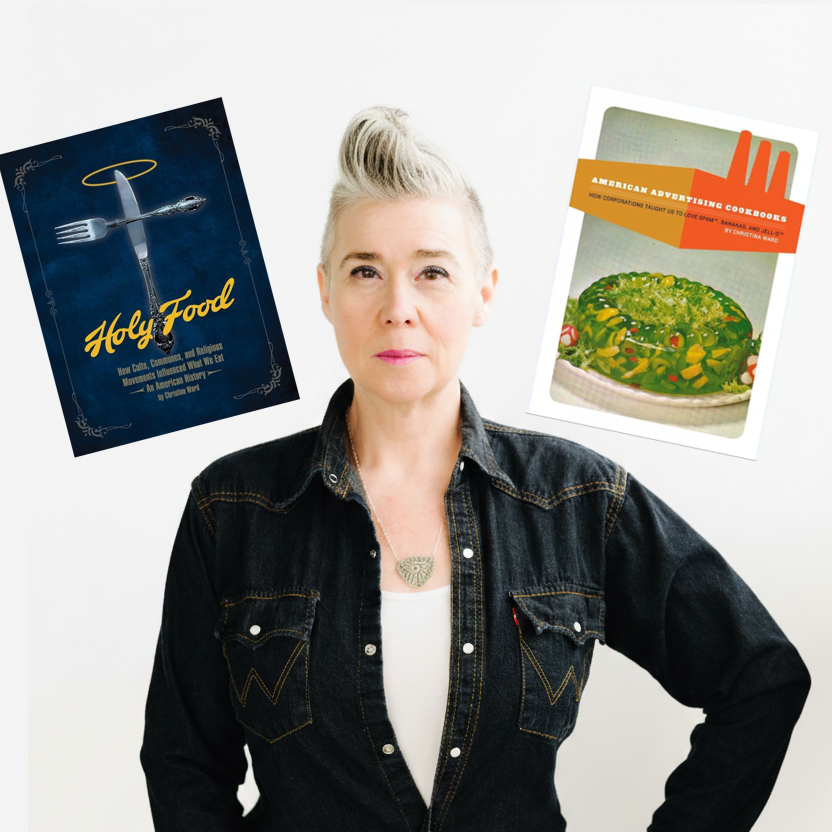
S05E20 – Cults, Corps, and the Culinary with Christina Ward
We’re joined by Christina Ward of Feral House publishing to talk about the intersection of food, culture, belief, control, and the weird as she tells us about two of her recent projects:
American Advertising Cookbooks and Holy Food.
SEO Transcript
This is not a fully accurate transcript, and was machine generated. It’s here for helping search engines find the episode but not intended to be a faithful transcript of the episode. (But it’s not AWFUL.) Some of the material in this transcript only exists in the Patreon/Premium edition of the show and was excised for the commercial version.
———————
Monster House presents.
This is the ad-supported version of Monster Talk.
We’re dependent upon the revenue from these ads and from the support of our patrons at patreon.com forward slash monster talk to continue making this show.
As a disclaimer, your hosts are unable to control what ads you will hear.
And while we have done what we can to avoid ads that are divisive, the system that injects them sometimes ignores our preferences and always seems to ignore our efforts to not interrupt the conversational flow.
While we understand this can be disruptive, we’re trying our best.
Patreon remains the best way to enjoy commercial-free listening to our content, plus you generally get extended coverage of the subject.
We’re working on other ways to consume our content as well, so please stay tuned.
It’s actually quite unlike anything we’ve ever seen before.
A giant hairy creature, part ape, part man.
In Loch Ness, a 24 mile long bottomless lake in the highlands of Scotland.
It’s a creature known as the Loch Ness Monster.
Monster Talk.
Welcome to Monster Talk, the science show about monsters.
I’m Blake Smith.
And I’m Karen Stollznow.
I dreamt it was 1975 and I was…
wandering through a suburban house where a celebration was being assembled with the collective energy of ritual.
The carpet had fresh vacuum lines.
A few brave scented candles were trying to exercise the pervasive ghosts of cigarettes.
Somewhere, a TV murmured low and constant, canned laughter and tinny music.
A hymnal to American entertainment.
On the dining table, a spread meant to say welcome.
Meats and crackers, dips and vegetables.
A bubbling fizzy punch that promised sweetness and afterburn.
Comfort food.
Food as hospitality, as performance, as right.
And then, something quivered at the far end of the table.
In dreams, you don’t always get to look away.
The scene unfolds at the mercy of a hidden director.
I wanted to return to the familiar geometry of cubes of cheese and rounds of meat, but the thing at the end of the table seemed to glow with an unnatural light of greens and yellows, a fluorescent sheen that belonged more to a lab than a living room.
It was a gelatinous presence.
At first it seemed to look back at me, a mass of floating eyeballs and entrails.
No, not eyes and not organs either.
Olives.
The red pupils merely pimentos.
And then a second awareness arrived, a revelation worse than the first.
Was that meat suspended in there too?
And marshmallows?
And savory vegetables commingled with sweet fruits?
No.
These ingredients were unhinged, flavors and textures never meant to mingle, now hung in a translucent, quivering suspension, waiting to go wriggling down the mouths of dear friends.
And that’s where our episode begins.
Not with a monster exactly, but with a familiar Monster Talk question.
Why does something common become uncanny?
Tonight, we’re talking with food historian and publisher Christina Ward about mid-century American food culture, the corporate and religious forces that shaped it, and the way that meals become more than nourishment.
She’s brought two books with her to help us think about what we eat and how it’s shaped by collective trends, economic efforts, marketing, belief.
These books are American Advertising Cookbooks and Holy Food.
And along the way, we’ll brush up against some of the strange borderlands where cuisine becomes symbolism, symbolism becomes obligation, and the dinner table starts to look, just for a moment, like some kind of altar.
Monster Talk
So who are you, Christina?
Who am I?
My name is Christina Ward.
I am a proud Wisconsinite.
I come from the land of the frozen tundra and cannibal sandwiches, i.e.
raw beef and onion sandwiches.
fish fries, and cheese curds.
But aside from that, I’m a food historian, as well as a writer and a master food preserver.
So I make lots of jams and jellies and pickles.
And I run a small independent publishing company that’s been around for a long time.
And it’s called Ferrell House.
And so we publish books that are nonfiction, that are investigative.
weird, fun, counterculture, some older pop culture, some memoirs, some biography and music books.
So that’s our channel.
That’s what we do.
And I just keep the little circus going.
A friend of mine described it as the entire Muppet show with just one puppeteer.
I’m Statler and Waldorf.
Well, Christina, we brought you on the show because I was looking for someone who could talk to us about monstrous foods.
So I think we often see a lot of those memes getting around on social media about different kinds of…
various meats in aspic and gelatin and jello and things like that.
And we’re all horrified and disgusted by them.
But it appears that these were quite fashionable and popular in the Western world during the 60s and 70s.
But it’s such an interesting topic.
And I think there’s a lot of overlap with the things that we like to talk about.
And then we met you and we came across two of your books.
So Holy Food and American Advertising Cookbooks.
And both of them, I think, really epitomize what we were wanting to discuss on the show.
So we’re really excited to be able to chat with you today.
Well, thank you.
So your two books explore very different forces that shape American food culture.
So religion and corporations, but maybe they are more similar than different in many ways too.
But what first drew you to investigate food through these particular lenses?
I have a joint love of this trifecta of weirdness, American history, and food.
And so I love it when I can bring it all together.
And so I look at things and historical things and…
In the sense of like what a micro history, because I think that you can tell a big story by focusing on the small parts of it.
And that’s where that to me became really interesting of always, you know, wanting to know facts and wanting to know stuff.
And growing up as a hungry kid, I’m a working class kid and wondering why were we eating boxed macaroni and cheese?
But if I went to the friend’s house, you know, they actually had pot roast.
What’s the difference?
How does this all happen?
And from even from childhood on, so that lifelong fascination of why.
Why is the thing the way it is?
Has really led me down to some really interesting pathways of my own research and work.
And the book you mentioned earlier, American Advertising Cookbooks, came out in 2019.
And that was, again, at a time that you mentioned, Karen, people were kind of rediscovering and seeing on the Internet the pictures of…
like green jello with like carrots and tuna fish in it and going, eww, because they didn’t know the history.
And everybody makes a fundamental error of looking at that green jello with vegetables or meat in it and thinking it’s lime.
It’s not though.
It’s celery flavored Jell-O.
And so now it gets, it kind of recasts of like, oh, wait a second.
The thing isn’t what I thought it was.
It’s something different.
And I think, and that’s where the great stories are.
I grew up with a great aunt who made a green Jell-O.
I never really cared for it, but it was a family.
Well, I don’t know if it was a family classic.
She always made it, you know, but it had I remember it had pecans and some other things in it.
It was a very crunchy.
It was a savory jello.
I think maybe that’s why it disappointed me.
It looked like it was going to be sweet and it was not.
By the way, these books are full of fascinating facts and history.
And photographs.
And photographs and some recipes.
But you cover this material very respectfully.
So while it’s not exactly a cookbook, it’s not really a kook book either.
So I thought that was well done.
In Holy Food, you uncover how spiritual beliefs and movements influence what people eat, which I think, if you look at at least the Abrahamic religions, is an old thing.
But it affects cults and new religious movements and other things.
Can you talk about some of the examples of…
food traditions from various religions that people will find when they get your book?
Yeah, absolutely.
I mentioned one already.
Coming from the Great Lakes region is fish fries.
Fish fries were born out of, one, the Great Lakes, and two, the Catholic prohibition on…
eating meat on Fridays during, especially during Lent.
And so traditionally that’s where a lot of churches as fundraisers would have like fish fries in their basement to help, you know, raise money and feed the congregation.
And if you’re in the Midwest, then all the bars started doing it.
But the real revolution was in Buffalo, New York, when…
McDonald’s franchisee noticed all his burger sales were falling off in a very Catholic Buffalo.
And he introduced what was to become the Filet-O-Fish sandwich.
McDonald’s corporate was against it, but he went forward and he proved that this was a very successful thing.
Again, is still permanently on the menu.
So that’s just like one small example of, so this, you know,
Early 1900s Catholic tradition and belief of not eating meat leads you to the Filet-O-Fish.
Now, Holy Food really talks about some of the more newer modern religious movements.
And I mean that is it’s only in America, kids, you know, where we don’t have state religions.
We’ve got sort of the First Amendment.
And so people started taking ideas, what they thought about their gods.
and inventing new ones or changing what the religious practices were.
And in that soup is a thousand other new religious movements.
And some of them we don’t even really know too much about today because they only lasted maybe a few years.
But the ones that lasted for a few generations really did influence the American food systems.
Well, I’d like to just get some clarification on fish fries, if you don’t mind.
I grew up in Australia.
And so when you say fish fries, I think of two things.
I think of fish fingers that you might call fish sticks here.
And I also think of the fries where you go to some countries like…
maybe in Barbados and or even in, I think, Florida, where you can fish or buy fish and then take it to a place and they fry it up for you.
So I’m assuming you’re talking about something more along the lines of fish sticks.
I’m talking more along the lines that I guess the most.
analogous food would be like a British-style fish and chips.
So it’s a battered, deep-fried, a lot of times it’s cod, and it’s served with potato pancake, applesauce, coleslaw, rye bread, and butter.
That is the tradition.
But in the Great Lakes, we had an abundance of fish.
So a lot of times you saw bluegill, walleye.
Perch was really popular in the Great Lakes before it really fished out.
You’re seeing it come back a bit.
But that is where that tradition.
So bringing the Catholic prohibition on meat and then knowing what we know about, you know, English fish and chips.
It comes to the United States, gets twisted around and becomes a staple.
I’d like to add, too, that growing up in Australia, we had lots of fish and chips, so just like the English.
And often we’d get a particular kind of fish called flake and only come to find out years later that it’s shark.
So I don’t know if they still sell that.
I think they call it lemon fish in New Zealand.
But, yeah, it’s interesting, just the variations on a theme, I guess.
And that, I think, to me is always so fascinating, whether you’re talking about religiously inspired food or even the corporate inspired stuff of like, what sticks?
How does it spread?
Because if something tastes good, everybody is willing to try it.
And so many of those, the ideas that then get married to what the food and what we’re eating and the culture that comes around it.
Thinking back, we just talk about like kind of fish and chips, as you’re saying, it morphs in different regions, what kind of fish is being used.
But also what’s similar is that idea of communal eating together.
So, yes, restaurants, but it started in, you know.
pubs and then church basements and then bars.
And so, again, these ideas of sharing food together also has a really interesting place in how we decide what we’re going to eat and what we believe.
Your advertising, American Advertising Cookbook, I’m holding this up.
It reminds me so much.
I had a dear friend named Leo Linkort who used to blog.
these strange 1970s cookbook.
I am so sad that he’s dead all the time, but especially I think he would have absolutely have loved this book.
It’s full of just heartbreakingly gut-wrenching photos.
Well, I think what’s really interesting, too, is it seems like everything old is new again.
You’ve got this whole section on avocados and avocado ice cream, and that’s…
kind of popular again nowadays, especially with Asian communities.
Our entire kitchen was done in avocado.
Nice and 70s.
Really was.
I was going to ask, though, how did marketing strategies change what might have been like a novelty, like a jello or a spam into like a staple of American dining for a while?
And really, it’s the story of the innovation of technologies in the 1900s.
Paper is cheap to produce.
It’s cheaper.
Printing presses are becoming are automated.
You can print things for so much cheaper.
So by the time you get to like the 1910s, 1920s, businesses that are, you know, in the food business are able to advertise differently.
There’s more magazines.
So there’s a need for writing about food for ads.
You need to have like Susie Homemaker, right?
recommending recipes.
So this whole ecosystem starts developing around automation, technology, and cheap paper.
And one of the first ones, the Hellman’s company was one of the first to kind of come up with this idea of a recipe booklet.
And it’s such an easy, brilliant idea of this booklet of if you’re going to sell a product to someone, teach them how to use it.
And in the early 1900s, you’re getting you mentioned avocados and your bananas.
And a lot of these foods were exotic.
And so we needed to be taught to eat them.
And one of my favorite illustrations in the world is from a very early United Fruit bananas cookbook where there’s a great little cartoon showing somebody trying to eat a banana with the skin on it because you didn’t know that you were supposed to peel it unless someone tells you.
Right.
If you think about it.
I had the same problem.
Yeah.
So it’s like you have to approach it with the child mind and then you go.
And so these cookbooks were very much instructional.
And this notion, again, of anybody who likes cookbooks, if you see these recipes presented, you’re like, well, I have to cook every day.
for, you know, my family.
It’s getting boring.
That looks interesting.
I’m going to try the infamous ham and bananas with hollandaise sauce.
And, you know, that’s like one of the more popular internet ones that people go like, oh, yeah, yeah, yeah.
Who could eat that?
But what’s really fascinating is that particular dish has roots in traditional Caribbean cuisine, because if you think about roasted pork and plantains, right, a little different.
And then it comes to the United States to the marketers and the marketers like, well, we’re not selling plantains, we’re selling bananas, you know.
People aren’t going to roast a whole pork, but they’ll eat ham.
And so you see there’s a whole cadre of people doing recipe development, figuring out specifically how to use these ingredients so they can sell more stuff.
You remind me, my husband and I were at Target yesterday and we were buying a plantain.
They couldn’t find the code for it.
So they just, the person thought it was a banana and just put it through as a banana.
Very unripe.
If anybody’s ever eaten a plantain thinking it was a banana, they’re in for a bit of a surprise.
Absolutely.
Both books involve a fair amount of historical research.
So you’ve done a marvellous job with these books.
And how did you go about finding and interpreting these old recipes and obscure food histories?
And did you come across any unexpected discoveries?
Lots, lots of great unexpected discoveries throughout researching through both books.
And part of that is I’ve always been interested in food and working in food.
And anybody who’s spent time in kitchens, whether it’s your home kitchen or even commercial kitchens, is you start to understand the chemistry and the science of cooking of flavor profiles and things go together.
Once you have a working understanding of that, in addition to like knowing how to research things and historians.
it starts making sense about the origin of recipes and where they come from and then which direction they can go.
So in doing that, if you can look at, like I gave the example of the bananas hollandaise, is you can, if you know the history and how the components, you can trace it back to where its source was.
So reversing that, one of my favorite discoveries that I didn’t know, and this is a childhood hated thing.
is our neighbors always would make for after-school snack, invite all the kids over, and the mom always made peanut butter and mayonnaise sandwiches.
I don’t know if anybody’s been subjected to that.
It’s disgusting.
It’s horrible.
I’m nodding in agreement.
And it was like, who thought of that?
Who thought of that?
And of course, I find out in this course of like doing the research and looking at all these old cookbooks.
And there it is.
The first time I see the recipe, the suggestion for peanut butter and mayonnaise.
And it was Jif.
Jif did it.
Wow.
Those jerks.
Goodness gracious.
Yeah.
And so that was, to me, a big discovery in that idea of like, wow, OK, how much autonomy and choices do we really have?
How much are we really choosing what we eat or how much of it is really chosen for us?
That is a beautiful segue into my next question, which is.
I think religions famously tend to restrict people’s behaviors.
And I think something that critics would say maybe is a bug, but some people might see it as a feature.
I don’t know.
But they give you strictures against dancing and music and some ideas against sex, how you do it, all these sort of things.
But there’s food laws.
There’s food laws.
You’ve got kosher, halal, vegetarianism.
Can you talk about how…
These prescriptive morality rules affect food around.
Well, I guess we’re mostly focusing on America, but just how religions and religious practices control what we eat.
Yeah.
You know, it’s interesting if you go back to when you mentioned the Abrahamic religions, which are kind of, you know, share the the Judea.
Judaic kind of origin story and share like the kosher and halal are very close in those food rules.
And if you follow the kashrut, the kosher rules, you would be very safe.
You would not be likely to get foodborne illnesses.
And so if you go back that way and think about what’s going to keep your community safe,
Some of those rules would definitely keep you safe.
And people always say like, well, don’t eat pork.
It’s filthy.
And we have to think about it differently.
It’s not filthy because they like mud.
They are very prone to pathogens that kind of coexist in a pig’s ecosystem with very little detriment to the pig.
But if someone else is going to eat that pig, you are going to get very sick.
So people before germ theory, well, just don’t eat that.
And so as these rules get codified into a culture, into a community, and then into a religious practice, they’re usually, and again, those form ones are there to keep your community safe as well as cohesive.
How do you tell another member of the tribe?
Well…
You’re not eating bacon.
You’re not.
And so some of those shared cultural experiences help form that community, that shared practice.
Now, you extrapolate that out and it comes back to we’re talking about like Buddhism and the variety.
I’ll call I’ll say Hinduism as the shorthand, knowing that it is a beautiful thousands of different beliefs that kind of the British called Hinduism.
But there are some core beliefs there of like the ahisma that do no harm.
A lot of in the Indian subcontinent, a lot of just their existence and religious practices are about doing no harm.
And that goes apply to animals.
And if you’re a Jain, a Jain monk applies to plants, plants.
You can only eat foods that are essentially not going to harm a plant.
So you can’t eat a carrot because it would kill the carrot.
You can eat an apple because the tree is giving it to you.
It won’t harm the tree.
So some of these rules come about because of belief.
And then other ones, the food itself shapes the belief.
So now, so we come to that big picture of that.
And you bring it back to the States now.
And food then becomes a really great way to build your followers, right?
And to share that belief.
The SDA, the Seventh Day Adventists, some of the healthiest people on the planet.
When they do like the blue zone studies about who’s the healthiest, it’s always Seventh-day Adventists.
Why?
Because they’re vegetarians and have been forever and most often vegan.
And they also published many, many cookbooks for twofold reasons.
And this comes to like in the United States and the cookbook convergence is.
It’s a recruiting tool for people to join your belief, and it’s also a way to help new believers adopt the practices.
And so this all converges together when it comes to the United States.
But you start off saying, what do those food rules do?
It keeps people safe in many instances.
It builds community, and it oftentimes builds control.
And I believe I found a kindred spirit in you.
You’re vegetarian?
I am.
Yeah, wonderful.
So I grew up vegetarian.
My mum just came home one day when I was about eight and said, I’m not cooking meat anymore.
And she was trying to fix a thyroid condition that she had at the time.
So we all went vegetarian.
And so at the moment, I am…
vegan and gluten-free, have to be gluten-free.
And you mentioned Jainism too.
I was on a flight once too.
It’s really hard to find something that, to find airplane food that is vegan and gluten-free.
And so I thought I’ll try.
a Jane meal on a flight to Australia with Air Canada.
And we had so much confusion when a flight attendant brought over my food and I said, oh, I’m Jane.
And she said, no, this is for Karen.
But yeah, it’s really difficult to find a combination of both of those.
But getting back to food as a tool of identity and belonging in your research into religious food ways and corporate.
cookbooks.
What patterns did you see in how food builds and can also manipulate community?
A lot of the times it can build community because of the shared preparation practice as well.
I’m thinking as soon when you were asking that, Karen, I was thinking about two different groups, is if you look at the Church of the Latter-day Saints, Mormons,
is they have a very robust community built around shared foods, storing food for disaster.
They’re very big on the prepper community and always have been since the 1800s.
You’ll have to have a year’s worth of food.
If your family is somehow incapacitated in some way, your neighbors are all going to help you to make sure that you have your food and you’re prepared.
um there’s a tradition of like community canning where people are the communities in the latter-day saint communities are always working together to build their food supply so again that’s the community building now conversely as a form of control
You see a lot of that with more of the modern American, what we would definitely term as a cult.
And I’m going to be very careful and say cult is a group that is definitely following like Hassan’s like bite model, that they’re controlling what you think.
They’re controlling your emotions.
They’re controlling your physical, like where you can go, what you can dress like some, and they’re controlling what you think.
Wait a minute.
My wife has put me in a cult.
I just realized it.
Some cults are happy cults.
It’s just me and her.
Well, maybe if she starts cooking and inviting people over, she might be expanding the cult.
When she cooks, there is definitely some behavior control going on there because I will do a lot.
Lucky she doesn’t listen to the show.
You have a podcast?
That’s my wife, right?
Yeah.
And so, and this was where it becomes monstrous, especially of withholding food.
That is a very popular thing.
And also hierarchies of food in high control cultish groups is the, you’ll see, I can tell you, I spoke and interviewed probably, you know, people who survived Jonestown, as well as a few people.
I talked to the son of Jim Jones Cook,
And she died with his sisters at Guyana at Jonestown.
And then I also talked to Jones’s former son-in-law.
And what to me was so interesting about that conversation, because they talked about food in two entirely different ways.
um because as his former son-in-law before they were exiled they were part of their elite the top they ate fantastic and they didn’t eat the same food that jones prohibited for the followers they ate whatever he wanted
Whereas the followers for sometimes he tried to take everybody vegetarian for a while.
It didn’t quite work out for a while.
He was on a liver kick that somehow liver was going to help you in some sort of healing properties.
And he was making people eat liver a couple of times a week.
And so that becomes then more the coercive control.
And then, of course, withholding food if people were behaving in the way that the leadership wanted is there definitely we hear this a lot.
I know you’re not supposed to say the word, but this in Scientology is if you’re not just your garden variety believer, but if you’re in that organization where you’re.
considered part of the kind of priesthood, so to speak, and working and living on the campuses is that there’s a lot of control through food.
You know, sometimes we get very concerned as sort of skeptical people about how people are being manipulated.
But there is…
There’s something powerful about sacrifice and about membership and identity.
And when you’re participating at the level of literally watching everything you eat, not from a health perspective, but from a behavior perspective, it gives you that sense of community.
And even as I grew up in an evangelical community, so when we had a get together, there was always food and it was always amazing.
And maybe that’s been one of the hardest things to give up from leaving the church has been that communal dining experience.
It’s just it’s really it’s quite a loss.
But I think that one of the universals is like Karen asked earlier about discoveries.
So most, and again, you can’t make too many generalities, but I can generalize about this, is most religious traditions, newer ones and older ones, have this idea of communal meals and about sharing.
And so if you go to a Sikh temple, there’s langar, you can go.
If you go to the Hare Krishna temple still, there’s always free lunch.
And well, they might charge a dollar now.
Good to hear.
And it’s good, too.
That’s my little asterisk to come back to the Hare Krishnas.
But also the church basement spaghetti dinners at the Catholic schools to, again, just as you’re talking about in evangelical communities of just the after church, after service, you know, potlucks.
Every community, every religious community has that idea.
And I think that that is more about being human.
um because there’s an act of trust if you think about just that idea of eating together um if i give you a cookie and you eat it that’s an act of trust because you don’t know if i gave you a poison cookie or not um and so in that act of trust is how we build communities seems like maybe that’s something that’s being lost in the internet world you you you get uber eats but you don’t get uber greets right
Right, right.
And I’ll go back to my Haris for a second.
I don’t know if anybody is a music fan or like punk rock.
One of my favorite like kind of little tidbits is in the New York City hardcore scene.
So we’re talking early 80s, the most like aggro hardcore punk rock.
All these guys, and it’s mostly guys, are dirt poor, living in squats.
And where they are is around the corner from the Hare Krishna temple.
So all these guys go and, you know, they get the free meals at the Hare Krishna’s.
Do they officially convert?
One does.
But many of the guys, if you talk to them today, and these are men now in their late 50s, early 60s, many of them are still vegetarians to this day.
And they also will use some of the Hare talk, not even consciously, but it’s just some of the phraseology is there.
And I think that’s fascinating.
And that to me is that larger influence.
Who would have thunk that, you know, the Hare Krishna temple down the Lower East Side would have that influence throughout hardcore punk rock music and starting in New York City and kind of spreading out to where, you know, you can make these through lines, this idea of like straight edge of veganism and stuff in punk rock.
kind of is rooted in the Hare Krishnas.
Not completely Hare Krishnas, just a lentil bit.
I love lentils.
We’ve got a local ashram and we go occasionally.
I went years ago for a book I was researching, God Bless America.
And yeah, we occasionally go back because…
of our diets.
And you do see a lot of people in low, lower socioeconomic groups.
So you’ve got to sit through a sermon, but there’s fantastic music as well.
And you just get people, it’s a real melting pot of people, not just Hare Krishnas.
And I’m a big fan of George Harrison too, but the food is fantastic.
Definitely recommend it to anyone.
And just to
have a different experience and go see a different culture and different religion and absorb it.
And absorb it because I think what most people, if you walk away with, again, the majority of these new religious movements, unless it’s a cult, is that it’s community.
People are building community and they’re building community.
And the best one of the better ways to do that is around food.
This American Advertising Cookbook, and you sort of talked about this with Jell-O and with how corporations have given people guidelines or basically an
Well, an entree into how to use their products.
I’m thinking here.
Books and cookbooks.
In fact, my wife and among her many cookbooks, she her family was from the Rochester area and the Rochester Electrical Company had a the electric company had a cookbook.
And I suspect it was like built by employees.
But it became like some of those recipes became staples.
And I see on eBay people trying to buy the cookbook so they can recreate those recipes.
And in your holy food.
book, you’ve actually included some updated recipes from these religious groups.
Can you talk a little bit about what did you have to do to make those accessible to the modern reader?
So we wanted to test them.
And luckily, the pandemic happened.
I try to look for that.
Something we hear all the time.
Recipe testing can be a bear.
And so all of a sudden, everybody’s at home.
And of course, I know a lot of people, both really good home cooks and professional chefs as well.
And everybody’s stuck at home.
And so it was great.
So we worked, friends worked together, testing everything out and finding out where the fail points were.
If you’re looking at a recipe from the 1800s, obviously, we’re not cooking on wood stoves anymore.
So you need to adjust things.
And so we were able to through testing to update them for modern cooks.
And that was really the only modernization.
So I didn’t change any flavor profiles or anything like that.
We just made it a little easier to for a modern cook and recognizing what some of the available ingredients are today versus what it would have been, you know, in the 1800s.
But, and I purposely to I’m going to say this is in our testing, we only, you know, everybody weighed in there were a couple terrible recipes like they look good on paper but when we made them they were, they were awful.
And so I only included the recipes that actually would taste good.
Because I think that came out of my experience from working with American advertising cookbooks, which is where the food is monstrous and disgusting looking.
And that would be easy to make fun of because you’re talking about religion, too.
People will often mock religion.
So I didn’t want to set the food up to fail.
You know what I mean?
So to have things to say, OK, here’s a horrible group, but that dish is delicious.
I think I.
First of all, I know you come from the zine scene to some extent.
A little bit, yeah.
And then we talked about magazines as well, like professional magazines and books.
And I think we’ve already talked about we’re book lovers here.
But it seems like…
YouTube and the Internet, especially YouTube, is really sucking all the air out of that kind of that ecosystem.
And I think my wife, first of all, I think it’s hard to get a recipe from a video.
I hate that.
And.
I guess the upside is you can go to the comments and see, are people actually trying the recipe?
Do they like it?
Are you doing anything internet-wise to give people that connection to the book when it’s a food-related book where people are going to try things out and give feedback on it?
No.
I am a book person.
Me too.
I will defend material culture.
YouTube videos can be helpful if you’re reviewing and you’re not sure on a step or something.
But I do think that there’s a value in a cookbook and actually have it printed and having it in front of you and being able to reference it, being able to write in the book and make your own notes and how you do it.
Did your own adjustments.
It’s a living document.
It’s a living document.
Some of the best recipes I picked up for a holy food and picking up some of these like cult cookbooks.
Some of my favorites were the ones that had notes in them, you know, and one I found from the Yogi Bajon group, the three HO they had, it was a great old book.
Their old golden temple cookbook actually had a pressed marijuana leaf between the pages and,
Wow.
How appropriate, right?
A real buddy.
You’re not going to see that on YouTube.
You’re not going to, you know, you’re not going to get that kind of the extra that the, we talked about, you were talking about passing on recipes too, is, you know, now it’s a living document.
It’s a thing.
It gets passed along and, you know, you can change it.
And a YouTube video doesn’t do that same thing.
You’re reminding me about going to my grandmother’s house as a kid and having to copy out recipes for things like cauliflower or gratin from the Common Sense Cookbook.
That was a popular one.
Cauliflower cheese is still a good, good dish.
Anything with cheese.
Yeah.
But I think that’s the thing that’s passed down.
And one of my fun facts about American advertising cookbooks is we’re so far away from when it began that…
My grandmother was born, my paternal grandmother was born in 1911.
And I can go back and I remember my great grandfather who was actually served in the end of the Civil War.
So that’s a different lifespan than if you think about today, we don’t often have touch with people who actually cooked from scratch or had food.
like just an isolated ethnic recipe experience because we’re such a global diversified community.
So that being said, when you look at these old cookbooks, people are starting to realize that grandma’s favorite salad or the thing that Auntie Fanny made all the time wasn’t really her invention.
What it was was something that was picked up in one of these very popular…
corporate cookbooks and then kind of just became a favorite and passed along so that that’s the big rude awakening for people if they start really looking at their favorite family recipes they should track it back because that may not be an original family recipe but it might be from campbell’s wow
I want to say thank you for putting an index in the book.
Also, because when I got the holy food, the first thing I wanted to find out was, did you cover sin eaters?
I just just as you know, it’s monster talk.
And that that fits right into that sort of folk horror.
It’s I mean, it’s a serious religious practice.
But also, I was wondering, did you talk about it?
So thank you for including that.
It’s not a big part of the book.
But did you want to mention that?
Or do you want to talk about that at all?
Oh, I’m happy to talk about it.
I think, you know, and that was the biggest challenge for me with the working on the Holy Food book is I was like, and then another thing and another thing.
And so it was a real exercise in scope and keeping the scope.
And so a lot of the early practices I kind of just glossed on a little bit because we’re going to focus on what was happening in modernity in the United States.
So that being said, sin eaters, I love it.
It was such a great, weird practice in earlier days of Christianity when the notion of transference of sins.
So, you know, you even hear some of that phraseology today, the sins of the father passed on, which is kind of a ridiculous notion.
But so the converse of that is coming out of it’s coming out of a Protestant tradition, but with its origination in Catholicism, where this notion you could be forgiven.
for your sins.
And again, then earlier in the Jewish tradition of atonement.
And so Catholics took it as this idea of like a confession.
You can be confessed to your sins and be absolved.
The Protestant break.
they didn’t take that so much with them.
And so there was a necessary way, how are we going to essentially absolve someone from their sins so they can get to heaven?
And so in Wales, and especially in the West of England is where this really kind of started-ish, and then it spreads to in Germany and in Holland, you’ll see that there are small variations, but similar notion behind it of…
If we can, like a transubstantiation, if God can enter the host and become the living bread and the bread and the wine and the blood and body of Christ, cannot the reverse happen?
And that’s the idea of the sin eating.
So can we take a physical thing and transfer someone’s sins to the thing and then have them ceremonially consumed in a way that absolves the sinner?
And that’s essentially the death cake.
The death cake, the honey cake, the sin eater, the sin cake.
And the sin eater specifically in, again, Western England and Wales was a designated mourner, essentially.
And every culture has a form of someone like this in the small community.
Someone who is essentially like the village scapegoat.
And the sin eater would be the one person in charge.
And they were…
usually, again, lived near the cemeteries, lived on kind of a little bit of an outsider on the outskirts of the community, but was definitely a part of the community and was called in at times to, you know, essentially perform this ritual act of eating the sins of the someone who died.
Were they stigmatized or did people think, oh, they’re going to hell for this or no judgments?
No, no.
And it was but it was always a bit of an outsider of the community.
So I wouldn’t say that I’m struggling a little bit because I’m trying to find the right analogy to say that someone who’s like the necessary, a garbage man, if you will, someone in the community needed.
It was very much a functioning part of the community, but was a little bit like looked down upon because they were doing the filthy job, if that makes sense.
So not completely ostracized, but not essentially at the upper echelons of society.
That is fascinating.
It shows up in so many horror stories and that concept because it’s kind of it’s Christian, but fringe folky, kind of like it feels like it’s not like it’s not part of like most mainstream versions of Christianity.
But but yet it’s well known and has persisted.
So and it has to do with food.
So I felt like I had to ask.
So, yeah.
And again, I love how this gets diffused.
So I give you, there’s the dark origin.
But in Bavaria, they celebrate, they make death cakes.
And it’s like a really lovely chocolate cake.
And so oftentimes it was placed on the corpse’s chest before pre-funeral homes, when if you died, you were laid out at home.
Not to be confused with a few more potatoes, which is very different.
Very different.
Death by chocolate.
Yeah.
And so, you know, they have this cake.
And then people would, again, it’s very much about ritual and ceremony.
Because then we get to touch on cannibalism a little bit too, right?
Because if you look at many early cultures looked at the consuming human flesh, the flesh of the enemy or an elder.
is you either you’re consuming that power that person had, you’re consuming the wisdom that person had.
And so that, again, influences that notion of what does death actually mean?
What are we putting in our bodies actually and then symbolically?
And so in old New York culture, that idea of the death cake was a death cook and it was a cookie.
And it became a commemorative thing.
And so when you, people in like the old duchies in New York, the cookie was very elaborate of very kind of a shortbread hard cookie.
And it was stamped with like the name of the person who died and their death date.
And it was this commemorative thing.
And again, people would save them, but the intention was it was eaten in memory.
It’s a, it’s so, so we get all these different variations on how we associate different,
Mostly sweets with someone dying and again sin eaters to death cakes to death cookies.
There’s a lot of variations but they all come down to this cannibalistic notion of by eating a portion of the person that we can either remember or absolve ourselves and absolve them.
Christina, you were talking about just having a wealth of information and having to decide what to include and what to discard.
And that leads me to ask, you’re always working on something cool.
What are you working on right now?
What I’ve been doing now is, again, putting the publisher hat back on and just really busy and working with writers and editing a lot of books.
But for myself, again, as a cookbook collector, there is always great information within those cookbooks.
So I have two different lines of where I’ve been going and following, and I’m not sure which one’s going to take more precedence.
It always depends where the research leads.
So that being said, and Blake, you mentioned about the church cookbooks, right?
Alongside advertising cookbooks, it was the idea of the community cookbook.
What is the community?
And there’s some funky communities that put some cookbooks out there.
So I’ve been collecting and researching there.
So there might be something along the lines of the church community cookbooks.
And the other fascination, and I have a large collection of them, is the notion of the celebrity cookbook.
And so, you know, there’s something going to be in that direction of the notion of what is the celebrity cookbook?
What makes that different?
What makes people want to care what Vincent Price was cooking for dinner?
Great example.
Yeah, yeah.
But Vincent and Mary were famous.
They published a number of cookbooks.
They were consummate hosts.
People, you know, getting invited to dinner at Vincent and Mary’s house was something to be coveted.
But why, if we’re not in their official friend circle, why are we interested?
Why?
Do we care what Zazu Pitts made for her candy?
Or Sophia Loren’s tiramisu recipe?
Which, by the way, is really actually a good recipe.
And then where’s that differential between, is it a celebrity who loves food and is actually a really good cook?
Or is it just another vehicle for marketing their image?
And so now you ask the question, Karen, you could see I’m in the midst of all the thinking and the research and kind of doing that.
So I think the celebrities might win out over the churches at this point.
My wife caught me before the interview and insisted that I ask this.
My wife wanted to know if you got stuck with one of the cult or religious groups that is in the book.
Who would you want to dine with?
Who among them has the goods?
I can tell you that the group is kind of faded a bit since the death of Yogi Bhajan.
But the 3HO organization, again, the inventor of kettle potato chips.
Right.
Yeah.
Their, their restaurants, their cookbooks, solid all the way.
If I had to get stuck, I’d want to be stuck with the three HOs because they solid, great, great food, really great, mostly vegetarian.
They had a couple of fishy things, but mostly vegetarian, all really solid.
And as a yoga cult.
It was, you know, fairly benign that way.
I’m not saying they were great people or Yogi Bhajan was a great guy because he wasn’t.
But for your everyday cultist, you know, you were going to eat pretty well and not be too mistreated if you were with the three HOs.
Well, they’re flexible.
That’s pretty flexible.
Baharis would be number two based on food alone.
Wow.
I’m with you there.
Yeah.
Well, now I get to ask our true signature question, and that is, Christina, what’s your favourite monster?
I am a proud Wisconsinite and I love our hoedag so much.
Okay.
Northern Wisconsin’s hoedag.
It’s a weird little creepy monster and, you know, team hoedag.
It’s very regional.
It is.
Yeah.
And I don’t think we’ve had that answer before.
I don’t think we have.
We’ve talked about the hoedag before as a community construct, but…
That was a favorite.
Yeah.
So there you go.
That’s fantastic.
Well, thank you so much for taking the time to talk with us and for these beautiful books.
Thank you.
It’s so much fun.
You can see, I get excited.
I love talking about all this weird food stuff.
Thank you so much for talking.
Yeah.
Thank you.
This was wonderful.
And I think our listeners are really going to love this one.
Have a good night.
Good night.
Good night, Karen.
Bye.
Monster Talk.
You’ve been listening to Monster Talk, the science show about monsters.
I’m Blake Smith.
And I’m Karen Stollznow.
You just heard an interview with author and publisher Christina Ward about two of her recent books, American Advertising Cookbooks and Holy Food.
Links to those books and to Ferrell House Publishing’s catalog are in the show notes.
Monster Talks theme music is by Pete Stealing Monkeys.
Hey, we could really use some new reviews at iTunes or wherever you listen to us.
And if you have a moment to give us a five-star rating or write a positive review, it will really help us reach new listeners.
Thank you.
This has been a Monster House presentation.