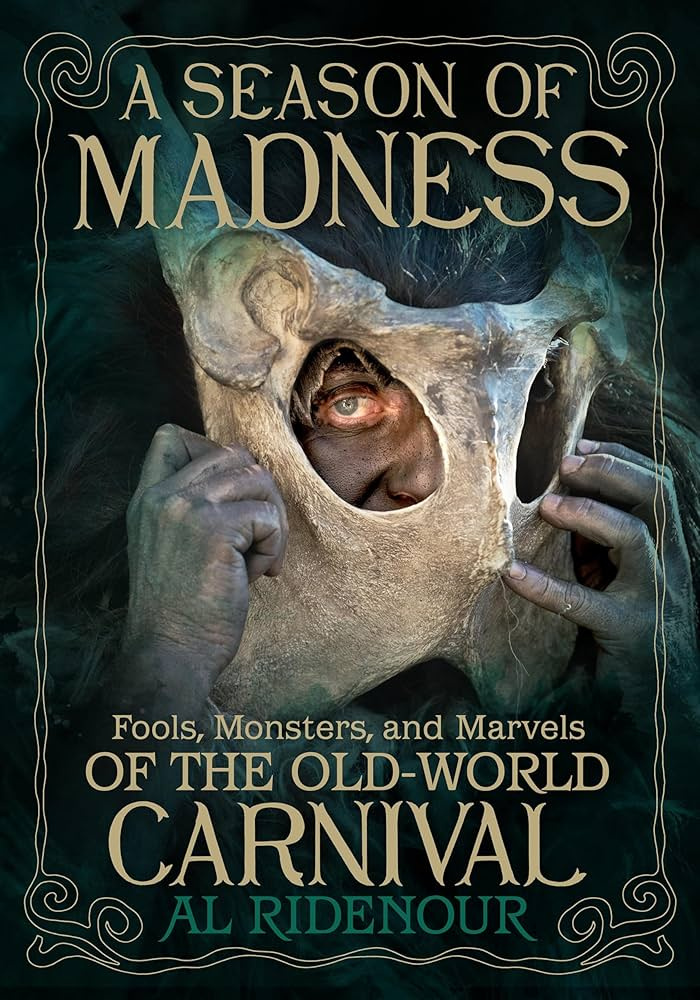
S05E19: A Season of Madness – Old World Carnival with Al Ridenour
Host of Bone & Sickle,Al Ridenour joins us to talk about the traditions of European Carnival season. It’s the subject of his latest book, A Season of Madness.


Author Al Ridenour (right) with masked carnival figure.

SEO Transcript
This is not a fully accurate transcript, and was machine generated. It’s here for helping search engines find the episode but not intended to be a faithful transcript of the episode. (But it’s not AWFUL.) Some of the material in this transcript only exists in the Patreon/Premium edition of the show and was excised for the commercial version.
———————
Monster House presents…
This is the ad-supported version of Monster Talk.
We’re dependent upon the revenue from these ads and from the support of our patrons at patreon.com forward slash monster talk to continue making this show.
As a disclaimer, your hosts are unable to control what ads you will hear, and while we have done what we can to avoid ads that are divisive, the system that injects them sometimes ignores our preferences and always seems to ignore our efforts to not interrupt the conversational flow.
While we understand this can be disruptive, we’re trying our best.
Patreon remains the best way to enjoy commercial-free listening to our content.
Plus, you generally get extended coverage of the subject.
We’re working on other ways to consume our content as well, so please stay tuned.
It’s actually quite unlike anything we’ve ever seen before.
A giant hairy creature, part ape, part man.
In Loch Ness, a 24 mile long bottomless lake in the highlands of Scotland.
It’s a creature known as the Loch Ness Monster.
Monster Talk.
Welcome to Monster Talk, the science show about monsters.
I’m Blake Smith.
And I’m Karen Stollznow.
Well, it’s that season again.
The time of year when the veil between the mundane and the monstrous wears thin.
People are pulling on furs and masks and taking to the street to transform into frightening horned entities.
Well, they’ll be going door to door, performing time-honored rituals and extracting hospitality, usually in the form of rich, fattening food or strong spirits, from neighbors who are half terrified and half delighted, for tradition says you do not refuse the mask.
It’s a time of sanctioned chaos and license misrule, where the social order has slipped upside down and spirits and demons seem to roam the earth once more.
You might be looking at your calendar and thinking, are we doing a late October rerun?
Well, not quite.
Because while some of that sounds a bit like Halloween, I’m actually talking about the traditions of Old World Carnival.
Al Ridenour, author and host of the Bone and Sickle podcast, is here to tell us all about this fascinating season of madness.
Monster Talk.
We’re welcoming back Al Ridenour.
And Al is an author, cultural historian, and folklorist dedicated to the study of folk horror in the real world.
He’s probably best known for his 2016 book, The Krampus and the Old Dark Christmas, which is the only comprehensive English language study of that Alpine devil, and which helped ignite the American fascination with the figure.
And in his latest book, A Season of Madness, Feral House 2024,
Ridenour turns his attention from the wrongs of winter to the rights of spring, documenting the anarchic and often brutal traditions of European carnival.
And beyond his writing, he is the voice behind Bone and Sickle.
Well, he’s not the only voice, but he’s the main voice behind Bone and Sickle, the podcast, which is kind of an…
audio journey into the intersection of horror, history, and folklore.
And he has a background with the Cacophony Society, which I didn’t know before today.
Also with underground art.
And his work bridges the gap between the academic researcher and the macabre enthusiasm of a true fan.
Thank you so much.
That’s a wonderful introduction.
Oh, the missing voice on my show, my co-host is Sarah Chavez, but we call her Mrs. Carswell.
You know, what happened was I remembered that as I was reading it, and I thought, if I say Mrs. Carswell and don’t know her name, it’s going to be stupid.
So thank you for fixing that.
I think of her as Mrs. Carswell, so I don’t think that’s a problem.
Your book, A Season of Madness, deals with European traditions of carnival.
And I think it’s safe to say, I think this is safe to say, that most Americans think of carnival as either a traveling collection of rides run by shady characters or as something that happens in New Orleans.
And…
This may cause a long answer, but that’s OK. We have that kind of a podcast.
But what is Carnival in the European tradition?
I think in your book, you call it the old world tradition.
And how is that different from the American conception?
Well, the other thing that I think Americans think of is a Latin American carnival in South America, particularly.
Ah, yeah, Rio.
Yeah.
So the European carnival traditions involve more clothing to start than Latin American.
So everything you mentioned is something I’ve been dealing with.
First of all, the first people asking me about the freak shows and side shows I’m writing about, because I had to fight that for a long time when I told people about the book.
But yes, we have that idea of Carnival, which is actually based on the European festive season.
because the carnival shows were kind of, they would appear and then they’d disappear and come and go like the carnival season.
But I kind of focused in on old European traditions because the whole project grew out of my interest in the Krampus and the research I had done years ago on the Krampus.
I kept seeing stuff that I thought must be related, and I wanted to include it, but I couldn’t, and I realized, oh, but that’s later in the year, so it’s not related.
It’s also geographically distant.
And eventually I kind of started returning to some of that, and I realized, well, some of it I realized at the time, this is Carnival, but I didn’t know as much about Carnival as I wish I had, and so the book kind of grew out of this kind of…
pathological desire to research things to the very, very, very ends of the earth.
And monetizing your curiosity.
I have a friend who had actually gone to the Krampus Festival.
in Austria a couple of years ago.
And I really got the impression that it was very chaotic and crazy.
And that was borne out by some videos, some promo videos that you sent to us before we started the interview to give us a bit of a taste of this season of madness.
And so from the title of that book, it…
hints at this kind of structured riot and thinking about this too.
Years ago, I wrote about the Roman festival of Lupercalia with regards to fertility of all things.
And so it makes me think of that kind of thing as well.
So can you tell us about, I guess, the connection between the carnival season and historical festivals going back to ancient times and more recent times?
Well, the first three – my book is kind of one-third and two-third.
The first third is history and looking for origins.
And definitely there are connections to customs of the Roman Empire.
I –
From digging into it, it seems less Lupercalia and more the Callens celebrations.
Because the Callens was more white.
Lupercalia was strictly Roman.
It was celebrated in just that city.
But the Callens were celebrated…
Throughout the empire, throughout all the way from Spain up into France and Germany.
And I don’t think, not in Britain, but and then into the east too.
Okay.
So and it also was celebrated into the 10th century.
And Lupercalia had kind of been neglected for a few centuries, several centuries by that time.
So it seems and the descriptions we have talk about stuff that sounds very carnivalesque to us.
It talks about rowdy singing, satirical songs, people blocking their faces or covering themselves in straw.
And there’s definitely a sort of spirit of rebellion that you don’t quite see the same in the Rekelia.
The fertility stuff…
is not as present, but the rudeness is actually more of a feature.
The connection between fertility and carnival is something that I kind of had to fine-tune in my own thinking.
At first, I thought, oh, it’s…
Well, first, I live in Los Angeles.
So at first, I think spring is warm, but it’s not warm when carnival is celebrated.
And it’s not it’s sort of anticipating the coming of life and fecundity and all that.
But it’s not it’s not there yet.
So it’s it’s not the sort of sensual celebration that you would see in Latin America.
So and that kind of a culture thinking, too, obviously.
Right.
And no whipping of women.
Or maybe, I don’t know.
Well, I mean, hey, now.
I’m sorry, no what?
No whipping of women to make them more fertile.
Oh, well, yes.
I mean, that is…
There’s a lot of…
Okay, so what I’ve seen and what I’ve…
Some in person and some much on video is there’s definitely a subtext of men…
who are very often dressed as women, that is, unusually as witches, who sort of attack women.
It sort of seems like something that Freud would say is sublimated sexuality, but there’s lots of kind of grabbing women and throwing them around.
I think you’ve seen some of that on the video that I sent, throwing them in barrels or barrels that are spun around or wagons that are filled with straw.
It’s the same sort of thing you actually see in the Krampus tradition with the people disguised, young men disguised as Krampuses chasing women and smacking them.
That is similar.
Yeah, you have that connection.
I think what I’ve just learned is that the American Midway Carnival, these rides are a mechanized recreation of those old festival antics.
The Scrambler.
Yeah, you actually see there’s a very popular carnival.
I don’t know what to call it.
It’s not a float.
It’s something that’s dragged behind a wagon or horses in the old days.
Now, you know, a tractor or something like that.
But there’s, yes, there is a revolving wheel that people ride on.
And the gearing of it is a little obscure to me.
But the gears, as it rolls forward, spin the wheel around.
Something’s very visual.
You’d have to almost see it.
But they spin the wheel on two different axes.
And either a performer will ride in it or they’ll put a person on it.
But there’s also just sort of something that spins on the Y axis, I guess you would say, that people will be grabbed from the crowd.
Women, usually, will be thrown in.
It’s sort of like a centrifuge.
So, yeah, you’re actually onto something.
There are kind of mobile rides that are towed behind certain, like, tractors and wagons and so forth as well.
part of the early carnival.
And I think those date back to the 1700s.
It reminds me a little bit of kind of early punishments too.
I wonder if there’s a kind of reference to that there.
I mean, just breaking people in the wheel.
A fun punishment, I think.
I don’t know.
I don’t know.
A punishment.
A punishment.
I mean, carnival has fun with all the things we take seriously or dread or…
you know, have very fearful feelings about.
So being grabbed and dominated is something that happens.
You see what I was just describing.
But it’s also, it’s all done playfully.
And it’s kind of something that I think the participants can kind of have a positive experience of laughing off and saying, oh, well, that wasn’t real.
It’s like we have, you know, we have horror movies to experience that now.
And, you know,
But when Carnival started, there wasn’t such a thing.
So there was another way to kind of experience things that seemed threatening.
But again, laugh them off again.
I just wanted to follow up.
And you said playful.
I got a sense of danger with some of those videos.
And I showed my 10-year-old a video.
I said, do you want to go someday?
And he said, hell no.
So for our listeners, I sent Blake and Karen a video, which was the worst of the worst.
That’s not how I see it.
I see it as the most exciting and wild of the wild.
But it was different carnivals that have particularly chaotic, anarchic elements.
And one of them…
One of them I made, that was after I had written the book, one of them was the first carnival I realized I was missing and that I had to go, a bucket list.
I’ve been to a couple of carnivals, but not this one.
And it’s in Northern Italy.
It’s in the city of Tramina.
It’s called the Egetman Festival.
And I went there last year.
And yes, it’s pretty crazy.
There’s, let’s see, I got smeared with soot or grease and soot, which sort of my face is blacked.
And then I had, let’s see, well, definitely water thrown on me.
I had…
wheat chaff, I guess.
There was a wagon that came through town.
They were threshing wheat, so there was lots of that, and it was blown out through a fan on people.
I had wet laundry slung at me because there was another wagon that had washerwomen who were pretending to wash laundry, and they were throwing water and laundry on people.
There was another wagon that was staged as sort of a…
It was a fisherman’s wagon, so they had people dangling fishing poles off of it.
And so I was smacked by fish that were used as bait, hanging from their fishing poles.
And there was even a wagon that represented the local bike repair shop.
And these are all old traditions.
These go back to the 1800s at least, but I guess bike repair was the thing already back then.
Maybe this came along a little bit later probably.
And the bike repair shop was throwing bike wheels and tires, wheels, not as people.
But yes, it was it was pretty severe.
And there were also like explosions of feathers flying out.
Were these like factory made or were these bespoke?
Oh, dear.
Well, I’m going to ask my question.
So you mentioned wheat and I guess it’s no good if you’ve got celiac disease.
That was my immediate thought.
But are there actually any dangers to these carnivals and to these festivals?
Does anyone ever get harmed or are there ever any accidents that take place?
I think the people that live there know if they should go or not.
I think it’s sort of an inherited caution that you have if you grow up there.
The one in Trameen that I went to was not – I didn’t hear – there was no – and the hotel or person who ran the hotel was also a major participant.
He said that he never –
He doesn’t know Americans that have come before.
So there were not there.
I think there are people from Germany.
This is in northern Italy, but where they speak German.
So there are Germans there.
There are Austrians there.
People from other regions of Italy.
But I think it’s one of those if you know, you know things, I think.
And so people it’s that’s and that’s why I was excited about sharing it, because it’s not even, you know, if you Google, I want to go to Carnival in Europe, you would never find this.
And to me, just I think because I got excited about the chaos and the kind of crazy animalistic qualities of the Krampus, this is the kind of carnival that attracted me.
So as I said, that was like top of my bucket list and had to take care of that one.
I’d also gone to Venice and other carnivals, but this was one I was really, really excited about going to.
I’m thinking about what are the thematic ties?
between these kind of festivals and then horror culture.
And here I’m thinking about things like the influence of masks and that sort of thing.
But then I immediately went to, well, folk horror and how much the festivals you’re describing seem like something where it would be an Eli Roth film and someone goes to a festival and things get way more violent and unexpected and less pleasant than one expected.
Well, I mean, no reason to be coy about it.
I mean, Focor is definitely something that drew me to all this subject matter.
I think, you know, and Focor always revolves around the outsider, the city person going to the country, going to the small town.
And so it kind of comes back to what I was saying earlier about, well, if you live there, you know it.
So we don’t, this is a local carnival for local people, I think.
Yeah, yeah.
I get the reference.
League of gentlemen.
The permissiveness is, like, you would know.
It was implied that you give consent just by showing up, right?
Yes, you do.
And in fact, the thing with… One of the first things that happened when I attended that carnival was a witch, a guy dressed up as a female witch, came up and smeared me and my wife with black…
grease or whatever and it’s kind of a way to mark you once you’re in once you’re marked you’re in and you can anything can happen but i also like you kind of want to be you don’t want to be excluded you want to be in and um i don’t know it’s it’s a very ambiguous ambiguous thing uh region you enter when you when you when you accept that
Yeah.
It’s a twilight area.
Okay.
I didn’t mean it like the show, but then I guess that is kind of the point of the show’s name, but you’re in this mid zone.
You’re in a, you’re in a, Oh, it’s a liminal space.
The academics love that.
Well, I’m just thinking about New Orleans and the Mardi Gras.
I haven’t been to one before.
I’ve been to New Orleans just before and just after, and you certainly get a sense of it.
But why is the American conception of Carnival and Mardi Gras so much more tame than the European version?
Or is it?
Let me also admit that it’s a very curated look at Carnival.
As I was saying, the folk horror, interest in folk horror and the stuff that’s wild, it all came from my…
If people know me as a Krampus researcher, they would understand, but…
I mean, New Orleans has, I guess it’s wild in its own ways.
It’s more about sexual promiscuity, but the drunkenness definitely happens.
I don’t know.
And I don’t know the Latin American carnival, but…
So what happens with carnival festivities that I think all begin as kind of untamed creatures and then are tamed, what happens is they kind of bring with them some risks and dangers and things that city fathers don’t want to happen.
The city starts, municipalities start to organize it and say, we’re going to sponsor this.
Okay, we see what you guys are doing out in the rural areas, but we’re going to sponsor it.
You’re going to do it here.
not other streets.
You’re going to walk down this street and we’re going to give prizes.
And New Orleans has prizes, I believe, for year to year awards that are given.
It’s sort of tamed in that way.
And the same thing happened.
Philadelphia had a wild carnival.
It’s now the Mummer’s Parade.
Now it’s on January 1st now because there’s this whole bleed over between the Christmas season and carnival that Americans aren’t aware of.
But carnival goes way early, can start way earlier than Mardi Gras that Tuesday.
This happened with the Krampus activities also.
It even happened in Bulgaria.
I look at the carnival celebrations in Bulgaria, and it radically changed the nature of the celebrations, and the costumes became much more elaborate.
The kukar is the figure there, and they have these elaborate costumes.
But after the city started organizing stuff and awarding prizes, they grew.
They completely changed.
They became much, much more elaborate.
People were vying with their neighbors to win the prize and get the prestige.
So cities kind of have that way of kind of taking them under their wing and making sure things are channeled in the right way.
Yeah, so this is complicated.
And you actually talk about this a little bit in the book, which is the way that historians, cultural historians, have looked at this stuff has changed over time.
And if you look at things like the Golden Bough, there’s this sort of tendency to sort of roll things all together.
Well, to make everything Neolithic.
Exactly.
Extremely ancient, which is not – Oh, and the unmasking of the real meaning.
This comes up all the time.
I guess what I’m curious about is if you look at these festivals, they don’t seem to have much to do with Christianity slash the church, the Catholic church.
But yet –
they’re inextricably tied to the seasonal festivities.
And I guess to what extent has the church actually managed carnival versus trying to endure it?
Has it ever tried to ban it?
I’m not sure I understand, and maybe it’s not even easy to explain, the relationship that organized religion has with these less organized folk festivities.
Carnival wouldn’t exist without the church.
It’s intimately tied to the church’s seasons.
People really misunderstand medieval culture.
We’re not a religious society, but Lent was an extremely big event in medieval culture.
You actually had to fast, and it was actually a very hard period to get through.
So, you know…
Carnival was the last day of celebration before Lent started, and everyone taking Lent seriously also took seriously the idea to get their jollies in by Mardi Gras, so the Tuesday before Ash Wednesday.
So it’s very clear that a lot of…
Earlier customs, pagan customs, I know you wouldn’t say a lot.
I’ve found stuff in Slavic culture and Polish culture.
But most of our carnal customs are much, much later than the baptism of Europe and much later than the Christian era.
And again, I was always confronting this with people talking about the Krampus as an ancient, ancient tradition.
It’s just it’s actually a 19th century tradition with reaching back to stuff that goes back to the 17th century, perhaps.
But Carnival is kind of the same.
The earliest Carnival stuff we read about that sounds recognizable.
is from Germany in the 14th century, the Schimbachlauf, which had costumes and crazy parades.
But before that, the carnival festivities were tied.
They were celebrated in Rome by the pope.
So there’s no way to – I know people – I know everyone wants me to tell them that carnival is actually a pagan tradition that the Christians appropriated.
That’s kind of the meme folks like, but that’s –
Not the case, really, except maybe in certain Slavic cultures.
So they really are tied together.
And it was St. Augustine wrote about the city of God and the city of the devil.
So the carnival was kind of a chance for Christians to experience the city of the devil, you know.
how exciting and how dangerous and how much of a hangover do you have from this?
It was sort of a way for people to get it out of their system and to realize, you know, I kind of like this safe system that the church has given us.
So it was, you know, we have the later theories of the safety valve, the, you know, kind of letting off steam.
19th century steam era theories about society.
But it’s, yeah, they’re definitely tied together.
The whole idea that you had to get this, get your party out of your system by Ash Wednesday was the generation of Carnival.
City of the devil.
You got to have a little disrespect.
Al, this is Monster Talk, so let’s talk a little bit about the monsters of Carnival.
Are there any particular recurring monsters that come into play?
Well, the ones that I… Yeah, the ones… And again, these figures, you know, the figures themselves don’t come from the church.
They come from folk tradition.
So there are different regions that have different kind of embodiments of Carnival.
They generally represent good luck and…
fertility uh but fertility uh in the sense of you know your good crops good babies have kids so when i was researching my grandpa’s book there were certain figures that particularly reminded me of that figure and they were monstrous and uh had horns um a couple of them one of them was the slovenian um current and then there’s also the bush show in hungary and uh
They both have sheepskin.
They were heavy, shaggy sheepskin costumes.
They both wore bell belts, which is now I realize is where the bell belt of the Krampus came from.
And they both also originally engaged in house visits like the Krampus.
The different anthropologists have pointed out that the Krampus seems to be an older tradition.
Doesn’t mean it’s an ancient pagan tradition, but it means it’s an older tradition where young men or teens that went house to house being wild and wearing sheepskins because this is what they did.
They had raised sheep in those regions and wore bells because the livestock didn’t need them during the winter or the early spring when carnival is celebrated.
But this Krampus tradition added St. Nicholas as a kind of chaperone.
So there you have the kind of idea that the church is appropriating things or kind of forming things.
So in Slovenia, there’s the Kurenti, and then in Hungary, you have the Busho.
And they both look very Krampus-like.
The Busho actually even has the long red Krampus tongue.
It looks sort of like, it’s very stylized, so it’s kind of confusing.
It looks kind of like a necktie, if you don’t know how to read the face.
The faces are a little confusing.
But it has a wooden mask, as does the courant.
So, again, when I was originally researching the Krampus book, I kept seeing these figures.
Then in Bulgaria, you have the kukeri, which are also used like animal hides.
Not only animal hides, but also animal…
heads and limbs and so forth.
In the west of Bulgaria, they have these figures that are kind of like, it’s almost like you’re wearing an animal parfait on top of your head.
It’s all these different parts of taxes, I mean, animals.
But there’s also a type of animal, it looks kind of like Chewbacca.
But they have a very long, tall cap that they wear that’s covered with fur.
So it’s kind of like a cross between Chewbacca and Cousin It.
So there’s these various furry monsters.
And then in Sardinia, there’s also a lot of figures that are costumed looking like…
different hoofed animals uh horn there’s lots of horns lots of goat uh goat horns are worn multiple goat horns like the pierston or the krampus also so you have all of these creatures that are very much like you know have this kind of savage animalistic feel
Throughout Europe, I mean, Bulgaria is very far away from Germany, a little closer to Austria.
And then you have also the different characters that are called bears in France and Spain, especially at the border between France and Spain.
And they’re also kind of a savage…
Wild man.
They don’t look like bears.
Usually there’s one, one of the towns they actually use a taxidermy bear head, but they’re basically like, because, you know, they look like, they look like they’re called bears because in medieval Europe, they didn’t know Simeon’s.
So the bear was the kind of the closest thing to a wild man.
So a beast.
So we have that, those characters too.
So all of these things are kind of reminding me or making me think of a
of the Krampus, just the kind of animal qualities.
And then, you know, I started to read up and I realized, oh, the dates are wrong.
It’s nothing to do with St. Nicholas Day, of course, but it does have to do with Christmas because Christmas will bleed into carnival in strange ways.
Interesting.
So…
A lot of the depictions show, and modern images, show masks being used.
And you mentioned masks.
What is the role of the mask here?
Is it hiding the face or revealing the heart?
That’s too poetic.
That’s very pretty.
Hiding the culpable identity, I think, is part of it.
It’s also, Carnival is about license.
It always has been about license.
It was a license you had before Lent started.
So Venice is one of our early Carnival models.
Rome had a Carnival that was unrecognizable, but Venice had a culture of masks.
They actually had, Venice actually used masks outside of Carnival.
Venetians would wear masks as a sort of symbol of local affiliation and pride, the way Scotsmen wear kilts.
So meetings, municipal meetings, people would wear masks to those.
And then it also, because if you’re voting on a proposition, you maybe don’t want to have your identity, have your allegiance known, you would wear masks.
But also masks would be worn in the…
Well, the very first casino in Europe, masks were always worn there.
So people, the higher upper class could gamble with the lower class.
People couldn’t suss out whether you had a lot of money, that you were worth the gamble or the wage.
So there’s, yes, there’s that.
I think the use of masks, I mean, we associate masks with America.
What we know about Carnival has a lot to do with Venice, but masks went back before that.
And…
I think we think of masks in the Venetian context only, but characters in the Kalans were masked too.
And this idea of the face that’s blacked with soot and grease goes back to the 4th century, to the Kalans.
And
It’s so that’s another way to kind of disguise yourself, you know, to block your face out.
It’s not a racist thing.
Get over your 19th century American prejudice.
It’s blocked faces are part of mumming traditions in Britain.
Britain doesn’t really have the carnival, but all.
but all carnival traditions everywhere everywhere the black face is part of it and it’s the cheapest way to people are always burning firewood and firewood and they always have grease so it’s the cheapest way to disguise yourself and i think even certain regions the krampuses will just black their faces too so we have we have different ways and i think it’s i think it is disguising yourself and kind of distancing yourself from whatever behavior you might produce
I guess that’s my answer.
Yes, it’s not.
I don’t know that it’s expressing yourself.
I guess it is expressing yourself because we all produce bad behavior naturally.
Well, I wonder if it’s another class reference to to blacken your face with you would have had a lot of kitchen maids and scullery maids and.
The old insult, black guard, referring to kitchen workers and people who had blackened faces from working in the kitchens and all the sort of that kind of stuff.
And yes, and oddly, chimney sweeps, too.
And we have the idea that chimney sweeps are lucky.
That’s a well-known thing.
As lucky as can be.
Have you not seen Mary Poppins?
Exactly.
So I’ll admit it, I kind of rolled my eyes at this.
I was mocking the idea, an idea I was sure Disney had tried to inject into the world, that Chimney Sweets are good luck.
And Al Ridenour is gracious enough to not mock me for my ignorance, so thanks for that, Al.
Because I’m guessing I’m not the only person walking around thinking that Chim Chim Cherie from Mary Poppins is just a catchy make-em-up nonsense song, it turns out that no, the song is tipping its hat to a genuinely old superstition.
Now, some superstitions feel like they’ve got a practical core, a little safety advice wrapped up in supernatural packaging.
Don’t walk under a ladder, for instance.
Yeah, don’t do that.
You could knock it over.
Someone could drop a tool, spill paint on you.
It’s easy to avoid.
Other superstitions are harder to rationalize, like spilling salt and throwing it over your shoulder.
I have no idea what that would accomplish except wasting more salt.
But chimney sweeps?
In a world where there’s coal stoves and open fires, keeping your chimney clean really could prevent horrific house fires.
So it’s not hard to imagine how that basic truth got mythologized.
How a clean chimney means good fortune slid into the sweep himself is lucky.
The belief goes back at least to the 1700s and gets especially entrenched in the late 1800s, right when the sweep’s own advertising starts leaning into it.
Shaking a sweep’s hand, tipping your hat, these gestures were said to bring good luck to the non-sweeper.
And the idea that it was lucky to spot a chimney sweep on your wedding day became so widely believed that you could find newspapers joking about it from the 1910s all the way through the 1950s saying sweeps were earning more money showing up at weddings than actually cleaning chimneys.
The superstition even brushed up against royalty.
There are stories that at the wedding of Elizabeth II and Prince Philip, Philip made the point of stopping to shake the hand of a conspicuous sweep outside of Kensington Palace, a little insurance policy for a propitious marriage.
And there’s older folklore that tries to anchor the whole thing to George II of Great Britain, a runaway coach supposedly saved by anonymous sweep, and voila, royal gratitude turns into public superstition.
But here’s the darker layer, and I can’t prove this, but it seems possible that the whole lucky sweep legend, plus the fact that British sweeps often wore secondhand black finery associated with the funeral trade, helped soften the public image of a job that historically was brutal.
The industry leaned heavily on exploited child labor, it exposed workers to toxic chemicals that could lead to skin cancer, and it had lots of other grim realities.
So yeah, maybe it was lucky to see a chimney sweep, but it certainly wasn’t lucky to be one, especially around the turn of the 20th century.
So the idea that chimney sweeps are lucky, also it’s like a weird overlap.
Also milkmaids are lucky though, but that’s a whole different thing.
It’s a very suitable profession for sure.
Well, Al, with all your research, has this impacted your feelings about these events, going and attending them and things like that?
Has it changed your opinion about the communities that keep these old traditions alive?
Well, I mean, my research made me want to go.
I mean, I’m trying to I don’t know that I will be able to get a carnival tradition started in Los Angeles.
There are Los Angeles actually has.
Germans are very absent in their carnival tradition.
So there are German societies that have carnival.
It’s not the kind of carnival that I looked at, though.
So there’s a North German and South German carnival.
The Southern German is a bit more folkloric and a bit more like what I’ve researched and been interested in.
The Northern German carnival is very…
let’s say.
Okay.
Whatever you like, kind of let fly whatever German stereotypes you have for that.
But armies of people costume the same, which happens a little in the South too.
But yeah, I don’t know if I’m ever, I don’t know if I would ever be able to start a carnival stuff here, but I’m, I’m working on, I’m working on some costumes.
Some of them, we can borrow some of our Krampus season costumes.
Yeah, I don’t know.
I love that these things happen.
I have an infinite bucket list of places I want to go as I discover stuff in my research, and I’ll never get to all of them.
But I’m checking them off one by one every year, and maybe I’ll have to just make some of them happen here.
I don’t know.
But, yeah, no, I have a fondness for all those cultures.
Those are, those are things that I would, I would love to experience and love to bring to other people.
Very cool.
Yeah.
So I.
So, Al, I know offline I asked you about this.
I wasn’t sure if you wanted to go into it or not, but I’m a big fan of season one of True Detective.
And it’s not a core thing, but they talk about that the killers are part of this secret society and they practice the old carnival ways.
I used to be a pirate hideout.
I was an intern in plantations and whatnot.
Had a very rural sense of Mardi Gras.
You know, the men on horses, animal masks, such.
Courier du Mardi Gras.
That’s right.
Now, they had an annual winter festival.
Aren’t heavy on the Saturnalia.
A place where that Santeria and Voudon all mash together.
Have a look.
On the winter festival.
Leinfeld.
Antlers.
Masks.
And they show some photos of some children wearing strange, you know, outfits and the adults wearing almost like clan-like costumes.
And there being parades and marches.
And it’s very, it’s a little unclear exactly what’s going on, but it’s supposed to be sinister and ancient.
Right.
Yeah.
So pedophile is supposed to be, pedophilia is supposed to be a carnival custom.
Yeah.
According to my research, that’s not part of it.
I think they had to drop that.
Yeah.
Ancient Greece and Rome.
A couple of things.
So rural Cajun carnival is very much.
So again, we’re going to the folklore connection attracted me.
And what I focus on in the book is the rural carnival and.
So in rural regions, you don’t go to the city and see the procession through the main street.
You have people visiting your home.
It’s like the Krampus tradition, another thing that kind of made me interested or kind of connected me with this topic.
The costumes they wear also look very much like – and there’s been research on this, I know, connecting it to –
medieval French customs.
But the costumes they wear, the tall caps they wear are not clan.
I am so tired of this.
It’s the same with Easter processions.
The capuchon are the tall caps they wear.
Tall conical caps are part of carnival…
Everywhere, every country I looked at had tall caps and blacked faces.
So people, Americans lose their minds because they only know 19th century American history.
This is something that goes back centuries and centuries.
And I don’t understand, I can’t necessarily explain it, but…
Well, the tall cap was a naughty thing, you were in the Inquisition.
So there’s something, I don’t know.
Other anthropologists say it represents the other, the aspiring to the greater world, the…
greater world of the spirits.
You’re representing the spirit when you’re dressing these costumes.
I think it was just a fun way to make yourself look taller by putting a cone on top of your head.
But yeah, so the caps aren’t Klan hats.
I understand this context.
It is America.
It is America in the South, but the Klan ruined pointy hats in the same way.
They ruined pointy hats, yes.
The Nazis ruined the toothbrush mustache, right?
Yeah.
That’s true.
That’s true.
It is in America, yes.
So I know they wanted people to associate it with that.
I’ve been to a bunch of Holy Week activities in Europe, and they wear the conical caps, and it has nothing to do with shame or the Inquisition.
It’s just kind of annoying that Americans interpret everything through our political lens and our –
history only beginning in the 19th century so i i we do yeah yeah you’ve got to keep it in context but i think you’ve got good intentions for it but we need to wrap up now and we’ve got a final question we’re just not sure like can i discuss this we’re not sure if we have ever asked you about your favorite monster we don’t have it on record anyway so uh even if you have answered this perhaps you can we can revisit the question so what’s your favorite monster
It doesn’t have to be a carnival monster, I guess.
It could be whatever you think is a monster.
I didn’t want to answer this in my Krampus episode, but then I probably said the Krampus, so that doesn’t count.
I guess this is a phantom of the opera count as a monster.
Eric?
Yes, Eric.
I think he does.
I think so.
He certainly is a monstrous personality.
Well, I just watched the Phantom of the Opera.
My wife insisted I watch the musical.
I’ve never seen it.
Oh, you watched the Andrew Lee Webber one.
Yes, the musical.
The only fan for the opera that exists is the 1925 version.
But she wanted me to watch the musical, which is gorgeous.
They do beautiful staging of the Palais Garnier.
The opera house looks gorgeous.
The operas look gorgeous.
But that’s, please, please, please avoid that movie.
Yes, and it was always, I grew up in the Monster Kid era, so I loved Lon Chaney because Forrest Ackerman told me Lon Chaney was a genius.
So I have all the kind of film, 1920s and 30s films in my soul that the Monster Kids have.
So I’m going to go ahead and give that as an answer.
I love it.
Thank you so much.
I loved your book.
It’s beautiful.
It’s so dense with information and cool info.
Really great idea.
Yeah.
Well, thank you.
There’ll be a link in the show notes.
Check it out.
And you’ve got to go listen to Bone and Sickle if you don’t.
Fix that.
Go subscribe.
Anyway, thanks.
I look forward to seeing whatever you’re working on next.
Thank you.
Pleasure being here.
Thank you.
Monster Talk.
You’ve been listening to Monster Talk, the science show about monsters.
I’m Blake Smith.
And I’m Karen Stollznow.
You just heard us chatting with Al Ridenour about his beautiful and fascinating book, A Season of Madness.
Check the show notes for links to his book and some monstrously beautiful photos that Al shared with us.
Be sure to check out Al’s show, Bone and Sickle.
If you love folklore and traditions partnered with intricate sound design, you’ll dig it.
Plus, it’s all wrapped up in a delightful radio spook show garb.
Monster Talk theme music is by Peach Stealing Monkeys.
Thank you so much for making us a part of your listening life.
This has been a Monster House presentation