Regular Episode
#114 – DEMON DOLLS
Blake opens with a slow-burn ghost story involving a little girl, a persistently returning doll, and a hotel room revelation — all of which turns out to be a prank he cheerfully admits to engineering himself. It sets the tone nicely: the mechanics of a good creepy-doll story are not so different from the mechanics of a good parenting lesson.
🧵 Who (and What) Is Robert the Doll?
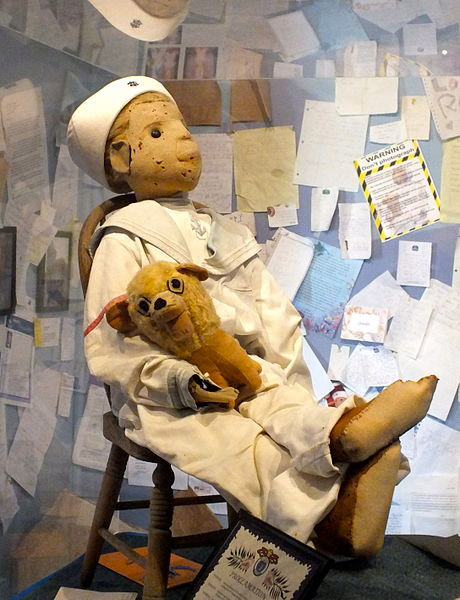
Guest Dr. Cori Convertito, curator of the Key West Art and Historical Society, provides the most historically grounded account of Robert’s origins you’re likely to find. Robert is a Steiff doll — manufactured by the venerable German toy company best known for producing the first teddy bear — and almost certainly dates to 1904, when a member of the prominent Otto family of Key West purchased him as a birthday gift for young Robert Eugene Otto.
The doll was originally costumed as a Harlequin court jester, complete with rosy painted cheeks and a colorful hat — details that have long since faded. The sailor suit he wears today is almost certainly Eugene’s own childhood clothing, repurposed sometime after the doll came into the boy’s possession. Steiff company historians have confirmed Robert belongs to a specific window-display series of that era, effectively debunking popular claims that the doll was handmade by a Bahamian servant and imbued with voodoo. Dr. Convertito is refreshingly direct: once the voodoo origin story falls apart, she notes, many of the more outlandish associated claims (including the one about Robert setting a person on fire) tend to fall apart with it.
👦 Gene and Robert: The Boy and His Double
Robert Eugene Otto — who went by Gene — was inseparable from the doll for years. Family memory holds that the boy would blame Robert for his own misdeeds, a pattern of transference that Dr. Convertito suggests may lie at the psychological root of the doll’s reputation. Gene eventually left Key West for France to study art, returning as an adult with his wife Anne, a concert pianist. It was after this return — with non-family members in the house for the first time — that reports of strangeness escalated: neighbors claimed to hear two distinct voices coming from a room containing only Gene and the doll, to see the doll appearing in different windows without anyone moving it, and to hear unexplained footsteps in empty rooms.
Gene died in the 1970s. Anne did not take Robert with her when she vacated the house, and the doll passed with the property to a new family before being donated to the Fort East Martello Museum. Several people who knew Gene and Anne personally are still alive and have been interviewed about the household’s atmosphere.
📬 Letters, Curses, and Social Media
Robert’s supernatural reputation has generated a remarkable volume of correspondence. Visitors who feel they disrespected the doll — by photographing him without asking permission, or simply by expressing skepticism in his presence — report strings of bad luck afterward and write apology letters to Robert directly. The museum receives these by post, email, and through Robert’s own Facebook page. Dr. Convertito describes one woman in Indonesia who had never left her country, had never met the doll, and was nevertheless emailing Robert’s social media accounts three or four times a day convinced he intended to kill her family.
The Travel Channel crew filming Mysteries at the Museum had their primary camera malfunction during the shoot and subsequently sent Robert an apology letter. When Robert briefly traveled to Las Vegas to appear on a program hosted by Zak Bagans, the museum received furious phone calls from people insisting Robert belonged in Key West and that staff would be cursed for moving him. (Dr. Convertito also managed to get Robert photographed at a casino slot machine, which required negotiating with a pit boss and a security detail.)
🎬 Robert and Chucky: Not the Same Story
One of the most persistent myths about Robert is that he served as the inspiration for Chucky in the 1988 film 🎬 Child’s Play 💵. Dr. Convertito is unequivocal: the film’s director has been asked repeatedly and has consistently said no. The connection appears to rest entirely on the superficial similarity of “scary doll with an owner” — and the fact that internet rumor is stickier than studio statements.
🏛️ The Fort East Martello Museum
The Fort East Martello is a Civil War-era fortification that served through the Spanish-American War, both World Wars, and the Cuban Missile Crisis — making it among the closest American structures to Cuba. The fort’s long association with yellow fever quarantine and military death gave it a funereal atmosphere that made Robert a natural fit when he was donated. The collection also includes a 19th-century horse-drawn hearse and a marble cemetery marker salvaged from an above-ground mausoleum. The Key West Art and Historical Society operates two additional sites: the Key West Lighthouse and the Museum of Art and History; a single pass covers all three.
Dr. Convertito also recommends the Key West Cemetery as one of the most underrated things to do on the island — integrated, historically rich, and home to the Otto family plot (complete with their pet deer). One headstone reportedly reads: I told you I was sick.
🧠 The Skeptical Lens: Priming, Attribution, and Tainted Objects
After the interview, Blake draws on psychology professor Bruce Hood‘s work to offer a framework for understanding Robert’s power over visitors. Hood’s research — detailed in his book 📚 The Science of Superstition 💵 — includes an experiment in which people readily refuse to try on a clean sweater once told it belonged to a serial killer. The sweater hasn’t changed; the meaning attached to it has.
Blake walks through three related psychological mechanisms at work in the Robert phenomenon:
– Priming: arriving at the museum after absorbing more than a century of Robert lore sets powerful unconscious expectations before the visitor even sees the doll.
– Confirmation bias: noticing and remembering the odd camera glitch or delayed flight while discounting the dozens of uneventful visits and working equipment.
– Attribution: the cognitive tendency to assign a cause — particularly an agentive cause — to coincidental clusters of unusual events.
As Blake puts it: Robert isn’t just stuffed with straw. He’s stuffed with meaning — and that, more than anything supernatural, explains why he has unsettled visitors for over a century.
📚 Further Reading
– 📚 Robert the Doll 💵 by David L. Sloan (authorized history, written with access to museum archives)
– 📚 The Science of Superstition: How the Developing Brain Creates Supernatural Beliefs 💵 by Bruce M. Hood
– 🎬 Child’s Play 💵 (1988) — not based on Robert the Doll, despite widespread claims
– 🎬 Magic 💵 (1978) — creepy ventriloquist-doll film referenced in the episode
– 🎬 Trilogy of Terror 💵 (1975) — TV anthology film, classic of the evil-doll genre
🔗 Related Links
– Fort East Martello Museum — Robert the Doll’s permanent home
– Robert the Doll — Wikipedia
– Steiff — Wikipedia (history of the doll manufacturer)
– Annabelle — the Warrens’ allegedly cursed Raggedy Ann doll
– Voodoo Dolls — Wikipedia
– Twilight Zone Season 5 — “Living Doll” (Episode 6)
– Twilight Zone Season 3 — “The Dummy” (Episode 33)
– Lore Podcast — Episode 15 covers Robert the Doll
– Confirmation Bias — Wikipedia
– Priming (psychology) — Wikipedia
Note: ads inserted into the distributed audio alter the timestamps in unpredictable ways, so timing references in these notes are approximate.
In this week’s episode of MonsterTalk, we talk about demonic or evil dolls, and look into the history of one of America’s most famous creepy playthings: Robert the Doll. Our interview is with Dr. Cori Convertito, Curator of the Key West Art and Historical Society, which oversees the Fort East Martello Museum, home of Robert the Doll.
Robert the Doll links
- dramatized film
- authorized history book
- novel
- Facebook page
- Twitter account
- official website
- Stories about Robert — Lore podcast
Videos
- Child’s Play (not based on Robert the Doll. See episode for details.)
- Twilight Zone — Season 5, Episode 6: Living Doll
(watch Episode 6 on Amazon) - Twilight Zone — Season 3, Episode 33: The Dummy
(watch Episode 33 on Amazon) - Trilogy of Terror — a creepy doll classic
Further Reading
Music
- Monstertalk Theme: Monster by Peach Stealing Monkeys
- Additional music: Creepy Doll by Jonathan Coulton.
MTArchivist
0