Regular Episode
#113 – FRAUDS, HOAXES AND SPLENDOR IN THE PAST
Fair warning: Ken speaks with what the hosts diplomatically call a “colorful” vocabulary. Blake did his best with the bleep button. Listener discretion is, as always, advised when small ears are nearby.
🗺️ The Book Behind the Book
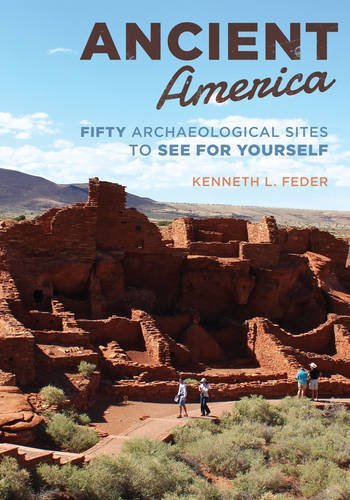
Ken traces the origin of Ancient America to a letter he received in 2008 — a typed note from a former C-student who had stumbled across Montezuma Castle National Monument in Arizona with his young family and pulled over because of a photograph Ken had shown in class years earlier. That single letter prompted Ken to restructure his introductory archaeology course so that its final third would focus on real, publicly accessible sites — letting the methods he’d spent weeks teaching land in vivid, specific places.
The book covers fifty sites that are open to the public (most free of charge), from well-known landmarks like Cahokia, Mesa Verde, and Chaco Canyon to lesser-known treasures like the Three Rivers Petroglyph Site in New Mexico and Horseshoe Canyon in Utah. Ken describes Horseshoe Canyon’s Great Gallery pictograph panel — over 100 feet long, 15 feet off the canyon floor, filled with elongated anthropomorphic figures — as one of those rare places where even confirmed atheists find themselves whispering.
👽 Ancient Aliens, Rock Art, and Borrowed Imagination
Ken describes visiting the International UFO Museum and Research Center in Roswell, New Mexico, where photographs of Native American rock art — including panels from sites featured in his book — are presented as evidence of extraterrestrial contact. He draws a pointed comparison: no one looks at a Picasso or a Salvador Dalí and concludes the artist was depicting something literally real — yet Native American artists are routinely denied the same creative license. Ken argues this double standard is not merely condescending but racist, and he does not pull punches about it in the book.
Blake brings up John Keel‘s recurring digs at “orthodox” archaeology in his 1960s books, and Ken connects that to the broader pseudo-archaeology genre, citing 📚 Forbidden Archeology 💵 by Michael Cremo and Richard Thompson — a text rooted in Hindu creationism, published by the Transcendental Meditation movement, that accuses scientists of applying a “knowledge filter” to suppress evidence of billion-year-old humans. Ken is happy to own the filter metaphor: science does filter claims, the same way you’d filter advice from a mechanic who prefaces his medical opinion with “I don’t know anything about medicine, but…”
🦴 The Piltdown Man — What the Headlines Got Wrong
A newly published study prompted breathless media coverage claiming the Piltdown Man hoax had finally been “solved.” Ken walks through why that framing is a textbook case of science journalism pitching a ball that was actually outside the strike zone.
The basic story: around 1909–1912, amateur collector Charles Dawson — already nicknamed “the Wizard of Sussex” for his suspiciously prolific discoveries — produced skull fragments and a mandible from a gravel pit at Piltdown in East Sussex. Paired with paleontologist Arthur Smith Woodward of the British Museum of Natural History, the find was announced to the Geological Society of London as a sensational missing link — one with a surprisingly modern cranium and an ape-like jaw. Britain, which had been mocked by French colleagues for its lack of hominin fossils (“mere pebble collecting”), was suddenly claiming it had the best human ancestor in the world.
The problem was that Piltdown contradicted everything else being found. By the late 1940s, mainstream textbooks were already footnoting the specimen with explicit uncertainty. The hoax was formally exposed in 1953 when fluorine testing, morphological analysis, and microscopy confirmed the skull was human and the jaw was an orangutan’s — with teeth deliberately filed down and the articulating condyle conveniently broken off to prevent a definitive mismatch. The new study Ken discusses added genuine value by using DNA to confirm the mandible’s orangutan origin beyond any remaining doubt — but that last 1% of certainty is not the same as discovering Dawson did it. Virtually every serious Piltdown researcher had already reached that conclusion on circumstantial grounds decades earlier.
Ken also runs through the rogues’ gallery of alternative suspects that have accumulated around Piltdown over the years — including the entertainingly implausible case against Arthur Conan Doyle, who lived near the site, was credulous enough to endorse the Cottingley Fairies, and allegedly had a grudge against the scientific establishment. The evidence is: he lived nearby. Ken is skeptical. He is also skeptical of the new paper’s claim that the internal consistency of the planted fossils proves Dawson acted alone — two people collaborating on a hoax can be consistent too; that would rather be the point.
For comparison, he cites Shinichi Fujimura, the Japanese amateur archaeologist nicknamed “the Hand of God,” who was caught on hidden camera literally burying the artifacts he would later “discover” — pushing Japanese occupation dates from 30,000 years back to a claimed 600,000 years, feeding the same nationalist impulse that made Piltdown so seductive to Edwardian Britain.
🏛️ Mound Builders, Monks Mound, and the Etowah Connection
Blake grew up near the Etowah Indian Mounds in Georgia, and Ken confirms they made the book. The site’s marble effigy figures and intricately engraved shell gorgets — depicting figures in elaborate eagle-dancer regalia — are, Ken says, among the most remarkable artifacts in North America. He notes that Spanish chroniclers accompanying Hernando de Soto through the Southeast in the 1530s explicitly described enormous earthen pyramids with chiefs’ houses on top, surrounded by miles of cornfields — direct documentary evidence that later Anglo settlers in the Northeast chose to ignore when spinning theories about mysterious lost races of Mound Builders.
The conversation culminates at Cahokia near Collinsville, Illinois: a city of perhaps 10,000–20,000 people at its height, centered on Monks Mound — over 100 feet tall, covering 14 acres, and by volume the fifth-largest pyramid on Earth, built one basket-load of clay at a time. Ken and Blake agree that the “it had to be aliens” response to sites like this is, at its core, a failure to reckon with what it actually takes to build a civilization: agriculture, language, belief systems, social hierarchy, and the buy-in of a population that accepts the whole structure as legitimate.
📺 Science Journalism and the “Framing the Pitch” Problem
Ken offers a memorable metaphor for how popular science reporting distorts incremental research: a skilled baseball catcher who “frames the pitch” — catching the ball outside the strike zone and snapping his glove inward just fast enough to fool the umpire. Headlines that call confirmatory DNA work “groundbreaking” or declare a century-old mystery “finally solved” are doing exactly that. The actual abstract of the Piltdown paper, he points out, was already old news to anyone who had read the literature.
The same dynamic comes up with cryptozoology: the Montauk Monster gets wall-to-wall coverage, while “it’s a decomposed raccoon” barely rates a correction. And it extends to the bones-of-giants genre, where nineteenth-century newspaper filler — written in an era when readers were expected to recognize a tall tale — gets strip-mined for “suppressed evidence” by modern conspiracy theorists. Ken cites Adrienne Mayor‘s work on how ancient Greeks encountering the bones of ground sloths and mastodons generated the myths of Titans and giants — a much more satisfying explanation than Smithsonian cover-ups.
🎬 Monster Movie Corner
Ken’s pick for the film that still reliably unnerves him is 🎬 The Mummy 💵 (1932) with Boris Karloff — specifically because of its quietness and slow dread, attributes he contrasts favorably with the kinetic noise of modern horror. Blake confesses to an annual viewing ritual built around 🎬 The Thing 💵 (John Carpenter, 1982), and the conversation detours pleasantly through the original 🎬 The Thing from Another World 💵 (1951) — in which James Arness played the creature in what may have been his first film role — and 🎬 Carnival of Souls 💵 (1962), which Ken reports scared him considerably more as a child than on a recent rewatch. Also briefly mentioned: 🎬 The Beginning of the End 💵 (1957), notable mainly for featuring Peter Graves — James Arness’s equally tall brother — fighting giant grasshoppers to considerably less cinematic effect.
📚 Further Reading
– 📚 Ancient America: Fifty Archaeological Sites to See for Yourself 💵 by Kenneth L. Feder
– 📚 Frauds, Myths, and Mysteries: Science and Pseudoscience in Archaeology 💵 by Kenneth L. Feder
– 📚 Forbidden Archeology: The Hidden History of the Human Race 💵 by Michael Cremo and Richard Thompson
– 📚 The First Fossil Hunters: Dinosaurs, Mammoths, and Myth in Greek and Roman Times 💵 by Adrienne Mayor
🔗 Related Links
– Piltdown Man (Wikipedia)
– Charles Dawson (Wikipedia)
– Shinichi Fujimura (Wikipedia)
– Cahokia Mounds State Historic Site (Wikipedia)
–
Ken Feder returns to talk about his new book Ancient America: Fifty Archaeological Sites to See for Yourself, which is available for pre-order now on Amazon. Discussion in this episode centers around the failings of science coverage in the media, the latest on the famous Piltdown Man hoax, and why everyone needs to visit historical archaeological sites when they can.
Mentioned in this episode
- Frauds, Myths, and Mysteries: Science and Pseudoscience in Archaeology
- Carnival of Souls
- The Thing from Another World
- The Beginning of the End
- The Archaeological Fantasies Podcast
Music
- Monstertalk Theme: Monster by Peach Stealing Monkeys
MTArchivist
0