Regular Episode
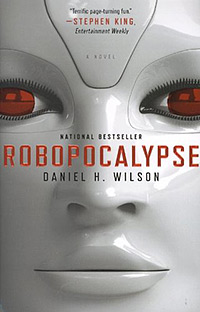
#090 – THE ROBOT APOCALYPSE
The word “robot” comes from the Czech robota, meaning slave or forced labor — a fitting etymology for a conversation about mechanical servants that keep turning on their creators in fiction. But how worried should we actually be?
🤖 What Is a Robot, Anyway?
Wilson’s working definition: a robot is a mechanical artifact that can sense the environment, think about what to do, and act on it. He acknowledges this sense-think-act paradigm technically describes a fire alarm too, which is why the boundaries get slippery fast. Historical antecedents range from Talos, the bronze giant of Greek myth, to the Golem of Jewish folklore, to the elaborate mechanical automatons built by Jacques de Vaucanson for European courts. The first widely recognized useful robot is probably Unimate, the industrial robot arm deployed in Japanese auto manufacturing in the late 1950s — the U.S., Wilson notes, was too afraid of robots at the time.
The conversation also covers the Mechanical Turk — the famous 18th-century chess-playing “automaton” that concealed a human operator inside — which Wilson cheerfully classifies as a “phobot.” Spoilers, he adds.
🐕 Big Dog, Cheetah, and the Rise of Bio-Inspired Robots
Wilson’s current obsession at the time of recording is the quadruped robots coming out of Boston Dynamics — particularly BigDog and the Cheetah platform, along with MIT’s own cheetah-inspired robot. BigDog was originally developed on a DARPA grant as a squad support platform: essentially a robotic pack mule to carry soldiers’ gear over rough terrain. It runs on a diesel engine (noisy, but logistically compatible with existing military fuel supplies), and by the time of this episode had recently been acquired by Google along with a wave of other robotics companies including DeepMind and Willow Garage.
Wilson explains the distinction between biomimetics (copying animals) and what the field now prefers to call bio-inspired robotics — extracting the underlying mathematical principles of how animals locomote and then applying those principles to whatever materials and scales are available. The goal isn’t to build a mechanical cockroach; it’s to distill the cockroach down to its locomotion math.
⚔️ Kill Bots: We Already Have Them
The episode takes a sobering turn when Blake asks how far we are from autonomous weapons. Wilson’s answer: we’ve had them for a long time, and most people just don’t recognize them as robots. A landmine is essentially a robot — it senses a stimulus and acts. More sophisticated examples include homing torpedoes that track submarines and the Phalanx close-in weapons system fitted to most U.S. Navy ships, which can identify, target, and destroy an incoming missile faster than any human reaction time — fully autonomous, and entirely unremarkable to the public. Automated gun emplacements in the Korean DMZ represent an even more explicit case of autonomous lethal force.
Wilson references P.W. Singer’s 📚 Wired for War 💵 for what he considers the sharpest ethical question in this space: even if autonomous military robots can be built to make more ethical battlefield decisions than frightened human soldiers (no panic, no revenge, no self-preservation instinct), does that just make it easier for states to wage unethical wars in the first place?
🧠 The Singularity: Skepticism Applied
All three participants are skeptical of Ray Kurzweil‘s Singularity — the idea that raw computational power will spontaneously give rise to superintelligent AI. Wilson’s objection: intelligence in biological systems is efficient, not brute-force. Our brains don’t solve sensory and social problems by having enormous processing reserves; they solve them elegantly under tight constraints. Stacking more compute doesn’t obviously get you to consciousness any more than filling a larger library gets you a sentient library. That said, Wilson allows that a deliberate, long-term, well-resourced research effort could iteratively approach something like general AI — it just wouldn’t be spontaneous, secret, or dramatic, which happens to ruin several popular science fiction plots.
On transhumanism, Wilson draws a sharp practical line: the real pioneers of human augmentation are people with serious disabilities — cochlear implant recipients, prosthetic limb users — who adopt the technology out of necessity, not ideology. He’s respectful of body-modification enthusiasts but firm that a magnet in your fingertip does not make you a cyborg. The discussion of cochlear implants leads into a genuinely moving aside about neuroplasticity: early implantation gives a child’s brain decades to build the relevant auditory pathways, which makes the parental decision — made for someone too young to consent — extraordinarily high-stakes.
📖 Robopocalypse, Robogenesis, and What Robots Actually Want
Wilson explains the narrative logic behind Robopocalypse: to make a robot truly terrifying as a monster, it has to be capable of making a to harm you. An animal attack is frightening; a machine malfunction is gruesome. But neither rises to the level of horror because neither involves agency aimed at you. The decision to give the book’s AI genuine malevolent intent was a deliberate craft choice to maximize dread.
More interesting to Wilson, though — and explored in the sequel 📚 Robogenesis 💵 — is what a robot apocalypse would look like if it weren’t projection of human motivations onto machines. His middle-reader 📚 A Boy and His Bot 💵 contains a parable Wilson considers more realistic: a robot designed solely to paint happy faces, whose safety constraints fail, which self-replicates and ends up painting happy faces on every corpse on every planet. The catastrophe isn’t malice — it’s a well-designed system doing what it was designed to do, without limit. He also references Arthur C. Clarke‘s short story “The Nine Billion Names of God” and Philip K. Dick‘s 📚 Do Androids Dream of Electric Sheep? 💵 as essential texts for thinking about machine consciousness.
🎬 Robots on Screen (and in Games)
The conversation touches on several robot-centric films and media. Westworld (1973) — written and directed by Michael Crichton directly as a screenplay — is praised warmly, with Wilson noting the structural similarity to Jurassic Park: an amusement park built on hubris, going catastrophically wrong. HAL 9000 from 2001: A Space Odyssey is held up as a rare success at depicting a disembodied superintelligence cinematically, largely because the film gives HAL a clear physical embodiment (the ship itself) and concrete high stakes. Blake’s personal robot of choice is Floyd from Planetfall, Infocom’s 1983 text adventure — confirmed by Wilson as a real and great robot, which is all the validation anyone needs.
📚 Further Reading
– 📚 Robopocalypse 💵 by Daniel H. Wilson
– 📚 Robogenesis 💵 by Daniel H. Wilson
– 📚 Amped 💵 by Daniel H. Wilson
– 📚 How to Survive a Robot Uprising 💵 by Daniel H. Wilson
– 📚 A Boy and His Bot 💵 by Daniel H. Wilson
– 📚 Wired for War 💵 by P.W. Singer
– 📚 The Turk 💵 by Tom Standage
– 📚 The Singularity Is Near 💵 by Ray Kurzweil
– 📚 Do Androids Dream of Electric Sheep? 💵 by Philip K. Dick
– 📚 I, Robot 💵 by Isaac Asimov
– “The Nine Billion Names of God” by Arthur C. Clarke (short story)
🔗 Related Links
– BigDog (Boston Dynamics)
– Unimate — the first industrial robot arm
– The Mechanical Turk
– Phalanx Close-In Weapons System
– Technological Singularity
– Asimov’s Three Laws of Robotics
– Steve Mann (wearable computing pioneer)
– Westworld (1973 film)
– Planetfall (Infocom, 1983)
– M.U.L.E. — play free online at planetmule.com
Note: ads inserted into the distributed audio alter the timestamps in unpredictable ways, so timing references in these notes are approximate.
WHEN THE ROBOTS TAKE OVER, will we all be forced to speak bocce? Author and robotics engineer Daniel H. Wilson visits MonsterTalk to discuss the nature of robots and the risk of a robot apocalypse. Steven Spielberg has purchased the rights to produce a film version of his New York Times bestseller, Robopocalypse.

References
Book Links
- The Turk by Tom Standage
- Wired for War by PW Singer
- I, Robot by Isaac Asimov
- The 9 Billion Names of God by Arthur C. Clarke
- The Singularity is Near by Ray Kurzweil
Books by guest Daniel H. Wilson
Old Computer Game Links
- M.U.L.E. planet colonization video game (more fun than you might imagine)
- Planetfall by Infocom — available on iTunes via Infocom
Movie Links
Music
- Monstertalk Theme: Monster by Peach Stealing Monkeys
MTArchivist
0