Regular Episode
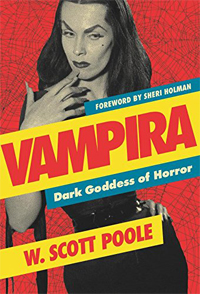
#089 – VAMPIRA
This is a pop-culture special rather than a straight cryptozoology episode, but it fits squarely in MonsterTalk’s wheelhouse: Vampira is the woman who taught America how to be morbid on television, laid the groundwork for goth aesthetics, and may have quietly inspired the look of a certain Disney villain — all while living in near-poverty and fighting an ultimately unsuccessful lawsuit against her far more commercially successful successor.
📺 What Is a Horror Host, and Why Did They Happen?
The classical era of the TV horror host is generally dated to 1958, when a Philadelphia station hired John Zacherle — then playing a morbid undertaker called Roland on a local serialized Western — to host late-night films. The catalyst was Shock Theater, a package of more than 50 classic Universal Studios horror films that suddenly landed in the laps of local TV executives across the country. Zacherle later shortened his name to Zacherley when he moved to New York, and is widely (if incorrectly) credited as the originator of the format. Poole’s book makes the case that Vampira beat him by four years and that Zacherley was consciously borrowing from her playbook — despite the two apparently never having met.
Vampira’s own lineup was more limited: she didn’t have access to the Universal catalog, so she hosted a mix of B-movies and film noir, with White Zombie (1932) being the standout. When the films weren’t horror, she improvised — greeting happy endings with theatrical disappointment and finding ways to inject Gothic menace into detective thrillers. The format was also more free-form than later hosts: elaborate ad-libbed skits, a visible pet spider named Rollo, and a recurring bit involving an apparent nude bath scene and an unseen scuba-suited character named Igor swimming around in the tub.
🧛 Who Was Maila Nurmi?
Born to a Finnish immigrant father who toured the country as a Lutheran temperance lecturer, Nurmi left home shortly after high school in the late 1930s, did glamour and pinup modeling, and landed in Greenwich Village during the early Beat generation. She eventually made her way to Hollywood, where producer Howard Hawks briefly decided she was going to be the next Lauren Bacall. Hawks planned to cast her in a vampire film called Dread Hollow — written by William Faulkner and apparently involving a corpse sewn inside a taxidermied wolf — which was never produced. She was subsequently discovered by studio executive Hunt Stromberg of KABC, the local Los Angeles television station where Vampira debuted.
Poole also discusses Nurmi’s fascination with bondage modeling — specifically the underground magazine Bizarre, produced by photographer John Willie — as one of the aesthetic sources for the Vampira character alongside the 1936 film 🎬 Dracula’s Daughter 💵 and the macabre New Yorker cartoons of Charles Addams. The signature 17-inch corseted waist — achieved through fasting, wrapping herself in a tire inner tube overnight, and a cinch belt — was, Poole argues, a deliberate parody of 1950s ideals of femininity and fertility.
🔮 Proto-Feminist, Psychic Evangelist, Goth Ancestor
Poole stops short of calling Nurmi a feminist — it wasn’t a word she used — but frames her as a proto-feminist precursor to the performance-art elements of second-wave feminism in the 1960s. She described herself as being “on a mission” to upset American social conventions, and her humor was distinctly different from later hosts: rather than defusing fear, her jokes deepened the morbidity and, frequently, satirized the domestic ideals of her viewers. Her famous on-air quip about children — “I love children. They’re delicious.” — landed very differently in 1954 than it might today.
Nurmi also harbored a longstanding interest in the occult, psychic phenomena, and dream interpretation, and for years expressed a sincere ambition to become a traveling tent-revival evangelist under the name Sister St. Francis. Her model was not Billy Graham but Aimee Semple McPherson — the first woman in the United States to hold a radio broadcasting license, and a figure whose ability to survive scandal and male ecclesiastical opposition clearly appealed to Nurmi.
Later in life, largely forgotten by Hollywood, she became a fixture of the West Hollywood bohemian scene, ran a thrift-and-antique shop on Melrose Avenue called Vampire’s Attic, and in the 1980s performed spoken-word monologues at the Cathay de Grande (the “Annie Club” referenced in the episode) alongside bands like Black Flag and the early Red Hot Chili Peppers.
🎬 Plan 9, Ed Wood, and the Hidden Maleficent Connection
Nurmi’s best-known film appearance — 🎬 Plan 9 from Outer Space 💵, directed by Ed Wood — was, by her own account, taken purely for the money; she was at one point living on public assistance. Her association with Wood was revived in mainstream consciousness by Tim Burton‘s 1994 biopic 🎬 Ed Wood 💵, which brought her a cult following but essentially no income.
More surprising is a connection that documentary filmmaker R.H. Green uncovered through access to materials held by Nurmi’s niece, Sandra Nearme: around the same period she was working with Ed Wood, Nurmi was also being used by Disney as a physical model for Maleficent in 🎬 Sleeping Beauty 💵. As Poole puts it, she was “sort of everywhere in this foundational movement of America becoming Gothic again.”
Green’s documentary Vampira and Me is also the source of the only known live footage of Nurmi in performance — kinescopes recovered from a national variety show and a game show appearance, the rest of her television work having been destroyed in the routine tape-recycling practices of early television.
💄 Vampira vs. Elvira: A Complicated Legacy
Around 1980, Nurmi was approached by a Los Angeles TV station to serve as executive producer for a new horror host character — essentially choosing her own successor. Her preferred candidate was a woman of African descent (she mentioned Lola Falana by name), reasoning that by 1980 the sex-and-morbidity formula alone was no longer sufficiently subversive. The studio instead chose Cassandra Peterson, who developed the character of Elvira, Mistress of the Dark.
Nurmi first sued the studio and later Peterson herself for trademark infringement, on look-and-feel grounds similar to those the Lugosi estate had already tried and failed on. The case was essentially thrown out. Poole notes that Peterson’s original concept had been a horror host modeled on Sharon Tate‘s character in 🎬 The Fearless Vampire Killers 💵 — vetoed by the studio for obvious reasons. Poole suggests the two women, whose backgrounds were remarkably similar, might have been friends under different circumstances, and that one of Nurmi’s blind spots was failing to recognize Peterson’s own genuine talent.
📚 Further Reading
– 📚 Vampira: Dark Goddess of Horror 💵 by W. Scott Poole
– 📚 Monsters in America 💵 by W. Scott Poole
– 📚 Satan in America 💵 by W. Scott Poole
🔗 Related Links
– 📺 Vampira intro promo (YouTube)
– Maila Nurmi / Vampira — Wikipedia
– John Zacherle — Wikipedia
– Elvira, Mistress of the Dark — Wikipedia
– Aimee Semple McPherson — Wikipedia
– Shock Theater (Universal package) — Wikipedia
– Plan 9 from Outer Space — Wikipedia
– Charles Addams — Wikipedia
Note: ads inserted into the distributed audio alter the timestamps in unpredictable ways, so timing references in these notes are approximate.
A POP-CULTURE INTERVIEW with historian Scott Poole on the first monstrous horror movie host, Vampira (Maila Nurmi). His new book is Vampira, Dark Goddess of Horror.
Related Links
- Scott Poole’s official site
- Maila Nurmi interview
- Intro to Vampira show
- Vampira and Me (Documentary)
- American Scary (Documentary)
- TV Horror Hosts (Amazing list of local horror hosts)
- Aimee Semple McPherson (Evangelist)
- Chiller Theater Expo 2014 (See Zacherley)
- Dracula’s Daughter
- Plan 9 From Outer Space
Music
- Monstertalk Theme: Monster by Peach Stealing Monkeys
MTArchivist
0