Regular Episode
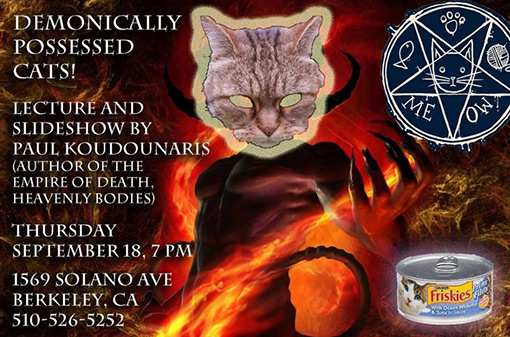
#091 – DEMON PURRSESSION: Tales of Demonically Possessed Cats
The conversation ranges from the theological logic behind animal possession in medieval Christian thought, to the Scottish ritual of cat-roasting for demonic protection, to a heartwarming consumer-advocacy story involving a frying pan haunted by the ghost of a cat named Angus.
🐾 From Sacred to Sinister: The Long Fall of the Cat
Paul traces the cat’s dramatic reputation arc from divine icon to diabolical suspect. In ancient Egypt, cats were sacred to Bastet (also known as Bast), the cat-headed daughter of Ra, and the city of Bubastis became the royal capital of the late New Kingdom. The Roman encyclopedist Diodorus Siculus recounted that even accidentally killing a cat in Bubastis could earn a Roman diplomat a death sentence at the hands of a mob — and apparently did.
The fall from grace came gradually. Hebrew culture’s association of cats with Egyptian paganism carried into early Christianity. The Greek goddess Hecate, goddess of magic, had the black cat as one of her symbols — a neutral emblem in ancient Greece that Christians later folded into their framework of diabolism. Cats also kept nocturnal hours, which wasn’t helping their case. One piece of European folklore held that cats slept by day because they were out at night working for the devil. What they were paid, Paul notes, remains unrecorded.
It was only in the last two centuries, he argues, that the cat’s reputation has been substantially rehabilitated — and that our modern, emotionally intimate relationship with pet cats would have looked deeply suspicious to medieval observers.
😈 The Theology of Possessed Animals
Paul draws an important distinction upfront: a demonic cat is the demon itself; a demonically possessed cat is an ordinary animal that has been taken over by an outside infernal agency. The distinction matters theologically.
Medieval Christian thought held that the primary defense against demonic possession was faith. Animals, lacking faith entirely, were considered far easier targets than humans. A demon didn’t have to breach any spiritual fortification — it could simply walk in. This gave the doctrine of animal possession its own internal logic, even if horror films and homocentric academic study have since caused us to think of possession as exclusively a human affliction.
A possessed cat would behave the way a possessed person would: levitating, speaking in tongues, breathing fire. Paul’s inbox, post-lecture, regularly fills with emails from people convinced their cat is possessed because it won’t stop pawing at a chair. He is patient but clear: that’s just cat behavior.
Cats were also theologically suspect for a more mundane reason — their independence. Unlike dogs, cats do not acknowledge human authority in the home. To medieval theologians, this failure to accept man’s God-given dominion was itself a kind of affront to Providence. As Paul puts it: if you live with a dog, it’s your house; if you live with a cat, it’s your house and the cat’s house.
🏛️ The Demon Cat of the U.S. Capitol
The most famous demonically possessed cat in American history reportedly still haunts the basement of the U.S. Capitol — specifically in a crypt that was originally built as a mausoleum for George Washington, who declined the honor by dying elsewhere and leaving instructions to be buried at Mount Vernon. The crypt became storage. Something moved in.
Known as the Demon Cat (or “D.C.” — a coincidence that has not gone unremarked), sightings reportedly date to the Civil War era. The creature appears as a small black kitten, then swells to terrifying size before vanishing. According to Paul, it has been linked to the deaths of Lincoln and Kennedy, and Capitol maintenance workers allegedly heard strange meowing from the crypt shortly before September 11th. It is also, Paul notes, the only demonically possessed cat with its own Wikipedia page, though it is admittedly just a stub.
🏴 Scottish Cat Lore: The Cait Sìth and Worse
Scotland furnished some of the episode’s most vivid — and most disturbing — cat lore. Paul describes the Cait Sìth (the “cat sìth,” or cat fairy of the Scottish Highlands) as large black cats capable of emitting sparks, believed to steal the souls of the unburied dead by leaping over a corpse. A ritual — Paul believes it was called something like the Feill Fadalach (a night-long wake tradition) — was performed specifically to keep these supernatural cats away from bodies before interment.
For those seeking active protection from cat magic rather than passive defense of a corpse, the prescribed method was considerably more unpleasant: stay awake for three consecutive days while continuously roasting cats over an open fire. If you persevered, the devil would allegedly appear in the form of a cat, ask you to stop incinerating his servants, and reward you with immunity from cat magic and, as a bonus, the gift of second sight. Paul acknowledges this ritual has a significant logistical problem at the front end.
⚖️ Famous Cases: Agnes Waterhouse and the Chelmsford Witch Trial
One of the most documented early English cases of a supposedly possessed cat comes from Chelmsford, Essex. A woman named Agnes Waterhouse was tried as a witch whose cat — named, with conspicuous directness, Satan — was believed to be not merely a familiar but a fully demonically possessed animal. The cat was accused of committing infanticide on Agnes’s behalf. Both Agnes and her cat were arrested. The cat’s culpability as an independent moral agent apparently presented no procedural difficulty.
Paul also references the Malleus Maleficarum (the Hammer of Witches, 1487) in the context of what devils could and couldn’t do. The theological position was that only God can create or transubstantiate; anything the devil produces is a phantasm. This meant a demonically possessed cat was, strictly speaking, performing illusions — which did not make contemporaries any less afraid of it, or any less likely to arrest the cat.
A 1484 papal bull (almost certainly Summis desiderantes affectibus under Innocent VIII) is cited as going so far as to decree that excessive closeness to a cat was itself grounds for suspicion of witchcraft — cats before confessions, essentially.
🍳 Modern Encounters: The Ghost in the Frying Pan
Paul’s most memorable recent case came after a San Francisco newspaper ran a photo of him under the headline “Expert on Demon Cats.” A woman in San Leandro, California, contacted him to report that the ghost of her recently deceased cat had taken up residence in her frying pan. Evidence: a persistent hissing sound when cooking, and a handle that kept falling off.
Paul met with her, maintained judicious agnosticism about feline pan-haunting, and eventually found himself drawn into a consumer-dispute negotiation with the cookware store’s customer service department. The store wanted to exchange the pan; she refused to surrender it (the cat was in it). Paul wrote what he describes as “a really magnificent letter” making her case. The right person read it, recalled feeling a presence after their own dog died, and issued a replacement pan. The woman kept both: the new functional one, and the old haunted one, which she sent Paul a thank-you note about, written in the voice of her cat, Angus.
The hosts observe that this is, at minimum, a story about misattributed agency — the tendency to leap from point A to point Z without working through the intervening possibilities. Paul agrees that’s the correct skeptical framing, while noting that he finds the human impulse behind it genuinely interesting rather than contemptible.
📚 Further Reading
– 📚 The Empire of Death 💵 by Paul Koudounaris — a study of charnel houses and ossuaries decorated in human bone
– 📚 Heavenly Bodies 💵 by Paul Koudounaris — elaborately jeweled 17th-century decorated skeletons and their histories
– 📖 The Discovery of Guiana by Sir Walter Raleigh — the Elizabethan travel account that (sincerely or strategically) included an eyewitness report of the headless Blemmyae
🔗 Related Links
– Demon Cat of the U.S. Capitol — Wikipedia’s (stub) entry on D.C.’s most famous resident
– Chelmsford Witch Trials — Agnes Waterhouse and the case of the cat named Satan
– Malleus Maleficarum — the 1487 witch-hunters’ manual central to the demonology discussed
– Cait Sìth — the supernatural cats of Scottish Highland folklore
– Bastet — Egyptian cat goddess, daughter of Ra, and the starting point of the whole story
– Hecate — Greek goddess of magic whose black-cat symbolism was later diabolized by Christian theology
– Blemmyae — the headless people with faces in their chests, Paul’s favorite monster and a recurring feature of medieval map marginalia
Note: ads inserted into the distributed audio alter the timestamps in unpredictable ways, so timing references in these notes are approximate.
Credit: Dr. Paul Koudounaris’s PhotoBucket
CAN A DOMESTICATED CAT BE A MONSTER? What if it can talk, fly, predict the future and grow to enormous size? Get ready for some of the strangest lore we’ve ever covered on MonsterTalk as we interview art historian Dr. Paul Koudounaris about demonically possessed cats.
Art historian Dr. Paul Koudounaris has written some books that will probably be of interest to MonsterTalk listeners. The Empire of Death is a book about the history of Charnel Houses and Ossuaries. In his more recent book, Heavenly Bodies, you will discover astonishing works of art formed by decorating human remains.
Books by Paul Koudounaris
Music
- Monstertalk Theme: Monster by Peach Stealing Monkeys
MTArchivist
0