051 – WHAT THE BIGFOOT MARKET WILL BEAR
This episode also doubles as a case study in the economics of paranormal evidence: who owns a mysterious photograph, what Fair Use actually covers, and how the commercial value of an “unsolved” mystery can quietly shape what people are willing to conclude.
📷 What the Camera Caught
The relevant portion of the photo sequence runs roughly as follows:
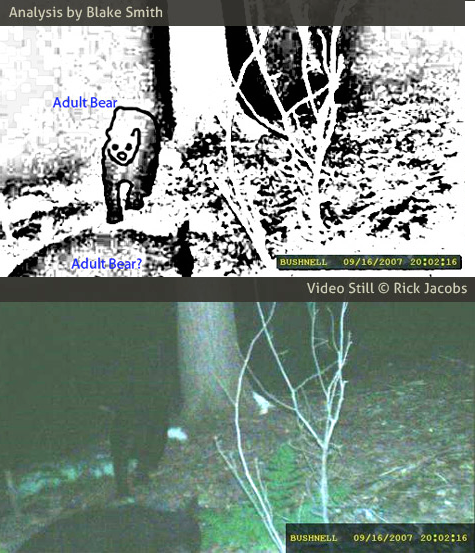
– At 20:02:16, a color/flash shot captures what appears to be a large bear and cubs near the salt lick.
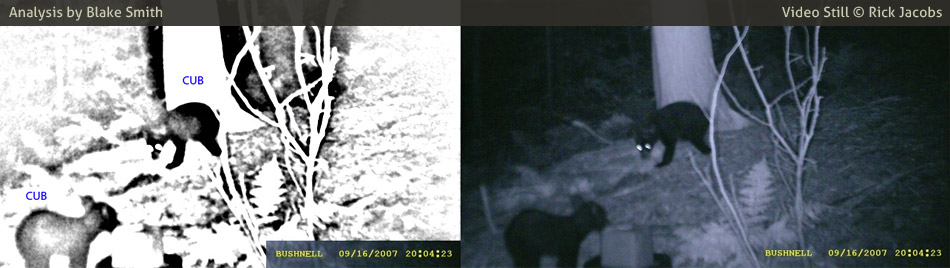
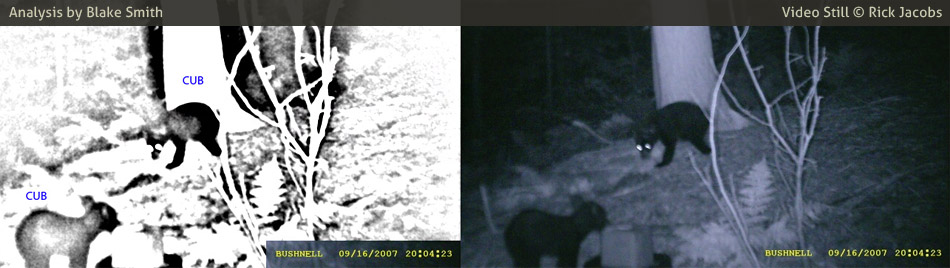
– At 20:04:23, two cubs are photographed at the salt lick — visibly much smaller than the adult-sized animal in the earlier frame.
– At 20:32:05 — nearly a half-hour later, with no intervening motion-triggered frames — a strange, thin, hairless-looking animal appears facing away from the camera. The salt lick has been knocked over.
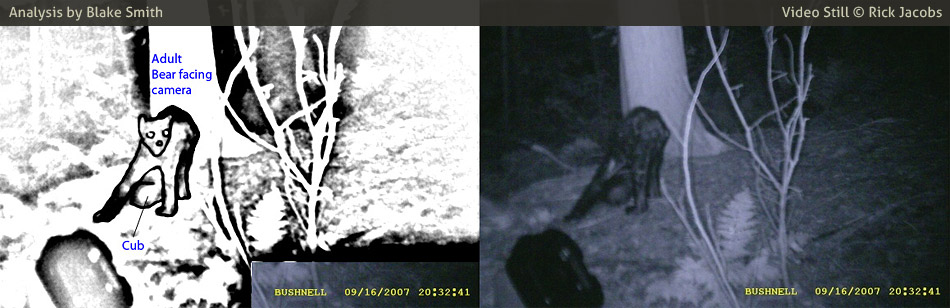
– At 20:32:41, a second shot shows the same animal in what the BFRO interprets as a crouching, head-tucked position. Blake’s interpretation: an adult black bear looking directly at the camera with a cub nursing underneath, on a hillside slope.
The camera’s fixed 30-second trigger delay (documented in the Bushnell Trail Sentry manual) raises a question Blake flags in the show notes: why are there no intervening frames between 20:04 and 20:32 if an animal was moving through the area?
🔬 Blake’s Photographic Analysis
Blake describes a methodical approach to the images that goes considerably further than the BFRO’s on-site visit:
– He sourced the same make and model of salt lick pan shown in the photos and used it as a foreground reference object for pixel-level scale measurements.
– The BFRO helpfully photographed the same tree in daylight with a measuring stick — giving Blake a background reference plane — allowing him to bracket a plausible height range for the mystery animal. It falls squarely within normal black bear dimensions.
– Blake’s size-match analysis of the 20:02:16 frame suggests the animal the BFRO labels “Mama Bear” is the same individual as the so-called “Jacobs Creature” — same size, same orientation relative to the tree.
– In the controversial third image, Blake used Photoshop brightening to identify what he believes is a bear face looking directly at the camera — two eye-shine dots and a rounded muzzle — above the blob that others read as the creature’s head. Once seen, he reports, it can’t be unseen.
– A bear biologist confirmed that the sharply inward-turned “paw” visible in image three is consistent with normal bear anatomy: bear fore-paw bones are remarkably similar to human hand bones and can rotate in ways that look strange in photographs. (The biologist noted this resemblance is a classic comparative anatomy quiz trick.)
The hosts also discuss allometrics — using limb-length ratios to identify species — and why applying it to these photos is nearly impossible: the animal is never perpendicular to the camera, is on an uneven slope, and is partially obscured. Pro-Bigfoot YouTube videos that overlay bear silhouettes and declare a mismatch are, as Ben points out, comparing the creature to a single idealized bear profile rather than the full range of sizes, poses, and conditions real bears present.
🐻 The Mange Hypothesis
Jerry Fieser, public affairs officer for the Pennsylvania Game Commission, looked at the photos and said immediately: bear with mange. Several independent bear biologists consulted by Blake reached the same conclusion. Sarcoptic mange, caused by a mite infestation, strips a bear of its thick coat and can leave the animal visibly emaciated — producing an animal that looks startlingly un-bear-like in a grainy night-vision frame. Blake notes this is the same explanation that accounts for the wave of hairless-canid Chupacabra reports in the American Southwest — a connection that inspired MonsterTalk’s separate episode on mites and cryptozoology.
Pennsylvania’s black bear population is substantial — the Game Commission estimated more than 15,000 animals as of 2000, with annual harvests averaging over 2,000 — making a bear the overwhelmingly parsimonious explanation for any large mammal photographed at a forest salt lick in the state.
💰 The Market Value of Mystery
The more unusual thread in this episode is what happened after Blake posted his analysis and annotated video breakdowns to YouTube. He received a copyright takedown notice — which he initially suspected came from the BFRO trying to suppress a skeptical reading. It turned out to be Jacobs himself. Their subsequent exchanges were less about the biology of the images than about whether Blake owed Jacobs $5,000 for reproducing them.
Ben, who has professional familiarity with intellectual-property law, is unequivocal: using a photograph for critical journalistic or research analysis is textbook Fair Use under U.S. copyright law. Blake agrees in principle but notes the practical asymmetry — a rights-holder doesn’t need to win in court to win in effect. The threat of litigation alone is enough to take down a hobbyist’s YouTube channel.
The deeper point the hosts draw out: a photograph’s commercial value depends heavily on remaining a mystery. The BFRO licensed the images and featured them on Finding Bigfoot (Animal Planet). As long as the creature is officially “unidentified,” the photos are worth something. A definitive bear ID deflates that market entirely — which means the incentive structure actively works against resolution.
🧠 Context, Priming, and the Camera That Always Lies
Ben closes with an observation that applies well beyond this case: cameras compress three dimensions into two, distort scale, and freeze animals mid-motion in poses that no living creature would ever “hold.” The camera never gives an accurate representation — it always lies, at least a little. The Jacobs photos caught a mangy bear (probably a nursing mother on a slope) at precisely the wrong millisecond to look like anything in a field guide.
The hosts also note the crucial role of the initial label. Jacobs’s daughter said “Bigfoot,” and that framing traveled to the BFRO and then to the press. Blake asks: who makes the first identification, and why? It’s a question worth holding onto for any blob-squatch, ghost photograph, or lake-monster sonar trace.
🔗 Related Links
– Bigfoot Field Researchers Organization (BFRO)
– American black bear (Ursus americanus)
– Mange (sarcoptic and demodectic)
– Allometry and morphological scaling
– Fair Use (U.S. copyright law)
– Pareidolia
– Chupacabra
Note: ads inserted into the distributed audio alter the timestamps in unpredictable ways, so timing references in these notes are approximate.
IN THE FORESTS OF PENNSYLVANIA, on a dark September night, a trail-cam took a series of controversial pictures. The Bigfoot Field Researchers Organization (BFRO) still claims they show a juvenile Bigfoot. Skeptics claim the photos show a bear. Join the hosts of MonsterTalk as they discuss Bigfoot photos, fair-use and the economics of unusual photos.
Read the BFRO’s analysis of the “Jacobs Creature” photos.
All Bushnell Cameras have a delay set to 30 seconds. For details on the trail cam itself, you can read the manual at Bushnell’s website. According to the manual, “Image Delay—Time elapsed between photos while events are sensed and recorded. This is fixed at 30 second intervals in the Trail Sentry”
According to the BFRO, “The two images at the top of the page [20:32:05 and 20:32:41] are the only two images of the unidentified animal. The camera obtained other photos that same night, and others earlier that same month. Some of those images are shown below, along with some scale images of the same tree in daylight.”
Blake Smith’s Analysis of the Photos
At 20:02:16 photo of mother bear and one cub taken. The BFRO website labels this photo as “More of the Bear Cubs” but size analysis shows that the bear closest to the tree is the same size as the so-called “Jacobs Creature.” Of some interest, if you compare the size of the bear in the foreground to the cubs taken at 20:04:23 (below) you will see that the animal in the foreground also has to be an adult bear, not a cub! I didn’t notice this until preparing the notes for this episode.

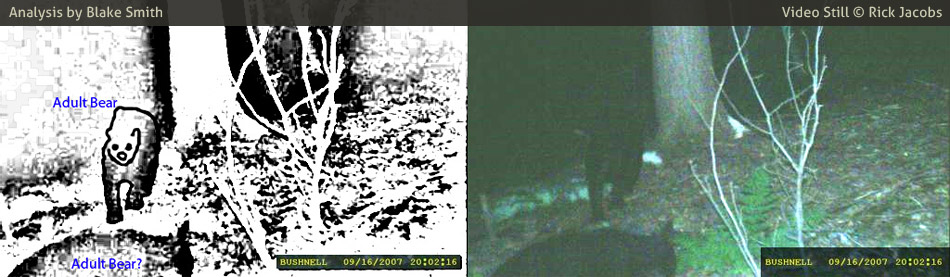
Trail Cam photo (right) taken by Rick Jacobs. Additional Analysis material (left) by Blake Smith. Copyright 2007 Rick Jacobs.
At 20:02:55 the adult bear and two cubs are photographed. According to the BFRO this next photo shows “The ‘Mama Bear’ image, showing “the bear cubs huddling around the mineral lick with a larger bear—likely the mother of the cubs.” They point out that in this color photo, the adult bear does not look mangy. That may be a result of the differences in the night-vision shots vs. the color/flash shots. The adult bear appears to be facing down the hill, away from the salt-lick and cubs. I’ve inset a photo of a similarly posed healthy bear to give an estimate of the pose.
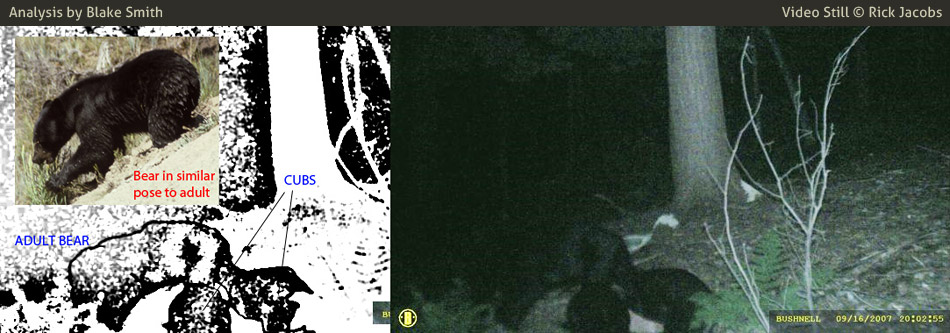
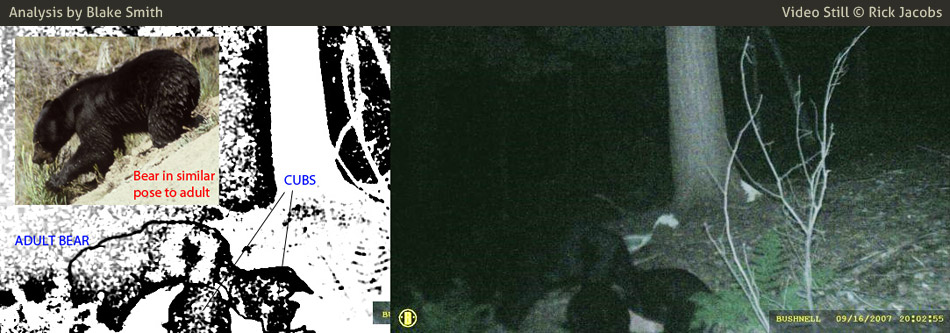
At 20:04:23 this is the next photo we’ve been provided in the series. Why didn’t the adult bear and cubs trigger any more photos in the intervening minute and a half? Observe that the salt-lick is still upright in this photo. The photo shows two cubs at play. Note how much smaller the cub closer to the tree is compared to the adult bear in 20:02:16. The so-called Jacobs Creature is the same size as the creature the BFRO is calling the Mama Bear. (Update: Note the cub in the foreground—it is tiny compared to what the BFRO have been calling “more of the cubs” but which now appears to show two adult-sized bears in the 20:02:16 photo.)
At 20:32:05 nearly a half an hour has gone by and the salt-lick has been tipped over. Are there no photos existing between these two time-stamps from a camera that takes photos every 30 seconds when motion is sensed? 20:32:05 is the first photo of the two “Jacobs Creature” photos. Several bear biologists agree that while this is a strange looking creature, it is likely an adult bear with mange. This makes the bear look thin due to loss of its thick coat, plus potentially emaciated due to side-effects of the mite infestation. It is likely the same adult bear from 20:02:16—but the other photos which show her do not allow the level of detail needed to observe emaciation; too much of her is hidden in the dark.
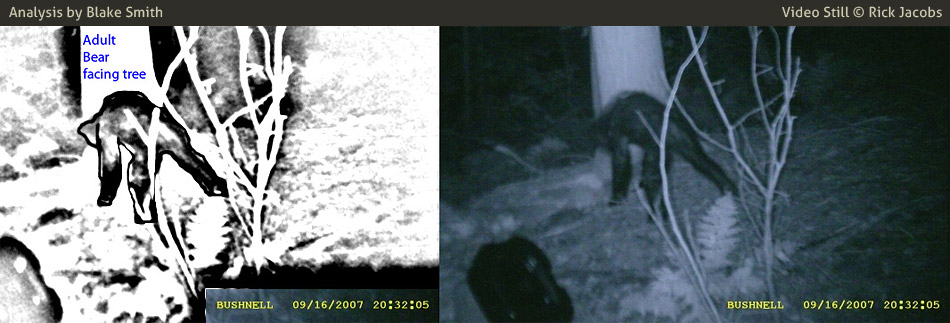
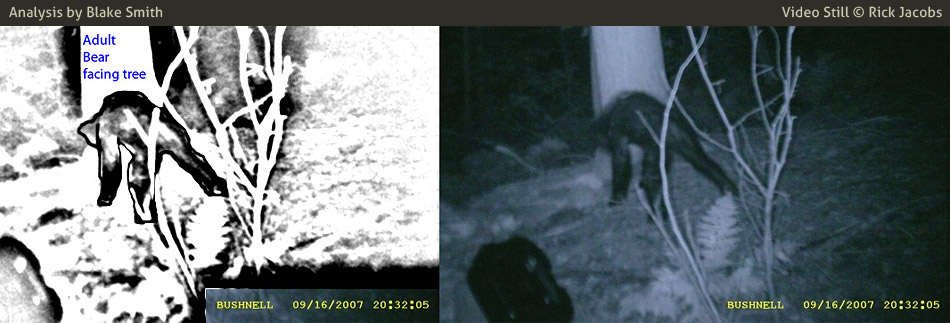
At 20:32:41 we have the second photo of the “Jacobs Creature.” In the image below I’ve outlined what I think the photo really shows: an adult bear with a cub attempting to nurse underneath it. Note that if this pose is correct, it corresponds to the adult bear in size and orientation from the 20:02:16 photo almost exactly.

Music
- Monstertalk Theme: Monster by Peach Stealing Monkeys