Regular Episode
050 – HELL HATH NO FURRY!
The episode opens with a dramatic reading from the original 1577 pamphlet — A Straunge and Terrible Wunder, written by Protestant preacher Abraham Fleming — describing the appearance of a monstrous black hound during a violent storm at Bungay‘s St. Mary’s Church. From there, the conversation expands into the broader folklore of spectral hounds, the sociology of ghost stories, and how a single terrifying pamphlet became the DNA of an entire town’s identity.
🐾 The 1577 Event: Storm, Lightning, and a Very Bad Dog
According to Fleming’s pamphlet, on August 4th, 1577, a great tempest struck the Suffolk town of Bungay during Sunday morning services. A huge black hound reportedly burst through the church doors, killed two parishioners (described as having their necks “wrung clean backward”), and left another “shriveled and distended like a leather purse with the strings drawn shut.” The church steeple collapsed, and widespread panic ensued.
David’s archival research found a more grounded version in the church’s own registrar: a real and severe lightning storm did occur, and two men were indeed killed — most likely bell-ringers struck by lightning while ringing bells in the steeple, a common medieval practice intended to drive away evil spirits. Fleming, writing in London with no apparent firsthand knowledge of Bungay, repurposed the story as a vehicle for Protestant theological argument. The demon hound, in other words, was good propaganda.
📜 Abraham Fleming and the Reformation Context
David situates the 1577 pamphlet squarely within the chaos of the English Reformation. Towns like Bungay had experienced decades of violent upheaval — Catholics and Protestants burning each other in neighboring parishes, local lords changing allegiances, entire frameworks of religious practice overturned overnight. A monstrous visitation during a church service, David argues, was not just a scary story but an emotionally coherent response to social terror. The black dog gave terrifying shape to a communal experience of chaos and uncertainty.
A fascinating undercurrent: the local Catholic population, partially driven underground by the Protestant framing of the event, quietly maintained their faith for centuries under the protection of the Lord of Flexton Manor, practicing Mass illegally until well into the modern era. The Black Dog story, whatever its origins, had real and lasting effects on religious community life in the town.
🌍 Black Dogs Worldwide: Psychopomps and Boundary Creatures
David traces the black dog tradition well beyond Suffolk. Black Shuck haunts Norfolk’s roads as a shape-changing omen. The Barguest stalks Yorkshire. The legends of Squire Richard Cabell on Dartmoor fed directly into Arthur Conan Doyle‘s 📚 The Hound of the Baskervilles 💵. Australia has its own black dingo legend from Chiltern (once called Black Dog Creek), and David mentions a colleague’s account of an Aboriginal story involving a black dingo that could turn you to stone if it spoke to you.
The connective tissue, David argues, is the psychopomp role dogs occupy in human culture — guides between the living and the dead, as seen in Cerberus, Anubis, and the canine aspect of the Celtic death goddess the Morrígan. Dogs are boundary creatures: domesticated yet capable of sudden violence, beloved yet associated with carrion and graves. That ambivalence gets projected onto their supernatural forms across cultures.
The phrase “black dog” as a metaphor for depression — most famously associated with Winston Churchill — and its use by the Black Dog Institute in Australia shows how deeply the symbolism has penetrated the language itself.
🔬 Folklore Research Method: Context Over Cherry-Picking
A recurring theme in the conversation is what separates rigorous folklore investigation from credulous monster-hunting. David emphasizes doing broad literature searches — not just scouring sources for black dog references, but reading local newspapers, estate records, and community histories to understand what was actually going on in a town at any given time. He co-wrote the book with Christopher Reeve, curator of the Bungay Town Museum, and drew on the archives of folklorist Theodora Brown at the University of Exeter — boxes of 19th- and 20th-century folk stories, letters, and eyewitness accounts that would otherwise have been lost.
He also flags the problem of Jungian universalism in folklore studies — the temptation to draw straight lines from Egyptian myth to Celtic tradition to a 16th-century Suffolk church. A Puritan in 1577 Bungay, David points out, would have had no concept of Celts or Anubis. Symbols mean what they mean in local context, not in a globally unified collective unconscious.
Ben mentions 📚 his own book on paranormal investigation 💵 in a related aside about how cultural expectations shape anomalous experiences — the same principle Richard Wiseman explored in 📚 Paranormality 💵.
🏘️ From Portent of Doom to Town Brand
The second half of the episode traces how the Black Dog of Bungay evolved from a symbol of Protestant divine wrath into a civic mascot. In the 1930s, a local figure identified in the book as Dr. Kane deliberately revived and publicized the legend to rescue the town’s identity following the collapse of local industries during the Depression — republishing the story in every newspaper he could reach and rebuilding the castle as an anchor for historic tourism. The black dog weather vane over the town became a beloved landmark; when it was taken down for repairs, letters flooded the local papers.
By the time David was researching the book, Bungay had fully committed: black dog antiques, black dog karate, black dog cinema, the story embedded in school curricula, kids drawing pictures of the hound and occasionally having nightmares about it. Christopher Reeve still dresses as a monk to perform the tale at the town’s summer festival in St. Mary’s Church. A proposal around the year 2000 to install a large bronze statue of the Black Dog behind the church altar was gently discouraged by the minister at the time — who pointed out the theological awkwardness of erecting a statue of the devil in a working church.
David also traces one particularly revealing act of modern myth-making: the popular claim that the Black Dog is the disembodied soul of Lord Bigod, builder of Bungay Castle. He tracked this story back no further than a 1973 book called Haunted Britain by Antony D. Hippsley Coxe, who had imported the Dartmoor legend of Richard Cabell wholesale without, apparently, visiting Bungay at all. The story caught on not because it was old, but because it fit the narrative logic the town had already built around its dog.
📚 Further Reading
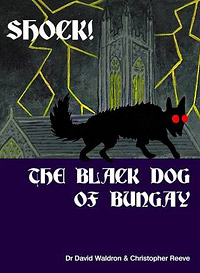
– 📚 Shock! The Black Dog of Bungay 💵 by David Waldron and Christopher Reeve
– 📖 The Hound of the Baskervilles by Arthur Conan Doyle
– 📚 Paranormality 💵 by Richard Wiseman
– 📚 Scientific Paranormal Investigation 💵 by Benjamin Radford
– 📚 Bigfoot: The Life and Times of a Legend 💵 by Joshua Blu Buhs
🔗 Related Links
– Black Dog (folklore) — Wikipedia
– Black Shuck
– Barguest
– Bungay, Suffolk
– Richard Cabell (the Dartmoor legend behind Baskervilles)
– Psychopomp
– Abraham Fleming
– The Morrígan
– Anubis
– Cerberus
Note: ads inserted into the distributed audio alter the timestamps in unpredictable ways, so timing references in these notes are approximate.
Episode 50 of MonsterTalk takes us to a small English village in the 1570s where a morning church service is interrupted by a horrific storm which heralds, perhaps, the appearance of Satan himself in the form of a huge black hound. Join us as we talk with David Waldron (author of Shock! The Black Dog of Bungay) as he helps us discover the facts behind this creepy tale—a tale which influences paranormal literature even today.
Further Reading
Music
- Storm effects via RHumphries at FreeSound.org
- Church Bell via DJ Chronos at FreeSound.org
- Screams by FreqMan, thanvannispen, and Sea Fury at FreeSound.org
- Monstertalk Theme: Monster by Peach Stealing Monkeys
MTArchivist
0