Regular Episode
040 – DEAD MEN ARE A GHOUL’S BEST FRIEND
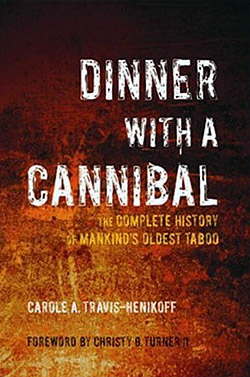
Travis-Henikoff spent seven years researching the book, a project that grew out of her work in paleoanthropology. Her original hypothesis — that Neanderthal decline may have been accelerated by a prion disease contracted through cannibalistic practices — sent her down a research rabbit hole that turned into one of the most comprehensive surveys of human cannibalism ever published.
👻 From Ghoul Folklore to the Living Dead
The episode opens with a reading from Neil Gaiman‘s The Graveyard Book — a Newbery Medal-winning novel in which a trio of wandering ghouls take their names from the first corpse each devoured. From there, Blake traces the ghoul from its roots in pre-Islamic Arabic folklore — desert-dwelling demons haunting ruins and graves — through the literary transformations wrought by H.P. Lovecraft and Robert E. Howard, and on to the modern Romero-style zombie. Notably, Romero’s landmark film was originally titled Night of the Ghouls before becoming 🎬 Night of the Living Dead 💵 — the flesh-eating reanimated dead owe more to ghoul tradition than to Haitian zombie lore.
🦴 Defining Cannibalism — And Finding It Everywhere
Travis-Henikoff defines cannibalism simply as “the ingestion of any part of a member of your own species.” By that definition, it turns up across the animal kingdom — from gut bacteria consuming one another, to intrauterine cannibalism in some shark species, to herbivores consuming placenta and feces. She frames it within the evolutionary “four F’s”: flee, fight, feed, and fornicate — survival imperatives that make starvation-driven cannibalism understandable, if no less disturbing.
Her taxonomy of human cannibalism distinguishes several types:
– Survival cannibalism — driven by starvation (e.g., the Andes flight disaster survivors).
– Exocannibalism — consuming an enemy, often with the belief that the enemy cannot be truly destroyed otherwise.
– Endocannibalism — consuming one’s own dead, usually embedded in funerary belief systems.
– Culinary cannibalism — consumption of human flesh as food, without ritual framing.
– Benign cannibalism — the diner is unaware of what they are eating.
🌿 The Fore People, Kuru, and the Prion Connection
Travis-Henikoff’s original research focus was on the Fore people of Papua New Guinea, whose practice of endocannibalism — consuming their deceased — led to an epidemic of kuru, a fatal prion disease formerly classified as a spongiform encephalopathy. Research into kuru by D. Carleton Gajdusek and others fundamentally advanced the scientific understanding of prion diseases — a line of inquiry that extends to Creutzfeldt-Jakob disease and BSE. Travis-Henikoff hypothesizes that a similar prion disease may have contributed to the slow, geographically progressive decline of the Neanderthals over roughly 5,000 years.
Far from collapsing when Australian authorities banned cannibalism, the Fore adapted: they negotiated road construction to their mountain villages and became successful coffee growers. As Travis-Henikoff puts it, they went “from human beans to coffee beans.”
🗺️ Global Reach: From the Andes to the Anasazi
The conversation ranges widely across cultures and eras. Highlights include:
– The Wari’ people of Brazil — the only tribe documented to have practiced both endo- and exocannibalism. Their funerary endocannibalism was an act of profound love: they believed a loved one’s spirit could not pass to the other side unless the body was consumed. Missionaries who introduced Christian burial left at least one mother in perpetual mourning, convinced her daughter remained trapped on earth.
– Archaeologist Christy Turner‘s identification of 27 sites of apparent cannibalism in the American Southwest, all dating between 900 and 1400 A.D. — a period of severe drought. Evidence included a coprolite (fossilized feces) containing myoglobin, a protein found only in human muscle tissue, settling the debate about whether the bone assemblages represented cannibalism or ritual witch-processing.
– Medicinal cannibalism in Renaissance Europe: for roughly 500 years, European apothecaries sold preparations made from Egyptian mummies — and later from battlefield dead — as cures. A German apothecary catalogue as late as 1903 still listed “mummy” as a remedy. None of it was called cannibalism at the time.
– The Nag Hammadi discovery in 1945, where the Bedouin farmers who unearthed the scrolls later killed and ritually consumed the heart of a man they believed had murdered their father — an act of vengeance rooted in deep cultural tradition.
✝️ Metaphorical Cannibalism and Religion
Blake raises the question of transubstantiation — the Catholic doctrine that the Eucharist literally becomes the body and blood of Christ — and its relationship to cannibalistic symbolism. Travis-Henikoff notes that the Old Testament contains passages in which God warns his people that disobedience will lead them to eat their own children, and that other passages describe exactly that outcome. She is careful to note that no practicing Catholic she is aware of thinks cannibalistic thoughts while taking the Eucharist — but the symbolic architecture is undeniably there. Karen observes that growing up Jewish, the very concept of communion struck her as genuinely strange.
📚 Further Reading
– 📚 Dinner with a Cannibal: The Complete History of Mankind’s Oldest Taboo 💵 by Carole A. Travis-Henikoff
– 📚 The Graveyard Book 💵 by Neil Gaiman
🔗 Related Links
– Ghoul (Wikipedia)
– Kuru — prion disease linked to the Fore people
– Fore people of Papua New Guinea
– Wari’ people of Brazil
– Andes flight disaster (Uruguayan Air Force Flight 571)
– Transubstantiation
– Cannibalism (Wikipedia overview)
– Medicinal cannibalism in early modern Europe
Note: ads inserted into the distributed audio alter the timestamps in unpredictable ways, so timing references in these notes are approximate.
IN THIS EPISODE of MonsterTalk we discuss Ghouls and their real world counterpart: cannibals. The hosts are joined by Carole A. Travis-Henikoff, author of Dinner With A Cannibal: The Complete History of Mankind’s Oldest Taboo. This episode also features guest MonsterTalker Adam Levenstein, a long-time friend of the show whose background combines anthropology and skepticism.
Music
- Monstertalk Theme: Monster
by Peach Stealing Monkeys - Intro music: 1_2_0 by Symbion Project (used by permission)
MTArchivist
0