Regular Episode
039 – A CONNECTICUT HAUNTING IN A KEEN AUTHOR’S COURT
🏚️ The Case: A Funeral Home, a Sick Son, and a Family in Crisis
The basic frame of the story: the Snedeker family rented a house in Southington, Connecticut that had formerly been a funeral parlor, partly to be closer to medical facilities for their son’s treatment. Strange experiences followed — initially reported by the son — and the family eventually contacted demonologists Ed and Lorraine Warren, whose involvement transformed the story into a supernatural spectacle complete with demonic assault, necrophilia at the old funeral home, and a book deal.
Garton reveals that the Snedekers in fact knew the house had been a funeral home before they moved in — it was advertised as such by the rental company. Neighbors never experienced anything unusual, the house had no reported incidents before the Snedekers arrived, and none afterward. A neighbor who lived upstairs told Garton that Carmen’s accounts had originally amounted to bad dreams — and that her story only escalated after she learned about the Warrens and decided to call them in.
✍️ Ray Garton’s Account: “Just Make the Rest Up”
Garton was brought onto the project through his literary agent, who connected him with the Warrens. They wanted a horror writer — someone who could make the story scary — and Garton, fresh from his days reading Warren exploits in the National Enquirer, said yes. What he found in Connecticut was a family whose stories flatly contradicted each other across multiple recorded interviews.
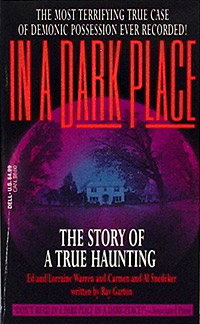
When Garton brought this to Ed Warren, Warren’s response was blunt: “They’re all crazy. That’s why they come to us. Just use what you can and make the rest up. That’s why we hired you — you’re a horror writer.” Garton did as he was told, but was deeply uncomfortable that the result was being published as nonfiction. He began denouncing the book publicly as soon as it was released, and says his account has not changed in twenty years. In a Dark Place: The Story of a True Haunting has been out of print for years — at Garton’s insistence — but was reportedly the second most-requested out-of-print book in the country at one point, behind only Madonna’s Sex.
🔍 What Was Actually Going On?
The most significant detail Garton shares: the Snedeker son, whose reported visions and strange behavior were the seed of the haunting narrative, was later diagnosed with schizophrenia. When Garton briefly spoke with him by phone — with Carmen listening in — the son mentioned that his experiences stopped as soon as he started taking medication. Carmen ended the call immediately. Garton also learned that the girls in the household who claimed to have been touched by invisible hands had actually been molested by the son; he was subsequently institutionalized.
Additionally, Garton discovered during his visit that Carmen was running an illegal interstate lottery scam. The landlord reported that the family had gone three months without paying rent before demonic activity was first claimed — and that they subsequently used the haunting claim, through a lawyer, as leverage. “They have a history of walking out on a lot of bills,” Garton notes.
👻 The Warrens: A Pattern of Practice
Baxter, who did fieldwork with Ed and Lorraine Warren in the mid-1990s after reading In a Dark Place, corroborates Garton’s portrait. He describes the Warrens as running two distinct personas: compassionate and authoritative for clients and cameras, privately dismissive (“they would roll their eyes and express that the people were crazy”). Ed Warren in particular, Baxter says, could turn explosive when questioned — skeptic Joe Nickell reportedly had to be kept physically separated from Ed after a joint appearance on The Sally Jessy Raphael Show (the episode was titled, memorably, “I Was Raped by a Ghost”).
Garton notes that the Warrens consistently sought out horror writers rather than journalists for their book projects — a deliberate choice, since they wanted stories that were frightening rather than accurate. He also points out that the priests ever associated with Warren investigations appear to have been defrocked or otherwise unofficial, despite the Warrens’ claims of close ties to the Catholic Church. John Zaffis, introduced to Garton as the Warrens’ nephew who was “just observing” and “not involved in the case,” has since recast himself as the lead investigator and is reportedly co-writing a new book with Carmen about the case.
📺 From Book to Documentary to Film
Garton had no involvement with either the Discovery Channel documentary or the Haunting in Connecticut feature film, and the Snedekers have publicly distanced themselves from his book — Carmen citing its graphic content (which, Garton emphasizes, came directly from what she told him). The film added its own embellishments, most notably a subplot suggesting that the son’s proximity to death from cancer made him more spiritually permeable — a notion Garton finds genuinely alarming, since Baxter reports encountering paranormal investigators who have since tried to bring actual cancer patients along on investigations to improve their results.
The production company Lionsgate briefly posted the current occupants’ street address on the film’s website, leading to a stream of uninvited visitors and souvenir-hunters at a home that has had no paranormal reports from any resident other than the Snedekers.
📖 Satanic Panic, Fiction as Fact, and the Horror Genre
The conversation widens to the broader ecosystem of credulous “true” paranormal narratives. Garton connects the Snedeker case to the Satanic Panic of the 1980s and 90s — tracing a lineage from Mike Warnke and John Todd in the 1970s, through Michelle Remembers (1980), Rosemary’s Baby, and on to the McMartin preschool case. He notes that when Geraldo Rivera devoted a special to satanic ritual abuse, Rivera used a clip from Rosemary’s Baby to illustrate claims about “breeder” women — a remarkable conflation of fiction and reportage. Garton wrote his own novel Shackled (1997) as an explicit speculative-fiction thought experiment about the panic, and has since had to publicly clarify that it is not a factual account. He also mentions Dennis Wheatley and the way Wheatley’s novels — including The Devil Rides Out — were treated by some readers, including Christopher Lee, as authoritative occult documentation rather than pulp fiction.
Garton also describes his own religious background — raised as a Seventh-day Adventist — and explains that horror fiction, far from reflecting supernatural belief, was his escape from the genuine terrors he was taught to fear as a child. By the time he worked on In a Dark Place, he was in the process of deconstructing that upbringing. The experience with the Warrens accelerated it considerably.
📚 Further Reading
– 📚 In a Dark Place: The Story of a True Haunting 💵 by Ray Garton (out of print)
– 📚 The Loveliest Dead 💵 by Ray Garton
– 📚 Ravenous 💵 by Ray Garton
– 📚 Bestial 💵 by Ray Garton
– 📚 Meds 💵 by Ray Garton
– 📚 Shackled 💵 by Ray Garton
– 📚 Michelle Remembers 💵 by Michelle Smith and Lawrence Pazder
– 🎬 The Haunting in Connecticut 💵 (2009)
– 🎬 The Howling 💵 (1981)
– 🎬 An American Werewolf in London 💵 (1981)
🔗 Related Links
– Ed and Lorraine Warren — Wikipedia
– The Amityville Horror — Wikipedia
– Jay Anson — Wikipedia
– John Zaffis — Wikipedia
– Satanic Panic — Wikipedia
– McMartin Preschool Trial — Wikipedia
– Mike Warnke — Wikipedia
– Schizophrenia — Wikipedia
– Rocky Mountain Paranormal Research Society — Wikipedia
Note: ads inserted into the distributed audio alter the timestamps in unpredictable ways, so timing references in these notes are approximate.
The 2009 film The Haunting in Connecticut is purported to be based on true events. Similarly, there was the 2002 documentary A Haunting in Connecticut (which aired on The Discovery Channel and helped spawn the series A Haunting). These true events have been compiled by author Ray Garton into his book In A Dark Place: The Story of a True Haunting. The shocking tale contains adult elements of a graphic nature, and if true, described a terrifying case of a demonic and ghostly attack on a family. But Garton now says that the allegedly true events weren’t quite what they seemed.
Content Advisory: This episode of MonsterTalk contains adult themes and coarse language.
Music
- Monstertalk Theme: Monster
by Peach Stealing Monkeys
MTArchivist
0