041 – THE BIG BAD WOLF
The subject is genuinely controversial among monster enthusiasts, wildlife advocates, and historians alike — which is exactly why it’s worth examining carefully. The short version: over 100 people were killed and scores more were attacked in a remote corner of southern France between 1764 and 1767, the likely culprit was wolves, and the reason that conclusion still surprises people says more about modern mythology than medieval reality.
🗺️ The Gévaudan: Place, Time, and Terror
The killings began in the late spring or early summer of 1764, concentrated in the Gévaudan, a rugged sub-region of the Massif Central in south-central France — granite outcroppings, dense impassable forests, underground rivers, marshes, bogs, and winters that could drag into May or June. The victims were predominantly peasant women and children tending livestock. Smith notes that the terrain alone explains much of why skilled Parisian hunters took more than fourteen months to kill a large wolf there: they had never seen anything like it.
The documentary evidence for the deaths is solid. Local curés recorded burial notices describing bodies savaged by a ferocious beast, wounds consistent with animal attack, and in dozens of cases — decapitation. Chest cavities were torn open, organs consumed. Ghastly, certainly, but Smith points out that compared to other documented wolf killings across early modern Europe, the pattern was not unusual at all. What was unusual was that the people of the Gévaudan had no frame of reference: they were illiterate, isolated, and unaware of very similar episodes in the Lyonnais, the Soissonnais, and the Limousin in the preceding decades.
📰 The First Modern Media Monster
By the end of 1764 the Beast of Gévaudan had become an international news story — one of the first of its kind. A skilled journalist writing for a paper in Avignon, the Courrier d’Avignon, recognized its market value early and became the primary conduit of beast news to editors across France and northern Europe, who plagiarized or repackaged his dispatches liberally. Smith describes this as a near-perfect storm: a pre-literate peasant population with rich folkloric traditions, a newly dynamic newspaper culture hungry for sensation, political pressure from Louis XV‘s court, and the lingering trauma of France’s losses in the Seven Years’ War (called the French and Indian War in North America). The beast’s reported characteristics inflated with each retelling: blazing red eyes, the ability to walk on its hind legs, a hide impervious to lead shot, supernatural speed. Werewolf rumors — loup-garou — percolated in the countryside even if official documents carefully avoided the term.
Blake draws an explicit parallel to modern cryptozoological panics: scanty evidence goes viral, each retelling amplifies the strangeness, and the monster acquires characteristics that no one originally claimed. The Montauk Monster gets a name-check.
⚜️ Church, Crown, and the Scourge of God
The institutional response added fuel. On December 31st, 1764, the Bishop of Mende issued a public proclamation describing the beast as a divine scourge — a tool of God’s vengeance, supernaturally empowered to evade hunters as punishment for the population’s moral failings. He stopped short of calling it a werewolf, but the implication was plain: piety and humility were the only real defenses. Smith notes this is a textbook example of how monsters function as instruments of social control — behave, raise your children devoutly, care for the poor, or the monster will come for yours.
The Crown’s response was more logistical but equally fraught. A sequence of hunters were dispatched: Dragoon Captain Duhamel, Norman aristocrat Donaval, and finally François Antoine, the royal gun-bearer sent by Louis XV. In September 1765, Antoine killed a large wolf, embalmed it, paraded it before the king, and more or less declared victory — even though everyone involved could see there was nothing extraordinary about the animal. It was a face-saving exercise. The attacks resumed in December 1765.
🐺 Wolves, Hyenas, and the Weight of Evidence
The “false ending” of September 1765 gave way to a further eighteen months of killings before local huntsman Jean Chastel killed another large wolf in June 1767 and the attacks genuinely ceased. Smith is confident the culprits were wolves — probably more than one — based on the considerable circumstantial evidence for widespread lupine predation across early modern Europe, including a 2007 study by a French rural historian cataloging wolf violence against humans from roughly 1500 to 1900, which shows a peak between 1650 and 1750 and a sharp decline after the Revolutionary state launched systematic wolf-hunting campaigns in the 1790s, killing thousands of wolves per year.
The rival hypotheses each have their problems:
– The hyena hypothesis — popularized in part by the Comte de Buffon‘s influential and somewhat sensationalized natural history of the 1750s–60s — caught on early but was discounted by experienced hunters on the ground. A History Channel documentary revisited it and reached the same credulous conclusion, drawing on 19th- and 20th-century retellings rather than original documents. Smith calls it, diplomatically, “pretty laughable.”
– The serial killer hypothesis emerged in a 1911 article by a Montpellier doctor, tellingly written in the wake of Jack the Ripper and France’s first encounters with the concept of the serial murderer. It influenced the film 🎬 Brotherhood of the Wolf 💵 and, apparently, a majority of French Epcot employees.
– The dog-wolf hybrid trained by a deranged local nobleman is another perennial favorite.
– The dire wolf hypothesis — floated elsewhere — was pre-emptively dismissed by a paleontologist consulted by the hosts: dire wolves weren’t dramatically larger than modern wolves and there’s no plausible survival mechanism anyway.
🐍 The Silver Bullet and Modern Werewolf Mythology
One of the episode’s more delightful detours: the legend that Jean Chastel killed the beast with a silver bullet, and that this story directly inspired screenwriter Curt Siodmak when he invented the silver-bullet-kills-werewolves rule for 🎬 The Wolf Man 💵 (1941). Smith confirms there is zero documentary evidence that silver was used in 1767 — the silver bullet story appears to be an early 20th-century invention, likely from the same wave of fictionalized beast literature that ran from the 1880s through the 1930s. Whether Siodmak borrowed from that literature or independently invented the trope remains unresolved, but either way, one of the most iconic rules of werewolf fiction is almost certainly a fabrication layered onto a real historical event.
After the interview, Blake adds a postscript: loup is French for wolf, but the meaning of garou was unclear during recording. Smith wrote back afterward — garou denotes a mythic, malevolent figure with characteristics of both man and wolf, thought to wander the countryside at night. Variations of the loup-garou legend crossed the Atlantic to Louisiana, where it became the rougarou — a shape-shifting boogeyman still active in Cajun folklore.
📚 Further Reading
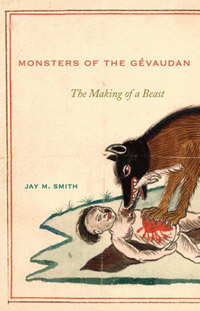
– 📚 Monsters of the Gévaudan: The Making of a Beast 💵 by Jay M. Smith
– 📚 Tracking the Man-Beast 💵 by Joe Nickell
🔗 Related Links
– Beast of Gévaudan — Wikipedia overview
– Wolf attacks on humans — historical record on Wikipedia
– Wolf of Soissons — a comparable earlier French episode
– Wolf of Sarlat — another regional parallel
– Wolves of Paris
– Loup-garou — French werewolf tradition
– Rougarou — Louisiana variant
– Curt Siodmak — screenwriter of The Wolf Man (1941)
Note: ads inserted into the distributed audio alter the timestamps in unpredictable ways, so timing references in these notes are approximate.
CHANCES ARE IF YOU LISTEN to MonsterTalk you probably like nature documentaries. No doubt you’ve seen stories about wolves and heard words to the effect that wolves are often maligned and that wolves have an undeserved reputation for being killers. Yet how does one reconcile the idea that dangerous wolves are a myth with the many myths and fairy tales which feature wolves as the villain? In this episode of MonsterTalk we take on the legend of the big, bad wolf and what we find may surprise you.
This episode features an interview with author Jay M. Smith, about his book Monsters of the Gévaudan: The Making of a Beast.
Additional Resources
History of wolf attacks on humans in recorded history (via Wikipedia) — A disturbing list of wolf attacks through history.
Other wolf attacks in France:
Music
- Introduction features an excerpt from
“Who’s Afraid of the Big Bad Wolf” by Henry Hall - Introduction also features the track:
1_2_0 by Symbion Project (used by permission) - Monstertalk Theme: Monster
by Peach Stealing Monkeys