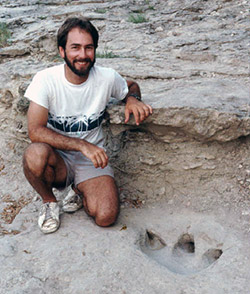
S01E003 – Fins & Fossil Footprints
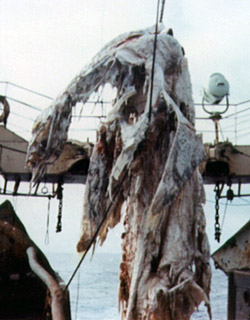
GLEN KUBAN HAS DONE EXTENSIVE RESEARCH on two cases important to monster enthusiasts. His article explaining the true nature of the “mysterious” carcass netted by the Japanese fishing vessel Zuiyo-maru and his decades long investigation into the alleged “giant humanoid tracks” in the Paluxy fossil bed in Texas both highlight the importance of a thorough investigation before assuming the remarkable is true. In the case of the Zuiyo-Maru, the carcass bore a preliminary similarity to plesiosaur remains — an animal which should have been extinct for millions of years. And in the case of the Paluxy tracks, the appearance of hominid tracks fossilized along-side dinosaur tracks would have given young-earth creationists a potential falsification for the theory of evolution. Glen examined that case and his work revealed that the tracks were not those of a prehistoric giant people — but rather weathered dinosaur tracks led to an interesting confrontation with the young-earth creationists.
In this episode, we also briefly discuss a new effort to find the elusive “Mongolian Death Worm.” While we do joke about the MDW during the episode, if the expedition does come up with evidence for a real animal like the one described in the legend (a poison and lightning spewing killer lurking in the desert) we will be delighted to talk about it on a future episode of MonsterTalk.
In this episode
- Glen gives an overview of how he got involved in cryptozoology and the struggle with young-earth creationists.
- Scientists quickly determined carcass found by Zuiyo-maru was a heavily rotted Basking Shark.
- Basking Sharks often rot down to a “pseudo-plesiosaur” appearance.
- Even after the creature was identified as a Basking Shark many people continued to report it as a plesiosaur or as ongoing mystery.
- Finding a living plesiosaur would not falsify the current theory of evolution.
- Glen thinks proof of Bigfoot would pose bigger problems for creationists than a living dinosaur might.
- Glen gives an overview of the Paluxy tracks — a set of fossil tracks that some believed showed giant humanoid footprints next to dinosaur tracks.
- He explains how dinosaur foot prints are fossilized.
- A brief tangent about Bionic Bigfoot ensues.
- You can not tell the weight of a dinosaur by the depth of its tracks.
- You can estimate the weight of a dinosaur and its speed by the size of its bones.
- There are thousands of dinosaur tracks fossilized as well as nesting sites, through multiple layers of sediment — which is strong evidence that these sites were not fosilized in a single great flood event.
- Dinosaur tracks are actually much more common than dinosaur bones.
- There is no set time for how long it takes for a fossil to form
- Any organic matter preserved for over 10,000 is considered to be a fossil.
- A brief overview of some of the massive evidence that Earth is much older than 10,000 years old.
Coincidentally, blogger Phil Plait commented on the tie between creationists, plesiosaurs and Nessie as I was editing this for posting.
SEO Transcript
This is not a fully accurate transcript, and was machine generated. It’s here for helping search engines find the episode but not intended to be a faithful transcript of the episode. (But it’s not AWFUL.) Some of the material in this transcript only exists in the Patreon/Premium edition of the show and was excised for the commercial version.
———————
A lot of the mystery-mongering books, you know, Lorenz and Carl Schuchers and others are more than happy to sort of leave out the inconvenient parts.
Well, it’s the same thing that happens with the ghost cases.
You know, somebody may explain a ghost photo or a haunting, and then the explanation is never reprinted the way that the original haunting story is reprinted again and again.
I call that Chinese whispers, the way that stories are passed down to people and just seem to morph and change, become embellished.
That’s the scientific term.
Chinese whispers.
Yeah.
It’s a linguistic term.
Yeah.
Yeah.
Yeah.
It’s actually quite unlike anything we’ve ever seen before.
A giant, hairy creature.
Part ape, part man.
In Loch Ness, a 24-mile-long bottomless lake in the highlands of Scotland, it’s a creature known as the Loch Ness Monster.
Monster Talk.
Welcome to Monster Talk.
I’m Blake Smith, and together with my co-hosts, Benjamin Radford and Dr. Karen Stolzno, we examine stories about monsters to see what science and skeptical inquiry can tell us about the veracity of such claims.
This week, we’re going to talk about two monster stories.
The first is the case of the Zuio Maru, in which a Japanese fishing boat hauled aboard an animal carcass that looked suspiciously
like a dead plesiosaur.
The second case is that of the Paluxy tracks.
These tracks were once touted as evidence that giant humans walked alongside the dinosaurs.
Our guest today is Glenn Cuban, who investigated both of these cases, and he will tell us about his findings and how young Earth creationists wanted to use both of these cases to try to disprove the theory of evolution.
I think you’ll find it an interesting tale and maybe learn something new.
I know I did.
Monster Talk.
I could read something to you.
The case of the Zuio Maru.
I’m reading from the Reader’s Digest Mysteries of the Unexplained.
On April 25th, 1977, the Japanese fishing vessel Zuio Maru hauled aboard a huge carcass that no one had been able to…
Actually, it says no one has been able to identify.
And this was 1980, I believe, when this book came out.
82, this is the updated version.
Printing is actually 1985.
So this is one of those cases where I believe by 1985 they knew what it was.
But they didn’t go back and fix the Reader’s Digest.
Just looking at some of the citations, it doesn’t seem like too much was really done after the 80s into it.
It seems like they had some big conference, I think between France and Japan, some oceanographic conference, and they basically declared that these were the remains of a basking shark.
The bulk of people in science seem to have accepted already that it’s just a shark.
Right, exactly.
But the monster books are still reporting it as being a sea monster as late as 1985, or at least unknown.
Did you read that article that I sent to you about the death worm?
Oh, I sure did.
I’m very excited about that death worm research.
Yeah, I don’t know if you saw that, Ben.
This was from the Herald Sun, which is a newspaper in Victoria.
It advertised the acid-spitting death worm hunt in Mongolia, the Derby Desert, to find the fabled acid-spitting and lightning-throwing Mongolian death worm.
So a fellow from New Zealand.
So they seem to be causing a lot of trouble at the moment.
That’s the topic of what we’re discussing today.
But it’s called the Algoi Corkoi, the intestine worm, because it resembles a cow’s intestine and is about 1.5 meters long.
And so the worm apparently jumps out of the sand and kills people by spitting concentrated acid or shooting lightning from its rectum over long distances.
How cool is that?
It’s the fact that it can attack in two different directions that I think it makes it so formidable.
Yeah, I remember there was a 14 times unconvention a couple years back.
I think one of the cryptozoologists, I think it was John Downs, gave a recounting of his expedition to Ulaanbaatar to go check out the Mongolian death worm.
That’s interesting.
So it spits acid, and weirdly enough, if you take acid, you’re more likely to see it.
Right.
Yeah, there you go.
And it poops lightning.
It does.
It does.
Apparently, there have been four unsuccessful expeditions searching for it in the last 100 years.
And this New Zealand team, they’re going to try and bring the worm to the surface with explosives.
And they’re going to get through security?
I think.
That’s dangerous.
I think what they should use is thumpers.
So one of the things that amused me about that article was that they were using the position, why would they make something like this up as a reason why it’s plausible?
Because, I mean, come on.
Yeah, it’s rumors could inflate the reputation of things like the Loch Ness Monster and Bigfoot sparsely populated Mongolia was not a place where rumors were going to propagate.
So there’s no reason to lie.
That’s what he said.
That’s an interesting theory.
That particular thread of illogic hadn’t really come across.
Monster Talk.
Tonight we’re talking with Glenn Cuban.
Glenn, you come from a paleontological background.
Is that accurate?
More of a biology background, actually.
I have a B.A.
in biology, and I’ve taught high school biology.
But I do a lot of active paleo research on the side.
That’s kind of my background.
my passion, especially footprints, trace fossils, dinosaur tracks, things like that.
But, yeah, I also, you know, am interested in the…
Creation, evolution, controversy, and cryptozoology, and I guess that’s what you made me want to talk about tonight.
Yeah, we’ve got a couple of things we want to talk to you about tonight.
You’ve been involved with some research on a couple of big cases that have been around for a few years.
One for a lot of years, if you think about it.
But the first one is the Zuoyomaru case, and the second thing we’d like to talk about is the Paluxy fossilized tracks, which some people have alleged are human tracks next to dinosaur tracks.
Right.
So how did you get involved in researching the Zuoyomaru?
Well, I guess I’ve been interested in cryptozoologies since I was a kid, even before I got interested in cryptozoologies.
paleontology and the fluxitracks.
But actually both groups, cryptozoologists and creationists, as you probably know, during the 1980s and early 90s, wrote quite a few articles suggesting that this carcass that was netted in 1977 in Japan might be some type of sea monster or plesiosaur.
So after I read these various articles, I
I decided to look into it further myself.
I wasn’t really satisfied with the level of treatment that many of them had done on it, and so I started gathering all the information I could and then wrote an analysis of it, which was published in 1997 in the reports of the National Center for Science Education.
It’s kind of a skeptics-type journal.
Yeah, why don’t you give us sort of a background on the case?
Basically, this carcass, which was quite large and did sort of resemble a plesiosaur, it had a small head with a long neck and four large flipper-like limbs.
And one of the crew members took a few photographs of it and some quick measurements before they threw it overboard because it was stinking and they were afraid it would spoil the fish catch.
But before that happened, some tissue samples were taken of one of the fins, and that really helped resolve the case, although for some reason many of the people writing about it did not look into the results of that tissue analysis very carefully.
But basically there were several lines of evidence, which I think strongly pointed to it being a basking shark.
Anatomically, its proportions matched a large basking shark,
When basking sharks decay, they often form what can be called a pseudopleasiosaur type shape where tissue around the throat and gills falls away.
It will leave the appearance of a small head and a long neck.
So basically it does kind of resemble a sea monster.
But, again, the proportions are right for a basking shark.
And then when the tissue samples were looked at, they –
They matched the Baskin shark both physically and chemically.
Their physical appearance and their properties in terms of elasticity and translucence and things like that were identical to shark fin rays and specifically a substance called elastoidin, which is only found in shark fins, no reptiles or other fish even.
And then the chemical analysis of the tissues gave a real tight match to the protein profile of a Baskin shark.
And so that pretty much quenched it, even though, again, the word didn’t get out too well for a while.
But, again, if you look at all the evidence combined, it seems pretty clear it was a decayed basking shark.
And there were many previous cases where basking shark carcasses had been caught or washed up on shore and were initially mistaken for sea monsters, but then when studied better, it was concluded to be basking sharks.
I read your article, Sea Monster or Shark, that you wrote for the National Center for Science Education, and I noticed that there was a disparity between the early opinions of the Japanese scientists and those of the Americans and European scientists.
So why do you think that was the case with their early perceptions?
Well, I think it was just some initial reactions which conflicted.
They all pretty much agreed in the end, for the most part.
Initially, it seemed like the American scientists were somewhat more cautious or skeptical about the case.
They didn’t want to suggest that it was a plesiosaur or any kind of unknown animal because many of them were familiar with the previous cases of basking sharks or whales or other known creatures being mistaken for sea monsters.
So even the Japanese, some of the Japanese sources were more than more popular about
newspapers and so forth, the scientists, once they did their tissue sample analysis, they all pretty much came around to concluding it was almost certainly a decayed basking shark.
You were talking earlier about the links between creationism and cryptozoology.
I’ve read some stuff by, for example, there’s a guy named Chad Arment who’s written a couple books on cryptozoology, and I’ve heard some people talking about how part of the reason that many…
scientists, or at least I should say many of the Bigfoot proponents, some of whom are scientists, such as Jeff Meldrum, are really fighting for belief in Bigfoot and other cryptids is because evidence for cryptids and these sorts of long-lost creatures would bolster the arguments, for example, for Noah’s Ark and other biblical things.
What’s your take on that?
Well, the creations we see on these potential cryptids
living fossils, if you want to call them that.
What they seem to be doing for the most part is trying to argue that the Earth must be young or conventional geology must not be accurate if we find these living fossils, which I think involves a major misunderstanding of geology and Earth history.
There is no conflict between evolution or an old Earth and the finding of these cryptids because once an animal group
or any organism, could be a plant even, appears in the fossil record, there is no reason why it has to go extinct at any particular time.
It may appear to have gone extinct based on the lack of fossils, but we know the fossil record’s incomplete, so it’s always possible that the group or some remnant of that group survived later than we thought and even into modern times.
There are many groups which many people think of as modern, like lizards and snakes and turtles,
which were living alongside the dinosaurs.
So if another reptile group, such as plesiosaurs, happened to have a modern representative, it would not destroy conventional geology or the theory of evolution or anything like that.
It would just be another interesting case where we thought…
a group had gone extinct, and we come to find out that that was not the case.
Now, in the case of Bigfoot, I think that’s especially interesting.
Most creations have stayed a little bit farther away from that than, say, these pleasesore cases, because if Bigfoot exists, it would apparently be some type of subhuman hominid-type creature, and that does not fit very well with strict creationist ideas that humans did not evolve, that nothing evolved, that everything…
All basic life forms were created by fiat just several thousand years ago.
So most creations are not big on Bigfoot, so to speak.
Like many scientists, I’m fairly skeptical, based largely on lack of physical evidence.
The fact that it seems that most of the evidence for it is either anecdotal or based on things like footprints, which can be faked, you know, rather than some compelling physical evidence.
So you’re saying that the main influence that the creationism would have on it would be either arguing for a young Earth or sort of challenging evolution?
Yeah, in the case of things like alleged plesiosaur carcasses, they would argue that, one, it might somehow disrupt conventional geologic timetable.
They seem to think that if scientists conclude that plesiosaurs went extinct of the dinosaurs, for example, that that is somehow some critical tenant of evolution, when really it is not.
Now, the plexi tracks, which we can get into, are a more interesting case.
That would be a much better…
support for their position if there actually were human tracks alongside dinosaur tracks, because the general pattern of the fossil record does indicate that large modern mammals, and especially humans, did not appear until long after the non-avian dinosaurs went extinct.
So the finding of human tracks back in the Cretaceous rocks of dinosaurs would, in fact…
be a major problem for conventional geology.
Much more of a problem than, say, finding a modern plesiosaur, which all that would mean is that some group of reptiles survive longer than we thought.
In the case of creationists who have used plesiosaurs or other brachiosaur or a similar animal in Africa, that seems to be a popular one as well.
And, of course, there’s the pterodactyls.
Right, right.
In all of those cases, like I say, they really…
in many cases implied it would be huge problems for conventional geologists to explain, but really not.
In fact, just like with the discovery of the coelacanth or the ginkgo, conventional scientists would celebrate those finds.
They would say, oh, great, some creature we thought was extinct is still alive.
It would not be a problem for them whatsoever.
On the other hand, again, finding human tracks…
In Mesothelic rock, that would be a different story.
That would be a big problem.
How have the creationists been using it in their literature and in their program?
It seems like you presented a few cases where they had.
Yeah, well, to be completely honest, they, the creationists, and cryptozoologists for that matter, have really not used either of these cases in recent years very strongly.
Cryptozoologists have backed off the Japanese plesiosaur and have acknowledged it’s most likely a basking shark.
And in the case of the Paluxy tracks, almost all the major creationist leaders and groups have admitted that they were wrong or likely wrong in a lot of their initial identifications and that there is no compelling evidence of human tracks in the Paluxy or in the ancient rocks as far as that goes.
There are only a few individuals still promoting the Paluxy
Mantrax, as they call them, but they’re considered disreputable or unreliable even by most creations.
So really, that controversy has kind of faded.
Most of them have backpedaled from their older claims.
Has there been any major scientists or spokespeople who’ve rescinded their endorsement of this creature as being a plesiosaur, anyone in particular?
It was primarily a few cryptozoologists and several creationists who
promoted the plesiosaur interpretation initially.
I don’t think any of them were actually experts in the field of marine science or paleontology or anything like that.
So I don’t think it was ever a case where conventional scientists were embarrassed by misidentification.
Especially American scientists seemed to be pretty cautious initially.
And they speculated that it could be a shark or perhaps a whale or a large turtle with a shell missing or something like that.
But they waited for the tissue analysis before drawing any firm conclusions, which was good.
And unfortunately, the initial sensational reports seemed to get a lot more attention than the scientific reports of the tissue analysis, which pretty much…
Well, that’s always what happens.
The original claim is just this big headline grabbing, you know, mermaid found.
Oh, wait, hold on.
That’s why I basically wanted to do the article to kind of compile the history of the case and explain all the lines of evidence which pointed to the fact that it was almost certainly a basking shark to try to just set the record straight on the thing.
And occasionally you’ll still see…
An article here or there, which is not familiar with the whole case, and suggests that it could still be a plesiosaur.
But though those are few and far between, it seems like almost all creationists, cryptozoologists, and mainstream scientists have come to believe.
I agree that it’s almost certainly a basking shark.
A lot of our listeners may not be familiar with the Paluxy case.
Can you sort of give us a little thumbnail sketch of the whole incident and basically what your thoughts are on it?
Yeah, that’s something which has largely consumed my spare time for about 30 years.
I began investigating the tracks right after college in 1980.
and would fly down to Texas and work in the riverbed for a week or two or three, almost every year since then.
And I was just there a few weeks ago, as a matter of fact, trying to finish up some mapping in the state park where a lot of the tracks are exposed.
And it’s hard to summarize the case in just a minute or two.
I referenced my website where I have many articles explaining the whole controversy.
And what website is that, Greg?
Well, my homepage is paleo.cc, P-A-L-E-O dot C-C. And from that, there are links to my Plexi articles as well as my plesiosaur shark article.
So that’ll give listeners a chance to look into it in more detail.
But I can try and summarize quickly.
Around the turn of the century, 1908, there was a large flood in the Plexi, which is a riverbed about 60 miles south of Fort Worth near the town of Glen Rose, Texas.
And the flood ripped up some limestone layers, revealing…
many dinosaur tracks, which the locals initially mistook for ancient elephant tracks.
Some of the elongated forms they thought were giant human tracks, or as they called them, moccasin prints, giant moccasin prints.
And in the 1970s and 80s, many strict creationist groups seized on these tracks.
They did a film there and took a lot of photographs and didn’t do a lot of rigorous work, but…
wrote a lot of articles and, again, this film that promoted these elongated footprints as giant human tracks alongside dinosaur tracks and claimed that that proved that evolution could not be true in the conventional geologic time.
People had to be wrong, and the Earth was only several thousand years old.
That’s kind of their argument.
This was one of their best tangible lines of evidence they claimed for this.
During my…
studies in college I began reading creationist literature and ran across these claims about human tracks alongside dinosaur tracks and I didn’t know what to make of them and I wasn’t satisfied really with the level of documentation either in the creationist literature or the mainstream responses a lot of conventional scientists had dismissed the claims as just all carvings or all middle toe impressions of dinosaurs or as one thing or another without apparently a lot of careful research to determine what exactly they were
So I decided right after college to fly down there and try to investigate and figure out what they were.
And it turned out to be a perfect time.
The riverbed was dried up and all the sites could be accessed.
And I was able to, with a friend of mine, clean off and photograph and study a lot of the depressions which were claimed to be human tracks.
And before long, we had concluded that some of them were just erosional features, just natural regularities or erosional marks that had been selectively highlighted to look kind of human.
And there were some cases of what appeared to be carved prints.
Most of the carvings were on loose blocks of rock.
But there were definitely some striding trails of elongated prints, which did not look like typical dinosaur footprints.
Bipedal dinosaurs typically make footprints with three large toes, almost like large bird tracks.
And these were much longer, and the toes were not very distinct on many of them.
They did look somewhat like moccasin prints in some cases.
But when we cleaned the surface very well, we could see on almost all of them indications of a three-toed, a long three-toed
pattern at the front.
So it was becoming clearer to us, even before the end of our first trip, that they must be some type of reptilian or unusual dinosaur prince, but we really didn’t understand what was causing them to be that elongated and take on that roughly human-like shape.
And to make a long story short, in my subsequent trips there and further studies on other sites
I found more and more examples of these elongated footprints and better and better indications of a three-toed pattern at the front.
And it appeared to me that at first I thought maybe there was a dinosaur with an unusually long foot making these impressions.
And then it suddenly dawned on me it wasn’t a dinosaur with an unusual foot.
It was a dinosaur walking in an unusual fashion.
It was putting weight on its soles and heels in what I call a plantigrade type.
way of walking, and I call these metatarsal tracts because they’re impressing their metatarsia, their soles and heels, rather than just being up on their toes like most dinosaurs.
Well, when I show this evidence to some paleontologists, initially they kind of downplayed it and said dinosaurs, as far as we know, they don’t walk that way, so you must be mistaken.
But I gather more and more evidence and some very clear examples of these metatarsal tracts
And then in 1986, I gave a couple of papers at the first international convention on dinosaur tracks, and they all then agreed that these were, in fact, metatarsal dinosaur tracks, and they did appear to explain most of the alleged human tracks in the Pluxy.
And during all this, I was also writing letters to many of the creationists who had made the claims, urging them to come down to the Pluxy and look at the evidence that I was uncovering and reexamine it.
some of the tracks and trails that they said were human because in almost every case you could see some pretty strong evidence of these dinosaurian toes at the front of their human tracks.
I wasn’t sure if they had not cleaned the track surface well enough or if they just were selective in what tracks and which trails they had showed.
But in 1985, the evidence was becoming even plainer that many of these were dinosaur tracks because we noticed that on their most famous sites,
the digit impressions of the dinosaur tracks were infilled with a secondary sediment, and the infilling was rusting.
As we had cleaned and exposed them repeatedly, the iron in the infilling material was actually oxidizing and becoming a dark, rusty brown color and was contrasting with the limestone and increasing the contrast.
In other words, they were becoming more and more obviously dinosaurian.
And finally, after they saw enough of our pictures and diagrams and so forth, representatives from the largest creationist group in California, ICR, the Institute for Creation Research, and representatives from the company that did the film, Footprints in Stone, they came down and were quite shaken when we showed them all the evidence, and they admitted that they apparently had made a mistake.
And soon afterwards…
They withdrew the film from circulation, and ICR stopped selling their book.
I don’t mean to interrupt.
That right there is pretty remarkable.
I’ve rarely heard creationists admit they made a mistake.
Well, they weren’t too eager to do it.
That’s exactly right.
There’s a little bit more to the story.
John Morris, who’s now the director of ICR, he was at that time the son of Henry Morris, who was the director.
He wrote the longest creationist treatment on the subject.
It was the book called Tracking Those Incredible Dinosaurs.
And when I showed him all this evidence, he looked quite upset.
And he said, I don’t know what we’re going to do.
We just printed thousands more copies of this book.
And I said, well, John, you’re going to have to tell people the truth.
And he said, well, I don’t know what we’re going to do.
I don’t know what we’re going to do.
I have a lot of pressure from the group.
And he was saying things like this.
And then he said, well, how do I know?
that some of these features weren’t painted on the tracks.
And I said, John, you can see that, you know, there’s not just the color contrast, but there’s indentations or cracks or other indications of these three-toed dinosaur patterns on the tracks, you know.
And he said, yeah, I can see that.
So he admitted on site, in other words, that these were actually dinosaur tracks, that the coloration features were part of the infilling phenomenon.
They weren’t painted on.
He also acknowledged that there were cases of carving and highlighted erosion marks and so forth.
But he said, I don’t know that I can just come out and say all this.
He kept looking for ways to kind of backpedal without admitting fully that they had misidentified these things.
Did they consider putting a sticker on their book?
Well, yeah, he actually did keep selling the book for a while.
in most cases, did not have disclaimers in it.
He eventually stopped selling it.
But what really disturbed me is that when he did finally write a statement about the tracks, he admitted that they had made some possible mistakes, but that it is possible that some of these features may have been artificially applied with paint or acid or something like that.
And in the context of talking about my research, it kind of insinuated that…
My colleagues might have doctored the tracks to make them look more dinosaur-like, but he admitted on site that that was not the case.
So that disturbed me, that he could not just come clean and say he was wrong.
In any case, most groups, they praised him for admitting a possible mistake, and ICR and other groups no longer promote the tracks.
There are only a few individuals that still do so, and again, they’re not considered reliable even among creationists.
So the controversy has died somewhat.
Well, I knew that John Green, the Bigfoot journalist, had written about these tracks and wanted to know why no specialists in fossil footprints had investigated them, but he wrote that a few years before your investigation.
Yeah, I didn’t claim to be a fossil footprint expert when I began studying the Paluxy tracks, but I’ve learned an awful lot in the course of my research, and I have…
I often work with professional paleontologists in the Biloxi.
And, in fact, just a few weeks ago, again, I was doing more work with some paleontologists, Jim Farlow from Indiana Purdue University and representatives from the Texas Parks and Wildlife Department and so forth.
So I’ve not done all this by myself, but I did kind of spearhead the resolution of the controversy, mainly because no one else was really doing it.
For some reason, especially when I first started working,
Footprints in general, fossil footprints, didn’t seem to be too interesting to many paleontologists, and I think some of them might have been staying away from the Biloxi tracks just because of all the creationist involvement and their reluctance to kind of get embroiled in the whole controversy, which I think was a mistake because we learned an awful lot about dinosaur behavior and locomotion and posture and so forth just from studying the dinosaur tracks, even aside from the human footprint controversy.
How big are these tracks?
You said giant.
Well, they’re not all huge.
A typical metatarsal dinosaur track is about two feet long, sometimes shorter.
But the portion of it which appears human-like is the metatarsal section at the back.
These tracks appear roughly superficially human-like.
when the digits are subdued by either erosion or infilling or mud collapse or some combination of those factors.
And it’s that back part, the middle tarsal segment, which roughly resembles a human foot.
And in many cases, it’s somewhat larger than a normal human foot.
It might be 14, 15, 16 inches long or longer.
And that’s why when some of the locals during the Great Depression carved some giant human tracks on loose blocks,
I think they were just trying to make better examples of what they assumed were human prints or human moccasin prints in the Paluxy.
I don’t even know that they had any anti-evolutionary motivation.
I think they were just trying to make a little extra money.
They probably didn’t even understand that human tracks weren’t supposed to be with the dinosaur tracks geologically.
And I’m not even 100% sure that they sold the tracks as real tracks.
They might have even admitted they were carvings, for all I know.
I recently, during my last trip,
met the grandson of the man who apparently carved most of the loose slabs, and they recently found another one in the cellar.
And the family acknowledges that this man did carve the tracks.
His name is George Adams.
They all have the ones that lose blocks, anatomic problems that usually the toes are too long, the balls misplaced, and so forth.
And several have been cross-sectioned, and the subsurface features abruptly truncate after depressions, so that shows pretty clearly that they were carved.
But again, I think he was just trying to make better examples of what he assumed were human tracks in a plexiglass riverbed, which, again, I think began when the locals misidentified these metatarsal dinosaur tracks as human tracks.
And when they’re not well cleaned, they do look roughly like large human tracks.
They do have that general shape.
So it was an understandable misidentification for the locals.
Most of them, I think, were sincere, but they could have done a lot better research.
They just, again, seemed to have not cleaned and studied the tracks carefully and kind of jumped to the conclusion that they were human tracks, which was what they wanted to conclude they were.
But, again, most have backed off and backpedaled in recent years, and very few promote them anymore.
Glenn, can you tell us how footprints are fossilized?
It’s interesting.
Even scientists debate the exact conditions under which different footprints are formed or fossilized.
In most cases, though, it seems like for footprints to be preserved well, they need to be made in a moist but fairly firm sediment.
In the case of the Texas tracts, it would have been a firm, limey mud.
And during early Cretaceous times, the ancient Gulf of Mexico came inland much farther than it does today.
And when the tide went out, it would have left a vast mud flat, and the dinosaurs were marching through that for who knows what reason.
And then probably they dried out for a short period of time, maybe days, maybe in some cases a little longer, which would have given them a chance to get a little harder, kind of baking in the sun, before they were buried with another sediment.
And again, for tracks to be well-preserved…
In most cases, it would be gently buried, and probably usually with a contrasting sediment.
In other words, if the original material was a limey mud that they walked through, if the sediment that buried them was a little sandier or coarser, that would help the layers to separate later.
And that’s what happened in the case of the Biloxi tracks.
There’s kind of an alternating sequence of different types of sediment and sediment.
Of course, the Paluxy Riverbed was not there initially.
Many visitors to the state park, they’re puzzled by the fact that all these tracks are in the middle of the riverbed, and they wonder how could they survive for millions of years with the river flowing over them.
Well, of course, it wasn’t flowing over them.
The river wasn’t there.
The river just removed the overlying rock layers that exposed the tracks again.
And, of course, while they were buried, they gradually turned to limestone.
And that does help them to resist erosion.
But they do erode fairly quickly once they’re exposed.
It only takes years or decades before they start getting eroded or broken away and washed downstream.
Just since I began studying the tracks in 1980, many dozens of tracks have washed away or eroded badly with epoxy.
But then sometimes the river cuts into the banks more and exposes new ones.
So there are still many good tracks to be seen there.
But it’s interesting.
Whenever I’m working in the Plexi, a lot of visitors will come by and then ask questions about how the tracks were made.
And some of them, I don’t mean to make fun, but are kind of humorous.
One lady had a very puzzled look on her face, and I asked her what was bothering her.
And she said, well, I knew dinosaurs were heavy, but I never imagined they could punch holes in solid rock.
You’ve got to leave scientific literacy among the masses, huh?
Right.
You don’t know whether to even begin explaining at that point.
But most people do understand that the tracks were made in soft mud initially, but they many times are confused as to how they stay preserved so well or whether the river was there all along and so forth.
So how long will these tracks survive with a river going over them?
It depends a lot.
The ones that are in the middle of the riverbed, which gets the greatest force of the water action and the scouring from the sediment and so forth, they don’t last but a few years until they get noticeably scoured.
And some of them that were quite nice when I first visited in 1980 are completely obliterated or very badly scoured now.
When the track surface is moist and it was raining on and off,
It looks like the dinosaurs just walked by a few minutes ago.
They’re back there.
I posted some photos from my recent trip on my website photo gallery, and I’ll be putting more up soon.
You can see the tracks in the flux are some of the best dinosaur tracks in the world, and the sauropod tracks, which are made by the four-footed rhinosaur-type dinosaurs, are unquestionably the best in the world.
They show the digits, the claw marks, really plainly, whereas…
sauropod tracks and other sites, and there aren’t too many other sites that have sauropod tracks.
They usually look like just big potholes.
They don’t have the details, you know, the crisp features that the plexiglass have.
And the three-toed tracks, they occur in quite a few sites, and most of the ones in plex are made by theropods, which are two-legged meat-eating dinosaurs.
But even though they’re fairly common, the ones in the plexi are some of the best in the world.
They have really distinct features.
You can see the claws and tabs on each of the feet in many cases.
So they’re quite impressive.
I was going to ask, just to change gears a second, I was going to see, what do you make of the often heard Bigfoot claim that when you bring up the fact that there really is no fossil record for Bigfoot, they often say, well, you know, bear bones are rarely found out in the wilderness, and we know the bears exist, and therefore, I’ve never really understood therefore what, because, you know, we know the bears exist.
Yeah, I’ve heard that.
As a matter of fact, a good friend of mine is this,
a pretty avid Bigfoot tracker.
He goes looking for it and believes it probably exists.
I’m much more of a skeptic, and I was never too impressed by that argument.
For one thing, I don’t think the analogy holds up too well when you consider bare bones or other bones of large vertebrates, whether they be cougars or deer or whatever.
They may be rare, but they are found.
Dozens and dozens are found every year in not only their bones, but complete carcasses and the living animals in all those cases.
Many, many examples every year.
What would be different about Bigfoot that would make its physical remains so much more rare that they’re essentially nonexistent other than the alleged footprints?
You just don’t find bones or carcasses ever.
Right.
There’s one thing to say they’d be rare, but if they were rare, you’d still have dozens of examples.
But to explain why you never find them, that becomes much more problematic.
Right.
And plus, if the Bigfoot are really 12 feet tall, or depending on which one you’re talking about, then presumably the bones would be scaled up, so they should be…
even larger and presumably leave an even bigger record.
Right, right.
I mean, you could make the argument, well, maybe they’re burying their dead or something, but then you’d have evidence of graves and so forth or tool using or something.
It’s just hard to explain why you don’t find any evidence of, you know, where they sleep or their physical remains or other than the alleged footprints.
It’s pretty much just anecdotal sightings.
And, you know, most scientists just can’t put a whole lot of stock in that.
Well, it’s my understanding that extraterrestrials actually come and snatch dead Bigfoot, and they take them somewhere else, and therefore that’s why we can’t find them.
That’s possible, I guess.
I think that’s a joke, though, right, Ben?
You know what?
I’m sure someone’s made that claim.
Actually, I think that was an episode of The Six Million Dollar Man.
There you go.
They had an alien Bigfoot.
They did.
They had bionic Bigfoot, but I was just thinking that aliens prefer cow rectum.
That might have been before your time.
No, no, I was right in there with the six-man.
Anyhow, I mean, like a lot of people, I would love for Bigfoot or any of these cryptids, as they call them, to exist.
But, you know, most scientists, they just want compelling evidence before, you know,
accepting it, and that’s all I ask for, too.
You know, I’m glad to entertain it, but before I say it, it’s probable, you know, or likely I’d want to see better evidence for it.
Because I know from the Paluxy tracks and other things that people often do misidentify things or jump to conclusions, you know, and if they see something big and furry from a distance, you know, whether it’s a bear or…
somebody in a costume or some footprint that someone may have faked.
I mean, it’s easy to jump to a conclusion, but in order to prove it scientifically, it takes more rigorous evidence, I think.
Well, actually, there’s some real good overlap here between cryptozoology and this particular misidentification of footprints, and so I’m glad you’re answering some of our questions here.
Can you derive roughly how much a dinosaur weighed from the depth of the tracks?
No, not at all.
That’s a common question.
But actually, the depth of a print has a lot more to do with the consistency of the sediment than how heavy the animal is.
If you think about it, you yourself can make a very shallow track or no track at all if you’re walking on firm ground.
If you’re walking on soft mud, you might sink in a foot.
So it’s very hard to gauge someone’s weight from the depth of the print without knowing exactly how, you know, the density and consistency of the sediment.
And even in the flux, you can see what appears to be the same type and roughly the same size dinosaur will make.
prints of vastly varying depth depending on where and when he walked.
You know, the areas where that mud appears to have been firmer and very shallow prints and other areas where it appears the mud was soft and the same size print will sink in, you know, very deep, sometimes up to a foot into the mud.
But you can get an idea just based on what type of dinosaur it is by the structure of the flood.
You can tell whether it’s a theropod, two-legged meat-eater, or an ornithopod, a two-legged plant-eater.
And in the case of Texas tracks, most of the theropod tracks were probably made by a dinosaur called Acrocanthosaurus.
And we have its bones and some fairly complete skeletons.
And so we can judge based on the size of the footprint how big the animal would have been and using some reasonable guesses on how it was fleshed out, about how much it would have weighed and so forth.
So it’s based more on the size of the prints than the depth of the prints.
And you can calculate the speed, too, but, again, it’s based on some assumptions about analogs with modern animals based on the size of the foot and the hip height and so forth and the length of the step, how fast, roughly, it would have been moving.
But there are some formulas you can use and get a reasonable estimate for how fast a dinosaur on any particular trail would have been moving based on its pace length and its foot length.
So if two dinosaurs, you had a theropod and a sauropod crossing, and they’re roughly in the same strata track-wise, how closely can you tell whether they were, are they within years of each other or minutes of each other?
Well, on most of these sites, there’s very little doubt that even when you have sauropod tracks and theropod tracks together, in some cases, there are nornithopod tracks too.
Some are a little deeper than others, but…
it appears they were made probably within hours or days of each other most of the trails on any one particular site.
Because even though they may have dried out and, you know, not been buried immediately, they couldn’t have been sitting out there for years or they would have been marred by erosion and weather and so forth.
So at most it’s weeks or months and probably in most cases less than that that any particular track site was exposed before it got buried.
And…
In the case of some of the plexi tracks, they are so clear that it looks like they were probably, you know, dried out and then buried, you know, pretty quickly before any series of, you know, say tides or weathering came.
Probably the first tide buried them enough where they were protected, you know, and came in fairly gently and just kind of settled into them.
Some paleontologists think on some sites there may have been some laminations of different types of sediment where as soon as the dinosaur stepped,
stepped, some sediment of a different type sloshed right into them immediately.
They were almost instantly preserved in that sense.
But there’s some debate about that.
In any case, it looks like on most sites that there was not much time between when different dinosaurs walked through the area.
But of course, tracks are found throughout the fossil record from a lot of invertebrate tracks and paleozoic periods to just
you know, dozens and dozens of, actually thousands of track sites throughout the Mesozoic, which is really difficult for a strict creationist to explain how all these thousands of track sites were formed during the midst of a violent global flood.
It just doesn’t add up.
And if you think about the large nesting sites that have been found in some areas, we have hundreds of dinosaur nests, which would require that dinosaurs get together, mate, you know,
make nests, lay the eggs, hatch the eggs, and so forth.
It could not happen during the midst of a violent flood, so it really puts a kink in their argument about the Earth being only a few thousand years old and the flood explaining most of the fossil record.
The tracks really seem to be a big challenge to that idea.
Sure.
So your work has been a big challenge to that, too, apparently.
Yeah, I have not really pushed that particular line of argument, but I think
I’ve mentioned it, and I think creationists realize that.
They really haven’t come up with a good explanation for that.
The best they can do is say something like, well, maybe there were some lulls in the floodwaters, and yet, by their own other descriptions, it was a rapid and continuous deposition, very violent, worldwide, and so forth.
And, you know, even if you could say, you know, there were some periods where the floodwaters were less violent, where were all these dinosaurs while the…
thousands of feet of sediment were being deposited underneath.
Were they treading water for months?
It doesn’t make sense.
And then when you consider, like I say, besides the dinosaur tracks throughout the Mesozoic, there’s thousands and thousands of other track layers of amphibians and other reptiles and invertebrates, insects and spiders even, and things like that, all throughout the fossil record.
And so to explain how they could all be made in the midst of a global flood just doesn’t make sense.
You can get into radiometric dating and all the problems with that, too, that conflict with their limb model.
But I think the tracks are really especially interesting because they’re really a record of the living animal, and you can learn a lot about their behavior and posture and locomotion that you can’t easily learn from their bones or dead remains.
And they’re very common, too.
A lot of people think that dinosaur tracks are fairly rare, but actually they’re much more common than dinosaur bones.
And that makes sense when you think about it, because if Dinosaur had only one skeleton, that’s the most it could have left.
And, of course, many skeletons aren’t even preserved.
it could leave millions of tracks during its life, and at least some of them would probably be preserved.
That’s true.
Well, Glenn, I really appreciate you taking the time to talk to us today and for taking so much time to investigate these questions because somebody needed to, and you’ve done some really good case studies here, and obviously this one’s captured your imagination.
Thank you.
Thank you very much.
A lot of fun.
And as soon as I…
saw the tracks in 1980, I was immediately hooked on them.
I couldn’t believe that more people were interested in working on them.
It’s been a passion of mine ever since.
I know we’ve been talking for quite a while.
You had a couple other questions about how long it takes a fossil to form and so forth.
Did you want to touch on those?
If you want to talk about that, yeah.
How long does it take a fossil to form?
Interesting question because there really is no set answer.
Some creationists have
try to cite examples of very rapid fossilization where some, say, modern object will be encased in a rock nodule or something and then try to argue, well, see, it doesn’t take long for things to fossilize, so maybe the Earth is very young after all.
But that really is a fallacious argument because even though some things may fossilize quickly, if you want to even call that fossilization, in other cases it appears that it requires many hundreds of thousands, if not millions of years, for something to be fossilized.
And by fossilized,
Generally, what we mean is that the original tissue or material is being replaced by other minerals or sediments, and it’s turning into a more stone-like state.
But that’s not really required.
Actually, for something to be a fossil, it has more to do with its age than its composition or hardness.
As a rule of thumb, if an organic object is…
older than about 10,000 years old, it’s considered a fossil, no matter how well mineralized it is.
Really?
Even if it’s not mineralized at all?
Right.
You can have, for example, a shark tooth, which might be, say, many thousands of years old or even a couple million years old, and still retain most of its original material and have very little mineral replacement, because it’s extremely hard and dense to begin with.
Things don’t just tend to absorb in it very easily.
But it’s still considered a fossil as long as it’s over about 10,000 years old.
And the reason they use that
That rule of thumb is that, you know, the beginning of the Holocene is considered to be about 10,000 years ago, and the Holocene is considered, you know, the modern epoch, essentially.
So anything that’s pre-modern, prehistoric, if you will, is considered a fossil if it’s the remains or trace of any living thing.
And, of course, even a footprint can be considered a fossil.
A prehistoric footprint would be considered a fossil.
But if the sediment was made and is not completely petrified or it might still be pliable, in some cases they are,
That doesn’t mean it’s not a fossil.
And the composition might be almost identical to what it was originally.
It’s just maybe gotten a little harder.
But that has nothing to do with whether you consider it a fossil or not.
Anyhow, there are many types of fossilization and the rates at which something becomes hard or mineralized varies a lot depending on the conditions, what other minerals are in the surrounding sediments and how fast the water might be leaching through it and so forth.
So it varies a lot.
There are some things which can become encrusted or
or somewhat mineralized, just even in decades or centuries.
And creationists like to seize on those and say, well, see, there it can happen very quickly.
But just because it occasionally happens quickly doesn’t mean it usually does, or does in most cases.
Well, that’s a bit confusing, though, Glenn, because if anything that’s organic but 10,000 years or older is a fossil, but the world is only 6,000 years old, then how could there be any fossils?
Something’s not jiving here.
Well, that’s interesting, because in the creationist framework, right, there would be, there should be no fossils, and that, in fact, the existence of so many well-minerized fossils does, in my view, and most scientists strongly, among the amount of other evidence, discount their model, because…
There are things like, you know, paleozoic, you know, invertebrates in wood and so forth that they’re thoroughly mineralized.
They’re essentially completely turned to rock.
And, you know, they can’t easily explain how that can happen in centuries or a few thousand years even.
They don’t have the mechanism or, you know, I mean, just because they occasionally find some coke bottle in a, you know, limey rock nodule, you know, rock slurries can harden around almost anything, but to completely mineralize, you know,
you know, permineralize something and absorb it into all the tissues and become, you know, a stone-like object is something that, you know, I’m not an expert on mythology or something, but it just appears that all the evidence indicates it takes much more than a few thousand years.
And again, if you look at the rate of metric dating and all the other lines of evidence, you know, it just doesn’t add up that it’s all a few thousand years old.
And besides, the order of the fossils is consistent around the world.
Each period of geologic time has its own
assemblage of plants and animals, and it’s consistent like that in the same order around the world.
They don’t cite these alleged exceptions, but why are there only a handful of alleged exceptions?
There should be millions and millions of out-of-order fossils if their model is true.
There should be no trouble documenting countless examples.
Not just, you know, the Plexi tracks are just one of a few cases I could point at.
They should have no trouble pointing to thousands if, you know, everything’s moving at the same time and got all…
falsify it together during Noah’s flood a few thousand years ago.
Yeah, exactly.
I think evolution’s got a way to be falsified, and no one’s managed to do it yet.
But it would be really difficult to falsify creationism if the whole premise is God did it, so that’s the end.
Well, yeah, they can appeal to miracles.
But actually, I think both can be falsified.
It’s just that they haven’t come up with the evidence that would falsify evolution.
For example, Paluxetraxon.
And in terms of creationism, I think they have a hard time explaining many things which I think do falsify their model, whether it’s radiometric dating or the order of fossils.
I have some on my Paluxy website near the bottom.
I have some essays which I describe as falsifications of creationism.
They’re very brief, but I think they’re powerful arguments that show that the Earth can’t be only a few thousand years old.
Just one example would be meteorite bombardment.
If you look at the moon, you can see that it was hit by millions of meteorites
And now on the Earth, being an even bigger body, it would have been hit by even more.
And most of them, according to astronomers, would have hit within the first billion years of Earth’s history.
But according to creationists, the whole Earth is only maybe 10,000 years older than most.
So all those meteorites must have hit within that time frame.
Well, it’s completely incompatible with human survival.
I mean, even a few of those would have wiped out the human race, let alone, you know, all the millions.
So, I mean, they can say, well, maybe, like Henry Morris tried to say, it was
Well, those are just scars of some battle between Satan and the angels or something ridiculous.
Or maybe, you know, the moon was created with those craters intact, you know.
But if you look at it realistically, no, those are real craters by real meteorites.
And they would have hit the Earth, too.
And it’s just not compatible with the 2,000-year history.
Well, you’ve given us a really good overview here of the dinosaur slash creationism arguments.
And this is going to come up again on Monster Talk because we’re going to talk about dinosaurs in Africa and supposed pterosaurs that are still flying around.
Oh, cool.
Yeah, well, those are some side interests of mine, too.
And if it’s possible, if you could reference my paleo.cc website, I have links to…
Again, the ZM case and then the Pluxy controversy.
But as part of the Pluxy menu, I have articles and essays on alleged living pterosaurs and the African case and so forth.
So, you know, in case readers want to.
Yeah, that sounds good.
In fact, we might be able to put some excerpts or some links from our Monster Talk page.
Like I said, you can just do even the paleo.cc because everything kind of chains off from that.
Sure.
Absolutely.
Well, thank you so much for coming and talking to us tonight, Glenn.
Okay.
Thanks very much for having me.
Good talking to you.
Thanks.
Bye.
Take care.
Bye-bye.
Well, thanks again for listening to another episode of Monster Talk.
Theme music provided by Peach Stealing Monkeys.
Your hosts today have been Ben Radford, Karen Stolznow, and myself, Blake Smith.
Our guest today was Glenn Cuban, and he was discussing the case of the Zuio Maru sea monster and the Paluxy dinosaur tracks.
Glenn’s website is paleo.cc.
Check it out.
And be sure to check out monstertalk.org, our website, and our sister site, monsterscience.org, where we collect articles like the ones Glenn wrote.
Thanks.