S01E002 – Anatomy of a Beast
In this episode
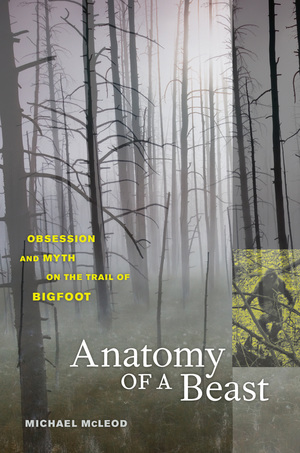
🎙️ Blake Smith, Ben Radford, and Dr. Karen Stollznow welcome journalist and documentary filmmaker Mike McLeod to discuss his book 📚 Anatomy of a Beast: Obsession and Myth on the Trail of Bigfoot 💵 — an investigative, character-driven account of the men who built the Bigfoot legend and the famous film at its center.
McLeod comes to the subject not as a believer or a debunker, but as a veteran documentary journalist who worked for Frontline, Discovery, and PBS. Raised in Eugene, Oregon — squarely in Bigfoot country — he found himself drawn to a simple journalistic question: had anyone ever actually gone back to the original sources? The answer, he discovered, was mostly no.
🎥 The Patterson-Gimlin Film for Dummies
Karen provides a grounding overview of the Patterson-Gimlin film — the roughly one-minute piece of 16mm colour footage shot on October 20, 1967, at Bluff Creek in the Six Rivers National Forest, Humboldt County, Northern California.
Roger Patterson, a former rodeo rider and self-published Bigfoot author (his 1966 book: Do Abominable Snowmen of America Really Exist?), and his friend Bob Gimlin, a rancher, were on a deliberate expedition — not a casual camping trip — when Patterson claimed his horse threw him and he grabbed a rented camera to film a large, bipedal, hair-covered creature striding across a sandbar. The creature — apparently female, with notably prominent breasts — glances back at the camera before disappearing into the forest. The men later cast footprints measuring roughly 14.5 inches long by 6 inches wide.
Key points raised in the discussion:
– Bluff Creek was already a known Bigfoot “hot spot” going back to the 1950s.
– Believers often claim the film has “never been discredited”; skeptics counter that it has never been authenticated.
– The stabilized version of the film, rather than strengthening the case, made the figure look more like a person in a suit to Blake’s eye.
– The film functions as a kind of Rorschach test: different analysts viewing the same frames report wildly different — sometimes contradictory — details.
– A single thread on the James Randi Educational Foundation forums devoted to the Patterson-Gimlin film accumulated nearly 500,000 page views across multiple years.
🧍 The Man in the Suit?
McLeod discusses the claim advanced in Greg Long‘s book 📚 The Making of Bigfoot: The Inside Story 💵 that Bob Heironimus — a friend of Patterson’s from the same town — wore the costume, and that the suit itself was originally supplied by costume maker Philip Morris before being modified by Patterson.
McLeod’s own timeline analysis is, in his words, “incontroversial”: the sequence of events Patterson and Gimlin claimed to have completed on the afternoon of October 20 — filming the creature, retrieving a loose pack horse, returning to a camp two to four miles away, collecting plaster, trekking back to cast the tracks, photographing the tracks, loading the horses, and driving to Willow Creek — is physically impossible in the time available. McLeod drove those roads himself. Town locals in Willow Creek, including Al Hodgson, confirmed that Patterson arrived in town around 4 p.m. that day with film he claimed needed processing — yet, per Heironimus’s account, the footage had already been developed weeks earlier. There were no cargo flights out of Eureka Airport after 5 p.m. in 1967.
On Gimlin’s evolving story, McLeod notes that Gimlin has at various points left open the possibility that he himself was the victim of a hoax — that Patterson may have pre-arranged everything on the morning of the shoot. Even so, McLeod points out, the timeline doesn’t hold up under that version either.
💰 Motive: Money, Illness, and the One Big Score
McLeod’s assessment of Patterson’s motivation is specific: he needed money. Patterson was chronically underemployed, working for himself, perpetually in search of a breakthrough — and he was ill. McLeod describes him as genuinely talented (an inventor, an artist, a man with a real eye for things) but always one job away from broke. The film, if it worked, was the score that would support his family. McLeod notes pointedly that Patterson maintained the film was real even on his deathbed — hardly surprising, since the licensing fees (reportedly in the range of $5,000–$6,000 per use) were his estate’s primary ongoing asset.
The “pious fraud” framing comes up: the idea of a hoax committed by someone who genuinely believes in the thing being faked, and therefore feels a kind of moral permission to manufacture the evidence they’re convinced must exist somewhere.
👣 Ray Wallace and the Jerry Crew Tracks
The episode traces the prehistory of the Patterson film back to the Jerry Crew footprint incident of 1958 and Ray Wallace, the logging contractor whose family later claimed he was behind the original hoaxed tracks near Willow Creek.
At a book signing, McLeod was approached by the wife of Wallace’s former accountant, who offered a detailed account: the Wallace brothers and their friends the Buswells were inveterate pranksters, and the tracks were created using carved wooden feet mounted on a piece of heavy logging equipment — a “cat” (likely a Caterpillar-brand machine) — that could distribute enough weight and stride length to leave convincing deep impressions in soft ground. The original purpose, she said, was to keep trespassers and thieves away from the job sites. The prank eventually got out of hand when local schoolchildren became genuinely terrified of the woods, and Wallace was asked to stop.
🧠 The Men Behind the Legend
A major strength of Anatomy of a Beast, all three hosts agree, is the way McLeod maps the relationships between the small, overlapping cast of characters who built the Bigfoot phenomenon. Brief profiles from the episode:
– Charles Fort — the writer for whom “Fortean phenomena” is named; catalogued anomalies and gleefully mocked institutional science.
– Ivan T. Sanderson — naturalist, adventure writer, and, per McLeod, arguably the first person to turn pseudoscience into a reliable livelihood. His descriptions of the Yeti directly shaped the young Patterson’s imagination. Sanderson was a genuine field scientist early in his career, but after clashing with British scientific establishments over reports of glowing reptiles and gliding snakes, he turned anti-establishment — becoming, McLeod argues, a skilled practitioner of science-flavored storytelling for magazines like True and Argosy.
– Bernard Heuvelmans — Belgian-French zoologist often called the father of cryptozoology.
– René Dahinden — Swiss immigrant to Canada who devoted much of his life to finding Bigfoot. McLeod found him an enigma: scrupulously rational about evidence, yet unable to walk away from the search. In later years he reportedly expressed private doubts — but his logic, “if I can’t disprove the Patterson film, it must be true,” struck McLeod as deeply strange reasoning.
– John Green — Canadian newspaper editor who joined Dahinden’s search and wrote extensively about it.
– Peter Byrne — Irish tracker (not British, as incorrectly stated in the episode) who hunted the Yeti in India before relocating to the U.S. to search for Bigfoot.
– Tom Slick — Texas oil millionaire who funded both Yeti and Bigfoot expeditions until his death in a 1962 plane crash.
🏔️ The Yeti, Everest, and the Newspaper Dispatch Economy
McLeod traces the Yeti legend to a 1921 dispatch by Lieutenant Colquhoun (referred to in the episode as “Lieutenant Beery”) relaying garbled second-hand accounts from mountaineers who had spotted dark shapes at altitude — shapes that ended up being reported in the English press as “abominable snowmen.” McLeod’s central argument: the Yeti was not a creature of Nepalese tradition that filtered out to the West, but a creature of English newspaper coverage that fed on mountaineering dispatches. Those dispatches, in turn, were the primary revenue stream for the enormously expensive Everest expeditions of the era. Nothing sold column inches like a mysterious creature.
🧬 Why People Believe (and Why They Don’t Stop)
The conversation closes on the psychology of belief. McLeod consulted Steven Novella (neurologist at Yale and host of The Skeptics’ Guide to the Universe) for an early draft of the book, and relays Novella’s point that facts and beliefs are stored differently in the brain — meaning that rational counter-evidence, even when accepted intellectually, may not dislodge an emotionally held belief at the physiological level. McLeod also notes the “source monitoring” problem: as memories age, we often forget where information came from, and tend to retain the claim while losing the credibility context that should attach to it.
The hosts and McLeod agree that ardent Bigfoot believers are essentially unreachable by argument — not from stubbornness alone, but because identity and belief have fused. Dahinden is the exemplar: a man who spent decades and a fortune on the search, for whom walking away would have meant dismantling who he was.
📚 Further Reading
– 📚 Anatomy of a Beast: Obsession and Myth on the Trail of Bigfoot 💵 by Mike McLeod
– 📚 The Making of Bigfoot: The Inside Story 💵 by Greg Long
🔗 Related Links
– Patterson-Gimlin Film (Wikipedia)
– Bigfoot (Wikipedia)
– Yeti (Wikipedia)
– Ivan T. Sanderson (Wikipedia)
– Charles Fort (Wikipedia)
– Bernard Heuvelmans (Wikipedia)
– Ray Wallace (Wikipedia)
– Tom Slick (Wikipedia)
– The Skeptics’ Guide to the Universe podcast (Wikipedia)
Note: ads inserted into the distributed audio alter the timestamps in unpredictable ways, so timing references in these notes are approximate.
SEO Transcript
This is not a fully accurate transcript, and was machine generated. It’s here for helping search engines find the episode but not intended to be a faithful transcript of the episode. (But it’s not AWFUL.) Some of the material in this transcript only exists in the Patreon/Premium edition of the show and was excised for the commercial version.
———————
See if you can figure out what this sound is.
Do you know what that was?
Do it again.
That’s it.
I can’t do it again.
No.
That was me opening up a can of worms because we’re going to talk about the Patterson-Gimlin film.
Ooh.
I know.
Did you prepare that beforehand?
Yeah, really, it’s just a cold Diet Coke.
Wow.
Not worms.
I’m disappointed.
It’s a metaphor.
Okay, let’s move on.
It’s actually quite unlike anything we’ve ever seen before.
A giant, hairy creature.
Part ape, part man.
In Loch Ness, a 24-mile-long bottomless lake in the highlands of Scotland, it’s a creature known as the Loch Ness Monster.
Monster Talk.
Hello and welcome to episode number two of Monster Talk.
I’m Blake Smith and together with Ben Redford and Dr. Karen Stolz now, we talk about monsters and science and skepticism.
So we had a couple of questions on the board from listeners about whether or not we wanted to talk about news items in the realm of monsters.
And at first I thought, well…
you know, that’s not such a great idea because I want the show to be timeless.
I like that idea of timeless, that any episode can be just picked up and listened to without really being dated by the material inside it.
Of course, in cryptozoology, it’s hard to be anything but timeless since apparently even really old stuff is considered fresh evidence.
I did want to talk about a monster in the news, if you guys would indulge me for a minute.
Um,
I don’t know if you heard today, a very famous monster passed away today.
Gidget, the Taco Bell dog, died today at the age of 15.
The Taco Bell dog.
Right.
As a famous monster, I just thought it would be right for us to take a moment and mention that that’s one monster that has died.
Now, not to interrupt, by famous monster, you mean what?
He’s a famous monster.
I mean, you know.
We’re talking the bug-eyed little wiener dog thing?
No, he’s… Well, I think he’s a chihuahua, but I mean… Well, I mean, you watch MonsterQuest, right?
Yeah.
So, I mean, so he’s a monster.
I mean, if you watch MonsterQuest, you know they’ve done episodes on octopus and squid and bears and dogs and coyotes.
And didn’t you, weren’t you actually in an episode of MonsterQuest?
Or more than one, right.
I was in several, yes.
And I believe that was about an animal.
Didn’t that animal turn out to be a canid instead of a chupacabra?
It did, although at first glance I thought it was the Taco Bell dog.
Well, see, there you go.
So my point being that, you know, if MonsterQuest says a chupacabra is really a Mexican slash Texan dog, then wouldn’t that qualify the Taco Bell dog to be a chupacabra?
Hmm.
Exactly, exactly, see?
Leave a rationale.
Right, so I think, yeah, so again, we mourn the death of this famous monster, Gidget, the Taco Bell Chupacabra, slash doc.
Yo quiero Taco Bell.
Karen, did you get your document ready to talk to us about the introduction to the Patterson-Gimlin film?
I certainly did.
The Patterson-Gimlin film for dummies.
How appropriate.
Yes.
And for the listeners.
Okay, so this is a bit of an overview of the Patterson-Gimlin film, which is also known as the Patterson film.
It’s a short movie that allegedly captures a close encounter with Bigfoot.
So the event occurred in October of 1967 and was recorded by one Roger Patterson and also witnessed by one Robert Gimlin.
At almost a minute in duration, the film reveals an unidentified creature in motion, a tall, large, hirsute, bipedal animal that appears to be a primate.
The film was recorded at Bluff Creek, which is a remote rural area in the Six Rivers National Forest near the tiny town of Willow Creek in Humboldt County, Northern California.
Bluff Creek was already a supposed hot spot of Bigfoot activity.
Even before the film was shot, the area was known for Bigfoot sightings dating back to the 1950s.
There’s a large collection of anecdotal evidence to attest to sightings in the area before 1967, and also plaster casts of a set of tracks claimed to be footprints of Bigfoot.
But the biggest claim was yet to be made.
Roger Patterson was a horse breeder and former rodeo rider, if you prefer, while Robert Gimlin was and is a rancher.
So both men lived in Washington State, and it’s often believed that Patterson and Gimlin were in Northern California on a camping vacation.
In contrast, the men were visiting the region as part of an expedition to find Bigfoot.
Both men had already conducted searches in Washington and Oregon, and both men were Bigfoot believers.
In particular, Patterson had been a highly active Bigfoot hunter for several years, and had self-published a book about the subject the year before the encounter.
So I don’t know the name of the book.
Do you guys know the name of his book?
Do Abominable Snowmen of America Really Exist?
By the afternoon of October 20, Patterson and Gimlin had already been in the Bluff Creek area for seven unremarkable days, but I’ve come across other sources that claim they were there for three weeks.
So the accounts continue to reveal inconsistencies, but what follows is a popular version of the events.
Armed with hunting rifles and equipped with a rented 16mm movie camera, the two men were out horse riding in the afternoon.
At around 1.30pm or 3.30pm, the men noticed a horrid stench in the air and their horses became skittish, just before they came upon a hairy, hominoid-like creature in the distance.
Patterson’s horse was startled and threw him to the ground.
He still had the wherewithal to grab the camera and start filming.
He ran towards the creature, reaching a distance of about 80 feet away, while Gimlin stayed on his horse and stood guard with his weapon.
Patterson took 24 feet of colour film, featuring the apparent female creature striding across the creek’s sandbar.
At one point, it turns around and looks at the men momentarily, then continues walking into the forest.
The men continue to track the creature for three miles until they’ve lost sight of it into the dense forest.
The men return to the site of the encounter and made two plaster casts of the footprints the creature had left behind in the banks of the creek.
These casts measure about 14.5 inches long by 6 inches wide.
However, this supposed evidence is overshadowed by the film.
This blurry, shaky, grainy footage is held up as, quote, the most convincing evidence of Bigfoot, although admittedly the source for this quote is from In Search Of, but this is a popular belief.
So believers tend to claim that the Patterson-Gimlin film has never been discredited, while skeptics tend to remind us that it’s never been authenticated.
And folklorically, this iconic film is perceived as proof of the existence of Bigfoot.
There’s a lot of other films of Bigfoot, but it’s the only one that I think is…
It’s certainly the best known in the original.
Yeah, I was trying to think of the right adjective.
It’s certainly the one that set off the Bigfoot craze, and it’s still the one that gets the most attention in the media and from believers.
And there’s a sort of anecdotal description that you’ll hear over and over again in Bigfoot fandom, which is that next to the Kennedy assassination, the Patterson-Ginland film is the most viewed film of all time.
The Zapruder film.
Exactly.
I don’t know if they mean the Zapruder film.
I’ve never heard the quote.
Well, they’ve got to.
There’s no other famous film that the Kennedys has named.
It’s certainly been scrutinized like the Zapruder film, just for example.
The James Rainey Educational Boards have had a Bigfoot thread just on the Patterson-Gimlin subject that spanned multiple years and had almost 500,000 page views.
That’s…
That’s one of multiple threads.
I mean, it is a really scrutinized piece of film.
Even now, the TV show Monster Quest just recently reanalyzed the film, and I think they tried to get back to the original film site and do some measurements with Bill Munns, and that created a whole new wave of controversy about the film.
Well, one thing that I found interesting when I was…
Giving a talk at a Bigfoot conference a couple years back in Idaho was I had been invited to this conference as sort of, of course, the token skeptic.
And I was also interested to see what new evidence they had.
I mean, it had been a while since I had been involved with the Bigfoot buffs.
And I was somewhat surprised to find that they were still flogging this 1967 film.
I went to the conference expecting to see, here’s the new great film, and here’s all this hot new evidence.
It was just reanalyzing and rehashing and rehashing the Gimlin film from 67.
And I found that very telling that…
After 40 years, they were still flogging that thing, and they couldn’t point to anything better.
That’s a good point.
I think as far as Bigfoot evidence goes, the Patterson-Gimlin film and the footprints are the main two pieces of evidence because they’re the hardest to refute.
Although…
They’re the easiest to duplicate in one sense, and I think some people’s heads probably just exploded if this makes it to air.
Because believers say no one’s ever duplicated the Patterson-Gimlin film, the suit, the walk, and lots of other aspects.
I personally used to find it a horrifying piece of film.
just very, very scary and frightening.
The idea that there were giant apes was very frightening to me, especially when I was a child.
In recent times, technology’s caught up with the film quite a bit, and of course I’ve seen it lots and lots of times.
The stabilized version of the film, while the people who stabilized it think it provides better evidence that the creature is an animal, to me, it makes the creature look like a man in a suit.
I found it…
Much less controversial when it wasn’t shaky and blurry and it was just walking across the screen.
To me, it looked like a guy in a suit.
And, of course, a man has come forward, actually multiple people, but Bob Hieronymus has come forward most recently claiming to be the guy who wore the suit.
And Greg Long, the author, has tracked down a lot of evidence to support that.
I was going to ask about this Bob Hieronymus.
Wasn’t he a neighbor of Gimlin’s?
Yeah, that’s interesting.
They’re friends from the same town.
And there’s some photos out there that show several of them working together.
Because my understanding was that, and maybe Ben could correct me here if I’m wrong, but the group of them were planning to make a movie about Bigfoot.
That’s my understanding, yes.
Yeah, and I’ve seen some photos of them with one of the characters wearing a long, it looks like a wig, appearing to try to be an Indian tracker for the film.
I might be misinterpreting that.
The idea that a man would be, I’m going to go make a movie about Bigfoot, and then, no, no, no, I’m going to make a documentary about me hunting Bigfoot, and then the first time I go out and try, coincidentally, I find Bigfoot, and then nobody else finds Bigfoot again.
After many weeks.
After many, many, many, many weeks, months, years.
I think you’re being a little skeptical there.
It’s true.
But I think this coincides with himself publishing this book as well.
It’s interesting.
Many people have noted that there were illustrations in his book that looked remarkably similar to the way the creature came out to be in the film.
So either he was very prescient in his guesses about what the creature would look like, and a lot of that apparently was tied to his study of the Abominable Snowman and the work of Ivan Sanderson.
Also, the breast, as I recall, was the main distinguishing feature that
Everybody thought it was so impressive.
If it was a hoax, which I think it was, it was a clever idea to make it into a female because people wouldn’t expect that.
Bigfoot, I think, is a male idea.
Are we talking about the pendulous breasts that I keep reading about?
They were quite pendulous.
If that’s what they were.
If they were breasts.
The thing about the film, this is what I find really interesting.
Watching it on television is a very different experience than seeing it at its original scale.
It’s usually zoomed in in the television version.
And if it’s shot, when you see it in scale, right, the way it was originally shot, Bigfoot’s like center for a lot of the filming.
He’s trying to keep it center frame.
But it’s very, very tiny.
So what happens is when you zoom in, when you enlarge it to make the picture more obviously focused on Bigfoot instead of all the nature around him,
There’s a lot of blurs, and you can interpret those blurs in a lot of different ways.
People see details, muscles moving, all kinds of things.
No zipper.
You can’t see the zipper.
Well, I’m not surprised that you can’t see the zipper in a Bigfoot suit 100 feet away filmed on this little camera.
But people think that’s such a big deal.
I can see this detail.
I can see that detail.
And I’ve heard it multiple times described as the Rorschach test of whether you believe in Bigfoot or not.
You can see lots of things.
And those nuances, how could this be faked?
Well, I can’t even be sure that it’s a real detail.
So how could it be proven to be a real detail?
I don’t know.
That’s very strange.
That was one thing that really jumped out at me.
You could watch three different presentations on the exact same film, and three different people would pick out
wildly different, sometimes contradicting details, talking about, well, you know, as you can see here, clearly, you know, Bigfoot’s left eye is green.
What the hell are you talking about?
I guess this makes these interpretations, really, just makes it more subjective.
But just one thing I wanted to comment on.
I’ve just spent the last couple of days researching Bigfoot and the Patterson Gimlin film and the various stories, and it just makes for very daunting work.
There is so much information out there, and having to sift through this material and to discover what is good and what is bad is just really mind-boggling stuff.
That’s certainly true.
It’s remarkable that a piece of film that’s a minute long, give or take, has engendered such a debate and such a wide variety of interpretations, dogmatic skepticism and dogmatic believing, and it’s amazing.
Monster Talk.
Anatomy of a Beast has a lot of characters in it.
Real men who made the world of cryptozoology what it is today.
We’ll put information on these people in our show notes, but here’s a brief overview of the men behind the legend.
Charles Fort, the man for whom Fortean phenomena is named, he chronicled the bizarre and scoffed at science, and lo, there was much rejoicing.
Ivan T. Sanderson, a naturalist and adventure writer who became obsessed with the unknown and the mysterious.
His descriptions of the Yeti profoundly influenced the young Roger Patterson.
Bernard Heuvelmans, a Belgian French explorer often regarded as the father of cryptozoology.
Roger Patterson, the rancher and entrepreneur who shot the famous Patterson-Gimlin film.
Bob Gimlin, Patterson’s friend and fellow Bigfoot enthusiast.
He was there when the film was shot.
Rene de Hinden, a Swiss immigrant to Canada who spent much of his life searching for Bigfoot.
John Green, a Canadian newspaper man who joined the search and wrote about it.
Peter Byrne, a Brit who hunted for the Yeti in India before coming to the U.S. to join the search for Bigfoot.
Jerry Crew, the logger whose camp was plagued by giant footprints.
Ray Wallace, the local man who said he was the original footprint hoaxer at the Jerry Crew site.
Tom Slick, a wealthy Texas oil man who funded searches for the Yeti and for Bigfoot until his death in an air crash.
Greg Long, the author of The Making of Bigfoot, who says that a man named Bob Hieronymus wore the suit and that the suit itself was provided by costume maker Philip Morris and then later modified by Patterson before the shoot.
Well, tonight we’re talking with Mike McCloud, who is the author of a new book called Anatomy of a Beast, Obsession and Myth on the Trail of Bigfoot.
Now, you come from a documentary background, right?
Yeah.
What kind of documentaries have you produced?
Well, a lot of grim stuff.
I did a lot of 60-minute, 90-minute long shows for Frontline and various other programs for Discovery and PBS aside from Frontline.
Sorry, how did you develop an interest in Bigfoot then, given the background that you have?
Well, I grew up in Bigfoot country.
I grew up in Eugene, Oregon, so that was right smack dab in the middle of Bigfoot country.
And as it turned out…
I think I really became interested in it later in life after I became a journalist to really find out, you know, that film of Roger Patterson’s played so often on TV that kind of led at one point in my life to just wanting to, you know, I say to myself, well, I’d never heard that that had been disproved.
And it just seemed to me something that, as a journalist, it would be interesting to know, you know, what was behind it because I didn’t believe in the animal.
But the film was certainly, I think, impressive.
So I think it was just the curiosity to put my background in terms of interviewing people and trying to go to original sources and just to try to find out how close I could come to answering how that film came to be.
Well, I have to say I really like the results.
This has been an enlightening book to me as a longtime interested party.
To see someone tie together a narrative to join these sort of individual characters together in a way and explain how they were interrelated that I had never seen before.
So that was nice.
Honestly, that was really what I was trying to do was tell a story.
I wasn’t trying to…
I wasn’t trying to investigate Bigfoot.
I was really trying to tell the story of the film, and in so doing, it just ended up being a story of this small group of disparate guys, you know, who were really hooked on trying to find it.
Just echoing what Blake said is that what I found most interesting was that, you know, there were all these characters who I actually knew a fair amount about, many of them, but it was never really clear to me exactly how they related to each other and
and, you know, how it all came about.
So definitely painted an accurate and oftentimes somewhat unflattering picture of some of the early folks.
I mean, you know, for example, you described the Patterson film as basically sort of a pious fraud, you know, sort of a hoax committed by a person who really ultimately, genuinely, sincerely believes in it, but you can’t get the real thing, so you fake it.
I mean, that was sort of the impression I got, so…
Do you think that’s the case with a lot of Bigfoot hoaxes, or what do you think is the motivation?
Gee, I don’t know.
I mean, what would be the motivation?
I honestly think Roger’s motivation was he needed money.
He was really, on one level, from all the information I have, he was a genius, actually on more than one level.
He was an inventor, and he had interesting ideas, and he was an artist, and he had an eye for things.
But he was always…
from one job to the next.
He was always working for himself, and I was always, as I say in the book, he was an inventor, and always trying to make, you know, looking for that one big score.
And that, coupled with the fact that he was sick, I think really drove him to do this.
And, you know, he wasn’t the first person to shoot a film of Bigfoot.
Ray Wallace did that, and I’ve seen that footage, and you may have, too.
You know, and it’s not against the law, and many people since have done the same thing, so…
It didn’t create any egregious breach of the law or anything like that.
But, you know, as to what would motivate people to shoot other films of Bigfoot, you know, it’s awfully strange.
I remember I interviewed Ivan Marks shortly before he died, and he shot at least one film of Bigfoot.
He might have shot a couple.
Actually, he did shoot two.
In fact, I talk about those in the book.
He did shoot two.
He tried to sell me a videotape of one of them.
So I don’t know.
I think it’s just a quirky thing.
I think nobody’s ever seen that thing, so if you could pull it off well enough, I think that’s one of the reasons Patterson’s film works so well, is nobody’s ever seen one.
So whatever you come up with in your mind that might be the creature, the more accurate you might seem to be to more people, perhaps the film would catch their fancy.
In Patterson’s instance, it really did.
Oh, I think so.
So there was, I guess, the first craze of Bigfoot in the public eye was the Wallace tracks or the crew tracks.
But were all of those original Jerry Crew tracks portrayed about Wallace and his friends?
Yeah, yeah.
In fact, it’s ironic that not long ago a woman showed up at one of my book signings, and her husband was Wallace’s accountant.
He did all the, you know, he filled out all the timesheets and stuff for all the logging crews and that sort of thing.
And it’s well known in Willow Creek at the time that Ray Wallace was the guy that did it.
And there were the three Wallace brothers, but Ray and his brother Shorty were complete jokesters.
And they had a couple friends named the Buswells, and apparently…
The Wallaces and the Buswells were just the talk of the town because they were always pulling jokes on people, just anything for a laugh.
According to her, the Wallaces started the whole thing because they were having problems on their job sites with people pilfering things, and they were afraid for insurance reasons and equipment getting stolen and broken and that sort of thing.
They would leave these footprints, and they would talk up this thing as a means of keeping people away from the job sites.
You know, that’s as close, I guess, as you can come without somebody actually who was in on the deal saying, you know, how come it came about.
And she claimed that the feet were done.
They did them using one of their… She called it a cat.
I don’t know if it was a caterpillar or some other piece of hydraulic logging machinery in which they put these feet on a wheel-like device.
And they spaced them far enough apart so that they…
And there was enough pressure and weight on the device that they could leave long strides and the imprints would be deep in the dirt.
And, you know, I worked on a logging crew briefly myself, so I imagine somebody who was, that was their life, and they knew how to operate big machinery and fix things and weld things.
You know, it sounds plausible.
But it was interesting to chat with her because she…
She seemed to have the lowdown as close as you can get all these years later, you know.
You had described some of the tracks being in what would appear to have been inaccessible places, but that you think with logging experience and equipment, you could pull off those feats without too much trouble.
Well, I think it would be a lot of trouble.
Yeah, but you could definitely do it.
But the payoff is big if you’re a joker.
And apparently her husband, after the tracks became publicized in Willow Creek, apparently all the kids at the local school were just terrified to death of the woods.
And, you know, it’s a small place, and mostly everybody lives basically in the woods.
And she said it was to the point that her husband went to Ray and told him to knock it off because he’s scaring every kid in town to death.
And shortly thereafter, you know, it all ceased.
So anyway, it was another insight that she had, so…
Well, thanks for sharing that.
I mean, that’s good information.
Even if it’s anecdotal, it’s interesting to get some more insight into what may have been going on.
In your book, I don’t want to spoil the book for anyone, but you do a nice job of introducing not just Bigfoot, but the whole field of cryptozoology through your profile of Ivan T. Sanderson.
And it was interesting to get – I’ve got some of Sanderson’s books, but to get your point of view on that.
In your reading, did you come across any instances where –
He came out and admitted some of the hoaxes that fooled him, like the giant penguin, the bayhead monster, and then the Minnesota Iceman.
Did he ever acknowledge being duped in those cases?
Well, I never found any indication of it.
Do you think he genuinely had become a believer in all these odd things, or do you think he had become financially dependent on them?
You know, it could be a combination of both.
You know, you get invested in something and you start to believe things differently.
You just put out, you know, he wasn’t, again, he wasn’t doing anything illegal.
So, you know, you put these things out of your mind, I think it becomes perhaps easier to, you become known for a certain slant on things.
And that becomes the mainstream way you support yourself.
He had some pretty outlandish ideas.
I mean, the articles he wrote for Argosy later in his life, when he was the science editor of Argosy, were just completely, you know, he was grasping at straws.
He was doing odd articles about, like, who was the guy that came up with the pyramids from space, or I don’t know.
Von Donaghan.
Von Donaghan, you know, he was doing that kind of stuff, and looking for evidence of sea monsters still, and
You know, all this stuff.
And, of course, he’d report it, and they’d put it in the magazine.
Sometimes it’d be a cover story.
But there was nothing to it, and, of course, there was no follow-up.
So, you know, it was sort of the heyday of that stuff.
You know, the 50s, 60s, and 70s, there was a lot of this.
Well, it really started, you know, it really started with the Flying Saucers back in the late 40s.
But it sort of…
there was a steady arc upwards of this information that was getting out there, and Sanderson just rode this wave.
And he was on TV, you know, mostly as a legitimate guy, you know, on the Gary Moore show.
But then later, in the late 50s, he started to, when he got into True Magazine, that’s when he started, the curve started to flatten out in terms of his grasp of reality.
And he really saw that there was a market for this pseudoscientific kind of stuff, right?
Yeah.
That’s why I basically sold the book on the idea that he was the guy who was the, you know, he was the modern, he was the first guy to really perfect the art of pseudoscience.
Because he was a scientist, and he knew how to write, and he’d done it straight, although his scientific writings after he got out of school were not really scientific, they were more travelogues.
But he learned, he had the science speak, and he had enough knowledge about how scientists talk and the terms they use.
that he could then take some of his wild dreams and he could infuse them with his scientific way of speaking and promoting himself as a scientist, offering himself on these odd things.
And there became a market for that.
And really nobody had done it.
I mean, there had been a few people that had done it before, a book here, a book there, but he was the first guy to really turn it into a means of making a living.
You’d also talked a little bit about his sort of inspiration, Charles Fort being another character who just sort of loved to poke fun at science and just come up with any wild theories and speculations, which may or may not have a grain of scientific truth to them.
Yeah, you’re absolutely right.
I mean, he was a real Fortean.
I mean, he really, for all the rest of his life, he was a committed Fortean.
And he really, something happened to him when he was just out of school and dealing with
while he was doing his animal collecting, and he got on the wrong side of some scientists there in Britain.
And I remember his old associate, Schoenberger, told me that what had really turned a corner for him is he’d presented a snake or some kind of reptile to the scientists that he’d found, and he told them that it emitted light, you know, like fluorescent light, and they wouldn’t hear of it.
And he also told them that he’d seen flying snakes
And he knew that they, which is, there are flying snakes.
I mean, they glide from the trees, you know what I mean?
Right, right, right.
Anyway, but when he would talk about these things, the scientists in the labs back in Britain would just ridicule him, you know?
Here’s old Ivan, you know, whatever, with his wild ideas.
And he just got turned off by it.
I mean, really, like Fort, you know, was turned off by science.
And a lot of people today are turned off by science.
I mean, we see that all around us.
And I think he really took that to heart and
So if science was behind it, he wanted to go the other way.
And I think that’s really what drove him to do a lot of what he did, because there was a market to do that, because there were a lot of people that really enjoy hearing about science being wrong or misspoken or, you know, whatever.
I was going to ask you, you say that the Bigfoot phenomenon has never been about the truth, it’s about storytelling.
So what would you say is the significance of Bigfoot storytelling in our culture today?
Why is it an important story?
I’m still wrestling with that.
Why Bigfoot is so wildly popular seems even increasingly so to some degree.
It’s a real mystery to me.
I mean, it’s kind of like the ultimate hobby for a number of people I’ve met.
There’s endless speculation about it and so forth.
I don’t know.
It’s really weird.
I tried to write about it in my book.
In the first few drafts, I had some really long sections.
I did a lot of research about the brain and how it works and why people believe one thing or another.
I finally realized, I said, you know, I can’t.
Real people that study the brain can’t explain it.
They can write books about it, but they don’t really explain it.
So I ended up cutting most of it out and trying to focus on what I thought was Roger Patterson’s state of mind in terms of how people under duress mentally, how they deal with their situation.
Why people get a hold of a belief like this and just can’t let go, it’s a real good question.
I came across one review on Amazon.com, and a reader said, while the book clearly discounts the existence of Bigfoot, it certainly had me wanting to believe, not just in the legend, but in the people who pursued that legend.
So really hold on to these beliefs, even if they don’t believe them.
Yeah, well, I think it’s fascinating, people.
I mean, you know, it’s really fascinating.
I mean, obviously all you three are interested in the subject.
Sure.
So why are you interested in it?
Do you believe it exists, or do you kind of maybe would like it to exist?
I don’t want to speak for the other two, but we’re all skeptics.
We’re all really skeptical skeptics.
We’re the skepticalists.
Not just token skeptics.
We’re like organized skeptics.
But the whole idea you’re talking about studying why people believe things, I don’t know about Karen and Ben.
Well, yeah, I do, of course.
We all studied that.
That’s exactly what we’re interested in.
The purpose of our show is because so many people are interested in monsters and aren’t that interested in critical thinking.
We want this show to be a gateway to let people take their crazy beliefs and reexamine them
under the scrutiny of science, the scientific method, and rationalism.
Well, I applaud that.
I applaud that.
Thanks.
It’s long overdue.
I mean, in fact, I said in the book at one point, I said, you know, if people believe in Bigfoot, what on earth do they believe about things that are really important?
Right.
Good point.
Yeah, yeah.
I mean, it’s ultimately, I had this belief when I started, this hope when I started the book that one of the main things I might accomplish was to convince some people
to re-examine it, right?
But I’ll tell you, some of the comments I’ve got about the book, and a number of comments, people haven’t even read it, but are ardent Bigfooters, obviously, there’s no way you’re going to turn them around.
It reinforces, when somebody comes up with a, tries to hold a rational discussion or write rationally about it, it’s absolutely a turn-off to these people.
So it’s interesting.
I don’t know why that is.
Without actually answering the question, I can tell you this much.
I talked to Steven Novella, who’s a neuroscientist or neurologist at Yale, and he has a podcast called The Skeptic’s Guide to the Universe, which is a really good show if you ever get a chance to listen to it.
But he talks about – it actually turns out that the way we store facts –
is different than the way we store beliefs in our brain.
So even if someone demonstrates to you rationally that something that you believe is not a fact, it’s really hard to let go of that, not just from the meta idea of how you think, but literally, physiologically, it may be hard to let go of that belief.
So it may go that deep.
That’s what evidence seems to be pointing towards.
Yeah, one of the points a fellow made today that was interviewed, the scientist…
said that one thing about memory is that it’s not hardwired.
I mean, it doesn’t implant itself and not change, that it’s overwritten all the time.
And, of course, because we are predisposed to want to accept more easily information that we agree with, it’s generally overwritten with stuff that we agree with.
And the other thing is that one way we establish what’s a fact and what’s not is by remembering where you got the information from.
But that oftentimes, as we grow older and experiences overlap, we forget where the information came from.
So we don’t know.
We can’t go to that.
In other words, the information is there, but we assume it’s true because we’ve forgotten the origin of the information.
And, of course, the origin of the information is important to the credibility.
I mean, did I read that in a scientific book, or did I hear that from my cousin?
Well, you know, that’s the reason when I did this book, I mean, that was the whole thing.
Nobody had ever done that.
I mean, all the books that have been written about this regurgitate the old stories, right?
And they relate tales that people tell of having seen one or having found footprints or this, that, or the other thing.
Nobody ever went to the source.
You know, they very seldom go to the source to find out, you know, who said that and why and what were the circumstances.
I mean, that’s basic journalism, and that’s really what I wanted to do.
with this story was…
Speaking on the idea of going back to old sources, you talked about the Yeti, which, of course, the Yeti is a precursor to the American Bigfoot legend, or at least the popularity of it.
And you did a great job of talking about the convergence between the efforts to climb Everest and the efforts to find the Yeti.
Would you like to talk about that a little bit?
Well, my line of investigation was to find out
you know, were these stories true?
Where did the stories come from?
And, of course, they all start with Lieutenant Beery, the Englishman back in 1921, who, you know, relayed a message from some mountaineers who’d seen these things at a great distance, and the message got garbled.
They ended up being identified as abominable snowmen.
So that’s where it starts, in essence.
But it became obvious to me early on that that…
It wasn’t something that a person of Nepalese extraction was telling the Western world.
The Yeti was a fabrication of English newspapers.
And English newspapers were writing about that because people were interested in it.
And they were writing about it because they were being given the information by mountaineers.
So you start looking into the mountaineers at the time and the efforts to climb Everest, which were…
were very important.
They were very nationalistic.
In other words, anybody that could climb Everest really elevated that nation in the eyes of the world, and the Brits wanted to do that.
And the Brits weren’t the only country.
There were a dozen other countries that were trying to do the same thing, to climb the same mountain.
Of course, those expeditions got very expensive very early, and the way they used to run those expeditions, as you all know, hundreds of people…
a dozen or a couple dozen principals, and then a couple hundred porters.
And what a way to search for an animal, right?
Right.
And, I mean, even if the search for the animal wasn’t primary on your list, I mean, what kind of animal is going to hang around with that kind of human presence, right?
I mean, it’s just absurd.
And so it became obvious.
In fact, I found this in various written accounts and that sort of thing, that the cost of these expeditions…
the major way they paid for them was to write dispatches from the mountain.
That was the primary way they got their money and memoirs afterwards.
And so nothing sells better.
You’ve got to have some drama.
I mean, it’s one thing to write about how beautiful the mountain is, but that pales in comparison to writing about maybe having seen some mysterious creature.
We have a question from listener Carl Rose about Rene DeHinden.
He asks, During your interview with Rene, did you detect or suspect any psychological undercurrents that may have more greatly influenced his involvement in the Bigfoot soap opera than a simple need to find the beast first?
I found Rene to be a real enigma.
I found him to be totally rational in terms of talking about…
quote, evidence that had been found to date.
And I never heard him say, and I’ve never heard anybody who talked to him say, that he absolutely believed in the film or that he absolutely believed in Bigfoot.
In fact, I’ve talked to a number of people who said in his later years he expressed quite a few doubts.
But at the same time, he was on the trail for years and years and years.
So I don’t know.
The gentleman I met just not long before he died was really an engaging character, but I don’t think he was the Rene of old.
I think that all the reports I get of Rene in the 60s and the 70s, he was really irascible and really a different kind of guy.
I mean, blunt spoken to the point of totally being obnoxious.
the sort of person he just wouldn’t want to be around.
And so many people told me that.
But on the other hand, they always told me there was this disquality to him, which I discovered, which made him really, really likable.
But that question that that gentleman posed who wrote that letter, I don’t know how to answer that because it does seem to be two different points of view from the same person, you know.
He stayed after this thing and…
and kept it in his mind that if I can’t disprove the Patterson film, then it must be true.
You know, it’s a point of view I just don’t understand.
I find that a really, really strange observation.
He was very vested by the end, wouldn’t you say?
I mean, he’d already spent a lot of his life and a lot of his money looking for Bigfoot.
It’d be hard to let go at that point.
Yeah, yeah.
Like we said, we were talking earlier that people who invest themselves in something, after a while it becomes…
That’s who they are.
Like Bob Gimlin.
Gimlin is absolutely not as straight a shooter as I could imagine talking to anybody and getting an impression.
After all these years of searching or being involved one way or the other, it’s
I don’t know.
It’s very strange.
Well, okay.
You mention in the book – you’re right, though.
I’ve read people say – in fact, I just read some today where people were saying that Gimlin’s a straight shooter, completely honest.
Why would he lie?
Why would he not come out and tell the truth now if he had lied?
And I think if you have a reputation as being truthful, but you have this secret untruth,
You know that you’re going to destroy your reputation if you do come out with it.
You talk a lot about the timeline for when the claim was made that they brought the film back, the Patterson Gimlin film, back from the film site to take it to go and have it developed, and that there’s just things that could not possibly be true.
How damning would you say that evidence is about the inconsistencies, even the contemporaneous reports?
I consider it incontroversial.
It’s absolutely impossible to do what they claim they did that afternoon and show up in town in Willow Creek at the time they claimed.
And then the whole airport thing was never explained.
I’ve been there.
I’ve traveled those roads.
With the modern roads today, you can’t make the trip in the time that they claim they made it.
And their versions of what happened changed notably from the very first interviews they gave.
First of all, neither Gimlin or Patterson
had completely the same story.
They varied a little bit.
Their stories changed over the months and over the years.
I mean, drastically changed to the point that at one point, Gimlin even told somebody in an interview that they didn’t even get out of camp until dark to get to Willow Creek.
And I know they were in Willow Creek that day because Al Hodgson told me that.
Two other people I interviewed in Willow Creek were there that day.
Those were town locals, right?
Yeah.
So we know he showed up that day.
in Willow Creek, and we know it was around 4 in the afternoon.
And he said he had film with him that he was taking to be processed.
So that’s the only thing that anyone knows for sure, other than Gimlin and Patterson.
All the rest is their story, which changed.
All the stuff they claim to have done, I mean, after the encounter, which they claim happened sometime around 1.30 in the afternoon, a lot happened.
They had to pick a pack horse that had broken loose, so according to their story, they had to go
retrieve the pack horse, and they had to go all the way back to camp, which, depending on which version of the story that you read, the camp was two to three, perhaps even four miles away from the site where the filming was done.
So they had to go back to camp, and they didn’t have the plaster with them to cast the footprint, apparently, so they had to catch the horse, they had to go back to camp and get the plaster to make the footprints go all the way back to the
the creek and Patterson also shot footage of the tracks which has been seen by some people but disappeared not long afterwards.
Shot footage of the tracks and walking the horses along the tracks to compare the two imprints and then they cast one or more of the tracks and then they had to go all the way back to the car, to the truck and then they had to load the horses and the plaster had to set dry and
load the horses, put the horses in the truck, and then drive all the way the two hours or whatever it took in those days to get to Willow Creek.
So the timeline didn’t add up.
So to me, the timeline plus the fact that their stories varied so often, plus that piece of additional information in the last chapter, which I interviewed a fellow who spent time up there not by himself.
He was on the job up there and didn’t see anybody in the area.
led me to believe that there’s no way that what they claimed happened.
And, of course, Greg Long’s book that proffers the idea that Bob Hieronymus was the guy in the suit, Hieronymus’ story that they shot the footage and then had it developed and a couple weeks later went back down there.
Then that’s when they made the tracks, and that’s when they went into Willow Creek.
The footage had been long ago developed, right?
So they weren’t on their way to send it anywhere for processing.
There’s no airplanes after 5 o’clock carrying cargo going out of Eureka Airport in 1967.
So nothing adds up.
Unless the real story is that really it was already developed and they had just decided this was the time to execute the tail.
I think the plan fits.
It’s a perfect plan in terms of my sense of Roger the man.
Roger was a wily guy.
He was no dummy.
It was a perfectly executed plan.
I don’t know.
If you were going to do a hoax, you’d want to shoot the film first to make sure it was turned out before you announced to the world you had it, right?
That’s a good point.
What if you took it, you announced the world you had it, you took it to the lab and there was something wrong with the footage, you know?
I mean, that does happen, you know.
Or you could see the zipper, I think this would be it.
Whoops!
Isn’t Gimlin now claiming that he could have been the victim of a hoax?
You know, that’s what I took away from my interview with Gimlin, was that he, I don’t know, has he claimed that?
He kind of left the door open to me when I interviewed him, and I’ve heard him make the same claim to other people who’ve talked to him about it, that the morning of the filming, Roger slept in and he went out on a ride by himself, and he came back to camp later, which would have to be sometime, you know, mid-morning, late morning, and Roger wasn’t in camp, and then Roger strolled into camp, saying he’d just been
walking down the creek.
And then Roger suggested, well, why don’t we get the pack horse and why don’t we head on down the creek and instead of staying in camp tonight, we’ll go camp somewhere else.
You know, a complete departure from what they’d been doing.
And Gimlin told me that they were down there for about three weeks, which is a long time.
So, you know, it’s all very strange.
To me, it sounded like what Gimlin was saying was that he was leaving himself an out, you know, like maybe Roger had arranged this thing.
That morning, right?
Yeah, but even in that case, the timeline still doesn’t fit.
I mean, if he’s claiming that everything Roger and I said is true, except for the fact that I may have been hoaxed, well, hold on here.
I mean, for all the reasons you just said, the timeline still doesn’t add up, even if he might have been hoaxed.
That’s interesting, but, I mean, you might consider the fact that if you were going to lie about it, that the creature was real, as Gimlin did…
why might not you, at the same time, knowing that it wasn’t true, leave yourself at the back door?
Right.
It may not be the best back door, but…
I mean, you know, it’s a fairly extraordinary…
It’s a fairly extraordinary situation you’re put in psychologically, you know what I’m saying?
That’s true.
And who would know it would turn into what it’s turned into, right?
Could these two cowboys down on that creek, whatever they were up to, could possibly not have imagined…
what would happen all these years later with that.
Have you heard this as being the most viewed film besides the Zapruder film?
You know, I don’t think I’ve heard that, but, I mean, that’s my own interpretation.
It’s certainly shown more than the Zapruder film.
Yeah, it’s on the lot.
I mean, it shows up all the time, a couple times a year, regular clockwork.
Do you have any insight into what the financials are?
I’d heard something that it costs something like $6,000 to have the video included in a documentary or…
I don’t know, but that doesn’t sound…
I heard a long time ago that Mrs. Patterson was charging $5,000, something like that range.
There’s film rights, and then there’s television rights, and then there’s all the Internet stuff, so I don’t know.
I have no idea what the going rate is today, but I can imagine.
I mean, I’ve dealt with a lot of stock footage in my time, and it could get pretty spendy.
I would say for $5,000 or $6,000, that’s not bad.
At the same time, I’m sure she’s getting ripped off a lot by people that are just using it or not.
You know, people say, well, when Roger Patterson was dying on his deathbed, he still said the film was real.
Well, why wouldn’t he?
If that was his best hope for making revenue for his family when he was gone, I mean, he has plenty of motivation to not say, it was a lie, you know.
Yeah, right.
I mean, that’s people just assuming that somehow death, you know, impending death makes people tell the truth.
People would say, why would he go to his deathbed and still claim the film was real, right?
Well, why not?
Right, right.
Does dying shortly mean you’re going to suddenly have to confess everything you’ve done in your life that wasn’t on the up and up?
I hope that’s not a requirement.
I hope not.
Doing some research myself on Bigfoot and the Patterson-Ginland film, there are just so many versions of the story, so many accounts, and I’m just wondering how you decided to treat that.
I made a decision early on that I was not going to get into the back and forth, who said what to who, and regurgitate all these sightings, and, you know, Bigfoot’s been seen here this many times and seen there, and there was the infamous story of this and whatever.
I just decided not to get into that.
I made a conscious decision to just do an investigative story like I do and not get into all these side things because there’s no end to that.
So I basically just went to the sources and tried to get everything from the original source and I made a conscious effort not to burden the story with all this extraneous information, none of which could be verified anyway.
You really got bogged down in that.
Yeah, real quick.
I had a lot of that stuff.
I had a lot of stuff in there.
And I just decided one day, I said, you know, this is not reading like a story.
This is trying to bolster what I’m trying to say with documentation.
And I said, you know, it’s more like a white paper.
You know, what am I trying to prove here?
And I think I went through it in a week.
I cut it from 120,000 words down to about 85,000.
That was huge.
I just walloped everything off.
And it ended up being a story just like that.
It just fell into place.
Well, that’s cool.
I like it.
It’s a good, brisk read, and it has a lot of really good information in it.
Well, I really appreciate your time.
This has been really interesting and enlightening.
Of course, we’ll put a link to your book on our website.
I appreciate that.
I really liked it, so I hope it does well for you.
Thank you.
Great.
Well, it’s always fun chatting about it.
I’m sorry I get long-winded.
It’s really fascinating.
The characters are fascinating.
I was just happy that I was able to find a story that almost wrote itself.
I think we should be getting it to the right crowd.
Hopefully this will help you.
There’s not enough good skeptical books about Bigfoot out there.
When are you going to do a good skeptical documentary?
I tried to pitch this as a doc originally.
That’s why I decided to finally make a book out of it.
Everybody wanted the woo-woo-woo kind of stuff.
They wanted to
got to show the beast walking through the woods.
I mean, nobody wanted to believe that there was a real good, honest story in there about human beings.
Everybody saw it as a story about the creature, and I never did see it as a story about the creature.
I saw it as a story of a small group of guys who just firmly believed in it, and they kept at it to the point that they made it an icon.
So I’m actually pitching it as a screenplay right now.
Oh, okay.
Yeah, you never know.
Well, thank you so much for your time.
Well, thank you for asking me to be on.
Thanks for listening to this episode of Monster Talk.
You’ve been listening to a discussion of the Patterson-Gimlin film and the book Anatomy of a Beast with author Mike McCloud, along with your hosts, Blake Smith, Ben Radford, and Dr. Karen Stolz now.
Music for today’s episode was provided by Peach Stealing Monkeys, Freya, and Ben Bass.
Music for today’s episode
Monster Talk is the podcast companion to the website Monsterscience.org, where you can find a variety of articles that skeptically examine monsters.
Be sure to check out the Monstertalk.org website, where you can find the show notes for this episode and links to science and skepticism resources.
And that’s when Kieran passed out.