S01E004 – The Plesiosaur Hypothesis
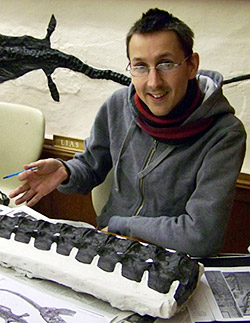
🎙️ Blake Smith and Benjamin Radford are joined by Dr. Karen Stollznow to examine one of cryptozoology’s most enduring hypotheses: that a colony of plesiosaurs survived the K-Pg mass extinction and still lurks in the cold, dark waters of Loch Ness. Their guest, Dr. Adam Stuart Smith, is a specialist in Mesozoic marine reptiles, a researcher at the National Museum of Ireland‘s Natural History Division, and the operator of plesiosauria.com — a resource so comprehensive it even includes a taxonomy of plesiosaur toys (heads almost universally sculpted wrong, he notes, with the eye sockets placed too far back).
Before the interview begins, the hosts do a brisk audit of the photographic “evidence” for Nessie — from the retouched Rines flipper photo to the long-debunked Surgeon’s Photo — and conclude, charitably, that the cumulative case amounts to approximately nothing. Ben also manages to pronounce “Loch” correctly, which is noted for the record.
📷 The Photographic Claims — and Why They Don’t Add Up
The hosts walk through the main visual “evidence” before turning to the science:
– The Surgeon’s Photo (1934) — now confirmed as a hoax, constructed around a small submarine with a sculpted head. It established the classic plesiosaur-silhouette expectation in popular culture, likely influencing all subsequent sightings.
– The Rines flipper photo (1972), taken by Robert Rines and the Academy of Applied Sciences, was released to the public as a clear triangular flipper — but when skeptical writers requested the original from Rines, they received a murky image of bubbles. The Academy admitted the published version had been “retouched,” extensively enough that Ben diplomatically observes “there’s a very fine line between fraud and retouching.” Both the original and the retouched versions are reproduced in his book 📚 Lake Monster Mysteries 💵.
– The Rines “dragon-head” tree-stump photo — widely regarded as a submerged tree stump, thoroughly debunked on its own merits.
– The Dinsdale film (1960), touted as the best video evidence for Nessie, shows something moving in the water at considerable distance. The most parsimonious explanation — and the one supported by a later re-examination cited at loch-ness.org — is that it is a boat.
🦕 What Plesiosaurs Actually Were
Dr. Smith provides a clear-eyed overview of the fossil record. A few highlights that complicate the “living plesiosaur” hypothesis considerably:
– Not dinosaurs. Plesiosaurs belong to Plesiosauria, an order of marine reptiles entirely separate from Dinosauria. They share the Mesozoic stage with dinosaurs but are no more “dinosaurs” than pterosaurs or mosasaurs are — a distinction Dr. Smith feels strongly about.
– The order divides into two major lineages: long-necked plesiosauroids (the Nessie-shaped ones) and large-headed, short-necked pliosaurs. Hundreds of species are known across both lineages.
– They ranged from roughly 1.5 metres to approximately 15 metres in length. Elasmosaurus, one of the longest-necked forms, had a neck comprising roughly half its total body length — up to 72 cervical vertebrae, the most of any known vertebrate.
– They went extinct at the K-Pg boundary, 65 million years ago. No plesiosaur fossils exist in any younger rock formation, anywhere on Earth.
– Plesiosaur research lags roughly 30 years behind dinosaur research in scholarly attention — a fact Dr. Smith finds both frustrating and motivating.
🌊 Biology, Diet, and the Freshwater Question
The conversation covers what the fossil record actually tells us about plesiosaur biology — and, critically, what it doesn’t:
– Plesiosaurs were long assumed to be strictly marine, but fossil evidence now shows they could enter lacustrine (freshwater-adjacent) environments. Whether they could tolerate fully fresh water long-term is unknown.
– Diet is inferred from teeth and preserved stomach contents. Long-necked forms had needle-like teeth analogous to gharials and ate fish and squid (cephalopod hooklets have been found fossilized in their stomachs). Large-headed pliosaurs had teeth comparable to killer whales and likely ate whatever they liked.
– Many long-necked plesiosaur skeletons are found with gastroliths — stomach stones, sometimes hundreds of them. Whether these served as ballast, digestive grinding aids, or something else entirely remains unresolved.
– Live birth is considered likely, given that closely related groups (ichthyosaurs, mosasaurs, pachypleurosaurs) are known to have given live birth, and the body plan of large plesiosaurs makes beach-crawling to lay eggs essentially impossible. There is at least one unpublished specimen, located in the United States, apparently showing a neonate within an adult’s abdominal region — but until it is described in the literature, it counts for nothing formally.
🏊 How They Actually Moved (Not Like That)
The classic image of Nessie — long neck arching gracefully from the water, paddling along — fails on multiple counts:
– The neck was not flexible. Vertebral processes interlocked tightly, front and back, making the neck a stiff rod. Snake-like coiling or the swan-like pose of popular illustrations was physically impossible.
– Basic hydrodynamics rule out raising a long neck clear of the water: displacing body mass above the surface while staying buoyant would drive the body below, not lift the head up.
– Plesiosaurs did not row. Joint morphology at the limb girdles rules out the rowing stroke once assumed. Instead, they used a modified underwater-flight motion — limbs functioning as wings, like penguins, only with four wings rather than two. Exactly how those four wings coordinated remains genuinely uncertain; researchers have tried everything from attaching paired swimmers with flippers together in pools to programming robotic plesiosaurs.
– Because plesiosaurs breathed air, they would have surfaced frequently — perhaps every hour. A breeding population in Loch Ness would be sighted constantly. The opposite trend is observed: more observers and cameras yield fewer sightings, not more.
🔬 Why the Long Neck, Anyway?
One of the episode’s most engaging detours concerns a question with no settled answer: why did plesiosaurs evolve such extreme necks in the first place?
– No living marine tetrapod has a long neck, making functional analogies nearly impossible to construct.
– The leading hypothesis, associated with researcher Leslie Noè, holds that the neck pointed primarily downward rather than forward or up — used almost like a vacuum-cleaner probe to disturb sediment and snap up crustaceans from the seabed.
– A stealth-predation hypothesis suggests the small head on a very long neck could penetrate a school of fish before the fish registered the large body behind it.
– Dr. Smith raises a third possibility: sexual selection, analogous to peacock tail displays — which would explain why the neck grew longer throughout plesiosaur evolution without any obvious survival payoff, and why no other marine lineage independently evolved the same feature despite facing similar prey.
– Simultaneously, the pliosaur line was evolving shorter necks over the same time span, creating a striking morphological dichotomy within a single order.
❓ So — Could One Be in Loch Ness?
Asked to rate the probability on a scale of 0–10, Dr. Smith is unambiguous: the evidence is 0, so the probability is 0. He is careful to note you cannot prove a negative, but the convergence of problems is damning:
– A viable breeding population would require on the order of 100 individuals, each potentially 15 metres long, in a single loch with insufficient biomass to support them.
– Air-breathing animals that size would surface constantly and be photographed constantly — but sighting rates are declining as observer numbers increase.
– A 2003 BBC sonar survey using GPS and side-scan sonar found nothing unusual whatsoever.
– No plesiosaur fossil exists in any rock younger than 65 million years, anywhere on the planet.
Dr. Smith adds, with barely concealed exasperation, that he cannot get a single news story about genuine plesiosaur discoveries published without an editor inserting a Loch Ness Monster reference — which rather undersells what are, by any measure, genuinely remarkable animals.
📚 Further Reading
– 📚 Lake Monster Mysteries: Investigating the World’s Most Elusive Creatures 💵 by Benjamin Radford and Joe Nickell
🔗 Related Links
– Plesiosauria.com — Dr. Adam Stuart Smith’s reference site for plesiosaur research
– Plesiosauria (Wikipedia)
– Elasmosaurus — the archetypal long-necked plesiosaur
– The Surgeon’s Photograph — history and hoax analysis
– Tim Dinsdale and the Dinsdale Film
– Robert Rines and the Academy of Applied Sciences
– Gastroliths
– Cretaceous–Paleogene Extinction Event
Note: ads inserted into the distributed audio alter the timestamps in unpredictable ways, so timing references in these notes are approximate.
Episode Transcript
Read a complete transcript of this episode