Regular Episode
#160 – THE MEG
The episode doubles as a post-mortem on Discovery Channel‘s infamous 2013 Shark Week special Megalodon: The Monster Shark Lives, widely condemned by the scientific community as a fake documentary that convinced a surprising number of viewers that a 60-foot prehistoric predator is still lurking in the ocean. Spoiler: it isn’t. But the real animal is astonishing enough on its own terms.
🦷 What We Know About Megalodon
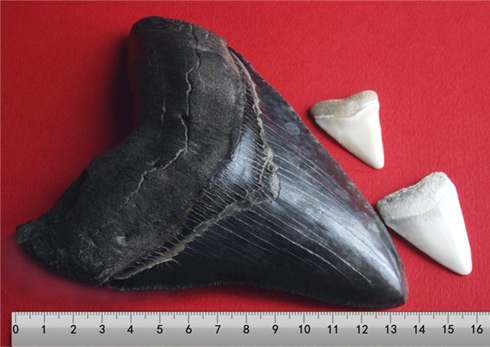
Megalodon (Otodus megalodon) ruled warm, shallow tropical seas from roughly 23 million to 2.6 million years ago. Almost everything scientists know about it comes from its teeth — it had more than 260 of them arranged in five rows, constantly shed and replaced throughout its life, and the largest examples are roughly the size of a dinner plate. There are also fossilized vertebral columns, what appears to be fossilized feces, and whale bones bearing deep tooth-slash marks that suggest Megalodon was actively taking on prey larger than itself.
Size estimates are derived by scaling the known mathematical relationship between tooth size and total body length in great white sharks and applying it to Megalodon teeth. The resulting upper-end estimate is around 59 feet (roughly 18 meters) — making even a juvenile Megalodon approximately the size of a modern adult great white. Craig is candid that there is inherent uncertainty in that double extrapolation, but notes that if the tooth-to-body relationship were wildly wrong, Megalodon would just become “a small shark with massive teeth — a bit cartoonish.”
🌊 Why We Know It’s Extinct
Craig walks through several converging lines of evidence. Megalodon teeth appear abundantly in the fossil record up to about 2.6 million years ago, then stop entirely — and because sharks continuously shed and replace teeth throughout their lives, a living population would be leaving fresh teeth on ocean floors and beaches worldwide. None have been found. Additionally:
– Megalodon was not a creature of the deep abyss. It preferred warm, shallow, tropical water — exactly the zones most intensively fished and explored today.
– Its global distribution means there is no single remote refuge where a relic population could hide undetected, unlike the coelacanth (restricted to deep caves off South Africa and Indonesia) or the Yeti crab (found only at specific unexplored hydrothermal vents).
– Global commercial fishing operations would almost certainly have netted one by now.
– The “video evidence” from the Discovery mockumentary was identified by shark researchers as footage of a sleeper shark.
🌡️ What Killed Megalodon
The short answer is that nobody knows for certain, but Craig outlines the two leading hypotheses — and explains why they may not be mutually exclusive. The first is that cooling oceans at the end of the Pliocene shrank the warm, shallow habitats Megalodon depended on. The second is prey availability: supporting a carnivore of that size requires an enormous food base, and a less productive ocean may simply have been unable to sustain it.
Craig adds a physiological wrinkle: an animal that large already runs close to the upper limit of what the ocean’s dissolved oxygen can support. Warming water raises metabolic rate, which increases oxygen demand — so a temperature shift could have simultaneously squeezed the food supply and pushed Megalodon past its physiological oxygen ceiling. A double hit, rather than a single cause.
📏 Sizing Ocean Giants — And the Guinness Book
Craig’s lab published a paper called Sizing Ocean Giants (co-authored with Alistair Dove of the Georgia Aquarium and collaborators at Duke), cataloguing the verified maximum sizes of nearly 30 of the ocean’s largest species — from blue whales and whale sharks to giant clams and giant isopods. The team tracked down individual museum specimens to confirm disputed measurements. Shortly before this episode was recorded, the Guinness World Records team contacted Craig to say his paper had become their primary reference for marine size records. Craig describes it as a full-blown geek moment.
The same laser-based photogrammetry technique Craig’s group developed to measure free-swimming whale sharks in the wild — mounting calibrated laser dots to a camera and photographing the region between the last gill slit and the dorsal fin — is directly analogous to the method used to estimate Megalodon’s length from tooth fossils: establish a known scaling relationship in a living animal, then extrapolate.
📺 The Discovery Channel Problem
Craig is diplomatic but unambiguous: Megalodon: The Monster Shark Lives (2013) and its 2014 follow-up Megalodon: The New Evidence, along with Discovery/Animal Planet’s mermaid mockumentaries, represent two of the worst things to happen to marine biology communication in recent memory. Before those programs aired, Craig says, not a single person in his career had ever asked him whether Megalodon was still alive or whether mermaids were real. Since then, he and colleagues including Dr. David Shiffman and Dr. Andrew Thaler have spent considerable time online — at blogs like Deep Sea News — pushing back against the misinformation. The core problem: even when the programs included accurate background facts about Megalodon biology, the overriding takeaway audiences retained was that the animal might still exist — drowning any accurate content in disinformation.
Discovery promised in January 2015 to stop producing fake documentaries. The hosts note, wryly, that Animal Planet had just wrapped up Finding Bigfoot at its 100th episode around the same time.
🔬 Modern Sharks and Current Research
The conversation turns to living sharks, which are in considerably more trouble than Megalodon — through no fault of their own. Craig notes that a large proportion of shark species are currently threatened or near extinction, facing pressure from commercial fishing, shark finning, habitat degradation, overfishing of prey species, and ocean warming.
Craig’s current research at LUMCON focuses on deep-sea biodiversity — why some regions of the seafloor support species richness comparable to coral reefs or tropical rainforests despite the near-total absence of sunlight and primary productivity. His lab also tracks the ongoing impacts of the Deepwater Horizon oil spill on Gulf of Mexico deep-sea communities, and studies how declining ocean productivity driven by climate change affects marine invertebrate populations. He mentions MBARI (Monterey Bay Aquarium Research Institute) and Canada’s Ocean Networks Canada NEPTUNE cabled seafloor observatory as leading examples of the autonomous and continuous monitoring infrastructure the field badly needs more of.
📚 Further Reading
– 🎬 The Meg 💵 (2018 film based on the novel by Steve Alten)
– 📚 MEG: A Novel of Deep Terror 💵 by Steve Alten
🔗 Related Links
– Megalodon — Wikipedia
– Sizing Ocean Giants — McClain et al., PeerJ (open access)
– Louisiana Universities Marine Consortium (LUMCON)
– Deep Sea News — Craig McClain’s science blog
– Coelacanth — Wikipedia
– Yeti Crab — Wikipedia
– Shark Finning — Wikipedia
– Deepwater Horizon Oil Spill — Wikipedia
– Ocean Networks Canada — NEPTUNE Observatory
Note: ads inserted into the distributed audio alter the timestamps in unpredictable ways, so timing references in these notes are approximate.
(Above) Megalodon tooth with great white sharks teeth (by Brocken Inaglory derived from Parzi and Kalanderivative: [CC BY-SA 3.0], from Wikimedia Commons)

Does a giant prehistoric shark lurk deep in the waters of the ocean, surviving against all odds to surprise us by occasionally biting a giant whale in half? No. But these animals did once exist and we don’t need to pretend they’re still alive to be blown away by their stunning biological features. We talk with Dr. Craig McClain about the amazing animal we call Megalodon.
Further reading
- McClain lab
- Megalodon Trivia
- How We Know Megalodon Doesn’t Still Exist
- The speed of Megalodon
- Discovery Promises no more Fake-umentaries
- More on Discovery
- Even more on Discovery and their leadership’s promise to steer clear of fake content
Music
- Monstertalk Theme: Monster by Peach Stealing Monkeys
MTArchivist
0