Regular Episode
#161 – THE CALL OF TUT-THULHU
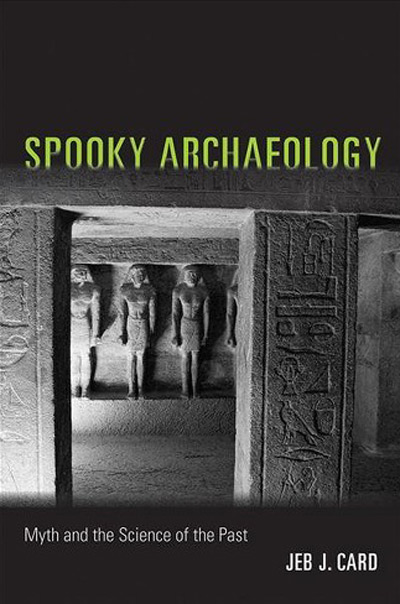
The book itself is broader than any single chapter, covering everything from the Mound Builder myth and Bigfoot to spies, witchcraft, and ancient alien narratives — all united by the question of why archaeology, more than almost any other science, attracts paranormal speculation. The hardback is priced as an academic press title, but Jeb notes a paperback edition is planned; in the meantime, your local library is a fine first stop.
🏺 Why Archaeology Gets All the Weird
Jeb argues that the strange intersection of archaeology and the paranormal isn’t accidental. The field sits at the junction of two deep human impulses: scientific curiosity about material remains, and a mythic need to make sense of time on a scale bigger than human history. When people learn he’s an archaeologist, they ask about crop circles. When they learn a colleague studies physics, nobody asks about quantum ghosts.
A big part of the answer lies in what Jeb calls the “long 19th century” — roughly the French Revolution to World War I — when a more scientific, professionalized archaeology was still wrestling free from antiquarianism. Ideas cooked up in the 1880s and never subjected to peer review have a way of persisting, often carrying their original baggage of racial lineages, lost continents, and mysterious builders — whether those are Atlanteans, Phoenicians, Nephilim, or aliens. The Mound Builder myth in North America is a well-known example; Great Zimbabwe is another.
🔮 Margaret Murray, the Witch Cult, and Lovecraft’s Smoking Gun
Jeb traces one of Lovecraft’s most direct intellectual debts to Margaret Murray, one of the first professionally trained Egyptologists (she studied under Flinders Petrie at University College London and had to fight the institution for her degree). Murray’s 1921 book 📚 The Witch-Cult in Western Europe 💵 argued that the accused witches of the early modern period were not innocent victims of hysteria but members of a surviving pre-Christian religion — a secret, ancient cult with rites centered on a horned god.
Most historians today (and the neo-pagan community itself, guided by scholars like Ronald Hutton in 📚 The Triumph of the Moon 💵) do not accept the “old religion” hypothesis. But Lovecraft took it very seriously. In letters to Robert E. Howard, he called Murray’s work cutting-edge anthropology and connected it to the Salem trials. The smoking gun appears in Lovecraft’s own commonplace book (his personal notebook of story ideas), where he writes, in essence: witch cult — don’t know your members — centered on ancient Pacific island — which is, unmistakably, the Cthulhu cult. The descriptions of the Louisiana swamp rites in “The Call of Cthulhu” — fire, a central idol, ecstatic worshippers moving like animals — are nearly indistinguishable from Murray’s descriptions of sabbat ceremonies.
🗺️ King Tut, Dead Archaeologists, and the New York Times
The second major pillar of Jeb’s argument is quantitative. He performed a content analysis of every archaeology-related article in The New York Times during Lovecraft’s adult life — over 1,000 articles. The discovery of Tutankhamun’s tomb in late 1922 dominated the front pages for nearly a year. Then, roughly a year later (precisely when Lovecraft was writing and setting “The Call of Cthulhu” in March–April 1925), two specific themes spiked in the press simultaneously: dead or imperiled archaeologists and sunken continents.
Lovecraft read the Times, clipped newspaper articles for story inspiration (he says so explicitly), and lived in New York at the time. Jeb notes that Tulane University — name-checked in “The Call of Cthulhu” — was conducting its very first archaeology expedition, covered extensively in the press. Tulane had no prior reputation in the field. The parallel is hard to dismiss: Cthulhu is an undead god hidden in a sunken city into which people poke and then die. Tutankhamun is an undead god in an ancient sealed tomb into which people poke and then (allegedly) die. The Tut-curse narrative, Jeb argues, primed newspaper editors — and readers — for exactly this kind of story for the next fifteen years, which is precisely why so much of our pop-culture archaeology is set between 1920 and 1940.
🌊 Theosophy, Sunken Continents, and the Necronomicon
Lovecraft was a committed materialist and atheist who openly mocked Theosophy — yet mined it shamelessly. Madame Blavatsky‘s legacy had seeded popular culture with root races, sunken continents (Lemuria and Atlantis), and channeled wisdom from ancient masters. Just before writing “The Call of Cthulhu,” Lovecraft read 📚 The Story of Atlantis and the Lost Lemuria 💵 by W. Scott Elliott, a theosophical text. He called this kind of material “really useful garbage.” One could read “The Call of Cthulhu” as an atheist’s burlesque of Theosophy — the sunken continent is real, the ancient religion is real, the god is real, but the cosmos is meaningless and hostile rather than spiritually ascending.
Separately, Jeb mentions that he and Jason Colavito believe they have identified the likely real-world source that inspired the Necronomicon — not the actual book (which doesn’t exist), but a genuine historical text that Lovecraft almost certainly encountered and that bears a striking structural resemblance to his fictional grimoire.
📡 Lovecraft as a Vector: From Pulp Fiction to Ancient Aliens
Jeb and Blake trace how Lovecraft’s synthesis became a cultural transmission node. Louis Pauwels and Jacques Bergier — the occultist authors who first championed Lovecraft in France and translated his work — wrote 📚 Le Matin des Magiciens 💵 (The Morning of the Magicians, 1960), which Jeb describes as something like the show bible for the History Channel: ancient aliens, Nazis in Antarctica, Illuminati. That book is an acknowledged influence on Erich von Däniken, who in turn shaped the entire ancient-aliens genre.
Meanwhile, in the American pulp world, Lovecraft’s circle fed directly into early UFO culture: Ray Palmer, Richard Shaver, and Jack Parsons were all reading this material. Maurice Doreal, often credited with seeding the reptilian-alien concept, was — according to Jeb — essentially plagiarizing Lovecraft, Howard, and Frank Belknap Long. The Slender Man, Jeb notes, is clearly Lovecraftian in inspiration. Delta Green emerged in the early 1990s via The Unspeakable Oath zine partly as a modernizing corrective to the 1920s time-lock of Sandy Peterson’s Call of Cthulhu RPG — itself a product of the same year as Raiders of the Lost Ark, which is probably not a coincidence.
🎬 Lovecraftian Film Recommendations
Jeb offers his picks for best Lovecraft adaptations. His top straight adaptation is the H. P. Lovecraft Historical Society‘s 2005 silent-film-style 🎬 The Call of Cthulhu 💵 — shot in black and white in the style of German Expressionist cinema. A close second is 🎬 The Resurrected 💵 (1991), Dan O’Bannon’s adaptation of “The Case of Charles Dexter Ward,” starring Chris Sarandon. O’Bannon (primary screenwriter of 🎬 Alien 💵) also directed 🎬 Dark Star 💵, which is why Alien — and by extension Prometheus — contains as much Lovecraft as it does. For the most broadly Lovecraftian film, Jeb gives the nod to 🎬 The Thing 💵 (1982): alien dug up in Antarctica, effectively a Shoggoth, Carpenter leaning hard into the cosmic-horror angle of John W. Campbell Jr.’s source novella.
Blake adds that he recently watched the 1973 made-for-TV movie 📺 Horror at 37,000 Feet — a Lovecraftian story about an architect trying to transport an ancient British chapel by 747, starring William Shatner, Chuck Connors, Buddy Ebsen, Roy Thinnes, Paul Winfield, and Russell Johnson. Improbable cast, surprisingly enjoyable, and currently free to watch on YouTube.
📚 Further Reading
– 📚 Spooky Archaeology: Myth and the Science of the Past 💵 by Jeb J. Card
– 📚 The Witch-Cult in Western Europe 💵 by Margaret Murray (1921)
– 📚 The Triumph of the Moon 💵 by Ronald Hutton
– 📚 The Story of Atlantis and the Lost Lemuria 💵 by W. Scott Elliott
– 📚 Le Matin des Magiciens (The Morning of the Magicians) 💵 by Louis Pauwels and Jacques Bergier
– 📚 Frauds, Myths, and Mysteries: Science and Pseudoscience in Archaeology 💵 by Kenneth Feder
–
Warning: Some of the language in this episode may not be suitable for children. Listener discretion is advised.
Archaeologist and author Jeb Card joins Blake Smith to discuss his new book Spooky Archaeology. The book is about many weird, spooky topics which are tied to the field of archaeology—but this episode spends a lot of time talking about the unusual connection between H. P. Lovecraft and the discovery of King Tut’s Tomb.
Mentioned in the episode
Music
- Monstertalk Theme: Monster by Peach Stealing Monkeys
MTArchivist
0