Regular Episode
#159 – NESSIE UNLOCHED
Blake notes that several science-minded friends online reacted with dismissive eye-rolls at the Nessie angle, missing the point entirely. As Gemmell puts it: without the monster hook, this story gets two column inches in the local paper; with it, NBC, CBS, Sky, and the BBC all showed up at the loch. Monster Talk listeners, of course, already know that monsters and good science are not mutually exclusive.
🧬 What Is eDNA and Why Does It Matter?
Environmental DNA is genetic material shed into the environment — water, soil, air — by organisms going about their lives: scales, mucus, feces, shed cells. Rather than netting animals or sending down cameras, researchers simply collect water samples at various depths and sequences whatever DNA is floating in them.
Gemmell gives a vivid illustration of the technology’s power: a study published around the time of the interview found that eDNA identified 44% more shark species in a Pacific survey than traditional bait-and-camera methods — because shy sharks that won’t come to a chunk of meat are invisible to cameras but leave DNA behind regardless. The same sensitivity applies to whatever might lurk in a cold, peat-darkened Scottish loch.
The Loch Ness project collects samples at multiple depths, accounting for the loch’s thermocline — a temperature boundary layer that affects not only where species congregate, but also (as Gemmell and collaborator Adrian Shine of the Loch Ness Project discuss) the subsurface water currents that have driven many a monster sighting.
🏴 Scotland’s Monster Problem
Loch Ness is far from Scotland’s only monster-haunted water. Gemmell notes roughly 13 Scottish lochs have reported creatures, underpinned by the older Celtic mythology of the kelpie or water horse.
Notable examples mentioned:
– Loch Morar, whose resident monster is called Morag
– Loch Oich (just south of Ness along the Caledonian Canal), home to a creature called Weoiki
– A further collection of Gaelic-named loch monsters Gemmell cheerfully admits he cannot pronounce
The lochs are not isolated: Loch Ness connects to the Moray Firth and the North Sea via the six-mile River Ness, and southward through the Caledonian Canal to Loch Oich and beyond. Migratory salmon, eels, lampreys, and the occasional seal all make use of these connections — which means, Gemmell notes with audible amusement, that any monsters could theoretically visit each other as well.
🦕 Testing the Hypotheses: From Plesiosaurs to Catfish
The eDNA approach lets the team run proper hypothesis tests rather than just peering into dark water. The hypotheses range from the grandiose to the merely improbable:
– The “Jurassic hypothesis” — a surviving plesiosaur. No intact ancient DNA exists to compare against, but a technique called ancestral state reconstruction can estimate where plesiosaur DNA would cluster on the modern tree of life — somewhere near crocodiles and birds, given the archosaur lineage. Anything reptilian and genuinely novel would stand out.
– The Wels catfish (Silurus glanis) — a European giant reportedly introduced to British waterways by the Victorians. These animals reach 14–16 feet and hundreds of pounds; Gemmell remarks, entirely plausibly, that seeing the bonnet-width head of one breach beneath a small boat would convince most people they’d encountered a monster.
– Migratory sturgeon — Adrian Shine’s preferred mundane explanation. Sturgeon DNA is well-characterized, so its presence (or absence) is directly testable. Gemmell deadpans that a good photograph of a sturgeon in the loch would finally give the world “the sturgeon photo” to replace the famous surgeon’s photo.
🌊 Logs, Thermoclines, and the Anatomy of a Sighting
One of the more illuminating digressions concerns why Loch Ness generates so many compelling sightings even absent any monster. Gemmell describes Adrian Shine’s work on the loch’s internal dynamics: a thermocline creates subsurface currents that can run counter to the surface wind direction. Waterlogged logs submerge and re-emerge, sometimes moving against the prevailing wind — and the intuitive human inference is that anything moving against the wind must be swimming under its own power. It doesn’t have to be.
🧊 Sediment Cores and Deep Time
Blake floats a hypothesis of his own: could the loch’s bottom sediments function like an ice core, preserving a historical DNA record? Gemmell confirms the idea has real merit — DNA survives longer in sediment than in open water — and reveals that Shine collected sediment cores 25 years ago for a project called the Rosetta Project, lowering equipment 230 metres to sample six metres into the loch bed, reaching deposits laid down roughly 9,500 years ago (approximately the end of the last glaciation). The cores have been sitting, stored dry, in Shine’s loft ever since. The team plans to attempt DNA extraction from them with help from Tom Gilbert‘s paleogenomics lab at the University of Copenhagen — a long shot, Gemmell acknowledges, but worth attempting given the extraordinary upside.
💰 The Budget and the Bigger Picture
The project runs to roughly $100,000 all-in — reagents, sequencing, travel, accommodation — with much of that offset by in-kind contributions from the Loch Ness Project (boat and skipper), volunteer researcher time, and likely sequencing support from Illumina. Gemmell is candid about the cost but frames it against the alternative: sonar surveys, trawl nets, and submersible drones are all expensive too, and they don’t produce published biodiversity data or headlines that get hundreds of thousands of people interested in genetics.
The practical scientific outputs extend well beyond Nessie-hunting: data on migratory fish movement patterns (of interest to UK fisheries researchers), biological markers of loch ecosystem health (relevant to Scottish Natural Heritage), and a baseline biodiversity snapshot of Loch Ness in June 2018 that future studies can compare against. Gemmell expects at least three peer-reviewed papers from the work.
He closes with a near-future vision: sequencing devices small and cheap enough to plug into a smartphone, letting anyone — hikers, surfers, recreational anglers — run a real-time eDNA survey of their local environment. Loch Ness, he suggests, is just the opening argument for that conversation.
📚 Further Reading
– 📚 Hunting Monsters: Cryptozoology and the Reality Behind the Myths 💵 by Darren Naish — the book that inspired Gemmell to propose the eDNA study
🔗 Related Links
– Loch Ness Monster (Wikipedia)
– Environmental DNA (Wikipedia)
– Ancestral State Reconstruction (Wikipedia)
– The Surgeon’s Photograph — the famous (and fraudulent) 1934 Nessie image
– Wels Catfish (Silurus glanis)
– Morag, the Loch Morar monster
– Kelpie — the Celtic water horse mythology underlying Scottish loch legends
– Caledonian Canal — the waterway connecting Loch Ness southward to other lochs
Note: ads inserted into the distributed audio alter the timestamps in unpredictable ways, so timing references in these notes are approximate.
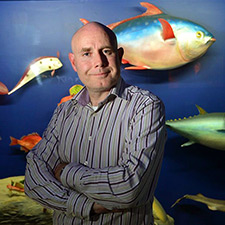
We interview Professor Neil Gemmell (@ProfGemmell) who is currently conducting eDNA research into various lake monsters of Scotland, especially Nessie and Morag. His lab at the University of Otago in New Zealand is hoping to find a lot of new information about the life within these cold, deep lakes using cutting edge techniques for gathering DNA from the waters at various depths.
Neil was inspired to this research from reading MT alum Darren Naish’s book Hunting Monsters, which is now available in paperback.
Further reading


Music
- Monstertalk Theme: Monster by Peach Stealing Monkeys
MTArchivist
0