208 – Monsters in the Media
Dr. Mueller is the author of three books on the press and the presidency, a member of the American Journalism Historians Association, and a former newspaper reporter who has also taught journalism in Mozambique. He brings a scholar’s depth and a working journalist’s instincts to the question MonsterTalk cares about most: when you find a 19th-century newspaper story about a captured ape-man or a crashed airship, what are you actually holding?
🗞️ A (Very) Brief History of American Journalism
Dr. Mueller traces the arc from America’s first newspaper — Publick Occurrences Both Forreign and Domestick (1690), which lasted exactly one issue before the colonial government shut it down — through the revolutionary and partisan press of the 18th century, and into the penny press era of the 1830s. It was the penny press, pioneered by Benjamin Day‘s New York Sun, that first aimed at a mass working-class audience rather than a political elite — and that created both the commercial incentive and the editorial appetite for sensational stories.
Journalism only began to be professionalized in the 20th century with the rise of journalism schools and codes of ethics like those of the Society of Professional Journalists. Before that, reporters learned on the job, there was no licensing body, and the line between news, humor, and outright fabrication was a matter of editorial whim. As Mueller notes, taking the fun out of newspapers was more or less the point of professionalization.
🌕 The Great Moon Hoax and the Snake Bureau
The Great Moon Hoax of 1835 — in which the New York Sun published a series of articles claiming a Scottish astronomer had observed bat-winged humanoids on the lunar surface through a powerful telescope — is offered as the template for understanding these stories. The Sun never admitted the hoax; one editor defended it on the grounds that readers appreciated good writing. Other papers picked the story up and ran it straight.
Mueller describes a memo from Joseph McCullough, editor of the St. Louis Globe-Democrat, instructing his reporters to file a “snake bureau” — a standing inventory of bizarre snake stories, because readers loved them. McCullough drew his personal line at a Cincinnati item claiming a snake was nursing from a cow like a calf; Blake notes that particular piece of folklore is still in circulation today. The broader lesson: 19th-century editors were actively curating the weird, and reporters were expected to supply it on demand.
📋 Reading the Context, Not Just the Clipping
Mueller’s most practically useful point for paranormal researchers: context within the newspaper itself was a critical signal to contemporary readers that modern researchers often strip away. Strange stories were frequently placed in columns of “brights” — one-liners, jokes, odd items — that any reader of the time would have recognized as a nudge-and-wink section. Lifted out of that context and cited in a cryptozoology book a century later, the same item reads as a straight news report.
Other editorial tells Mueller identifies:
– Phrases like “we believe” or “we have heard” were a 19th-century editor’s way of formally disavowing a story while still running it.
– Wilbur Storey, owner of the Chicago Times, sent his Civil War correspondents a simple directive: send all the news you can; if you have no news, send rumors.
– Political slant was openly declared — and readers who consumed multiple papers (as many did) could triangulate accordingly. Mueller uses the aftermath of the Battle of the Little Bighorn as a case study: Democratic papers blamed President Grant; one went so far as to claim Sitting Bull had visited the White House and Grant had gifted him the gun used to kill Custer.
📷 Jacko, the Thunderbird, and the Aurora Airship
The episode opens with three canonical “newspaper monster” cases that illustrate exactly why Mueller’s framework matters:
– The Jacko story (1884, British Columbia): a railroad crew near the Canadian village of Yale allegedly captures a 4-foot-7 gorilla-like creature covered in glossy hair. Researchers have since concluded the story was likely a tall tale or a hoax; no creature was ever exhibited.
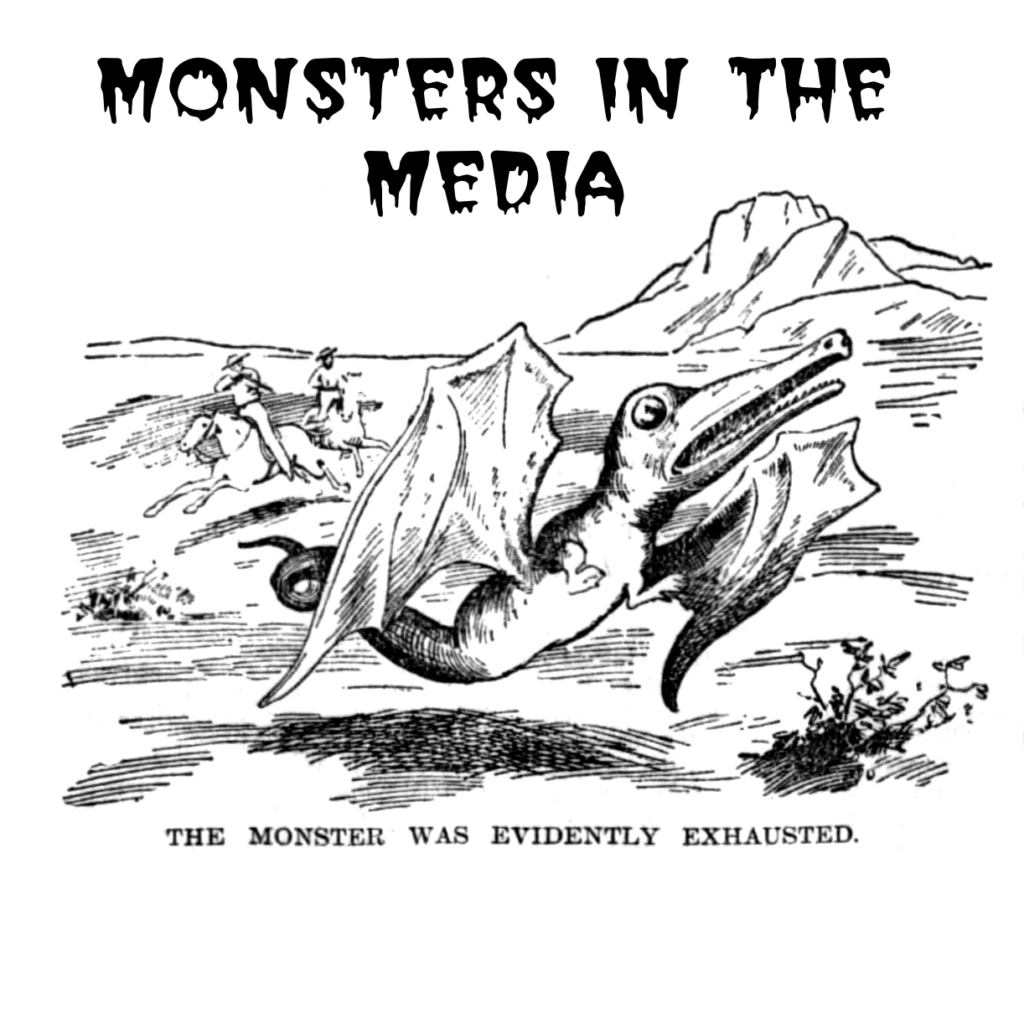
– The Tombstone Thunderbird (1890, Tombstone Epitaph): two ranchers encounter a winged, alligator-like monster in the Arizona desert between the Whetstone and Huachuca Mountains. The story has never been corroborated and the famous photograph that believers describe has never materialized.
– The Aurora, Texas airship crash (1897): an unidentified airship collides with a judge’s windmill and the pilot — rumored to be “not of this world” — is buried in the local cemetery. Part of the broader Great Airship Mystery wave of 1896–97.
Mueller’s advice: read the tone, look for hedging language, note the page placement, and consider the political and commercial moment in which the story was published.
🔭 H.M. Stanley, the Telegraph Race, and the Competitive Press
Mueller sketches the career of Henry Morton Stanley as a portrait of the 19th-century journalist: orphaned in Wales, Confederate and Union soldier, Union Navy sailor, stringer in St. Louis, and eventually star reporter for the New York Herald — famous for his 1871 expedition to find Dr. David Livingstone in central Africa. Stanley was also filing dispatches to London papers and sent back vivid accounts of mysterious pygmy warriors and unknown animals he had only heard rumors of — copy crafted to satisfy readers on both sides of the Atlantic who wanted adventure and the exotic.
The scramble to reach the telegraph first produced legendary acts of competitive sabotage: reporters feeding the New Testament to telegraph operators to block rivals, having competitors falsely arrested, and picking each other’s pockets during train wrecks. The AP correspondent covering the Little Bighorn was killed with Custer; the first reports of the June 25, 1876 battle didn’t reach most U.S. newspapers until July 6th.
Mueller also touches on the introduction of photographs into newspapers — technically possible only after the development of the halftone printing process in the latter part of the 19th century. Before that, newspapers used woodcut engravings made from photographs — a distinction that matters enormously when evaluating visual “evidence” from that era.
📰 Partisan Press, Press Freedom, and the Business of News
The conversation moves into the economics and politics of modern journalism: the collapse of local newspaper revenue as classified advertising migrated online, the struggle over paywalls, and the democratic cost of losing local coverage of school boards and city halls. Mueller also discusses press freedom internationally — including a student thesis comparing Saudi press coverage of the Gulf War to coverage of a more recent conflict, which Mueller noted after recording he had misspoken about (Yemen, not Sudan).
Blake raises the question of whether consuming news is structurally similar to consuming monster stories: both require active critical evaluation rather than passive reception. The episode closes with Blake offering five practical guidelines for news literacy, from reading past the headline to using fact-checking sites — a set of habits that applies equally well to that 1884 dispatch about Jacko.
📚 Further Reading
– 📚 Shooting Arrows and Slinging Mud: Custer, the Press, and the Little Bighorn 💵 by Dr. James Mueller
– 📚 Tag Teaming the Press 💵 by Dr. James Mueller
– 📚 Towel Snapping the Press 💵 by Dr. James Mueller
– 📚 They Knew Too Much About Flying Saucers 💵 by Gray Barker (Blake’s Audible recommendation this episode)
– 📚 The Great Airship Mystery 💵 by Daniel Cohen
🔗 Related Links
– Great Moon Hoax (1835) — Wikipedia
– Jacko the cryptid — Wikipedia
– Tombstone Thunderbird — Wikipedia
– Aurora, Texas Airship Incident — Wikipedia
– The Great Airship Mystery — Wikipedia
– Penny Press era — Wikipedia
– Henry Morton Stanley — Wikipedia
– Halftone printing process — Wikipedia
– Newspapers.com — digitized historical newspaper archive
– Society of Professional Journalists Code of Ethics
Note: ads inserted into the distributed audio alter the timestamps in unpredictable ways, so timing references in these notes are approximate.
Download this episode (Right-click, Save As)
We welcome Dr. James Mueller, associate dean of Journalism at the University of North Texas.
He’s the author of three books (with a fourth on the way) and they are:
Shooting Arrows and Slinging Mud: Custer, the Press, and the Little Bighorn
He’s also a member of the American Journalism Historians Association, and he joins us to talk about the history of newspapers and journalism and how to contextualize weird stories in the news.

Discussed in this episode:
Newspaper Rock – Petroglyph news
New York Sun – Great Moon Hoax
Gilbert Gottfried Incident after 9/11. (His take on it.)
Jacko the Canadian “Gorilla” hoax
Tombstone “Thunderbird” hoax
The Great Airship Mystery (wiki, book by Dan Cohen)
Historically Black Newspapers archived (Blog-post Newspapers.com)
History of photos being used in newspapers (1870s – 1880s)
Saudi involvement in the Sudan civil war (mentioned during the interview) However, Dr. Mueller corrected this via email and said he meant to say YEMEN not SUDAN.
1 thought on “208 – Monsters in the Media”
Comments are closed.
Have been a listener for many moons. BUT!!!!!!!, am getting really, really tired of Blake hijacking the discussion to see if he can’t weasel in some quasi-humorous pun-like conversation-stopper. I want to hear what these people have to say, not some unexplained reference to Blake’s magic light bulb.
My suggestion is that every time he makes a pun or otherwise derails the information blow, he should have to put a quarter in the “Bad Blake” jar. The money so deposited will buy Karen a Ferrari, and probably put Blake’s children through college.
Do, please, lighten up. And get Disotell back to give us the final disposition on Sykes, and on Melba Ketchum.
I do love you guys, but please try a little harder to stay on message.