Regular Episode
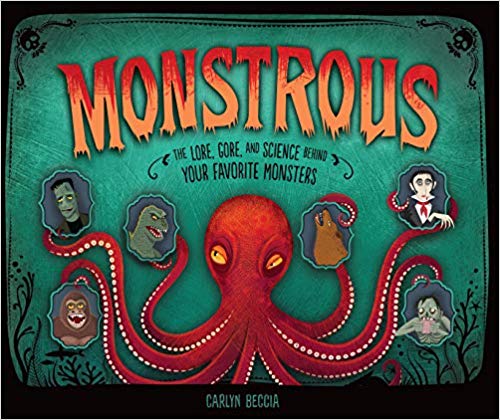
202 – Monstrous (with Carlyn Beccia)
The book took five years to complete, covers monsters from vampires and werewolves to Godzilla, and pairs each creature’s origin story with a genuine science lesson — neuroscience, biology, paleoanthropology, taphonomy, transgenics, and more. Blake puts it plainly: “There’s a few books we’ve dealt with that have been so absolutely in line with our core principles… this is right there in that sweet spot.”
🧠 The Neuroscience of Fear (and Why Monsters Help)
Beccia started the book not with monsters themselves but with the question of why we fear things at all. She traces the evolutionary logic: ancestors who responded to fear stimuli survived; the cavalier risk-takers did not. Fear, in that framing, is a feature, not a bug. Her father’s childhood strategy of telling her the bloodiest possible monster stories was, she now realizes, a form of informal exposure therapy — monsters as a contained way to rehearse fear, close the book, and survive. That philosophy shapes the entire project: make monsters logical, break down which traits are scientifically possible and which aren’t, and let young readers develop critical thinking alongside the creeps.
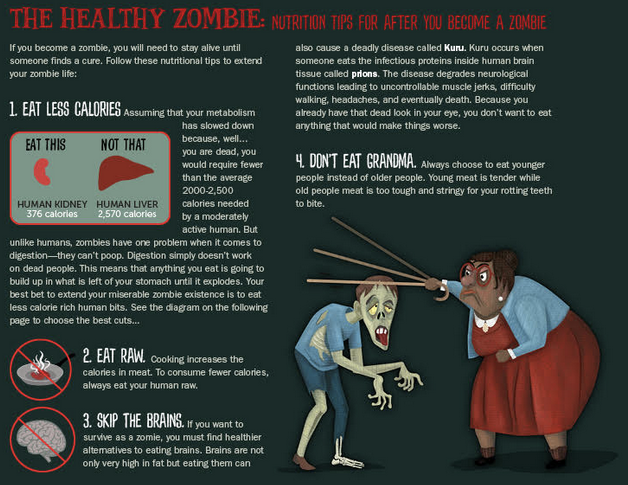
🧟 What Should a Zombie Actually Eat?
One of the book’s more memorably disgusting infographics presents the caloric content of various human body parts — drawn from actual cannibalism research — rendered as a zombie nutrition guide. Beccia’s advice: if you become a zombie, skip the brains. First, the brain is the most calorie-dense, fat-rich organ in the body. Second, eating brains risks contracting a prion disease analogous to kuru — the fatal neurological illness documented among the Fore people of Papua New Guinea, and closely related to bovine spongiform encephalopathy (mad cow disease). Sufferers of kuru exhibit symptoms disturbingly reminiscent of the zombie archetype.
Blake notes that the “zombies eat brains” trope is largely a pop-cultural artifact of one film: 🎬 The Return of the Living Dead 💵, directed by Dan O’Bannon and based on a story by John Russo (co-creator, with George Romero, of 🎬 Night of the Living Dead 💵). O’Bannon added the brains gag as a comic element; it spread far beyond its origins — a kind of cultural shibboleth for zombie fandom.
🧛 Vampires, Revenants, and the Science of Decomposition
The vampire chapter is the conversation’s richest stretch. Beccia traces the vampire’s origin back to 18th-century revenants — bloated, diseased corpses thought to rise and feed — long before the word “vampire” entered common usage. One of the book’s standout infographics is a guide to distinguishing the dead from the undead, built entirely on taphonomy:
– Purge fluid: a reddish-brown liquid that seeps from the mouth and nose after death, easily mistaken for blood.
– Apparent hair and nail growth: the skin and gums shrink as the body desiccates, making nails and teeth appear longer — they are not actually growing.
– Post-mortem vocalizations: as bacteria consume soft tissue, abdominal gases escape loudly — known historically as sonus porcinus (Latin: “noisy swine”) and apparently similar to a pig foraging in garbage.
– Bloat and rupture: gas buildup can cause a corpse to burst, producing what coroners describe as a combination of flatulence and vomit. Blake can personally confirm this phenomenon, having been present near an exploding roadside dog carcass in Georgia.
The conversation also touches on deviant burials — a term for archaeological interments in which the deceased were weighted with boulders, chained, staked, decapitated, or had stones placed in their mouths to prevent them from “escaping.” These practices have been found across multiple continents and reflect genuine pre-germ-theory terror of unexplained disease transmission. A Connecticut example — connected to the broader New England vampire panic and the well-known case of Mercy Brown — gets a mention, as does a separate “gravel pit” case in which children stumbled across a deviant burial.
The vampire chapter also covers telomeres and current research on aging — science that, Beccia notes with some frustration, kept changing between her Google alerts during the five-year writing process.
☢️ Godzilla and the Very Real Science of Nuclear Fallout
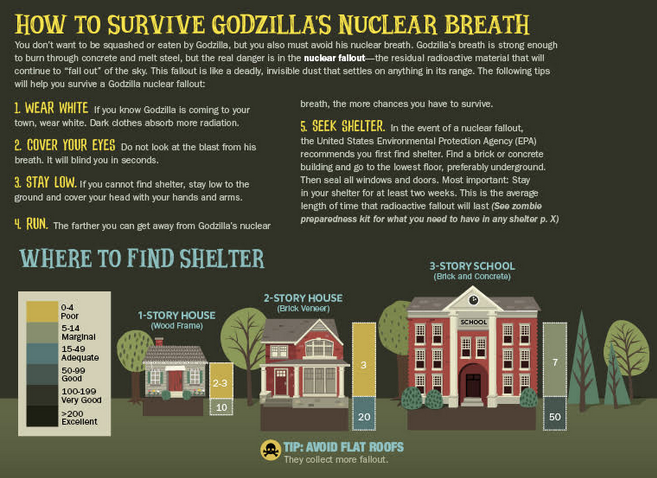
The book’s final chapter is its most serious: Godzilla, framed as a guide to surviving a nuclear disaster. Beccia researched CDC emergency preparedness materials, prepper resources, and publicly available data on global radiation levels to build an infographic on where to shelter if Godzilla — or, less metaphorically, a nuclear event — strikes. She connects Godzilla’s origin directly to Hiroshima and Nagasaki and the Bikini Atoll nuclear tests, noting that the original 🎬 Gojira 💵 is rooted in genuine national trauma. Beccia advises parents of very young children to consider skipping this chapter; it’s the one that scared her, too. Because Toho tightly controls Godzilla’s image, all depictions in the book are original illustrations — which fits Beccia’s art style perfectly. Her chapter-opener is an art-parody homage to Hokusai, complete with waves and Mount Fuji.
🐐 Transgenics: Spider-Goats and Spinach Pigs
Among the book’s “tasty nugget” science asides is a section on transgenics — the insertion of genes from one species into another to express a desired trait. Beccia highlights two examples:
– Spider-silk goats: because spiders cannot be farmed (they eat each other), researchers inserted the spider silk-production gene into goats. The goats’ milk contains the silk protein, which can be extracted to produce lightweight, extraordinarily strong material suitable for sutures, bulletproof vests, and other applications.
– Spinach pigs: pigs engineered with a spinach gene to produce leaner, healthier pork — reportedly heading toward commercial availability.
Blake floated the logical next step: engineer the pig to also lay eggs. Beccia allowed that it was probably possible.
🎨 Art, Process, and Five Years of Research
Beccia describes a three-stage digital process: pencil or iPad sketch → vector line art in Adobe Illustrator (scalable, clean, legible for data) → textural overpainting in Corel Painter for non-text illustration elements. The vector backbone was a deliberate choice for a book heavy with infographics; clean lines keep data readable at a glance. She paints on a pressure-sensitive Wacom Cintiq display with a stylus, and notes her digital oil-painting work is routinely indistinguishable from traditional media. Each chapter opens with a hidden art-parody illustration referencing a canonical artwork — the Godzilla spread’s Hokusai homage being the most immediately legible Easter egg.
Beccia also had a rotating team of expert readers — anthropologists, medical professionals, neuroscientists — fact-checking the manuscript over the five years of its development. Her closing caveat to readers: science changes, and that is a feature, not a bug.
📚 Further Reading
– 📚 Monstrous: The Lore, Gore, and Science Behind Your Favorite Monsters 💵 by Carlyn Beccia
– 📚 They Lost Their Heads 💵 by Carlyn Beccia
– 📚 Ghostland 💵 by Colin Dickey (Blake’s Audible pick this episode)
– 🎬 The Return of the Living Dead 💵 (1985), dir. Dan O’Bannon
– 🎬 Gojira 💵 (1954), dir. Ishirō Honda
🔗 Related Links
– Kuru (prion disease)
– Deviant burial
– Mercy Brown vampire incident
– New England vampire panic
– Taphonomy
– Transgenic organisms
– Spider-silk transgenic production
– Castle Bravo nuclear test (Bikini Atoll)
– Revenant (folklore)
Note: ads inserted into the distributed audio alter the timestamps in unpredictable ways, so timing references in these notes are approximate.
Carlyn Beccia has written a new book for kids that combines Monsters and Science! Monstrous: The Lore, Gore and Science Behind Your Favorite Monsters is an ooey-gooey romp through the world of monsters and the many fascinating things you can learn when you apply science to their premises.
But don’t think it’s just for kids. This book has lots of cool, disgusting, crunchy science morsels in it plus gorgeous art that make it a perfect Coffee Table book for macabre decor.
Here are some sample shots from the book, and there’s more like this from cover-to-cover – and this isn’t Carlyn’s only book. She’s got more.
Blake Smith
0