Regular Episode
#103 – A SERPENT’S TALE
The episode opens with an audio clip from Arthur C. Clarke’s Mysterious World, in which Belgian pilot Colonel Rémy Van Lierde describes a snake he estimated at close to 50 feet while flying over the Belgian Congo in 1959. It’s a gripping story — and, as Murphy gently but thoroughly explains, almost certainly not what it seems.
🐍 Defining “Giant” — And Why the Numbers Keep Getting Bigger
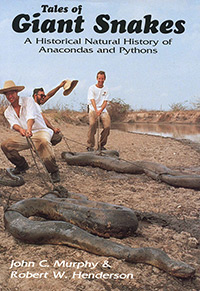
Murphy and co-author Bob Henderson used a threshold of 20 feet (6.1 meters) to define a giant snake in their book 📚 Tales of Giant Snakes 💵 — a standard borrowed from herpetologist Clifford Pope‘s 1961 survey. Pope identified six species potentially reaching that mark, including the common boa constrictor — based on a claimed record of 18.5 feet that later turned out to be a misidentified anaconda. Boa constrictors probably top out around 14 to 15 feet. As Murphy notes drily, this is the kind of mistake that happens when people get excited about snakes.
The two genuine titans today are the green anaconda and the reticulated python, each probably topping out around 25 to 26 feet. The famous Colossus, a reticulated python once held at the Pittsburgh Zoo and long cited as 28.5 feet, turned out to be considerably shorter on follow-up investigation. The Bronx Zoo‘s standing offer of $50,000 for a live 30-foot snake has gone uncollected for roughly a century.
Measuring live snakes is genuinely hard: a snake’s body is elastic, with up to 300 vertebrae that can stretch or compress, meaning there is no single “true” length for a large individual. Snake skins introduce further distortion — experiments show that removing a skin without stretching it by at least 20% is nearly impossible, so a 30-foot skin likely came from a ~24-foot snake.
🦎 Evolution: From Lizards to Leviathans
Snakes evolved from lizards, and many lineages still carry vestigial pelvic girdles — the external spurs visible on boas and pythons, which males use during courtship. Murphy outlines three leading hypotheses for why some snakes evolved such large body sizes: access to larger prey with less competition; sexual selection (larger females produce more and bigger offspring, and males preferentially seek them out); and thermal inertia (a bigger body loses heat more slowly, an advantage for an ectotherm in a variable climate).
The fossil record includes some impressive specimens beyond the famous Titanoboa cerrejonensis (~42 feet, from Eocene Colombia). Paleontologist Charles Andrews described Gigantophis garstini from eastern Egypt in 1901, dating it to 29–31 million years ago and estimating about 30 feet — though a later researcher inflated that estimate to 50–60 feet. Both Titanoboa and Gigantophis belonged to families distinct from modern boas and pythons; many prehistoric giant snakes fall into the aquatic family Palaeophiidae, relatives of today’s file snakes.
Murphy’s best answer for why snakes don’t grow as large today as Titanoboa did: the prey isn’t there. A 42-foot snake in the modern Amazon would find itself competing with anacondas for the same large prey, forced to eat smaller animals in higher quantities — an energetically poor strategy for a sit-and-wait predator.
⚠️ Are Giant Snakes Actually Dangerous to People?
Murphy admits he once wrote, in a field guide to the snakes of the Danum Valley in Borneo, that reticulated pythons were “probably not a serious threat to humans” — a claim he has since revised. A study by researcher Headland and herpetologist Harry Greene among the Agta people of the Philippines found that 25% of men interviewed had been attacked by a python, and roughly 15–16% knew someone who had been killed by one. Murphy also describes a captive incident in Illinois where a keeper was nearly killed by his own reticulated python and survived only because a coworker intervened.
The practical takeaway: anyone keeping a large constrictor should never handle it alone. Burmese pythons, African rock pythons, and reticulated pythons all pose genuine risk to adult humans. A 25-foot snake is, Murphy notes cheerfully, still entirely capable of swallowing a person — it just probably isn’t waiting for you in the grocery store parking lot.
🌿 Invasive Constrictors and the Constrictor Rule
The Burmese python invasion of the Florida Everglades gets extended discussion. Estimates put the population at over 10,000 individuals — animals that the native fauna, having no evolutionary experience with giant constrictors, are poorly equipped to handle. Pythons are already preying on alligators, and populations of native mammals and birds have declined sharply in affected areas. Murphy is blunt: once an invasive species is established, eradication is essentially impossible. The parallel case of brown tree snakes in Guam, despite decades of control efforts, underscores the point.
The Constrictor Rule — a U.S. Fish and Wildlife Service policy aimed at restricting the import and interstate transport of large constrictors — is discussed as a well-intentioned but largely after-the-fact measure. Murphy suspects that virtually every species capable of establishing a Florida population has already been released there. Florida now hosts more non-native lizard species than native ones; water monitor lizards are doing well in parts of the state.
Murphy also flags a less obvious ethical issue with releasing captive snakes: it isn’t just about ecosystem disruption. Released animals can introduce novel pathogens to wild populations with no immune experience of them, and can introduce genetically mismatched individuals into breeding populations. His advice to overwhelmed owners: find a new keeper or euthanize — not release.
🌍 Serpent Myths, Worldwide and Deep in Time
Murphy traces the deep cultural roots of giant snake mythology, arguing that the core narrative themes — serpents as guardians of water, shapeshifters capable of becoming human, beings that can reshape the landscape — appear consistently across hunter-gatherer traditions in southern Africa, and then resurface in the snake myths of the Middle East, India, Southeast Asia, Australia, and the Americas. His hypothesis is that these stories were carried out of Africa by migrating human populations and localized over millennia, giving rise to figures as diverse as the Nāga of Hindu and Buddhist tradition and the feathered serpent of Mesoamerica.
The first written appearance of the word anaconda in English turns out to trace to a 1768 article (likely pseudonymous, by a “R. Edwin”) describing an enormous snake eating a tiger in Ceylon — a story immediately suspect because tigers have never lived in Sri Lanka. Murphy suggests the name’s ultimate etymology traces back to a clerical error at the Leiden Museum. The story also illustrates how giant snake legends tend to snowball: this tale of a Ceylon python apparently kicked off a whole genre of sensational accounts.
On the question of “snake hypnosis” — immortalized for many listeners by Kaa in Disney’s 🎬 The Jungle Book 💵 — Murphy offers a prosaic but satisfying explanation: large ambush predators simply freeze and wait, relying on camouflage and stillness rather than any mesmerizing force. Prey animals interpret this motionlessness in ways that can look, to a human observer, like something supernatural.
The evolutionary basis of human snake fear also gets attention. Murphy cites the work of anthropologist Lynne Isbell (University of California, Davis), whose snake detection theory proposes that the co-evolution of primates alongside venomous and constricting snakes drove improvements in primate color vision, visual acuity, and possibly even behaviors like declarative pointing.
📚 Further Reading
– 📚 Tales of Giant Snakes: A Historical Natural History of Anacondas and Pythons 💵 by John C. Murphy and Robert W. Henderson
– 🎬 The Jungle Book 💵 (1967 Disney animated film — the one with the hypnotizing Kaa)
🔗 Related Links
– Titanoboa — Wikipedia overview of the largest known fossil snake
– Lynne Isbell and the Snake Detection Theory
– Burmese Pythons as Invasive Species in Florida
– Brown Tree Snake in Guam — a cautionary tale in invasive species management
– Reticulated Python
– Green Anaconda
– Nāga — serpent deities in Hindu and Buddhist mythology
– Quetzalcoatl — the feathered serpent of Mesoamerican tradition
– Arthur C. Clarke’s Mysterious World — the TV series featuring the Van Lierde Congo snake account
Note: ads inserted into the distributed audio alter the timestamps in unpredictable ways, so timing references in these notes are approximate.
Tales of enormous snakes have been a part of folklore for thousands of years. From myths to legends, to eyewitness testimony and photographs, these stories slither through our culture and seem inescapable. Prepare to recoil in horror as we talk about giant snakes with John C. Murphy, co-author of the fascinating book Tales of Giant Snakes. Do giant man-eating snakes lurk out there waiting to swallow the unwary? The answer is more complicated than you might suspect.
John C. Murphy is a Research Associate of the Division of Amphibians and Reptiles at the Field Museum of Natural History. He has recently retired from a 38-year science teaching career to:
- write about reptiles, amphibians, and biodiversity;
- do photography; and
- research whatever topics attract his attention.
Articles about the evolution and the innate fear of snakes by humans
- The Fear of Snakes and Spiders as Evolutionary Byproduct (National Geographic)
- Monkey Brains Wired to Fear Snakes (NPR)
- Are Humans Preconditioned to Fear Snakes? (Human Evolution Blog)
Related material
- Titanoboa (the largest snake found, so far)
- Giant Snake of the Congo (video from Arthur C. Clarke’s Mysterious World
Music
- Intro music credits: Crypto by Kevin MacLeod (incompetech.com) Licensed under Creative Commons: By Attribution 3.0 License
- Monstertalk Theme: Monster by Peach Stealing Monkeys
MTArchivist
0