Regular Episode
#102 – SKEPTICISM 101
Before the main interview, Karen discusses her debut novel, 📚 Hits & Mrs 💵 — a skeptical thriller about a charismatic psychic medium and the skeptic trying to expose him. The title pun is intentional (M-R-S, not M-I-S-S-E-S), a nod to the way we pay attention to the hits and ignore the misses — a theme woven throughout. Real-life mentalist Banachek appears as himself, drawing on his real history with Peter Popoff and Project Alpha.
🔬 What Is Scientific Skepticism?
Steve opens with the definition he uses most: scientific skepticism is an approach to claims about facts or knowledge grounded in logic, evidence, and empiricism. It includes understanding the philosophy of science, the science/pseudoscience distinction, and what he calls neuropsychological humility — awareness of all the ways our minds can deceive us, and especially the ways we deceive ourselves.
He draws a clear line between scientific skepticism and its impostors. Cynicism, contrarianism, and simple naysaying can mimic skepticism from a distance, but they’re not the same thing. As Steve puts it, scientific skeptics follow the evidence — sometimes that means agreeing with mainstream authority, sometimes it doesn’t. The goal is accuracy, not difference for its own sake. He also notes that the label has been hijacked — climate-change deniers, for instance, often call themselves “skeptics” while doing the opposite of what the methodology demands.
🧠 Why Our Brains Are Bad at This
Steve and Blake explore the uncomfortable reality that human cognition is not well-calibrated for truth-seeking by default. Some highlights from the conversation:
– Optical illusions are the most immediate demonstration: our brains construct a model of reality, not a recording of it, and that construction makes assumptions that fail roughly 1% of the time — which is exactly when we “see” things that aren’t there.
– Memory is reconstructive, not reproductive. The brain favors internal consistency over accuracy, and will silently rewrite details, merge memories, or invent experiences wholesale to resolve conflicts.
– Inattentional blindness — the well-documented phenomenon where attention directed at one thing causes us to completely miss something right in front of us — is a mechanism magicians have exploited professionally for centuries. Blake recommends the Selective Attention Test as a quick demonstration.
– fMRI research (with appropriate caveats about interpreting fMRI) suggests that listening to a charismatic speaker who shares your worldview can actually reduce activity in the frontal lobes — the regions most associated with critical thinking.
⚙️ Cognitive Biases and Heuristics
Steve walks through several of the most consequential mental shortcuts that undermine clear thinking:
– Confirmation bias: We selectively notice, remember, and accept information that supports pre-existing beliefs, while explaining away or ignoring disconfirming evidence. Two people looking at identical data can reach opposite conclusions because they’re running different confirmation-bias filters.
– Cognitive dissonance: Holding two conflicting beliefs produces psychological discomfort. The brain relieves it through rationalization — and neuroscientists have observed that resolving the dissonance produces a literal dopamine reward, reinforcing the rationalizing behavior.
– Availability heuristic: If you can easily think of an example of something, your brain treats that ease of recall as evidence that the thing is common or true. Steve’s illustration: “My grandmother smoked and lived to 100, so it can’t be that risky.”
– Representativeness heuristic: We latch onto pattern matches rather than base rates. In medicine this leads to chasing rare “textbook” diagnoses when an atypical presentation of a common disease is statistically far more likely.
⚖️ Skepticism in Institutions
Scientific skepticism isn’t just for monster hunters. Steve argues that any investigative profession — medicine, law, policing — is essentially doing applied skepticism, often without explicitly calling it that. Physicians have practical sayings (“rare things are rare”) that turn out to be informal restatements of Bayesian reasoning. The same cognitive errors that lead a UFO investigator astray — pattern-matching over base-rate reasoning, confirmation bias in evidence selection — show up identically in medical diagnostic errors and courtroom failures. Being a “full-service skeptic,” as Steve puts it, lets you see those parallels across domains.
🤝 Skepticism as a Community and a Practice
The conversation turns to the skeptical movement itself — its growth through social media, its internal tensions, and the perennial question of how to reach people outside the choir. Key points:
– Social media has dramatically expanded the skeptical community compared to 20 years ago, but also enables powerful echo chambers that feed confirmation bias at scale.
– Joe Nickell’s observation gets a warm endorsement from Steve: cynicism is a cheap way to fake being skeptical — you just position yourself one notch more dismissive than the next person.
– The biggest internal pitfall for self-identified skeptics: believing that the label confers immunity from bias. It doesn’t. The moment you think you’re free from bias, you become susceptible again.
– On argumentation: Steve distinguishes arguing (examining premises and logic together) from bickering (scoring points). He references his essay “How to Argue” — the goal is to find common ground and build from there, not to deploy logical-fallacy labels as rhetorical weapons. Pointing out that someone committed the argument from authority does not, by itself, mean they’re wrong — that’s the fallacy fallacy.
📅 NECSS 2014
Steve promotes the Northeastern Conference on Science and Skepticism (NECSS), running May 12–15 in New York City. The lineup includes workshops, a full day on science-based medicine, Richard Wiseman as keynote, and a return appearance by Bill Nye at the Friday-night skeptical extravaganza.
📚 Further Reading
– 📚 The Demon-Haunted World 💵 by Carl Sagan
– 📚 How We Know What Isn’t So 💵 by Thomas Gilovich
– 📚 Mistakes Were Made (But Not by Me) 💵 by Carol Tavris and Elliot Aronson
– 📚 Hits & Mrs 💵 by Karen Stollznow
– 🎬 The Thing 💵 (dir. John Carpenter, 1982)
🔗 Related Links
– The Skeptic’s Dictionary
– Snopes
– The Straight Dope
– What’s the Harm?
– Science-Based Medicine Blog
– Your Deceptive Mind: A Scientific Guide to Critical Thinking Skills (Great Courses) — Dr. Novella
– Medical Myths, Lies, and Half-Truths (Great Courses) — Dr. Novella
– Selective Attention Test (inattentional blindness demonstration)
– Richard Wiseman’s Quirkology videos
– Skepticism 101: The Skeptical Studies Curriculum Resource Center (Skeptics Society)
Note: ads inserted into the distributed audio alter the timestamps in unpredictable ways, so timing references in these notes are approximate.
What is a Skeptic anyway? Are they just naysayers? Are they cynics? Do they just automatically say “that’s not real” to anything exciting and mysterious? Find out the true meaning of Skepticism in this MonsterTalk special episode — Skepticism 101, featuring Dr. Steven Novella.
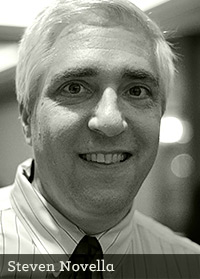
Dr. Steven Novella is a clinical neurologist and assistant professor at Yale University School of Medicine. He is a prominent figure in the Skeptic community, he is the host of The Skeptic’s Guide to the Universe, and he is actively involved in the promotion of Science Based Medicine. Steve joins us to talk about the basics of Skepticism we’re calling Skepticism 101.
Links for Dr. Steve Novella
- The Skeptic’s Guide to the Universe
- Your Deceptive Mind: A Scientific Guide to Critical Thinking Skills
- Medical Myths, Lies, and Half-Truths: What We Think We Know May Be Hurting Us
- Science Based Medicine Blog
- New England Conference on Science and Skepticism
- How to Argue
Useful Skeptical Links
- The Skeptic’s Dictionary
- Snopes
- The Straight Dope
- List of Skeptical Podcasts
- What’s the Harm?
- Skeptical Software Tools
Books
Skepticism 101: The Skeptical Studies Curriculum Resource Center
- Learn about Skepticism 101 (a project of The Skeptics Society)
- Read book recommendations on various skepticism topics
Videos
Music
- Monstertalk Theme: Monster by Peach Stealing Monkeys
MTArchivist
0