Regular Episode
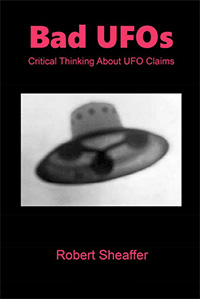
#104 – BAD UFOS
If your UFO education came mostly from the History Channel and Hollywood, this episode will introduce you to a different version of the story — one in which the slick, dramatic retellings have quietly dropped the details most likely to make you skeptical.
🛸 How It All Started: Kenneth Arnold and the Birth of the Flying Saucer
The canonical origin of the modern UFO era is June 24, 1947, when pilot Kenneth Arnold reported seeing a chain of unusual objects near Mount Rainier in Washington State. Robert points out several things the popular retellings omit: Arnold’s own sketch of the objects looks more like a boomerang than a saucer; he described their motion as skipping like a saucer across water, not their shape; and a reporter coined the term “flying saucers” from that description, after which subsequent witnesses conveniently began seeing saucer-shaped craft.
Robert and Blake discuss the hypothesis — supported by several researchers — that Arnold may have observed a flock of American white pelicans, the largest birds in North America, at a much closer distance than he estimated. Misidentifying their distance would have cascaded into wildly inflated speed and size estimates. Arnold went on to become a “repeater” — someone who reported multiple subsequent sightings — and remained loosely involved with the early saucer scene.
Earlier anomalies like the Foo Fighters of World War II are also mentioned; Robert suggests many were likely misidentified astronomical objects like Venus or Jupiter, which appear to “follow” aircraft just as the moon appears to follow a car.
📰 The Myth-Makers: Palmer, Moseley, Barker, and the Saucer Press
Before there were UFO conferences, there was a small, interconnected world of editors, writers, and promoters who shaped what the public believed about flying saucers.
Ray Palmer, editor of the pulp fiction magazine Amazing Stories and co-founder of Fate magazine, published the first account of Arnold’s sighting and enthusiastically promoted the flying saucer phenomenon. Palmer had previously championed the Shaver Mystery — the claims of welder Richard Shaver, who reported hearing voices from underground robots through his welding equipment — a story that drew a surprising number of readers who wrote in to corroborate it. Palmer later ran a cover story on a NASA photograph purporting to show a “hole in the pole,” which Robert explains was simply a composite satellite image taken during the Arctic winter, when there is no sunlight above roughly 70° latitude.
(Blake notes a pop-culture footnote: DC Comics named its shrinking superhero the Atom — alter ego Ray Palmer — after the editor. And a young Harlan Ellison apparently confronted Palmer in person demanding to know whether the Shaver stories were fiction or fact.)
James Moseley founded the Congress of Scientific Ufologists (later the National UFO Conference), which ran from roughly 1967 through 2004. He coined the term “ufoology” — with an extra O — to signal his view that most of the field was nonsense, though he personally believed some small paranormal residue might be real. His autobiography, 📚 Shockingly Close to the Truth 💵 (co-written with the late Karl Pflock), is described as a genuinely entertaining read. Gray Barker and radio host Long John Nebel — a 1960s predecessor of Art Bell — rounded out this circle of colorful early promoters.
🚀 Contactees, Space Brothers, and the Saucer Faithful
Not all early saucer enthusiasts were merely observers. George Adamski claimed repeated face-to-face contact with benevolent “Space Brothers” who landed in the California desert to share their wisdom with him alone. He built a foundation and following that, Robert notes, is still technically operating today through Glen Steckling in the San Diego area.
The annual gatherings at Giant Rock in the Mojave Desert brought together Adamski, Howard Menger, George Van Tassel, and other contactees in a social scene that mixed sincere belief, showmanship, and a certain festive atmosphere. Robert draws a structural parallel between the ever-expanding taxonomy of alien types (Greys, tall Greys, insectoids, Pleiadians, Reptilians) and theological demonology: when a field has no empirical data, classification schemes can proliferate indefinitely without anyone being able to say you’re wrong.
The Condon Report — the University of Colorado study commissioned by the Air Force and led by physicist Edward U. Condon — is discussed briefly. Robert allows that it has legitimate criticisms but argues its core conclusions have held up.
👽 Betty, Barney, and the Abduction Template
The Betty and Barney Hill case (1961) is widely treated as the founding document of UFO abduction lore. Robert outlines the skeptical case: the Hills saw an object following them (consistent with an astronomical object), Betty Hill began having vivid abduction dreams afterward, and those dream-derived memories were later reinforced through hypnosis by psychiatrist Dr. Benjamin Simon. Robert notes that Simon’s private correspondence — some of it coming to light more recently — makes clear he did not believe the abduction story was a real event. He treated it as a shared fantasy, in part rooted in what he described as Barney Hill‘s well-developed racial anxiety (Barney was Black in a nearly all-white state).
Writer John G. Fuller turned the story into the bestselling book 📚 The Interrupted Journey 💵 after first covering it for Look magazine. The subsequent made-for-TV film The UFO Incident (1975, starring James Earl Jones as Barney) portrayed Simon as a believer — a characterization he disputed publicly for the rest of his life. The film’s broadcast date matters: it aired roughly two weeks before the Travis Walton incident.
🪵 Travis Walton and the Forest Service Contract
The Travis Walton case (November 1975, Snowflake, Arizona) is one of the most-cited abduction claims in UFO literature, later dramatized in the film 🎬 Fire in the Sky 💵. Robert walks through the skeptical case assembled largely by the late Philip J. Klass:
– Walton’s crew chief, Mike Rogers, held a U.S. Forest Service thinning contract on which they were behind schedule and facing a penalty clause.
– When Walton disappeared, his family expressed no alarm — his brother reportedly envied him the ride, and his mother told police not to bother searching because “he’s not in this world.”
– The crew passed an early polygraph focused on whether they had harmed Walton — not on whether they had witnessed a UFO.
– When the National Enquirer arranged a separate polygraph for Walton after he reappeared, the examiner’s reported conclusion was “gross deception.” (This account was written up by Australian journalist Jeff Wells in The Age and later republished in Skeptical Inquirer.)
– The Enquirer was at the time offering a prize for the best UFO case of the year; the Walton story won, and the money was divided among those involved.
🎭 The Spectacle Economy: Conferences, Hoaxers, and True Believers
Robert describes the contemporary UFO conference landscape, anchored by events like the UFO Congress near Phoenix and the outdoor festival Contact in the Desert, where crowds sit in 100-degree heat to hear speakers including Erich von Däniken and Steven Greer. Greer, Robert notes, charges $5,000 for weekend desert outings to view alien spacecraft — and retains the right to remove attendees who display insufficient belief.
The discussion of Stan Romanek — the Colorado man who claimed, among other things, to have woken up wearing Betty Hill’s bathrobe and to have had his leg healed by aliens the night before surgery — includes mention of the alien in the window video, which Karen’s husband Matthew Baxter and collaborator Brian Bonner replicated so convincingly that many viewers mistook the replica for the original.
Billy Meier, described as “the George Adamski of Switzerland,” gets a brief mention: a contactee, self-described time traveler, and prophet whose copyright-enforcement representative Michael Horn is known for aggressive responses to skeptical inquiry.
Robert reflects that UFO true believers used to be considerably more hostile to skeptics at conferences — citing the late Walt Andrus, longtime MUFON director, who called Robert’s book The UFO Verdict “an insult to the intelligence of the reader” (a blurb Robert happily adopted for the book’s promotion). He finds the atmosphere somewhat more relaxed today, though Karen notes that her husband has received death threats from supporters of Romanek and others in the Colorado UFO scene.
📚 Further Reading
– 📚 Bad UFOs: Critical Thinking About UFO Claims 💵 by Robert Sheaffer
– 📚 The UFO Verdict: Examining the Evidence 💵 by Robert Sheaffer
– 📚 UFO Sightings: The Evidence 💵 by Robert Sheaffer
– 📚 Shockingly Close to the Truth 💵 by James W. Moseley and Karl T. Pflock
– 📚 The Interrupted Journey 💵 by John G. Fuller
– 📚 Walking Among Us: The Alien Plan to Control Humanity 💵 by David M. Jacobs (discussed critically)
– 🎬 Fire in the Sky 💵 (1993 dramatization of the Walton case)
🔗 Related Links
– Robert Sheaffer’s Bad UFOs Blog
– Robert Sheaffer’s Debunker Website (includes detailed pages on Kenneth Arnold and Travis Walton)
– Kenneth Arnold UFO Sighting (Wikipedia)
– Barney and Betty Hill Incident (Wikipedia)
– Travis Walton UFO Incident (Wikipedia)
– Roswell UFO Incident (Wikipedia)
– Condon Committee / University of Colorado UFO Study (Wikipedia)
– Philip J. Klass (Wikipedia)
– NICAP
Note: ads inserted into the distributed audio alter the timestamps in unpredictable ways, so timing references in these notes are approximate.
Have you learned most of your UFO stories from The History Channel and motion pictures? Chances are these glossy presentations of aliens and mysterious craft have hidden from you some of the shocking and silly history of this fascinating field. Join us as we interview UFO researcher Robert Sheaffer about Bad UFOs.
Books by Robert Sheaffer
Links to Robert’s Research
Items of Interest
- Shockingly Close to the Truth, by James W. Moseley
- Some early UFO related audio material with many interesting interviews
- A scanned Flying Saucer Magazine (Ray Palmer)
- Ray Palmer interview by Long John Nebell
- Could Kenneth Arnold have seen pelicans rather than craft?
- The Stan Romanek alien in the window video
- The UFO Incident — the made for TV movie about Betty & Barney Hill
Music
- Intro music credits: Crypto by Kevin MacLeod (incompetech.com) Licensed under Creative Commons: By Attribution 3.0 License
- Monstertalk Theme: Monster by Peach Stealing Monkeys
MTArchivist
0