Regular Episode
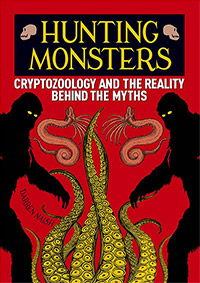
#101 – HUNTING MONSTERS
Naish frames Hunting Monsters as part of a small but growing shelf of pro-science, skeptic-led cryptozoology books — one that goes beyond retelling folklore to examine why cryptids exist as cultural phenomena, what the photographic and physical evidence actually shows when subjected to scientific scrutiny, and what (if anything) mainstream zoology can still offer the field. The conversation ranges from famous Loch Ness photographs to the deep roots of the Kraken legend, pausing along the way for a detour into evolutionary psychology and the neuroscience of monster perception.
🌊 The HMS Daedalus Sea Serpent (1848)
The Daedalus encounter of 1848 — spotted off the Atlantic coast of southern Africa — is one of the most-cited sea monster reports in history. Naish notes that the sighting landed in the middle of a cultural moment when public fascination with plesiosaurs was at its height, strongly shaping how witnesses and illustrators alike described what they saw.
The famous woodcuts published in the Illustrated London News were produced by professional artists working from Captain McQuhae’s description — not from direct observation. A far less-known first-hand sketch by witness Lieutenant Edgar Drummond depicts something strikingly different: lower in the water, more pointed at the anterior end, and decidedly less dramatic. Naish discusses an identification proposed by researcher Gary Galbraith that fits Drummond’s sketch precisely — and which, once you’ve looked at photographs of the candidate animal, is difficult to dismiss.
📷 The Hugh Gray Nessie Photograph
The Hugh Gray photograph of 1933 — one of the earliest alleged Nessie images — is, as Naish puts it, a Rorschach test for Loch Ness enthusiasts. Credulous authors have variously identified the blurry, double-exposed image as a plesiosaur, a giant Tullimonstrum (a 30-centimeter Carboniferous worm-like organism from Illinois), and — most memorably — a dog swimming toward the camera with a stick in its mouth.
Working with Dick Rayner, a well-known Loch Ness investigator, Naish arrived at a different conclusion: the object is almost certainly a mute swan with its head submerged in the water — a posture swans do occasionally adopt. The pale coloring, the “side knobs” (consistent with a bird’s ankle joint at the waterline), the pointed tail end, and the visible junction between wing and body feathers all line up. The book includes an illustrated overlay making the match explicit. Naish also notes that Gray claimed multiple prior sightings of the monster and reportedly took five photographs that day, none of the others ever released — circumstantial details that cast a shadow over the whole affair.
🦑 The Kraken: Island Monster, Not Giant Squid
A persistent piece of cryptozoological folklore holds that the Kraken of Scandinavian legend was essentially a folk description of the giant squid (Architeuthis dux), known to seafarers before science caught up. Naish (drawing largely on the published work of Charles Paxton) pushes back hard: the pre-1800s Kraken is categorically not a cephalopod. It is a horned or antenna-bearing island-creature — something that sailors would mistake for land, build fires on, and then drown alongside when it submerged. Possible ingredients in the legend include encounters with large turtles or whales, floating pumice islands produced by undersea volcanic eruptions, and a separate Scandinavian giant-crab tradition.
The squid connection was retrofitted in the early 19th century by Pierre Denys de Montfort, who cherry-picked the vaguely cephalopod-sounding elements of the older legends to bolster his own sensational claims about ship-grabbing giant octopuses. Later cryptozoologists — most influentially Bernard Heuvelmans — inherited De Montfort’s version rather than the original. Naish also notes that what we now know of Architeuthis biology suggests a relatively slow-moving, deep-water predator, not the rampaging ship-sinker of legend.
🧠 Cryptozoology as Culture (and Psychology)
Some of the most interesting passages in the book — and in this conversation — concern why cryptid belief persists long after the evidence has failed to materialize. Naish argues that cryptozoology is best understood as a cultural phenomenon: creatures like Bigfoot and the Loch Ness Monster have become so deeply embedded in the popular imagination that repeated debunkings barely dent them.
Several threads emerge:
– The diversity of descriptions for any given cryptid (smooth skin vs. rough scales; fluked tail vs. serrated dragon-tail; human-like ears vs. pointed ears) is irreconcilable with a single undiscovered species. The most parsimonious conclusion is that witnesses are not seeing the same thing — or anything consistent at all.
– The “superstar” cryptids disproportionately attract witnesses who are already invested in finding them. Naish cites Hugh Gray’s prior claimed sightings and the extraordinary coincidence of Roger Patterson and Bob Gimlin — men who had already written a book about hunting Bigfoot — happening to capture the only motion picture of one.
– Heuvelmans and Ivan Sanderson, the founding fathers of cryptozoology, were the same researchers enthusiastically promoting Bermuda Triangle mysteries, flying saucers, and interdimensional phenomena — suggesting the field was always adjacent to the broader paranormal worldview.
– There may be neurological and evolutionary-psychological underpinnings to monster perception: humans are primed to detect faces and human-shaped figures; primates have long contended with large predators (crocodilians, big cats, raptors) in dark water and dense forest; and certain “class-level” pattern-recognition heuristics in the brain may produce consistent false positives. Janet and Colin Board’s 📚 Alien Animals 💵 is cited as an early (if paranormally-framed) articulation of this idea.
🔬 What Zoology Can Still Deliver
Naish is clear-eyed but not nihilistic about future discoveries. Legitimate candidates include:
– New deep-sea chondrichthian fishes (relatives of sharks and rays) and members of the oarfish family.
– At least one additional species of beaked whale, then in active scientific description.
– One or two new hoofed mammals from tropical Southeast Asia, plus large rodents (Vietnam’s recently described giant rodents are offered as an example of just how surprising real discoveries can be).
– Possibly Orang Pendek — a putative small ape from Sumatra — which Naish considers the most zoologically plausible of the mystery hominids, though he remains on the fence.
None of these, he notes, are the superstar cryptids. The evidence for lake monsters, Heuvelmans-style sea serpents, and the classic crypto-hominids has not materialized — and the number of qualified scientists willing to take those claims seriously has declined steadily as the evidentiary bar has failed to be cleared.
📚 Further Reading
– 📚 Hunting Monsters: Cryptozoology and the Reality Behind the Myths 💵 by Darren Naish
– 📚 Abominable Science: Origins of the Yeti, Nessie, and Other Famous Cryptids 💵 by Daniel Loxton and Donald R. Prothero
– 📚 Alien Animals 💵 by Janet and Colin Bord
🔗 Related Links
– HMS Daedalus Sea Serpent (1848)
– Bernard Heuvelmans — founder of cryptozoology
– Ivan T. Sanderson — cryptozoologist and paranormal writer
– Grover Krantz — physical anthropologist and Bigfoot researcher
– Patterson–Gimlin Film
– Architeuthis dux — Giant Squid
– Orang Pendek
– Tullimonstrum gregarium — the Tully Monster
– Kraken
– Pierre Denys de Montfort
Note: ads inserted into the distributed audio alter the timestamps in unpredictable ways, so timing references in these notes are approximate.
Dr. Darren Naish (@TetZoo) returns to MonsterTalk to discuss his latest book on cryptozoology, Hunting Monsters: Cryptozoology and the Reality Behind the Myths. Naish is a paleontologist and the author of the popular Tetrapod Zoology blog, as well as a podcaster, co-hosting The Tetzoo Podcast along with artist John Conway.
In Hunting Monsters, Naish takes a detailed look at some of the most classic cryptids from the field. Some famous photos are explained, some mysterious creatures are identified, and cryptozoology is examined as a social phenomena.
Music
- Monstertalk Theme: Monster by Peach Stealing Monkeys
MTArchivist
0