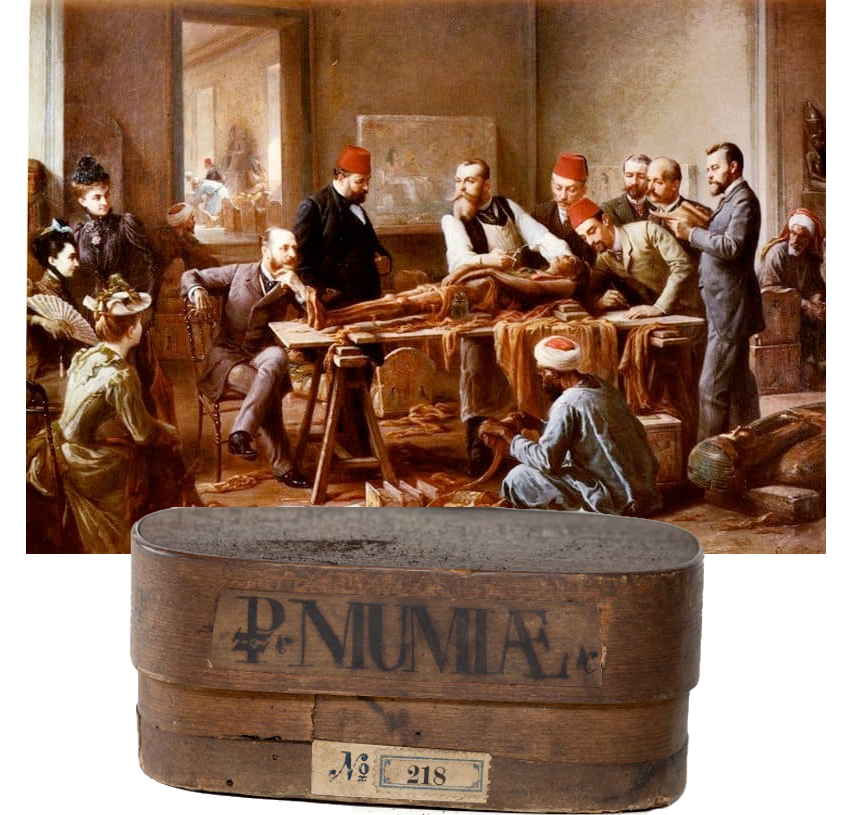
#083 – THE CURES OF THE MUMMY’S TOMB
🧟 The Mummy in Film and Fiction
Blake sets the scene with a brief tour of the mummy’s career as a pop-culture monster. The canonical Universal Studios The Mummy (1932) — starring Boris Karloff — was followed by a separate run of Universal films featuring a different mummy, Kharis. Hammer Film Productions produced its own colour remake in 1959, with its final mummy picture arriving in 1971. The franchise was rebooted in 1999 by director Stephen Sommers.
Dr. Brier singles out the 1932 Karloff film as his favourite — partly because the mummy actually has a personality and a romantic subplot. He also notes a remarkable piece of trivia: Karloff’s mummy makeup took eight hours to apply, so the fully bandaged creature appears on screen for less than a minute across the entire film.
The literary roots of the monster go even deeper. Sir Arthur Conan Doyle‘s short story “Lot 249” (1892) is credited as one of the first to portray a mummy as a supernatural murder weapon; it was adapted for the 1990 anthology film Tales from the Dark Side: The Movie. Dr. Brier also mentions The Eyes of the Mummy Ma (1918), an early German silent film directed by Ernst Lubitsch, as an example of the pre-horror era when mummies were more often portrayed as romantic figures than shambling terrors. Early 1920s sheet music — titles like Mummy Mine and Old King Tut Was a Wise Old Nut — underscores how differently the public once related to Egypt’s preserved dead.
🏺 What Is a Mummy, Actually?
Dr. Brier opens with a deliberately broad definition: a mummy is any preserved soft tissue. That encompasses European bog bodies, the chemically preserved Lady Dai of China (whose joints are still flexible after two millennia), Vladimir Lenin (a “wet mummy” maintained in a formaldehyde solution under a wetsuit-like garment), the artificially constructed Chinchorro mummies of Chile — and even, he notes cheerfully, the dried blueberries in your breakfast cereal.
Egyptian mummification improved steadily over centuries as practitioners learned, for instance, that the brain and internal organs had to be removed to prevent decay. The organs were desiccated using natron (a naturally occurring mixture of sodium carbonate and sodium bicarbonate) and stored in canopic jars for use in the resurrection the Egyptians fully expected. The process eventually declined in the Ptolemaic period, when increasingly elaborate external wrappings concealed increasingly shoddy preservation underneath.
Modern examination of mummies is almost entirely non-destructive: CT scanning and X-ray allow researchers to determine sex, estimate age, assess diet and occupational stress on bones, and sometimes infer cause of death — all without unwrapping a single bandage.
👑 The Case of King Tut
Dr. Brier literally wrote the book on this one. In 📚 The Murder of Tutankhamen 💵, he proposed that the boy pharaoh may have died from a blow to the back of the head, supported by a suspicious shadow on X-ray images and circumstantial evidence including a letter from Tut’s widow to the Hittite king expressing fear. He is careful to stress it remains a theory. Subsequent claims — chariot accident, genetic disease, broken leg — have not settled the matter. The honest answer, Brier says, is that we simply do not know.
Blake raises Zahi Hawass, Egypt’s former head of antiquities, who lost his government position following the fall of the Mubarak government. Brier confirms Hawass is alive and well, still writing and lecturing — and dismisses the persistent New Age rumour that Hawass maintained a secret tunnel from his office bathroom to hidden chambers beneath the Sphinx.
On the famous Curse of Tutankhamun’s Tomb: modern statistical analysis has consistently found no significant pattern in the fates of those who opened the tomb in 1922. The curse, in short, is a great story and not much else.
💊 Corpse Medicine: Mummies, Blood, and Skull Drops
Dr. Sugg’s interview is where things get genuinely strange. His book documents a centuries-long European tradition of using human remains as medicine — and it was neither fringe nor medieval. Corpse medicine was mainstream, commercially lucrative, and arguably at its scientific and social peak during the Scientific Revolution of the 1660s onward, overlapping with the careers of Robert Boyle, Robert Hooke, and Isaac Newton.
Key ingredients and their claimed uses:
– Mummia: powdered Egyptian mummy flesh, sold openly in apothecaries across Europe for wounds, bruising, and hemorrhage. So profitable that unscrupulous traders adulterated it with the flesh of camels, dead beggars, and dead lepers — a practice that may have actively spread plague.
– Powdered skull and skull moss: moss harvested from unburied skulls was used (along with powdered blood) against hemorrhage; the skull itself was distilled into a preparation for “diseases of the head.” A forensic pathologist told Sugg that any fine powder can stimulate the coagulation mechanism — an accidental, partial efficacy.
– The King’s Drops: a distillation of powdered human skull, famously compounded by Charles II in his own laboratory and his go-to remedy. It was also apparently mixed with hartshorn (later a component of smelling salts), used as an antidepressant by at least one miserable gentlewoman, and weaponised by Charles’s private secretary William Chiffinch to get courtiers blackout drunk and extract their secrets.
– Blood: consumed fresh at execution scaffolds, primarily as a cure for epilepsy. Patients were reportedly instructed to drink it and then run until they collapsed. Robert Boyle favoured a distilled version as a general panacea. The theological rationale: the soul resided in the blood, and a young healthy man executed at his physical peak had the most potent soul of all.
– Human fat: used as an ointment for rheumatism, gout, and wounds. Sugg notes fat rubbed into painful joints does improve circulation — tiger balm works on the same principle.
📦 The Skull Trade and Corpse Commerce
The scale of the trade was industrial. By the mid-18th century, whole human skulls complete with moss were still on open sale in London chemist shops — proof of provenance in a jar. A significant source was Ireland, where centuries of military devastation had left large numbers of unburied bodies. Irish skulls were imported into England and re-exported to Germany; an official import duty of one shilling per skull persisted well into the 18th century.
The practice faded gradually and unevenly. Educated practitioners began to turn against it around the mid-18th century, but folk use continued far longer: powdered skull for epilepsy was still being sought in Bradford and Wales in 1847, and blood cures were documented at German and Danish execution sites into the 1860s. Sugg draws a careful, if contested, line from Renaissance corpse medicine to more recent phenomena: the seizure by South Korean customs officials of thousands of capsules allegedly made from powdered infant remains, sold as a stamina cure-all.
📚 Further Reading
– 📚 Egyptomania: Our 3,000-Year Obsession with the Land of the Pharaohs 💵 by Dr. Bob Brier
– 📚 The Murder of Tutankhamen 💵 by Dr. Bob Brier
– 📚 Mummies, Cannibals and Vampires: The History of Corpse Medicine from the Renaissance to the Victorians 💵 by Dr. Richard Sugg
🔗 Related Links
– Mummy (Wikipedia)
– Canopic Jars
– Chinchorro Mummies
– Tutankhamun
– Curse of the Pharaohs
– Paracelsus
– Ambroise Paré
– Albertus Magnus
– The Mummy (1932)
– “Lot 249” by Arthur Conan Doyle
Note: ads inserted into the distributed audio alter the timestamps in unpredictable ways, so timing references in these notes are approximate.
UNWRAP THE SECRETS of the Mummy’s tomb as we talk to “Mr. Mummy” Dr. Bob Brier about the history of mummies and the world’s fascination with Egyptology. And then, we discuss the strange history of mummies as medicine with Dr. Richard Sugg. Join as we learn about The Cures of the Mummy’s Tomb!

Dr. Bob Brier, also known as “Mr. Mummy” is an egyptologist who has done extensive research in all kinds of mummification processes. He also appears frequently in documentaries pertinent to the topic of mummies and is the author of several popular books. You can follow him on Twitter: @AskBobBrier
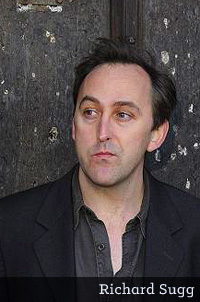
Dr. Richard Sugg is a lecturer in Renaissance Literature at the department of English Studies of Durham University, England. He is also a frequent contributor to the Guardian online. In addition to his book on corpse medicine (see below) he is also finishing up a book on vampires and poltergeists, so we expect to talk with him again soon. You can follow him on Twitter: @DrSugg
Further Reading
Further Watching
- The Eyes of the Mummy Ma (available at Amazon )
Book Links
- Dr. Bob “Mr. Mummy” Brier: Egyptomania and The Murder of Tutankhamen
- Dr. Richard Sugg: Mummies, Cannibals and Vampires: the History of Corpse Medicine from the Renaissance to the Victorians
Music
- Monstertalk Theme: Monster by Peach Stealing Monkeys