#071 – HIS TORY OF THE JERSEY DEVIL
Brian’s findings appear in two forms: a popular version in Skeptical Inquirer (September/October issue) and a longer peer-reviewed paper in the journal New Jersey History (October/November issue). Blake describes the long-form article as genuinely enjoyable reading — high praise for a peer-reviewed history journal.
👹 The Standard Legend
The accepted Jersey Devil story goes like this: in 1735, in the depths of the Pine Barrens of southern New Jersey, a woman known as Mother Leeds — already mother to twelve children — cried out during labor, “Let this one be a devil.” What emerged was at first a normal infant, then transformed into a creature with a horse-like head, bat wings, cloven hooves, and a long tail. It yelped at the assembled family, flew up the chimney, and disappeared into the forest, where it has been accosting passers-by for the better part of three centuries.
Brian notes that the Jersey Devil is an unusual cryptid in one key respect: unlike Bigfoot or the Loch Ness Monster, there is no proposed breeding population. It’s a single supernatural entity — which means it doesn’t even conform to the standard definition of a cryptid. It also presents a problem for any serious zoological analysis, since the described anatomy (four limbs plus wings) would require a body plan with no known evolutionary precedent. Brian’s pithy summary: “Imagine if Pegasus went over to the dark side.”
📜 The Real Leeds Family
The legend casts the Leeds family as dim-witted, occult-dabbling Pine Barrens hillbillies. The historical reality, Brian found, is almost the precise opposite. The Leeds were civic leaders, erudite participants in the Scientific Revolution who saw themselves as bringing astronomy and mathematics to the New World.
The patriarch of the American branch was Daniel Leeds, born in Leeds, England, who emigrated around 1676–77, initially converting to Quakerism and settling in southern New Jersey among an established Quaker community. He was not a dark occultist — Brian calls him a “Christian occultist” in the more precise sense: someone deeply influenced by German Pietism, particularly the mystical writings of Jacob Böhme, who saw ecstatic mysticism as a path to deeper Christian understanding rather than as a rejection of it. His Quaker neighbors, who were considerably more conservative in practice, did not share this view.
In 1687, Leeds began publishing an almanac — Brian’s apt description: “that century’s version of Twitter.” At its core an agricultural tool, the almanac quickly became a vehicle for Leeds’s pietist philosophy and medical astrology. The Quaker establishment was so offended they bought up the entire first print run and burned it. Undeterred, Leeds found an ally in William Bradford, one of the first major printers in colonial America, who kept publishing it anyway.
In 1688, Leeds published The Temple of Wisdom — the first book ever printed in New Jersey — attempting to explain Pietist theology to his neighbors. It went down even worse than the almanac. The Quaker fathers of New Jersey formally banned it and publicly denounced Leeds as evil. Leeds responded by leaving Quakerism and launching what Brian describes as the first scandal-mongering campaign in American history, publishing a series of attacks on Quaker morality and leadership. The religious in-fighting that would eventually spawn a monster legend had begun.
🪄 Ben Franklin, Sorcerer of the Press
Around 1714, Daniel Leeds retired and handed the almanac to his son Titan Leeds, an astronomer and mathematician who was content to keep publishing without his father’s polemical edge. The Leeds Almanac had become the most popular in New Jersey and eastern Pennsylvania — which made it a target.
In 1733, a young Benjamin Franklin launched Poor Richard’s Almanac, using a fictional narrator named Richard Saunders — a character Franklin adapted from a London almanac. In the very first issue, Franklin-as-Poor-Richard solemnly announced, based on astrological calculation, that his “friend Titan Leeds” would die within the year, providing a specific date.
The date came and went. Titan Leeds did not die. He was furious. Franklin, keeping a perfectly straight face, declared that Titan Leeds had in fact died as predicted — and that whoever was running around making these accusations was merely the ghost of Titan Leeds, a sorcerer risen from the dead. Leeds fumed. Franklin never broke character. Everybody got the joke except Leeds. The Leeds Almanac never recovered. Poor Richard’s Almanac became the most famous in American history.
By the time of the Revolution, the Leeds family — who had compounded their problems by siding with the British Crown (Daniel Leeds had served as a counselor to the deeply unpopular royal governor Lord Cornbury) — had accumulated a remarkable set of associations: called evil by the Quakers, accused of sorcery by Franklin, and tarred as Loyalists by revolutionaries. The “Leeds Devil” at this stage was not a monster. It was a figure of political ridicule.
🦘 From Political Insult to Winged Monster
After the Revolution, the Leeds Devil legend went mostly dormant. The family remained in New Jersey — Leeds Point, surveyed by Daniel Leeds and handed down as a family seat, still bears their name and remains the location most ghost hunters target when looking for the creature — but they were no longer prominent figures, and the legend became a local curiosity.
Then, at the end of the 19th century, reports of strange footprints in the snow began circulating around the Burlington and Atlantic City area. A Philadelphia dime museum at 9th and Arch Street, operated by Charles Bradenbaugh (an early exhibitor of motion pictures), saw an opportunity. His press agent, Norman Jeffries, began planting newspaper stories linking the old Leeds Devil legend to the mysterious footprints. Around 1905–1909, they went further: they rented a kangaroo from a man in Albany, New York, painted stripes on it, attached wings to its back, put it in a cage, and stationed a child with a nail-tipped stick behind a curtain to jab it whenever an audience arrived. The yelping, leaping kangaroo provided exactly the desired spectacle. Stories were reprinted as far away as Michigan and Oregon.
It was also around this period that the name shifted. “Leeds Devil” began giving way to “Jersey Devil” — and from there, Brian notes, the legend snowballed into a genuine folkloric monster, with every rattled barn door and moved lawnmower becoming potential evidence of a visit.
🔬 On Research, Documents, and Going Back to Case Zero
Brian’s methodological takeaway is direct: the most important monsters are found in libraries, not in the woods. As a trained historian, his first instinct was to look for the documents — correspondence, almanacs, court records, colonial publications — and the material came together quickly. He also checked colonial-era medical records for evidence of a genuine “monstrous birth” that might have inspired the legend, and found nothing persuasive. The political-propaganda origin, by contrast, is well-documented.
He acknowledges that not all cryptozoological research is equally poor — some researchers, he says, are “fantastic” — but argues that the field’s core problem is a lack of methodological training. Enthusiasts attracted to the idea of finding a biological entity and throwing a net over it have consistently come up empty. His suggestion: if you’re going to go into the field, learn what historians and anthropologists actually do. The side benefit of studying Pine Barrens ecology or Pacific Northwest animal migration patterns while looking for a cryptid is real, even if the cryptid itself isn’t.
Brian also mentions his next major project, tentatively titled Darwin and the Monsters — a wide-ranging study of how the study of monstrous creatures, from Aristotle through the mid-19th century, was mainstream science, and how it contributed to modern evolutionary theory. He is co-authoring the Jersey Devil book-length version with colleague Dr. Frank J. Esposito at Kean.
📚 Further Reading
– 📚 Searching for Sasquatch: Crackpots, Eggheads, and Cryptozoology 💵 by Brian Regal (now available in paperback)
🔗 Related Links
– Jersey Devil — Wikipedia
– Pine Barrens, New Jersey — Wikipedia
– Poor Richard’s Almanack — Wikipedia
– Jacob Böhme (German Pietist mystic who influenced Daniel Leeds) — Wikipedia
– Lord Cornbury (Edward Hyde), despised first royal governor of New Jersey — Wikipedia
– Religious Society of Friends (Quakers) — Wikipedia
– Colloidal silver (discussed in the context of silver’s real vs. mythologized properties) — Wikipedia
Note: ads inserted into the distributed audio alter the timestamps in unpredictable ways, so timing references in these notes are approximate.
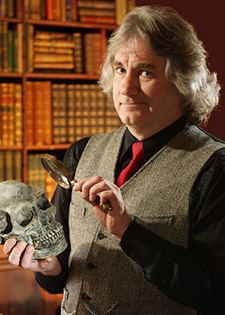
Kean University History Professor, Brian Regal, has tracked the Jersey Devil back to its astonishing historical roots. Religious in-fighting, self-publishing, snarky founding fathers, sorcery and political intrigue make the idea of a flying horse-faced monster almost seem tame.
Dr. Brian Regal previously joined us on MonsterTalk to discuss the demise of the Werewolf at the hands of Charles Darwin, and the history of Cryptozoology and the relationship of credentialed scientists and amateur enthusiasts.
Brian is an historian of science, with a specialty in human evolution and its relationship to religion, politics and American national origin theories. He is the author of Searching for Sasquatch: Crackpots, Eggheads, and Cryptozoology — which just came out in a much more affordable paperback edition.
Music
- Monstertalk Theme: Monster by Peach Stealing Monkeys