Regular Episode
#070 – MORE MAP MONSTERS
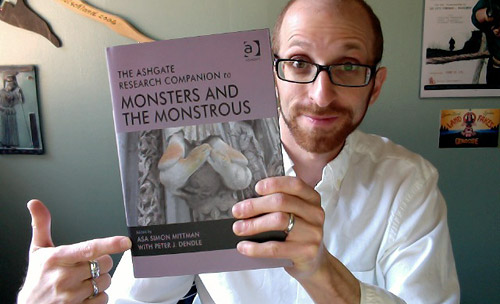
Mittman is the co-author of 📚 Maps and Monsters in Medieval England 💵 and 📚 Inconceivable Beasts: The Wonders of the East in the Beowulf Manuscript 💵, co-editor of 📚 The Ashgate Research Companion to Monsters and the Monstrous 💵, and president of MEARCSTAPA (the Monsters: Experimental Association for the Research of Cryptozoology Through Scholarly Theory and Practical Application). He stumbled into monster studies almost by accident — a misfiled library book on 8th-century China turned out to illuminate the radial logic of English medieval maps, and he never really looked back.
🗺️ How Medieval Maps Actually Work
Medieval European mapmakers placed Jerusalem at the literal center of the world — not as a symbolic gesture, but as a theological fact derived from passages in Psalms and Ezekiel and reinforced by theologians like Jerome. Medieval pilgrims even identified a specific spot in Jerusalem called Compass — supposedly where God placed his compass point to draw the circle of the Earth, retroactively explaining why cartographers had been doing exactly that for years.
From Jerusalem outward, the maps move in roughly concentric bands: biblical sites, then the familiar medieval world of Italy, France, and Germany, and finally the outer edge — where the monsters live. Mittman draws a striking parallel to an 8th-century Chinese map he encountered (in the wrong section of the Stanford library) that divided the world into four nested rectangles, the outermost labeled “the zone of culturalist savagery.” The English maps work the same way, with one irony: England itself sits out near that monstrous rim.
🐕 The Wonders of the East: A Taxonomy of the Monstrous
The creatures populating those outer edges largely descend from classical sources — Herodotus, and especially Pliny the Elder‘s Natural History — and were transmitted into the Middle Ages in Latin and Old English as the “Wonders of the East.” Mittman groups them into four rough categories:
– Hybrids: the Cynocephali (fire-breathing, dog-headed people-eaters), centaurs, fawns, bird-headed peoples.
– Excess: the Maritime Ethiopians with four eyes; giants of various descriptions.
– Lack: the one-legged Sciapods (who use their single enormous foot as a sunshade), the one-eyed Cyclopes, the headless Blemmyes.
– Behavioral difference: peoples defined not by physical deviation but by food taboos or sexual practices — including the Homo Dubii, who eat raw fish, and the communal wife-sharing peoples described in The Travels of Sir John Mandeville.
The unvoiced template in all these descriptions, Mittman notes, is always the self. A “headless person” means a person who otherwise looks like an Englishman but has no head. The same logic, he points out, explains why imagined aliens almost invariably have two arms, two legs, and one face.
📜 Monstrosity as a Tool of Othering
The episode’s most substantial thread is the argument that medieval monsters were not primarily about the supernatural — they were a cultural technology for defining out-groups. Two competing medieval etymologies for the Latin monstrum capture this neatly: Augustine of Hippo derived it from demonstrare (to show, to demonstrate God’s power), while Isidore of Seville preferred monere (to warn — monsters as divine omens against sin).
For Mittman, a monster is something that does more than frighten — it fundamentally destabilizes our understanding of how the world works. A dangerous dog is terrifying; a dog that punches in a security code crosses into the monstrous.
This framework extends to how medieval Christians reimagined the villains of the New Testament. When Charlemagne-era theology decided the Romans were rehabilitated allies — precursors of the Holy Roman Empire — the text of Scripture couldn’t be changed, so the images were. Roman soldiers in Passion scenes were visually recoded as caricatured Jews, inaugurating a tradition of anti-Semitic iconography whose tropes, Mittman observes with some personal weight, have not gone away. He recounts a classroom episode — while teaching a unit drawing on Deborah Strickland‘s 📚 Saracens, Demons, and Jews: Making Monsters in Medieval Art 💵 — in which a student’s outburst illustrated exactly how live those medieval prejudices remain.
The same transfer of tropes applies to the medieval “Wonders of the East” — that imaginary India-North Africa of decadence, danger, and looser sexuality — which Mittman argues maps almost directly onto modern Orientalist stereotypes, even when the geographic referent has shifted.
🖼️ Hieronymus Bosch and The Garden of Earthly Delights
Blake asks about Hieronymus Bosch (born Jheronimus van Aken, surname taken from his hometown of ‘s-Hertogenbosch — making him, as Mittman cheerfully notes, essentially “Jerry Bosch”), and Mittman describes seeing The Garden of Earthly Delights in person at the Museo del Prado as the most remarkable painting he has ever encountered.
The triptych is structured like a Last Judgment altarpiece — but subverts the form. The closed exterior shows a gray, cold creation scene with a God who seems to be retreating from his own work. Opened, the three panels read as a single pessimistic argument: Eden (already populated with hybrid horrors), then our world (a heaving orgy of naked, heedlessly hedonistic humanity), then Hell — rendered not in grand theological abstractions but in specific, banal punishments. A gambler nailed to a card table. A hunter strung up as prey by a giant rabbit. A lascivious man molested by a pig dressed as a nun. With no heaven panel to balance the hell, Mittman reads the sequence as implying everyone goes to hell — full stop.
Also discussed: Bosch’s Haywain triptych (in the same Prado room), where demons visibly drag people across the painted border into the hell panel; and the Seven Deadly Sins tabletop, centered on a giant divine eyeball inscribed Cave, cave, Deus videt — “Beware, beware, God sees” — depicting sins not as grand vices but as the small, private ones you commit when you think no one is watching. The Bosch collection ended up in Spain because the Netherlands became a Spanish colony and Philip II was a devoted collector of Northern Renaissance painting.
📦 The Franks Casket and Current Work
Mittman mentions two projects underway at the time of recording: a study of representations of Jews on medieval maps (largely untouched by scholarship), and a collaboration with Susan Kim on the Franks Casket — an early Anglo-Saxon whalebone box roughly the size of a cigar box, carved with scenes from Germanic, Roman, and Judeo-Christian mythology, inscribed in Old English and Latin, in both runic and Roman letters, and featuring a riddle and an encrypted passage. As Mittman puts it, it has all the ingredients of a Dan Brown novel without any of the inaccuracies.
📚 Further Reading
– 📚 Maps and Monsters in Medieval England 💵 by Asa Mittman
– 📚 Inconceivable Beasts: The Wonders of the East in the Beowulf Manuscript 💵 by Asa Mittman and Susan Kim
– 📚 The Ashgate Research Companion to Monsters and the Monstrous 💵 edited by Asa Mittman
– 📚 Saracens, Demons, and Jews: Making Monsters in Medieval Art 💵 by Deborah Strickland
– 📖 The Travels of Sir John Mandeville
🔗 Related Links
– Mappa Mundi — overview of medieval world maps
– Hereford Mappa Mundi — the largest surviving medieval map, dense with monsters at its margins
– Wonders of the East — the classical and medieval tradition of monstrous peoples
– Cynocephali — dog-headed people across world traditions
– Sciapods — the one-legged, foot-shading wonder-people
– The Garden of Earthly Delights — Bosch’s triptych at the Prado
– Franks Casket — the enigmatic Anglo-Saxon whalebone box
– American Anthropological Association Statement on Race
– Blemmyes — the headless people of ancient and medieval legend
Note: ads inserted into the distributed audio alter the timestamps in unpredictable ways, so timing references in these notes are approximate.
Medieval Art expert Asa Mittman discusses his love of monsters, the kinds of monsters that populate medieval land maps, and the persistent practice of monsterization as a cultural method for labeling “out-groups” in human interaction.
Books by Asa Mittman
- Maps and Monsters in Medieval England
- The Ashgate Research Companion to Monsters and the Monstrous
- Inconceivable Beasts: The Wonders of the East in the Beowulf Manuscript
Mentioned in the episode
- MEARCSTAPA: The experimental association for the research of cryptozoology through scholarly theory and practical application
- The Garden of Earthly Delights
- Hieronymus Bosch
- The Garden of Earthly Delights at the Prado Museum
Music
- Monstertalk Theme: Monster by Peach Stealing Monkeys
MTArchivist
0