Regular Episode
S01E069 – THE KEY TO THE LEGEND OF THE MAP MONSTERS
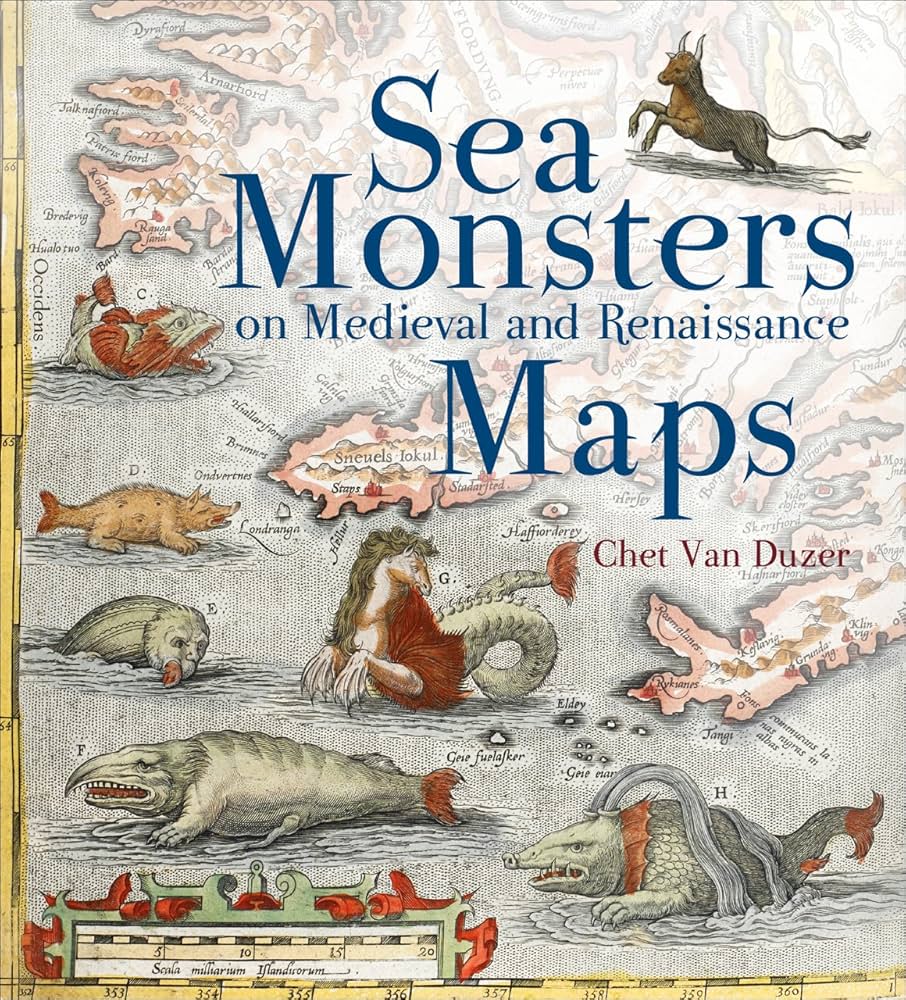
Van Duzer’s book 📚 Sea Monsters on Medieval and Renaissance Maps 💵 is the first in-depth study of its kind, covering the period from the 10th century (the earliest surviving maps with sea monsters) through the early 17th century, when the practice began to die out. Blake had already seen Van Duzer lecture at the Georgia Aquarium before this interview, and came away a reformed map-monster agnostic: it turns out those creatures weren’t idle doodles at all.
🗺️ Not Whimsy — Scholarship
The most striking finding of Van Duzer’s research is that cartographers weren’t improvising when they drew monsters in the margins of the sea. They were consulting the most authoritative sources available to them — illustrated medieval encyclopedias, books of cosmography, and travel narratives — and portraying creatures they genuinely believed to exist. The monsters, in other words, were meant to be accurate.
A prime example: Johann Schöner, a German mathematician and geographer, produced a terrestrial globe in 1515 whose sea monsters Van Duzer eventually traced to a German illustrated encyclopedia called the Hortus Sanitatis (Garden of Health), first published in 1491. The connection was clinched by Schöner’s 1520 manuscript globe, which reproduced the same images with accompanying texts drawn verbatim from that encyclopedia. Similarly, the dozen or so sea monsters on Gerard Mercator‘s famous world map of 1569 were traced to a book on sea creatures by Pierre Belon, published about twelve years earlier. (Bonus detail: the engraver on Mercator’s map simply copied the creatures directly without reversing them, so they all appear left-to-right mirrored compared to their source — because flipping a fish seemed like unnecessary extra work.)
The research method Van Duzer describes is bracingly unglamorous: hours in the library, pulling every illustrated book that predates the map in question and comparing images until something clicks. Chronological availability — whether a given manuscript or printed volume would plausibly have been in a particular cartographer’s workshop — is an additional constraint that makes the puzzle harder.
🌊 Two Kinds of Maps, Two Kinds of Audience
Van Duzer draws a useful distinction between the two main categories of medieval maps:
– Mappae mundi (world maps) were never intended as navigational tools. Oriented with east at the top and frequently centered on Jerusalem, they were objects of study and display — some elaborate enough to show mountain ranges and rivers, but not things you’d take to sea.
– Portolan charts (nautical charts) were practical tools for sea captains, dense with coastal place names and networks of rhumb lines. The working copies taken to sea were workaday objects that wore out and were discarded; the elaborately decorated examples that survive today were prestige objects made for princes — closer in spirit to a mappamundi than to a ship’s chart.
Sea monsters appeared on both types, but their presence always carried the implication that these creatures were real — attested to by respected encyclopedists — and that a sailor venturing far enough might actually encounter them.
🐟 The Theory of Sea Counterparts
One of the most productive generators of medieval sea monster imagery was a theory that goes back to classical antiquity: for every land creature, there exists a corresponding sea creature. Roman mosaics already showed leopards and goats fitted with fish tails, and the idea persisted well into the 17th century. The result was a whole bestiary of hybrid creatures — sea horses, sea hares, sea bishops — that populated both encyclopedias and maps. The sirens on these maps present a related puzzle: some are half-woman, half-fish; some half-woman, half-horse; some (truer to Homer) half-woman, half-bird. Whether the double-tailed mermaid figures indicate fish legs, motion, or something else entirely remains, Van Duzer cheerfully admits, unresolved.
Land monsters appear on maps too — the Hereford Mappa Mundi has a rich strip of humanoid creatures along the southern edge of Africa — including the cynocephali (dog-headed people), the Blemmyes (headless people with faces on their chests), and the wider cast of Plinian races. Van Duzer is tempted by the idea of a companion survey volume on land monsters — the field is less wide open than sea monsters were, but still inviting.
🔥 The Whale-Island: A Legend That Wouldn’t Sink
One story traces a long and sinuous path from antiquity to the maps. The Physiologus — a collection of animal fables with moral lessons assembled in late antiquity — contains a tale of a whale so enormous that sailors mistake it for an island, anchor to it, and light a fire to cook their meal. The whale, feeling the heat, dives to the bottom, carrying sailors and ship to their doom. The moral: if you put your faith in the devil, you’ll be carried to hell.
The story migrated into the medieval bestiary tradition and then into the Navigatio Sancti Brendani — the voyage of St. Brendan, the Irish monk said to have sailed the Atlantic in the 7th century, discovering miraculous islands, one of which turned out to be a whale. From the Brendan legend it reached the maps: the Piri Reis map of 1513, made by the Turkish admiral Piri Reis from a reported synthesis of 20 earlier maps, shows two sailors on an enormous fish’s back with a fire already lit — caught at the crucial narrative instant before the dive. By 1621, one map had elaborated the scene into a full outdoor Mass, complete with candles, performed on the whale’s back in the Brendan version of the tale. Same legend, more liturgical production values.
Blake notes that this arc — a legend repeatedly retold and embellished without anyone checking the original source — is essentially the same mechanism MonsterTalk traces through modern cryptozoological claims. Folklore doesn’t care what century it’s operating in.
🐢 The Flying Turtle and the Decline of the Map Monster
By the mid-16th century, something shifted. Some cartographers began inventing sea monsters wholesale — assemblages of elephant heads, bird bodies, and large spikes with no encyclopedic precedent whatsoever — and the creatures drifted from purported natural history to pure decoration. Simultaneously, ships on maps became more detailed and more numerous, signaling growing confidence in ocean navigation. Van Duzer sees these trends as intertwined: ships and sea monsters represent opposite ideas about the ocean (human mastery vs. natural terror), and as nautical charts grew more accurate and scientific, decoration of all kinds became less desirable.
The trajectory of the whale illustrates the shift particularly well. Early maps show whales as mysterious monsters; a 1413 map by Messier de Veladestes pairs a whale image with a text mixing the island-whale myth with practical notes on whale-skin uses. By 1625, a map of Greenland by Thomas Edge surrounds its cartography with vignettes of the Arctic whale fishery — harpooning, flensing, processing — with no mythological content at all. The monster had become a resource.
The story of the flying turtle is a perfect coda. In 1543, Dutch cartographer Cornelis Anthoniszoon published a map of northern Europe whose printer used a turtle as its shop sign (the map was “printed at the sign of the turtle”). Someone — Van Duzer suspects the artist — turned the printer’s logo into a flying turtle and dropped it into the sea on the map, apparently as a subtle advertisement. Subsequent cartographers copied the flying turtle for decades, never questioning what authority attested to winged chelonians in northern European waters. It is, Van Duzer notes, a very clear demonstration that Renaissance map-makers could be just as uncritical as anyone else when they saw something they liked.
📚 Further Reading
– 📚 Sea Monsters on Medieval and Renaissance Maps 💵 by Chet Van Duzer
– 🇪🇸 SPANISH LANGUAGE 🇪🇸: Monstruos marinos en mapas medievales y renacentistas 💵 by Chet Van Duzer
🔗 Related Links
– Mappa Mundi (Wikipedia)
– Portolan Chart (Wikipedia)
– Hereford Mappa Mundi (Wikipedia)
– Piri Reis Map (Wikipedia)
– Mercator’s 1569 World Map (Wikipedia)
– Physiologus (Wikipedia)
– Navigatio Sancti Brendani (Wikipedia)
– Hortus Sanitatis (Wikipedia)
– Plinian Races (Wikipedia)
– Blemmyes (Wikipedia)
– Ptolemy’s Geography (Wikipedia)
Note: ads inserted into the distributed audio alter the timestamps in unpredictable ways, so timing references in these notes are approximate.
MTArchivist
0