Regular Episode
067 – WHAT’S GOOD FOR THE MONGOOSE…
Christopher Josiffe had, at the time of recording, written what Blake calls one of the most thorough overviews of Gef available — a deeply researched article for Fortean Times — and was in the middle of writing a full-length book on the subject. (That book has since been published as 📚 Gef! The Strange Tale of an Extra-Special Mongoose 💵.)
🏚️ The Irving Family and the Farm at Cashen’s Gap
The story begins in the autumn of 1931 in the small village of Dalby on the western side of the Isle of Man. The Irving family — former piano salesman James Irving, his wife Margaret, and their teenage daughter Voirrey — had invested their last savings in a remote hill farm after James’s business collapsed following World War I. The farmhouse was built of stone, lined with wooden matchboarding, and left a four-inch gap between stone and wood — ample room for a small animal to move unseen.
According to the Irvings, a weasel- or rat-like creature appeared first in the farmyard, then inside the house. Within weeks, it was reportedly mimicking sounds, then words, then carrying on full conversations. It claimed its name was Gef (his own spelling — an attempt at “Geoff” from an animal that, to his credit, could spell at all). The creature described itself as “a freak,” claimed to have hands and feet, and warned that anyone who saw him would be “mummified” and “turn into stone.”
Gef’s reported size — roughly six inches long with a six-inch tail — was more squirrel or weasel than mongoose, and his tastes ran less to small prey and more to cream cakes and bacon: foods, Josiffe notes, more consistent with what a teenage girl might enjoy than what a mustelid would seek out.
🕵️ Harry Price and the Investigation
By spring 1932, word had crossed to the mainland press, reaching celebrated psychic investigator Harry Price. Price was already a well-known figure: he had exposed fraudulent spirit photographers including William Hope and his “Crewe Circle,” investigated physical mediums such as the Schneider brothers, and would later become famous — and controversial — for his investigations of Borley Rectory. He had, as Blake puts it, a reputation as a grandstander with a flair for publicity.
Price did not go to the Isle of Man himself initially. He first sent an ex-naval investigator named Dennis, who came away convinced he had heard Gef’s voice and that the daughter was not responsible. Price eventually traveled to the farm with R.S. Lambert, editor of The Listener magazine, with whom he co-wrote The Haunting of Cashen’s Gap (1936) — a book so rare (only 1,500 copies printed, never reprinted) that even Josiffe had not managed to obtain one at the time of recording. Price also produced a BBC radio piece on the case, which appears not to have been archived.
Price’s physical evidence testing was revealing: hair samples the Irvings presented as Gef’s were analyzed by the Zoological Society of Great Britain and matched the family’s sheepdog, Mona. Paw prints left in plasticine showed a bizarre and anatomically impossible disparity — massive front prints, tiny rear ones — that the Society’s contact said matched no known animal. Josiffe speculates the prints may have been made with a small implement by Voirrey herself.
🧠 Nandor Fodor and the Psychoanalytic Turn
A second, more thorough investigation was conducted by Nandor Fodor, a Hungarian-American psychoanalyst and psychical researcher who spent a full week at the farm and interviewed local witnesses extensively. Fodor published his findings in the Society for Psychical Research journals and later in his books 📚 Between Two Worlds 💵 and 📚 The Haunted Mind 💵.
Fodor initially believed Gef might be a genuine anomalous entity — partly on the strength of physical evidence like eating, drinking, and urinating in the house — but eventually concluded the phenomenon was a psychological emanation of James Irving’s thwarted ambitions and social decline: a frustrated former businessman’s unconscious projection, given voice. Price held a roughly similar view: he suspected a hoax, but not a financially motivated one. The Irvings turned down three guineas for photographs and refused a $50,000 American impresario’s offer for exclusive touring rights to Gef — suggesting, as Josiffe notes, that money was not the motive.
Local neighbors, however, had a simpler theory: it was Margaret and Voirrey, and they were doing it to frighten James into moving the family back to Liverpool. A former schoolfriend of Voirrey’s, tracked down by Josiffe, confirmed she believed it was a hoax by mother and daughter, and that Voirrey could throw her voice — though Josiffe notes that professional ventriloquists insist “voice throwing” is itself a myth of misdirection rather than a literal acoustic feat.
👻 Poltergeist, Familiar, or Folie à Plusieurs?
The conversation ranges across several frameworks for understanding what Gef might have been, none of them entirely satisfying:
– Poltergeist: The banging, knocking, object-throwing, nocturnal disturbances, and the presence of a pubescent girl at the center of the case all fit the classic poltergeist profile. The show notes a parallel with the Columbus poltergeist case, where the central figure was caught faking phenomena — possibly to give investigators the evidence they demanded and get them to leave.
– Familiar: Josiffe was researching a chapter on whether Gef fits the profile of a witch’s familiar — Price himself remarked that had this happened three centuries earlier, the family would have hanged. Early modern English witch trial records do describe polecats, ferrets, and small animals as familiars.
– Folie à plusieurs: A psychiatrist who contacted Josiffe suggested the whole-family delusion framework, though this struggles to account for the bus depot workers in Peel, the local postman, and other non-family witnesses who reported hearing Gef.
– The Bell Witch parallel: Gef is compared to the Bell Witch — a rude, threatening, temperamental entity that nonetheless never seriously harmed anyone and eventually established a kind of truce with the family.
🦦 Was There Actually a Mongoose?
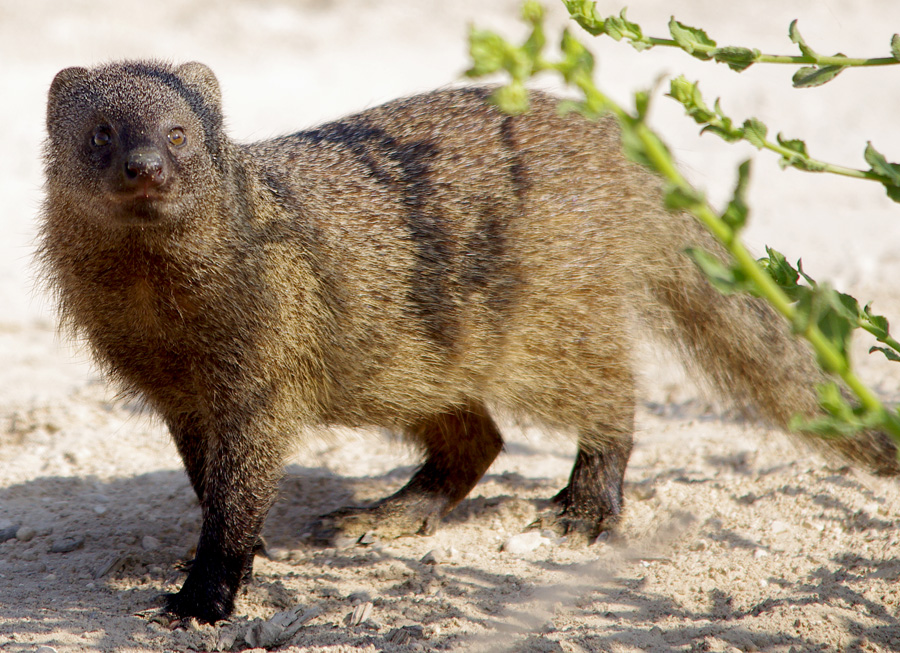
One question the episode addresses head-on: could a real mongoose have been behind the walls? Josiffe confirms that mongooses were indeed present on the Isle of Man — a neighboring farmer had imported six or eight from India roughly twenty years before the Gef events, to control the island’s rabbit population (there are no native foxes). Jenny Randles reportedly spotted a yellowish animal on the island about a decade before the recording that she couldn’t identify as a fox, and a local naturalist told Josiffe he’d seen something he thought was a mongoose.
But the size doesn’t fit: mongooses are considerably larger than the six-inch creature the Irvings described. And when the farmer who later took over the property killed an animal he thought might be Gef and photographed himself holding the carcass for the local paper, Josiffe assessed it as more likely a large old polecat — too big, wrong color, and conspicuously silent at the end.
⚖️ The BBC Libel Case
The episode’s most unexpected detour is into British legal history. Gef’s co-chronicler R.S. Lambert, as editor of The Listener, had an internal enemy at the BBC: Sir Lionel Levita. At a dinner, Levita dismissively remarked that Lambert “believed in the evil eye” and had gone to the Isle of Man to investigate a talking mongoose — and was therefore unfit to serve. Lambert sued for libel. The case became a national sensation, prompted questions in the Houses of Parliament, and Lambert won several thousand pounds in damages. Gef, one imagines, was very pleased to have his name raised in the Mother of Parliaments.
📉 The Fading of Gef — and the Fate of the Family
Gef’s visits grew less frequent as Voirrey aged into adulthood, a pattern consistent with the poltergeist hypothesis. His heyday ran roughly 1931–1937, with a brief local newspaper resurgence in 1942 before the war crowded him out entirely. James Irving died (around 1945–47), and around the time of his death there were reports of whisperings in the rafters heard by the elder daughter — a confirmed skeptic — and an inexplicably self-moving broom.
Voirrey eventually left the Isle of Man, changed her name, and refused all interviews. She was known locally as “the Dalby Spook.” One persistent reporter from Fate magazine tracked her down and doorstepped her into speaking; she maintained the whole thing had been true, that there really had been a little animal, and that she wished it had never happened because it had ruined her life. As Josiffe observes: whatever Gef was, it did none of the Irvings any good.
Christopher also floats, without being able to prove it, the intriguing possibility that H.P. Lovecraft‘s story “The Dreams in the Witch House” — featuring the rat-with-human-hands familiar Brown Jenkin — may have been inspired by the Gef reports, which were receiving international coverage in early 1932, right around when Lovecraft wrote the story. No smoking-gun letter has surfaced in Lovecraft’s correspondence, but the timing is suggestive.
📚 Further Reading
– 📚 Gef! The Strange Tale of an Extra-Special Mongoose 💵 by Christopher Josiffe
– 📚 Between Two Worlds 💵 by Nandor Fodor
– 📚 The Haunted Mind 💵 by Nandor Fodor
🔗 Related Links
– Gef the Talking Mongoose – Wikipedia
– Harry Price – Wikipedia
– Nandor Fodor – Wikipedia
– Isle of Man – Wikipedia
– Borley Rectory – Wikipedia
– Bell Witch – Wikipedia
– Familiar Spirit – Wikipedia
– Folie à deux / Shared Psychosis – Wikipedia
– The Dreams in the Witch House (Lovecraft) – Wikipedia
Note: ads inserted into the distributed audio alter the timestamps in unpredictable ways, so timing references in these notes are approximate.
ON THE ISLE OF MAN, between the World Wars, a lonely hilltop was home to a family of hardscrabble farmers. The father was a former piano salesman, and he struggled to make ends meet for his wife and daughter in their windswept cottage. And then one day, from up in the attic and behind the walls they began to hear the whispers of a mongoose-like creature who called itself Gef.
Items of Interest
- Gef the Talking Mongoose: Meet the strangest media sensation of the 1930s!
- Harry Price interview on YouTube
- (Since our coverage Christopher Josiffe has produced a book about Gef: Gef! The Strange Tale of an Extra-Special Mongoose)
Music
- Monstertalk Theme: Monster by Peach Stealing Monkeys
MTArchivist
0