Regular Episode
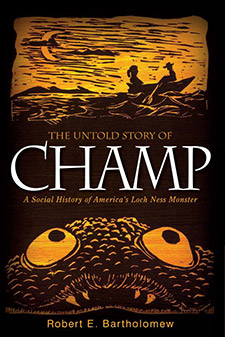
065 – WEAK ARE THE CHAMP PUNS
Half a century before Nessie became a household name, Champ was already a global sensation — newspapers around the world carried the story, and P.T. Barnum offered a $50,000 reward for the creature’s capture or carcass. Bartholomew argues that the full pre-1950 history of Champ has been systematically neglected, and his book sets out to correct that — drawing on primary newspaper sources, personal correspondence between key researchers, and a sociological framework for understanding why people see monsters in the first place.
🏔️ Champ Before Nessie: The 1873 Flap and the Making of a Monster
The first major wave of Champ sightings occurred in 1873, starting with a dramatic report from railroad workers near Dresden, New York, who described a large snake-like creature 15 to 40 feet long. The story was picked up by the Whitehall Times and spread from there. Bartholomew describes this as a textbook recipe for a monster flap: a sensational initial report, local press coverage, a newly primed public scanning the lake, and then a cascade of retrospective reinterpretation — people re-remembering earlier, unremarkable sightings as Champ encounters.
Between 1873 and roughly 1933, the Champlain Monster was, in Bartholomew’s words, the number-one lake monster in the world by newspaper coverage. Nessie only eclipsed it because the British Empire’s transatlantic cable and Commonwealth newspaper network gave the 1930s Loch Ness sightings a ready-made global audience — a point Bartholomew puts bluntly: “Colonialism. Imperialism.”
🗺️ Samuel de Champlain Did Not See Champ
One of the book’s most pointed corrections involves the oft-repeated claim that Samuel de Champlain recorded a sighting of a horse-headed, 20-foot snake-like creature in his 1609 ship’s log. Bartholomew traced this claim to a 1970 article by historian Marjorie Porter in Vermont Life magazine. When he checked the original log, the sighting wasn’t there — what Champlain actually described was a large fish, which Bartholomew identifies as a textbook description of a gar pike.
The sociological punchline: before 1970, there are zero Champ sighting reports describing a horse-like head. After the Porter article, witnesses started seeing Champ with a horse-like head routinely. The village of Port Henry, New York still lists Champlain as the first European to sight the creature on its official sightings board — a fact Bartholomew attributes to a mix of tourism economics and journalistic laziness.
📸 The Sandra Mansi Photo: Champ’s Smoking Gun?
The most-discussed piece of physical evidence for Champ is a photograph taken in the summer of 1977 by Sandra Mansi near St. Albans, Vermont, published in 1981. It is widely considered the best lake monster photograph ever taken — and possibly the best in all of cryptozoology. Bartholomew, who had access to correspondence Ben had gathered from a 2002 interview with Mansi, walks through a long list of inconsistencies: the negative was reportedly thrown away (or, in one account from Mansi’s then-husband, burned or buried in the backyard); Mansi gave contradictory accounts of where she kept the print (pinned to her kitchen bulletin board in some interviews, tucked behind other photos in an album in others); and the New York Times denied her claim that they had offered to buy the photo.
Adding to the tangle, Mansi had signed an agreement with a coworker named Roy Kapler to be her business manager for the photo, leading to a court dispute settled out of court — meaning that whenever the image is licensed, the proceeds are divided among Mansi, Kapler, both of their lawyers, and the estate of Mansi’s late ex-husband Anthony Mansi. Bartholomew’s tentative conclusion: he does not believe Mansi hoaxed the photograph, but the chain of custody and contradictory statements make it impossible to treat as conclusive evidence. At the time of recording, Bartholomew and Radford were working on a new investigation aimed at pinning down the photo’s location.
🔊 The Echolocation Claim: Elizabeth von Muggenthaler
Another piece of frequently cited Champ evidence involves underwater sound recordings made by Elizabeth von Muggenthaler of the Fauna Communications Institute, who claimed to have detected echolocation-like signals in Lake Champlain consistent with a large unknown animal. Bartholomew investigated her credentials and found that she holds a bachelor’s degree in psychology and founded her own institute shortly after graduating — a move he notes anyone can make. When he contacted the organizer of the Acoustical Society of America conference where she reportedly presented her findings, he was told her paper had been withdrawn and she never appeared. The abstract she sent him was the entirety of her documentation.
Bartholomew then contacted several of the world’s leading experts in marine biosonar, who were, in his words, “scathing” — the anomalous sounds could have had many mundane explanations, and von Muggenthaler had reached for the exotic without ruling out the ordinary. The pattern, he notes, is the same as auditory pareidolia in backmasking or electronic voice phenomena: people hear what they expect to hear.
🧠 Sighting Flaps, Social Contagion, and What Champ Is Really About
Bartholomew’s sociological analysis goes well beyond debunking individual claims. He notes that Champ sightings cluster dramatically — the majority of reports on Port Henry’s sightings board are concentrated around just a few years, especially after the Mansi photo was published. This is inconsistent with what you would expect if a breeding population of creatures were actually living in the lake (biologist Gary Mangiacopra‘s analysis of the full sighting record shows you are most likely to see Champ on a warm summer evening and least likely in mid-January when the lake is frozen). Instead, the clustering pattern fits a social-contagion model: one credible report prompts others to scrutinize the lake, lowers the threshold for reporting ambiguous observations, and triggers retrospective reinterpretation of past events.
He extends this analysis to a broader argument: cryptozoological creatures like Champ function as anti-scientific symbols in a secular age. Each new sighting report challenges the authority of mainstream science, and for some believers the implication runs deeper — if science is wrong about Champ or Bigfoot, perhaps it is wrong about other things too. Bartholomew draws a parallel to the Spiritualist movement of the late 19th and early 20th centuries, and he invokes E.O. Wilson‘s hypothesis that humans may be evolutionarily primed toward hypervigilance about large reptilian or serpentine forms — not hallucinating monsters, but predisposed to perceive them in ambiguous stimuli.
He closes with a passage from the book that captures the range of things Champ means to different people: a biological artifact of our evolutionary past, a green symbol for environmentalists, a baseball mascot (the Vermont Lake Monsters), a tourist draw, a cautionary tale for children, and — for skeptics — either a humorous legend or an annoying myth, depending on temperament.
📚 Further Reading
– 📚 The Untold Story of Champ: A Social History of America’s Loch Ness Monster 💵 by Robert E. Bartholomew
– 📚 Lake Monster Mysteries: Investigating the World’s Most Elusive Creatures 💵 by Benjamin Radford and Joe Nickell
– 📚 Champ Beyond the Legend 💵 by Joseph W. Zarzynski
– 📚 Abducted: How People Come to Believe They Were Kidnapped by Aliens 💵 by Susan A. Clancy
– 📚 Monsters of the North Woods 💵 by Robert Bartholomew et al.
🔗 Related Links
– Champ (cryptid) — Wikipedia
– Lake Champlain — Wikipedia
– Loch Ness Monster — Wikipedia
– The Surgeon’s Photograph (Loch Ness hoax) — Wikipedia
– Zeuglodon (Basilosaurus) — Wikipedia
– Plesiosauria — Wikipedia
– The War of the Worlds 1938 radio broadcast — Wikipedia
– Kolchak: The Night Stalker — Wikipedia
Note: ads inserted into the distributed audio alter the timestamps in unpredictable ways, so timing references in these notes are approximate.
THE SHORES OF THE LAKE were packed with strangers looking to catch a glimpse of the beast. A $50,000 reward was issued for its capture. Newspapers around the world carried the story of the strange creature that was said to lurk beneath these waters. Loch Ness? No—this is 1880s Vermont and the monster is alleged to be living in Lake Champlain. in this episode of MonsterTalk, Robert E. Bartholomew joins us to discuss his latest book, The Untold Story of Champ: A Social History of America’s Loch Ness Monster.
Music
- Monstertalk Theme: Monster by Peach Stealing Monkeys
- Audio excerpt “Where Did You Get That Hat” performed by Stanley Holloway — an 1880s music-hall tune contemporaneous with Champ’s greatest popularity.
MTArchivist
0