Regular Episode
064 – ARACHNOPHILIA
The conversation grew out of a happy Twitter accident: Blake’s legendarily awful puns caught Kristie’s attention online, he recognized the two from a MonsterQuest episode on giant spiders, and the rest is podcasting history.
🕷️ Camel Spiders, MonsterQuest, and the Myth Machine
The Bug Chicks were recruited for MonsterQuest‘s third-season episode on giant spiders after their Texas A&M advisor, spider expert Dr. John Jackman, was contacted by producers. The segment sent Kristie and Jessica into southwest Texas during a drought to search for solifuges — also called camel spiders, sun spiders, or wind scorpions. The name “solifuge” derives from the Latin for “fleeing from the sun,” though many species are nocturnal. In South Africa they go by haarskeerder (Afrikaans for “hair trimmer”), from the folk belief that they sneak up on sleeping people and clip hair to line their nests.
They found plenty of migrating tarantulas but no solifuges — which, in the final edit, didn’t stop the show from implying the team was hunting a solifuge the size of a dachshund. Their on-camera corrections for the record:
– Solifuges are not true spiders — they are arachnids in their own order, Solifugae.
– They possess no venom.
– They do not chase people. They chase shadows — a shady patch is precious real estate in a desert.
– The camel spider legend (stalking camels, eating intestines, laying eggs in carcasses) is entirely fictional.
– Their chelicerae are large and imposing, but their pedipalps — tipped with suction cups — are the real showstopper: imagine climbing a glass skyscraper using only your lips.
🦟 How to Actually Define a “Bug”
One of the episode’s most enjoyable tangents is a taxonomy lesson delivered painlessly. For entomologists, “bug” is a precise term: true bugs (order Hemiptera) — stink bugs, assassin bugs, wheel bugs — all with piercing, sucking mouthparts. In the vernacular, people use “bug” for anything with too many legs and an exoskeleton; the correct umbrella term is arthropod. The Bug Chicks chose their name deliberately as a teaching hook: “All bugs are insects, but not all insects are bugs.” Under arthropods sit insects, arachnids, centipedes, millipedes, and crustaceans — all united by jointed legs, segmented bodies, and an exoskeleton.
Additional classification notes from the conversation:
– Ants, bees, and wasps share the order Hymenoptera; flying ants and wasps are easily confused.
– Termites are not closely related to ants — they are related to wood roaches.
– Of roughly 4,000 cockroach species, only about 40 are household pests; the rest are quietly decomposing the world’s forests.
🦕 Why Don’t We Have Giant Insects Anymore?
Blake raises the prehistoric giant arthropod question, and the Bug Chicks walk through the leading hypotheses. The Carboniferous saw creatures like Arthropleura — a millipede relative estimated at up to 2.5 meters long. Two main explanations are in play:
– Higher atmospheric oxygen: the Carboniferous atmosphere was significantly more oxygen-rich, potentially allowing the passive tracheal respiratory systems of arthropods to supply enough oxygen to larger bodies.
– Exoskeleton mechanics: some researchers argue that scaling up an exoskeleton eventually outpaces the muscles attached to it, though internal muscle-attachment structures complicate that picture.
Whatever drove the downsizing, it worked spectacularly: insects are the most species-rich animals on Earth. Beetles alone account for roughly one in every ten described species of animal and plant combined — and scientists estimate only about a quarter of beetle species have been formally described.
🕸️ Beyond the Orb Web: Spider Diversity
The orb web is actually a relatively derived trait. Kristie explains that the more ancient lineages — tarantulas and trapdoor spiders — use silk in surprisingly sophisticated ways:
– Tarantulas use silk primarily for molting, weaving a mat and flipping onto it to push free of the old exoskeleton.
– Arboreal tarantulas (like the Antilles pinktoe) construct silk hammocks as retreats, hunting from them rather than using the web passively.
– Trapdoor spiders lay radiating trip lines on the ground surface; research suggests they can gauge prey size by counting how many lines are triggered simultaneously.
– Fishing spiders trap an air bubble against their book lungs using body hairs and dive to hunt minnows and aquatic nymphs — essentially a built-in scuba tank.
– The bola spider swings a single sticky globule on a thread like a lasso to snag moths.
– Net-casting spiders (Deinopis) hang inverted, hold a expandable silk net in four legs, and drop it over prey below.
🪲 Fear, Fascination, and the Case for Real Animals
Both the Bug Chicks and the hosts converge on a shared frustration: television nature programming defaults to fear and spectacle rather than genuine natural history. Kristie argues persuasively that real animals — with their actual behaviors — are inherently more dramatic than anything a production team can manufacture. The episode makes the case that fear of arthropods is largely learned (and can be unlearned), that teachers are disproportionately powerful in shaping a child’s relationship with science, and that simply sitting in a backyard for 15 minutes with “small eyes on” reveals an entirely invisible world that has been there all along, completely indifferent to you.
Blake and Ben note that the same argument applies to cryptozoology: bats navigating by echolocation, cuttlefish changing color in milliseconds, and colossal squid lurking in the deep are all more wondrous than anything Bigfoot could offer — and they’re real.
📚 Further Reading
– 📚 Life in the Undergrowth 💵 — the BBC series (also available as a companion book) covering velvet worms, bola spiders, and much more, recommended enthusiastically by the Bug Chicks
– 📚 The Eat-a-Bug Cookbook 💵 by David George Gordon (the “Bug Chef” mentioned in the episode)
🔗 Related Links
– Solifugae (camel spiders) — Wikipedia
– Arthropleura — prehistoric giant millipede relative
– Onychophora (velvet worms) — the living relatives of arthropod ancestors
– Net-casting spiders (Deinopis)
– Bola spiders (Mastophora)
– Fishing spiders (Dolomedes)
– Scolopendra — the large centipede genus discussed in the episode
Note: ads inserted into the distributed audio alter the timestamps in unpredictable ways, so timing references in these notes are approximate.
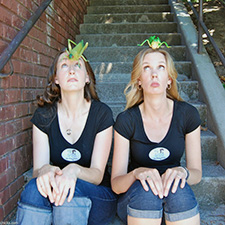
SOME PEOPLE HAVE A FEAR OF BUGS and creepy crawlies. Kristie Reddick and Jessica Honaker—collectively known as The Bug Chicks—work to fight myths about these fascinating creatures and to promote science and wonder. In this episode of MonsterTalk, we discuss giant spiders, common misconceptions and the entomologists’ experience on the TV show MonsterQuest.
The Bug Chicks can be reached via their website. They also have a coloring book!
Music
- Monstertalk Theme: Monster by Peach Stealing Monkeys
MTArchivist
0