Regular Episode
#012 – Suitable for Framing
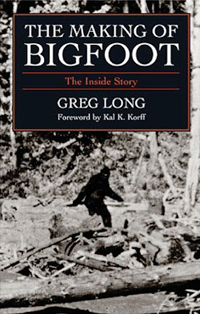
For believers, the 59-second clip of a large, hair-covered, bipedal figure striding away from the camera through a gravel bar at Bluff Creek, California, remains the gold standard of Bigfoot evidence. Long’s book — published in 2004 by Prometheus Books — argues it is something far more prosaic: a well-executed hoax by a charismatic, cash-strapped cowboy who happened to know the right people.
🎬 The Official Story — and Its Cracks
According to Patterson and his friend Bob Gimlin, the encounter was entirely accidental. The two rode on horseback along Bluff Creek, came around a fallen log left by a 1964 flood, and Patterson’s horse reared at the sight (and smell) of a large, female, ape-like creature crouching near the water. Patterson was thrown, grabbed his rented 16mm camera, and filmed the creature as it walked away. Gimlin, armed with a rifle, held back. Plaster casts were poured, a local hardware-store owner was told the news that same evening, and the undeveloped film canister was reportedly flown back to Yakima for processing.
Long methodically chips away at the timeline. Peter Byrne, one of the most senior figures in Bigfoot research, checked logbooks and interviewed pilots and postal workers: weather was too severe for private planes that day, and the post office would have been closed. If the film couldn’t have been rushed out as claimed, Long suggests the obvious inference — it was shot earlier than October 20th, giving Patterson time to develop it quietly through a third party, then stage an “accidental” public sighting to give the film a clean, spontaneous origin story.
Adding to the forensic gaps: the original film negative has never surfaced. No records exist of where, when, or by whom it was developed. Only copies of copies circulate. As Long notes, the leader strip on the original reel might have carried a date stamp — which could explain why it has never been produced.
🤠 The Man Behind the Camera — Roger Patterson
Long paints a portrait of Patterson that diverges sharply from the rugged, earnest frontiersman of Bigfoot lore. Through interviews with neighbors, business associates, and former creditors in the small Tampico and Yakima communities where Patterson was well known, Long found consistent accounts of a man who was entertaining and charismatic but chronically dishonest — someone who didn’t pay bills, ran up debts, and spun elaborate stories.
Crucially, Patterson had both creative ambitions and financial motive. Between the fall of 1966 (when his self-published book on Bigfoot appeared) and October 1967, he was actively trying to sell a dramatized Bigfoot hunting film to Hollywood — complete with friends on horseback, staged campfire scenes filmed in his own backyard, and Bob Gimlin dressed as an Native American tracker. Hollywood wasn’t buying. The common feedback, as Long reconstructs it: you’d need an actual Bigfoot in it. Patterson’s wealthy brother-in-law, Al “Aldi” Atlee, owner of Superior Asphalt Company in Yakima, was bankrolling the operation. Atlee later told Long that the film-distribution roadshow they ran through the Northwest and Midwest had grossed roughly $200,000 — a substantial sum in 1967–68 dollars.
🦍 The Man in the Suit — Bob Hieronymus
The centerpiece of Long’s hoax theory is Bob Hieronymus, a large, powerfully built Yakima man who was 26 years old in 1967 and stood roughly six foot two. Long says Gimlin approached Hieronymus on Patterson’s behalf and offered him $1,000 to wear a Bigfoot costume for a film. Hieronymus agreed on a handshake, tried the suit on behind Patterson’s house under Patterson’s direction, and then traveled down to Bluff Creek, where he slept in the horse trailer before the morning of the shoot.
According to Hieronymus’s account (which he has repeated consistently for decades, passed two polygraph examinations, and shared with a lawyer retained partly out of concern about potential legal action from Patty Patterson and Atlee), the actual filming was a single take. He put on the suit, walked to a predetermined position, turned to look back at the camera, and walked away until he reached a root hollow where he crouched down — partly because it was hunting season and he feared being mistaken for game. Patterson and Gimlin then helped him out of the suit, bagged it, and rode out.
Long acknowledges the evidentiary limitations plainly: no suit, no photos, no diary entries, no corroborating physical evidence. Hieronymus’s account rests on his word — a word Long found credible after extensive background checks, multiple interviews, and conversations with people who knew Hieronymus over decades.
🪡 The Suit Maker — Philip Morris
Philip Morris, a professional costume maker in Charlotte, North Carolina who supplied gorilla suits to carnivals, rodeos, and stage productions (and, later, to David Copperfield), told Long that he received a call from a man identifying himself as Roger Patterson, who ordered a gorilla suit and paid by money order. When the film aired on television shortly after October 1967, Morris says he immediately recognized the suit as his own. He acknowledged to Long that the face mask in the film appeared to have been altered — Patterson seems to have modified it — but said the body proportions, the way the hair caught sunlight, the shape of the feet and hands, were all consistent with his product.
Long watched Morris’s later recreation attempt (produced for a National Geographic documentary, in which Long was involved as a coordinator though his interview was largely cut) and observed Hieronymus put on an updated gorilla suit in his own living room. The transformation was striking: a man of Hieronymus’s build became dramatically larger, particularly in the hips and buttocks — consistent with the famously discussed gluteal profile of “Patty” in the film. A line visible on the creature’s upper right thigh in the film, Long and Morris suggest, likely marks the top of wading boots worn inside the suit.
🔬 The Skeptical Literature and the Locomotion Debate
One pillar of the authenticity argument has long been the claim that “Patty’s” gait — characterized by bent-knee, bent-hip locomotion and an unusually long stride — is biomechanically impossible for a human to replicate. Long and the hosts note that this claim has been substantially undermined. A colleague, Dave Daegling, published an analysis in Skeptical Inquirer demonstrating that human beings can in fact produce the locomotion pattern seen in the film. Long adds an earthy observation: people simply walk in a wide variety of ways, and a motivated 26-year-old ranch hand told to “walk like a Bigfoot” and given a single take to get it right might produce something that looks impressively non-human.
The hosts also briefly discuss a Fox television special that examined hoax claims and featured a member of the Romney family — reportedly an insurance agent connected to American National Enterprises, a Utah nature-film company — who was alleged (by a former ANE executive) to have worn the suit. The Romney family member denied it, and Long left this thread out of the book for space reasons, noting it ultimately rests on one person’s word against another’s.
📚 Further Reading
– 📚 The Making of Bigfoot 💵 by Greg Long
🔗 Related Links
– Patterson–Gimlin film (Wikipedia)
– Bigfoot (Wikipedia)
– Bluff Creek, California (Wikipedia)
– Bob Gimlin (Wikipedia)
– John Chambers — makeup artist rumored (and who denied) involvement (Wikipedia)
– Skeptical Inquirer — home of Dave Daegling’s locomotion analysis and related Bigfoot coverage
Note: ads inserted into the distributed audio alter the timestamps in unpredictable ways, so timing references in these notes are approximate.
Author Greg Long discusses his book The Making of Bigfoot which chronicles his search to get to the bottom of the Patterson-Gimlin film. His findings destroy the image of Roger Patterson as a simple country man looking for Bigfoot at the right place and right time. And it provides at least one plausible answer to the question “What did Patterson film that day in 1967?” Or should we say “Who?”
Long presents a very plausible tale of how two cowboys came to film one of the most controversial pieces of footage in American history.
Music
- Monstertalk Theme: Monster
by Peach Stealing Monkeys - Dirty Little Secret by 54 Seconds
Blake Smith
0