Regular Episode
#013 – Getting into the Spirit of Things
This episode is framed as the first in a planned series on ghost-related phenomena, covering everything from apparitions and poltergeists to shadow people and things that go bump in the night.
👻 Spirits, Ghosts, and the Paranormal Taxonomy Problem
Before Dr. Novella even picks up the phone, the hosts spend some time untangling the vocabulary of ghost belief. Karen draws a working distinction: a ghost is an apparition or visual manifestation (possibly a “residual haunting” — a kind of psychic replay of past events), while a spirit is an interactive entity, something with will and intent. Poltergeists get their own category entirely.
Steve’s take is blunter: since none of these things demonstrably exist, the elaborate classification systems ghost hunters use are essentially made-up — inspired by mythology and folklore, but ultimately arbitrary. He compares debating the categories to arguing about how many angels can dance on the head of a pin. The practical upshot for skeptics engaging with believers: always ask first what they mean by “ghost,” because you can be twenty minutes into a conversation before discovering the other person thinks ghosts are telepathic projections rather than the spirits of the dead.
📺 Ghost Hunting Reality TV and the Pseudoscience of “Anomaly Hunting”
Steve has a measured view of the paranormal TV boom. He sees it largely as reality television finding a cheap format — not a disturbing cultural trend — and wonders whether audiences will eventually tire of shows where, by definition, nothing can ever actually happen. The deeper problem, he argues, is methodological: ghost hunting shows engage in pure anomaly hunting. They find something superficially inexplicable, immediately label it a ghost, and never explore alternative hypotheses, test predictions, or demonstrate any understanding of the equipment they’re waving around. Blake notes that the book Ghost Hunting by Jason Hawes — from the cast of the long-running show — devotes exactly four paragraphs to “the science of ghost hunting” in a 263-page volume.
Steve’s verdict: classic pseudoscience. All the superficial trappings of scientific investigation, none of the substance.
🔬 Ed and Lorraine Warren: Ghost Hunting as a Faith-Based Enterprise
Ed and Lorraine Warren — the Connecticut-based paranormal investigators whose work inspired the Amityville Horror franchise and, decades later, The Conjuring — get extended discussion as the people who arguably launched the modern ghost-hunting industry in New England. Steve knew them personally through the New England Skeptical Society’s investigations.
His portrait is unflattering but not unkind: Ed was an unsophisticated man who had built a livelihood around the paranormal, desperately wanted scientific validation from the skeptics, and was genuinely upset when he didn’t get it. Lorraine’s role was to provide the “psychic impression” — her self-described clairvoyance serving as the primary investigative instrument. Steve describes their operation as a revolving door of trainees, a faith-based enterprise that overlapped heavily with exorcism and demonology, and which sometimes, he believes, exploited vulnerable people — whether through outright fraud or what he calls “pious fraud,” staging anomalies for the benefit of students on investigations.
The concern about real harm is pointed: when someone believes their house is genuinely haunted to the point of life disruption, ghost hunters who validate and reinforce that belief — especially if the person is experiencing something closer to a clinical delusion — are doing the worst possible thing. The “exorcism” produces a temporary response (the person follows the script), but the underlying problem is never addressed and the delusion is entrenched.
🧠 Neuroscience and the Case Against Dualism
The philosophical heart of the episode. Steve lays out the neuroscience position on dualism — the idea that something beyond the physical brain is responsible for consciousness — with clarity and a few memorable analogies.
The core argument: if the brain fully causes consciousness, we’d predict that turning off the brain turns off consciousness, damaging the brain damages consciousness, and pharmacologically altering the brain alters consciousness. That is precisely what we observe. Every way you ask the question, brain function and mental function are tightly correlated. Philosophers like David Chalmers who still argue for dualism are, in Steve’s view, committing a “god of the gaps” fallacy: we don’t fully understand how the brain generates consciousness, therefore there must be something else. But a gap in current understanding doesn’t require a non-physical explanation.
The popular “brain as antenna” model — the idea that consciousness exists externally and the brain merely receives it — gets particular attention. Steve calls it a special-pleading argument designed to accommodate the very strong correlation between brain states and mental states. More fatally, it gets the arrow of causation backwards: we can use pharmacology to alter the content of consciousness, not just remove pieces of it — something you cannot do to a TV set to change the story being broadcast. The simplest and best-supported explanation remains that the brain causes consciousness, not merely receives it.
😴 Sleep Phenomena, EMFs, and Internal Origins of Ghost Experiences
Steve walks through the neurological toolkit that can produce experiences people interpret as ghostly — without any ghost required:
– Hypnagogic and hypnopompic hallucinations: experienced by roughly 15% of the general population, these sleep-boundary states can produce vivid perceptions of a malevolent entity in the room, paralysis, and profound terror. Steve describes his own experiences during medical residency, working 40-hour shifts — lying paralyzed, convinced something was at the edge of his vision, unable to turn or call out.
– Out-of-body experiences: reliably produced in the lab via transcranial magnetic stimulation targeting the frontotemporal lobe. The brain contains structures whose job is to locate you inside your own body; disrupt them and you float above yourself.
– Near-death experiences: plausibly explained by oxygen deprivation, cardiac arrest physiology, and related mechanisms — all of which are well-documented triggers for the same brain phenomena.
– Michael Persinger‘s electromagnetic field work: Steve characterizes this as speculative but not implausible — lab conditions can use focused EM fields to induce unusual experiences, but environmental EMFs are far too diffuse and unfocused to produce the same effect in haunted houses or in front of computer screens.
– Fear of the dark: probably a deep primate survival instinct. fMRI studies can map which brain regions activate under fearful stimuli; the feeling of being watched in a dark environment is likely hardwired, not paranormal.
🎲 Skeptics in the Field (and at the Gaming Table)
Steve describes roughly a dozen ghost investigations conducted with the New England Skeptical Society around Connecticut — often called in by friends-of-friends who believed their homes were haunted. The results were uniformly mundane: lights on timers, traffic noise mistaken for EVP, a mobile spinning because a fan came on. His advice to skeptics who want to go beyond armchair analysis and actually investigate: just do it. You will lose enormous amounts of respect for the process once you see it firsthand, but you’ll gain something invaluable — a firsthand understanding of how much dumber the whole enterprise is than you imagined.
The episode closes on a pleasantly nerdy detour: Steve, Blake, and Karen discover a shared love of tabletop role-playing games. Steve reveals that he and friends actually published several supplements for the D20 system under the Open Game License, including Spellbound (a ritual magic system) and Agents of Faith (an expanded religious devotion system for non-cleric characters). The group is united in its distaste for D&D 4th edition.
📚 Further Reading
– 📚 On Intelligence 💵 by Jeff Hawkins and Sandra Blakeslee (mentioned by Blake as a theory of intelligence worth a neuroscientist’s opinion)
– 📚 Ghost Hunting: True Stories of Unexplained Phenomena from The Atlantic Paranormal Society 💵 by Jason Hawes and Grant Wilson
🔗 Related Links
– Ed and Lorraine Warren — Wikipedia
– Mind–body dualism — Wikipedia
– Hypnagogia — Wikipedia
– Transcranial magnetic stimulation — Wikipedia
– Near-death experience — Wikipedia
– Electronic voice phenomenon (EVP) — Wikipedia
– Michael Persinger and electromagnetic field research — Wikipedia
– The Skeptics’ Guide to the Universe podcast
– Science-Based Medicine — Dr. Novella’s collaborative blog
– NeuroLogica Blog — Dr. Novella’s personal neuroscience and skepticism blog
Note: ads inserted into the distributed audio alter the timestamps in unpredictable ways, so timing references in these notes are approximate.
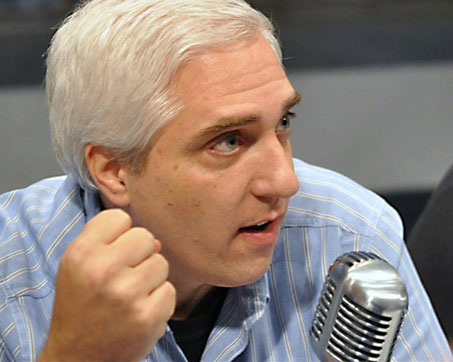
What does neuroscience have to say about the possibility of consciousness or mind existing outside the body — or continuing on after the body has died? This episode’s guest is neurologist Dr. Steven Novella (veteran of on-site ghost investigations, and host of the Skeptics’ Guide to the Universe podcast, who shares his insights on brains, minds, and specters from beyond the grave.
Blake Smith
0