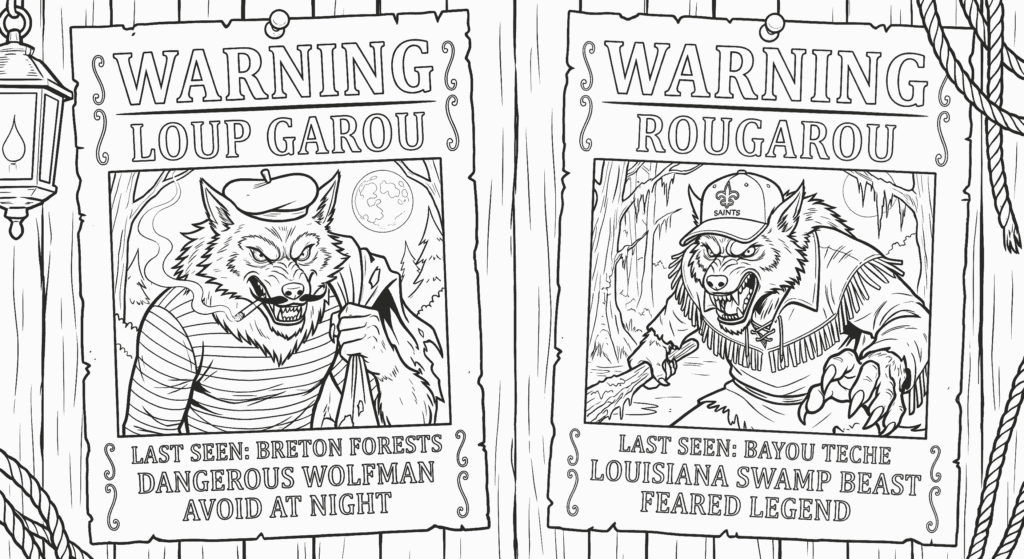
S05E30 – From Loup Garou to Rougarou (pt 1) with Louisiana Dread’s Kyle Crosby
🎙️ Episode Introduction
This is part one of a two-part conversation. Blake and Karen are joined by Kyle Crosby, filmmaker, historian, and founder of Louisiana Dread, a multimedia project dedicated to documenting the dark history, folklore, and culture of the Pelican State. Kyle is a native of Larose, Louisiana, who grew up in Lafourche Parish and on Grand Isle. He spent years working in the film industry before returning home to preserve the stories he felt were being lost to time. Through his popular YouTube channel and social media platforms, he bridges the gap between scholarly history and regional folklore – covering everything from the legend of the Rougarou and the Honey Island Swamp Monster to the real-life mysteries of the Cajun Coast. Kyle is currently adapting his historical deep dives into a scripted horror anthology series, with one episode in the festival circuit and a second in pre-production.
Blake met Kyle at the second Gods and Monsters conference at Texas State University, where Kyle’s presentation on Louisiana’s history and folklore inspired Blake and Karen to finally tackle the Rougarou as a proper episode.
In this first part, the conversation digs into the history of the Acadian expulsion, the cultural forces that produced Cajun and Creole Louisiana, and the Old World roots of the Rougarou legend. In part two, they’ll get into what the Rougarou actually became – a shape-shifting boogeyman with regional variants, plus feux follets, and a monster that might have been born from a traveling circus.
🐊 Kyle Crosby / Louisiana Dread
YouTube – Louisiana Dread
TikTok – @louisianadread
Instagram – @louisiana.dread
Facebook – Louisiana Dread
Website – louisianadread.com
🍲 Kyle’s Gumbo Reviews
📜 Topics and References
The Acadian Expulsion (Le Grand Derangement)
In 1755, the British Crown forcibly expelled French-speaking colonists from Acadia (present-day Nova Scotia, New Brunswick, and Prince Edward Island). The Acadians were a community of French colonists who had intermarried and intermingled with the Mi’kmaq First Nation over generations. The British separated families – men shipped in one direction, women and children in another – in what has been called the first documented ethnic cleansing in North America, a distinction that says more about whose suffering was recorded than who suffered first. By the Treaty of Paris (1763), over 11,500 of the roughly 14,100 Acadians in the region had been deported.
Some displaced Acadians eventually made their way to Spanish-controlled Louisiana. In 1785, King Carlos III of Spain funded seven ships to transport approximately 1,600 Acadians from France to Louisiana, in what has been described as one of the largest single migrations of Europeans into the Mississippi Valley. Some Acadians went to France first before eventually reaching Louisiana; others arrived in staggered waves over several decades.
The word “Cajun” itself derives from “Acadien” (the French term for the Acadian people), anglicized over time as English speakers dropped and shifted syllables.
Ancient Louisiana
Kyle notes that Louisiana’s human history stretches back thousands of years before European colonization. Among the ancient cultures discussed are Poverty Point, Marksville, and Coles Creek. The nearby Watson Brake site in northeastern Louisiana dates to approximately 3500 BCE – predating the Great Pyramids of Giza – and is considered the oldest known earthwork mound complex in North America. Poverty Point itself is a UNESCO World Heritage Site.
Above-Ground Burial – Spanish Influence, Not Floating Coffins
The episode tackles a popular myth: that New Orleans buries its dead above ground because coffins float up from the water table. Kyle and Blake discuss how this practice is actually rooted in Spanish colonial influence – the same above-ground burial traditions seen in Madrid and Barcelona. While early settlers who buried the dead on levees did occasionally see coffins displaced by flooding (and Hurricane Katrina produced dramatic examples), the architectural tradition itself reflects Catholic Spanish culture transplanted during Spain’s control of Louisiana, not a practical response to groundwater. Kyle notes that every tour guide in New Orleans repeats the floating coffin story because it gets the oohs and ahhs, but the truth is more interesting.
The Suppression of French in Louisiana
In 1921, the Louisiana state constitution established English as the official language and effectively banned French as a language of instruction in public schools. This happened at a time when an estimated 85% of the state’s population spoke French as their first language. Kyle describes the punishment children faced for speaking French at school – hit on the fingertips with rulers, forced to kneel on dried rice, made to write “I will not speak French” on the chalkboard. Karen draws parallels to the suppression of Welsh in British schools and the treatment of Indigenous languages in North American residential schools. The ban was not officially lifted until the Louisiana constitution of 1974.
Cajun, Creole, and Cultural Identity
Kyle discusses how after 300 years of French, Spanish, Native American, West African, and Caribbean communities living together in Louisiana, the distinctions between “Cajun” and “Creole” are more complex than most people realize. He defines a Louisiana Creole as someone born in Louisiana, French-speaking, of Catholic faith, with ancestry from West Africa, Western Europe, and/or Native America. He argues that after three centuries of intermixing, most people in South Louisiana share this heritage – but that racial divisions were deliberately reinforced during segregation and forced cultural assimilation in the 20th century, creating artificial separations that persist to this day.
Coastal Land Loss
Kyle emphasizes that Louisiana’s culture is inextricable from its land – and that land is disappearing. He states that Louisiana loses a football field of land approximately every 100 minutes, and that since 1930, the state has lost an area roughly the size of Delaware. His guiding principle: “You lose your language, you lose your land, you lose your culture.”
Visit NASA link for much more info on loss of coast-land.
🐺 From Loup-Garou to Rougarou
The French loup-garou was a werewolf – a proper lycanthrope. Belief in such creatures was not an ancient relic; the Beast of Gevaudan terrorized the French countryside between 1764 and 1767, barely a decade after the Acadian expulsion. French colonists carried the loup-garou legend wherever they sailed – including to Grosse Pointe, Michigan, where a werewolf legend dates to the French colonial period.
But when the loup-garou was transplanted to Louisiana – a landscape with no wolves – it changed. Kyle explains that the word “loup” means wolf and “garou” means shapeshifter. As Cajun French evolved in isolation, the L and R sounds in “loup-garou” swapped through a process called metathesis – the same linguistic shift that turned “plarine” into “praline.” The loup-garou became the rougarou.
Crucially, the Rougarou is not a lycanthrope. It’s a shapeshifter – half-human, half-anything. In Louisiana literature and oral tradition, the Rougarou appears as an owl, a bird, a mangy dog, or a wolf depending on the region. It is also more closely tied to Catholic religious belief than to European werewolf mythology. Native American folklore of the region also contributed to the evolution of the legend, creating a uniquely Louisiana creature that blends French, Indigenous, African diaspora, Spanish colonial, and Caribbean spiritual traditions.
Kyle also notes that Louisiana Cajun French preserves an older form of French than what is spoken in modern Paris – the language did not evolve in the same way because it was isolated from metropolitan French linguistic change.
🎵 Credits
Monster Talk theme music by Peach Stealing Monkeys.
💀 Support MonsterTalk
Visit monstertalk.org/support for links to our Patreon, donation options, and our Amazon wishlist. Used books and Kindle editions are always welcome! You can also support us by leaving a review on Apple Podcasts or wherever you listen, and sharing us on social media.
Come back for Part 2, where we’ll get into the Rougarou itself – how it became a shape-shifting swamp creature that can’t count past 12, why breaking your Lenten penance might be more dangerous than you think, and some other Louisiana monsters that deserve their time in the spotlight.
SEO Transcript
This is not a fully accurate transcript, and was machine generated. It’s here for helping search engines find the episode but not intended to be a faithful transcript of the episode. (But it’s not AWFUL.) Some of the material in this transcript only exists in the Patreon/Premium edition of the show and was excised for the commercial version.
———————
Monster House presents…
It’s actually quite unlike anything we’ve ever seen before.
A giant hairy creature, part ape, part man.
In Loch Ness, a 24 mile long bottomless lake in the highlands of Scotland, it’s a creature known as the Loch Ness Monster.
Monster Talk.
Welcome to Monster Talk, the science show about monsters.
I’m Blake Smith.
And I’m Karen Stollznow.
In 1755, the British crown decided it had had enough.
French-speaking colonists in what is now Nova Scotia, people who had built lives, families, and a whole culture blending European and Mi’kmaq traditions, had been a thorn in the empire’s side for decades.
So the Brits did what empires do.
They tore families apart, they loaded men onto ships headed one direction, and women and children onto ships headed another, and they scattered this community across the Atlantic.
It has been called the first documented ethnic cleansing in North America.
which is not to say it was literally the first.
The genocide of indigenous peoples across this continent was massive and ongoing, but the Acadian expulsion was deliberately planned, ordered, and recorded by the British crown, a paper trail of cruelty, which is the distinction that says more about who the imperial powers kept records of than who suffered.
Eventually, some of those displaced Acadians found their way to the swamps and bayous of Spanish-controlled Louisiana, where they started over.
They brought their Catholic faith, their French language, their recipes, and of course, their monsters.
You see, back in France, the loup-garou was a werewolf, a proper lycanthrope.
And belief in such creatures wasn’t some quaint relic of the Middle Ages.
The Beast of Gévaudan was terrorizing the French countryside barely a decade after the Acadian expulsion.
Werewolves were not just a continental concern.
French colonists carried the Lugaroo with them wherever they sailed.
For instance, there’s a werewolf legend in Grosse Pointe, Michigan that dates to the French colonial period long before it was even a state.
These weren’t dusty old stories to be discarded on the way to the New World.
These were important dangers of an ongoing and monstrous concern.
But when you transplant a monster across an ocean into a landscape with no wolves, where it mingles with native traditions and African diaspora folklore and Spanish colonial culture and Caribbean spiritual practices, well, that monster is going to change.
And that’s exactly what happened to the Lugaroo on its way to becoming the Rugaroo.
Today on Monster Talk, Karen and I are joined by Kyle Crosby, filmmaker, historian, and founder of Louisiana Dread, a multimedia project dedicated to documenting the dark corners of the Pelican State.
Kyle is a native of South Louisiana, descended from the very communities we’re going to be talking about.
And he gave us a fantastic presentation at the Gods and Monsters Conference at Texas State University.
that made us say, okay, we finally need to do that proper Rougarou episode we’ve been wanting to.
So this one’s a two-parter.
Today, we’re going to dig into the history, the Acadian expulsion, the incredible cultural gumbo, and I do mean gumbo, that produced Cajun and Creole Louisiana, and the old world roots of the Rougarou legend.
In part two, we’ll get into what the Rougarou actually became, a shape-shifting boogeyman with his own rules and his own regional variants.
Plus,
Ex-murderers, Will of the Wisps, and a monster that might have been born from a traveling circus.
You don’t want to miss this.
Kyle Crosby is a filmmaker, historian, and the visionary founder of Louisiana Dread, a multimedia project dedicated to documenting the dark corners of the Pelican State.
A native of La Rose, Louisiana, Kyle spent years in the film industry before returning home to preserve the stories he felt were being lost to time.
Through his popular YouTube channel and social media platforms, he bridges the gap between scholarly history and eerie folklore.
covering everything from the legend of the Rougarou and the Honey Island Swamp Monster to the real-life mysteries of the Cajun Coast.
He’s currently working to adapt these historical deep dives into a scripted horror anthology series, ensuring that Louisiana’s unique cultural heritage remains as haunting and vibrant as ever.
And I hope that’s true, because you talked about that, and I put it in here, and then I thought I probably should check and make sure Kyle is actually still in the process of adapting these stories.
Absolutely, I am.
Yes, I got one in the festival circuit right now and in pre-production for a second episode this summer.
Fantastic.
I met Kyle at the second Gods and Monsters conference, which I am now calling Gods and Monsters 2 Eclectic Rougarou because I can, because I can, because nobody can stop me.
So I met Kyle at Gods and Monsters where he gave this wonderful presentation talking about a broad overview of what he is doing with his media and outreach.
And part of that, just a little smidge of it, touched on one of my favorite, and Karen’s too, I believe, that we talk about a lot, the Rougarou.
We talk about it a lot, but we have never dug in to the Rougarou.
We haven’t.
Very remiss.
I well, and partly because I didn’t feel like we had anybody with whom to speak cogently.
Yeah.
So welcome to Monster Talk, Kyle.
Oh, there you go.
Oh, it’s a pleasure.
I love being on here.
This is great.
Thank you so much for having me.
And yeah, if there’s one thing I could talk about all day, it’s Louisiana.
And with that is the Rougarou for sure.
And don’t, don’t let me forget.
You also do something with food and besides eating it.
So we don’t want to miss that.
So we’ll put links to all Kyle stuff in the show notes.
This is going to be a two-parter.
So we’ll put those links in both parts.
Well, Karen, you want to kick us off?
Yeah, I just want to start.
I love Louisiana.
I’ve been there quite a few times and all around, but I never knew it was the Pelican State.
I guess I never saw that on the license plates.
Am I wrong?
Did I misremember?
No, it’s 100% the Pelican State, the Bayou State.
Best state in the Union, in my opinion.
It is the gumbo, the gumbo state.
Gumbo capital of the world, baby.
Yeah.
Well, let’s start with a little bit of history.
So, Carl, can you tell us, who were the Acadians?
Yeah.
So, just a brief, a little bit further.
So, we’re going to go to 1755, and even a little bit further back than that, because you have…
um louisiana under french control uh obviously after thousands of years of native american settlements you have uh cultures like the um culture the marksville culture coles creek culture poverty point cultures these are civilizations thousands and thousands of years old that still have
huge mounds, burial mounds, ceremonial mounds dotted all over the state of Louisiana that you could kind of see today.
And I’m talking like those predate the pyramids in Giza.
So they are ancient, right?
So when you have colonization kind of occur with the French first, we became Spanish for about 40 years or so.
During Spanish occupation is when you have the Seven Years’ War.
To most Americans, it’s known as the French and Indian War.
And with that, France loses.
And as a result, France will give Louisiana to Spain as sort of like a concession for the participation in the war, despite Spain actually losing as well.
So France gives Louisiana to Spain.
Then you have France losing possessions in Canada, primarily in New Brunswick, Cape Breton, Grand Pre, all that.
So that area was populated by French colonists that kind of intermarried and intermingled with the Mi’kmaq First Nation tribe.
And then, you know, a while later, you have a completely different generation of mixed European Native American people known as the Acadien.
The Acadien.
You can look at it as the Acadians.
That is the more anglified version of it.
We call them Acadien.
So when the British took control of that area, their main goal was to get French completely out the area.
So.
What they did was a genocide, as the British do sometimes, as you’ve seen throughout history.
It was a mass starvation, mass killing.
These people were forcibly removed from their homes, mass deportations.
They would take women and children and lock them in churches.
And they would take the men, some of the elderly, and they would ship them around the world.
And they would take the women and children out of the churches and ship them in the opposite end.
So they would never see each other, very much so displaced.
But King Carlos in Spain, King Carlos III would send…
famously send seven ships to collect a bunch of these Akajan people, and they would end up in Louisiana.
Now, those people, they’re called Akajan, but then English people can’t really say that, especially Americans.
They couldn’t be able to say Akajan.
So it would be Akajan, Akajan, Akajan, Akajan, and it would be the A would separate from that word.
So that’s where you get the name from.
Nice.
Well, I mean, not nice.
It’s actually terribly brutal, but still.
That’s why I’m here, man.
You know, it does suck.
But if it didn’t happen, I wouldn’t be here.
You know, so I’m grateful, you know, that that.
that I’m able to be here and to tell people more about the atrocity that occurred, but then also to let people know, hey, we are something to celebrate.
We’re not victims.
We’re not perpetual victims of this genocide.
The first recorded ethnic cleansing in North America, now I say recorded and I stress recorded because it’s not, it never accounted for the natives, the Native Americans that were here before, but it is a documented ethnic cleansing of people in North America.
that, you know, for the majority of my life, it was kind of glossed over a little bit.
And that is perpetuated by the American school system to not let us really know about where we came before.
We’re all American.
Yeah.
I was just going to say that with so much tragedy and displacement, these atrocities that you’re talking about, no wonder the area is so rich in folklore and myth and legend.
Oh, absolutely.
Because that comes with all other ethnic groups here, too.
We are.
There’s one thing that we have abundance of, and that is trauma, collective trauma.
Even when you talk about Creole, Creole has West African, you know, in that ancestry.
So there were free people of color.
Yeah, there were free blacks here.
You don’t see that anywhere else in the United States.
But the vast majority were enslaved Africans.
that were forcibly removed from their homes and brought here to do manual labor.
And it was the transatlantic slave trade was the darkest mark on the American history and culture.
And that comes from immense trauma.
You have what happened to the natives and you have what happened to the Cajuns.
You have all this stuff, all trauma.
And it just kind of builds what we have today, essentially.
I mean, I don’t know if there’s any way to talk about the mixture of cultures without relating it to gumbo, but.
Everything comes back to gumbo, all roads lead to gumbo.
But I mean, you know, they talk about the melting pot and all these things.
It’s like, but my God.
Louisiana is such a melting pot.
One of the things that struck me when you were talking at Gods and Monsters, two, eclectic Rougarou, one more time there for the not paying attention people, but the…
You mentioned the influence of Spanish style burial on the above ground tombs.
And I was so glad to hear that because it’s been sort of like a little pet peeve of mine.
Like when I realized that I, what actually I think may have triggered it was I was stationed in Spain and up on a big hill, a beautiful cemetery.
I love going to cemeteries.
And I noticed, my God, these cemeteries look like the ones in New Orleans.
But we’re nowhere near the water, you know?
So why?
So that’s what got me curious about it.
And then at some point, I think it was when that show Mythbusters was on.
I started doing these experiments to see, you know, because obviously I can’t go bury a coffin myself, but I got the hypothesis.
I’m lazy.
It’s not like there’s no law against it.
I’m just very lazy.
I did a scaled down version and I like with just what would have been the equivalent of like two foot of soil.
And I did real sandy soil.
you know, I couldn’t get anything to pop up.
I even like a water bottle, which is all filled with air wouldn’t pop up out of there.
And I thought, this is, this is not right.
And then I dug and dug and finally found some of just a few places on the internet where they say, yeah, it was the Spanish influence that caused that cultural shift towards that kind of burial.
But I, I, it is so pervasive, that myth that, that if you bury somebody in the ground, they’re just going to pop right up.
Well, it started that way, right?
Like it did.
That was the catalyst, was the first settlers here would do that.
They would bury their dead on the levee and the river.
Not a great place.
No, not a great place.
That could happen anywhere.
It could happen anywhere.
Not necessarily here.
Yeah, we are below sea level.
You go to where I’m from on Grand Isle, you pass by places like Leeville, South Lafourche area, and you are looking at…
water level that’s higher than the land it’s pretty crazy to see but when the river would flood one or two seasons that’s all it would take for human beings naturally to be like oh wait what the hell’s going on here we got to kind of fix this right and yeah like you put you put concrete on top of anybody they ain’t moving bro you know so you you you bury them
But also it was during Spanish times that the city was growing rapidly.
And like every large city, you are, you know, competing for space.
And there’s no more room for this, no more room for that.
And the cemetery is very confined.
And it only makes sense to build up, especially if you see the same things in Madrid, Barcelona, the same types.
It’s just our culture that does that.
Down to Bahia, you know,
There’s a big concrete slab with a few bodies under that.
And during Katrina is when there was an undertow and it swept some of them out from underneath that concrete slab.
And that’s when you do see coffins floating up.
It’s not impossible, but it’s just because the reason that we bury above ground isn’t because of the ground level water.
You know, it’s just truly because our culture.
If you get a hurricane tidal surge, it doesn’t matter where you’re buried.
That can wipe up.
It can move things.
It’s incredible.
People lose track of that stuff.
Absolutely.
Every tour guide you’re going to go to in New Orleans is going to say that because it does the oohs and the ahhs.
The tour guides, God bless them.
Do what you got to do.
You know what I mean?
I do.
Let them do what they got to do.
There’s a video on the Louisiana Dredge channel that you can watch that explains it very well.
And you don’t have to lie and make up all kinds of stuff.
It’s, you know, it’s the truth to me is so much more interesting than something that’s made up.
But I’m always under, I always say, never let the truth get in the way of a good story.
To give our listeners some context here, I was just thinking this expulsion of the Acadians, that was like 1755, I think.
And to give some context here, one of my favorite werewolf-related stories, it’s not really a werewolf story, but it’s this French story, The Beast of Gévaudan.
So that was like a huge story in France between 1764 and 1767.
So, you know, this idea that that maybe werewolves like ancient folklore.
No, no.
Like this was like werewolves in French culture in particular was.
a legitimate belief like it was really firmly believed and I think that I’m not sure how that translated overseas so I know in France they were like newspapers but I don’t know how people necessarily kept up with what was going on I don’t know if people were shipping newspapers back and forth or how that worked exactly but also keep in mind that the natives in the area had folklore of their own that
kind of amalgamized between French and native.
Because the Rougarou in itself isn’t a lycanthrope at all.
Even though the original word says is loup, it’s not a werewolf.
It is a shapeshifter.
That’s Garou.
Garou is a shapeshifter.
And in fact, I don’t know how long you’ve been in Louisiana, bro, but we ain’t got no wolves.
So the legend predates that.
Now, it’s more religious-based than it is lycanthrope, if anything, because you can be a wolf.
It’s half human, half anything.
So mostly in literature, you’ll see it as like an owl or bird or a dog, especially like a mangy dog.
That’s where kind of the Louisiana part kind of sifts in.
But still, you have different regional stories in Louisiana that will say.
That it is different things.
It is a wolf.
It is a half-man, half-wolf.
It is a full-blown wolf.
You know, you have different stories depending on the region of the state.
Cutting to the core of this, what did the Lugaru mean to the Acadians before they left France?
So it is, again, based on lycanthropy.
And you probably heard this term Lugaru, L-O-U-P.
and Rugaru, they are synonymous.
They are the same.
But because of the R, the L and the R, we’ll go to Lu.
So Lu, L-O-U-P, is wolf, and Garu is shapeshifter.
But when the Acadians came to Louisiana, and as time started going on, phonetically, an L and an R will change, will swap.
It’s the same, have you heard of the tasty treat of pralines?
Mm-hmm.
Oh, yeah, yeah, yeah, yeah.
That’s pecans with sugar, right?
Yeah, exactly.
So the original is plarin, P-L-A-R-I-N-E, plarin, but then the L and the R switch, pralin, and the same thing with lugaru.
As we became more, it’s more of an anglicized…
Most Americans or anglophones can’t really, they can’t do that.
Because that is an L sound.
It’s over time.
It’ll change.
I just want to say that that happens a lot in English too.
And over time we’ve had that, that transposing of sounds with words like bird used to be bread and horse used to be cross.
So yeah.
People say ask.
People used to, when I was, like, the switch from ask to axe was actually, it switched the other way first.
It was originally axe and became ask and then became axe again.
It’s like, so.
Yeah, they existed at the same time, both of them.
And axe was actually the more posh term.
Yeah.
Language of us.
That’s what people say in our, because, like, we, most people from Georgia.
sound more like British English than American vernacular because of the lack of evolution in that southern dialect.
And it’s the same with our French here in South Louisiana.
We speak an older French than what you would see or hear today in Paris because their language evolves.
You know, like the new kids go, oh, yeah, it’s lit.
Yeah.
All this kind of stuff.
They don’t have these, you know, words.
That happens in France.
That happens in Paris.
And that is the main location of the French language is the headquarters.
But for us, it doesn’t evolve.
It stayed the same.
The same words that I say in French today, my great-great-grandfather was saying those words too.
That’s preserved.
Very interesting.
Very much so because of the lack of evolution in the language itself.
The Acadians who came down, about how many people are we talking here?
Like, I mean, how big of a population is this?
It was a few thousand that came down.
I forget the exact numbers off the top of my head.
But not like…
I think it would be 1,200.
You said they fit on like seven ships, right?
So I guess it couldn’t be… Oh, yeah.
It would stagger.
It staggered.
And in some cases, they would go to France first.
Oh, get out.
Really?
Wow.
Okay.
That’s a hell of a…
So they would go back to France first.
Well, because they were displaced, right?
Yeah.
So your wife and kids are now in Haiti.
And you are now in France and you don’t know where they’re at.
But you do hear of this new world.
You couldn’t find them anywhere around Paris.
But you hear of this, you know, place in the new world called La Louisiane.
Or Louisiana at the time because it was Spanish.
And you need to go find your kids, find your wife.
Give it a try.
You know, you have nothing.
You have no home.
You have nothing.
So why not?
Hell, let’s go give it a try in the new world.
Some would find each other again, very few.
But others just came and started a completely new life.
Like the last name Cherami, that’s my mom’s last name.
They went to France first.
They aren’t considered the original crop of Acadians.
There’s about, I want to say, 30-something families that are considered the first Acadians to come here on those ships.
So, yeah, it would be staggered.
You said you lose your land, you lose your life.
So what’s happening to Cajun communities right now?
The exact quote that I always tell people is you lose your land, you lose your language, you lose your culture.
It comes in that order.
It comes language first, then your land, then your culture.
And that’s what’s happening to us at the moment.
When we lost our language was 1921.
The state of Louisiana made it illegal to speak French across the state in government buildings, public services, public schools, places like that.
And this is also happening when 85% of Louisiana is speaking French as their first language.
English maybe as their second or third language of the French or Spanish, right?
So how is…
an increasingly American state and elected officials going to combat this because they don’t like anything different than them, especially then because Quebec was trying to get to be their own country at that time.
Who in the U.S. would do that?
And it would be us for sure.
We’ve always been different.
than the rest of the united states um it’s hard to put us in a category because we don’t fit into any um you have um a and this is also during segregation so you have a minority anglo-american minority
in a predominantly Anglo-American school and you have minority Afro-Creoles in a minority African-American, sorry, majority African-American school.
And they’re both shoved down the rhetoric that, let’s be honest, still exists today in the U.S. as you’re not American unless you speak in English.
And that shoved down the neck of these kids.
My grandfather told me that he couldn’t speak French in school or else the nuns would hit his fingertips with rulers.
Make him kneel and dry rice until he spoke English right on the board a hundred times.
I will not speak French.
I will speak English a hundred times on the chalkboard before you can go home.
For the listeners, I think we should, because you did such a beautiful job and I’m really messing you up right now.
I apologize, but you did such a good job explaining your own position in this cultural heritage.
So you’re not speaking as an outsider who’s studying the Cajun culture, you Creole Cajun.
this is your community.
Could you give a little, like talk about how you fit into that?
Yeah.
And today, honestly.
In my opinion, we are all Creole, all of us here in South Louisiana that have these things in common.
There’s a big divide amongst people, and that division still exists, and that was purposeful.
As time goes on, in 1963, the schools are desegregated.
So now, all these kids are together, and they were both told, y’all are different, y’all aren’t the same, when in reality, we’re all related.
After 300 years, that’s Creole.
Born in Louisiana, French-speaking, Catholic faith.
That is a Louisiana Creole.
But you have to have ancestry from West Africa, West Europe, Native American.
Well, after 300 years, these French and Native American heritage Cajuns come here and they intermingle with free black people, enslaved black people.
You have that African diaspora now.
So 300 years later, we all Creole.
But it was meant to divide based on race in the 60s because it was forced…
cultural assimilation afterwards.
You want everyone to be the same, everybody to speak the same language in America.
You want everybody to, you know, be one thing and not have any multiculturalism.
And that was directly counteracted to what we were.
And you can easily divide a population.
I think it was Lyndon B. Johnson.
I quoted this at my speech that said, if you can convince the poorest white man that the wealthiest black man is lesser than you, that poor white man will give you all their money.
And it’s true because you instill that over a hundred year period.
You have people who are confused about their ancestry, who they are.
We don’t really fit into America, you know, and we never have.
And we were never meant to.
So that’s where I am in my community.
I consider myself an advocate for cultural unity amongst people of Louisiana and for the preservation of our history, culture, folklore, as well as our land that is eroding by the minute.
we are losing a football field of land every 100 minutes in this state of Louisiana.
That is not an exaggeration.
Since the year 1930, we have lost an area the size of Delaware in terms of land.
Now, it’s a long coastline, so it takes a while, but you look at the satellite images from when we landed on the moon in 1969 compared to now, it is breathtaking how much we’ve lost.
And what people don’t realize is that the more land we lose, the less protection we have against these hurricanes and these mega storms that are going to keep hitting major cities, but you need land to weaken them.
And if you don’t have land, you don’t have that weakness in these hurricanes.
So that’s how you lose your language, your land, and you will eventually lose your culture.
You will be removed from the land.
Yeah, there’s just so many issues all coinciding here.
And what you’re saying about this is a kind of linguistic genocide and that does unfortunately happen around the world.
I mean, in Wales, a similar thing was going on with kids learning or speaking Welsh in schools and being punished for it and being subjected to all kinds of cruelty.
And then, of course, across the United States too with residential.
schools and the way that Indigenous people have been treated.
So, yeah, it’s a very wide-ranging problem.
But could you tell us, Kyle, where you’re from and a little bit about your community’s history?
Yeah, I’m from a place called, so we have parishes instead of counties here in Louisiana.
And it’s all based off Catholicism.
How close was the church that you got to go to, essentially?
Not necessarily geographically significant place, right?
But…
I live in a place called Lafourche Parish.
It is about two hours south of New Orleans.
I live in the southern part of the, well, from the southern part of the parish called South Lafourche, an island off the coast called Grand Isle.
And that’s where I grew up between those two places.
And the history of that community is vast.
You have people from all walks of life coming down there.
You have Cajuns.
You have free Africans.
You have enslaved Africans, plantation life.
You have Creoles, all different types.
But also because it is an island, you have a lot of pirates, people descended from pirates, myself included.
Lots of pirates, stories and stuff like that.
um but also that gets romanticized too it’s all through like hollywood it’s not you know the swashbuckling type of stuff it’s you know it’s it was real real um cutthroat things going on but
If you look up any page of Louisiana history, they have from A to B what went on, and it happened in every place in South Louisiana, from plantation life to resort life.
you know, a lot of Cajun culture down where I’m from.
But the really thing that separates us from the rest of the state is the pirates.
There’s this beautiful mixture.
I say beautiful.
I mean, obviously it’s, as you said, it’s, it’s, it’s everything seasoned with trauma, big old.
Yeah.
But you can still love and appreciate it.
Yeah.
But I think, you know, I think as most of our listeners will be aware, the real measure of cultural migration and mixture is always measured in monsters.
But we’re about to end this segment and go to part two.
But I just want to say when we come back, we’re going to be talking about.
Louisiana monsters, specifically the Rougarou, but I know we’re going to talk about some other stuff, too.
But I want to remind people that Kyle doesn’t just talk about history and cool, spooky stuff.
He also talks about food, which many of us have to have to survive.
Yeah.
So be sure and check the show notes for links to all of his material because we’ll have it all there right there for you.
No, I don’t think we’ll have any recipes, but there’ll be lots of stuff to look at.
So we’ll be back.
You can ask for a recipe and I can get it for you.
There you go.
Monster Talk.
You’ve been listening to Monster Talk, the science show about monsters.
I’m Blake Smith.
And I’m Karen Stollznow.
You just heard part one of our conversation with Kyle Crosby of Louisiana Dread.
If you’re not already following Kyle’s work, check the show notes.
We’ve got links to his YouTube channel and social media and yes, his food content because he reviews gumbo and I have to respect that.
In part two, we’re going to get into the Rougarou itself.
How it went from a French werewolf to a shape-shifting swamp creature that can’t count past 12.
Why breaking your Linton Penance might be more dangerous than you think.
And some other Louisiana monsters that deserve a little time in the Monster Talk Spotlight.
So come back for that.
We hope you’ve enjoyed this episode of Monster Talk.
Each episode, we strive to bring you the very best in monster-related content with a focus on bringing scientific skepticism into the conversation.
If you enjoy Monster Talk, we now have a variety of ways to support the show, all with convenient links at monstertalk.org forward slash support.
That’s monstertalk.org forward slash support.
We have links there to our Patreon page as well as a donation button.
Another great way to support the show is to buy books from our Amazon Monster Talk wishlist, which directly helps us with our research.
We love used books very much, so don’t feel compelled to buy new ones.
And we love Kindle so we can share our digital libraries with each other.
And finally, without spending any money at all, you can support us by leaving a positive review at iTunes or wherever you get your podcasts.
Positive reviews help keep us visible in iTunes, which is a great way to help us find new listeners.
And please share our show on your favorite social media platforms.
If you enjoy Monster Talk, the best thing you can do for us besides listening is tell a friend.
Share an episode.
Leave a review on Apple Podcasts or wherever you listen.
It really does help people find us.
And to our patrons again, we say thank you.
Monster Talk theme music is by Pete Stealing Monkeys.
Y’all come back for part two, won’t you?
This has been a Monster House presentation