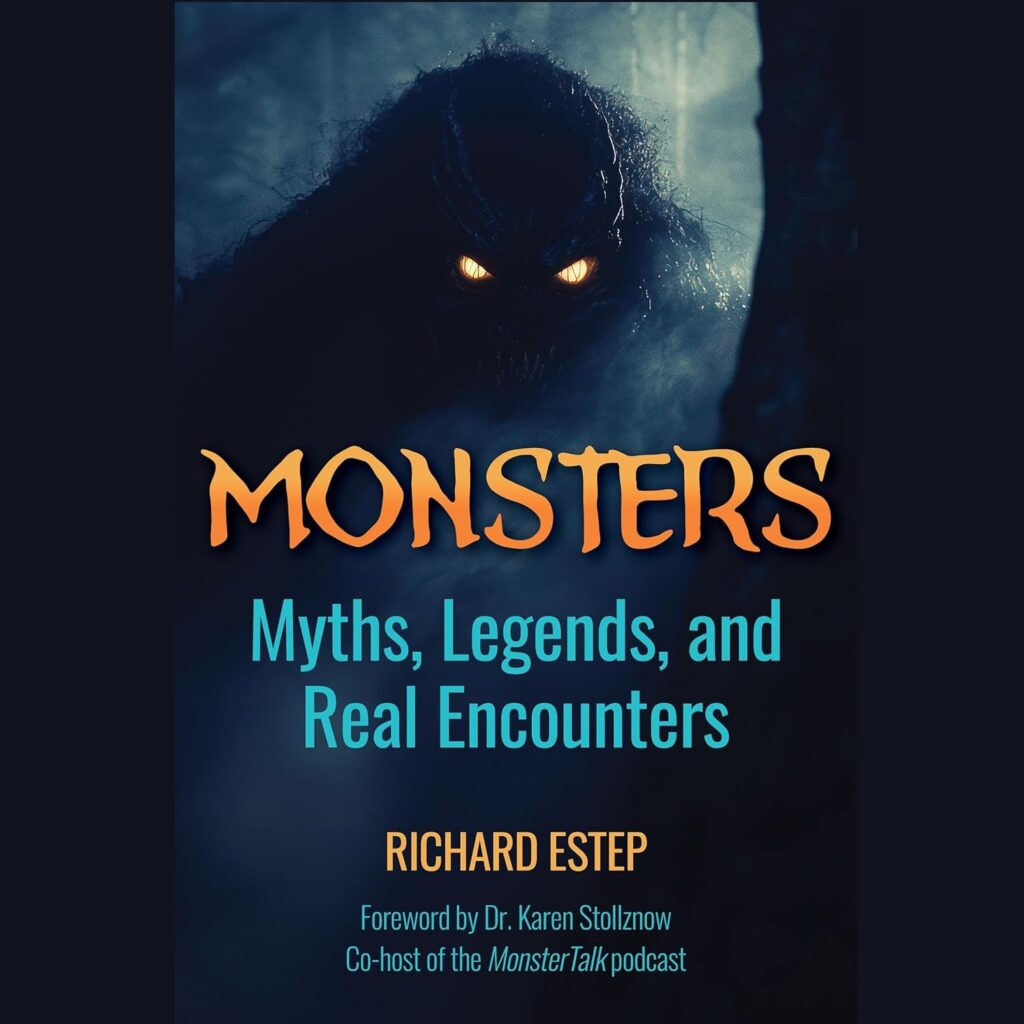
S05E27 – Monsters: Myths, Legends, and Real Encounters with Richard Estep
🎙️ Blake and Karen welcome back author and paranormal investigator Richard Estep to discuss his new book from Visible Ink Press, Monsters: Myths, Legends, and Real Encounters. Richard is a paramedic, clinical educator, and the author of more than 30 books on the paranormal, true crime, and history. Karen wrote the foreword for this one – and donated her fee to Doctors Without Borders. 👏
The book covers a grab bag of monsters – from the classics like Bigfoot and the Loch Ness Monster to lesser-known creatures like the Fresno Nightcrawlers. Richard describes his approach as mixing the tried-and-true big names with some weirder, more obscure entries – and giving each one a critical appraisal.
🦕 Australian Cryptids & the Hawkesbury River Monster
Karen discusses several Australian cryptids featured in the book, including the Yowie and the Bunyip. She was surprised to find a creature she hadn’t heard of – the Moolyewonk (also known as the Hawkesbury River Monster). Karen has crossed the Hawkesbury River many times and never heard of it.
The river is home to real creatures including bull sharks (which can swim in brackish and freshwater), large eels, dolphins, and even platypuses. Karen suspects eels – which can grow up to 8 feet – are likely candidates for sightings. The creature has sometimes been lazily compared to Australia’s Loch Ness Monster, but as Richard notes, unlike Loch Ness, the Hawkesbury River is connected to the ocean – making a very different kind of cryptid claim.
Richard draws parallels between the Moolyewonk and Morgawr, the Cornish sea/river monster spotted in Falmouth Bay, England – two nations on opposite sides of the world with remarkably similar water monster traditions.
Many Hawkesbury River Monster sightings cluster around the 1930s – coinciding with the global explosion of Loch Ness Monster interest, which historians have linked to the cultural impact of the 1933 film King Kong. The famous Surgeon’s Photograph of Nessie – long one of the most iconic images in cryptozoology – was eventually debunked as a toy submarine with a sculpted head and neck.
🦶 Bigfoot: Squatching in Colorado
Richard describes going “squatching” near Bailey, Colorado, visiting the Sasquatch Outpost – a combination store and museum. He went out into the woods with local filmmakers, tried tree-knocking, and even brought some of his ghost-hunting equipment along. Nothing definitive turned up, but he’s intrigued enough to be working on a full In Search of Bigfoot book.
Karen has also visited the Sasquatch Outpost and recalls their token system – visitors place a token in either an “I believe” or “I don’t believe” jar after seeing the exhibits. The “I believe” jar was significantly fuller. Karen’s token went in the skeptic jar. 😏
Richard mentions Belle Grove Plantation in Virginia – birthplace of President James Madison – which reportedly has the trifecta: UFO/UAP reports, Bigfoot sightings (including soldiers on exercises at nearby Fort Barfoot being stalked), and ghost encounters.
Blake mentions Joshua Cutchin, who has appeared on MonsterTalk and coined the term “weird washing” – the idea that a lot of high-strangeness Bigfoot encounters get filtered out of the literature because researchers want Bigfoot to be just an animal. Richard calls Cutchin a contemporary John Keel.
The gang also touches on the Ohio Bigfoot flap in the news, the Georgetown, Colorado train sighting (which turned out to involve a ghillie suit), and the infamous 2008 Bigfoot-in-a-freezer hoax from Georgia.
Blake reminds listeners that if Bigfoot turned out to be a real animal, it wouldn’t just be fun – it would be genuinely important for science, giving us another primate to study. But in an age of AI-generated imagery, even photos and videos are becoming harder to trust. As Richard puts it: “It’s either too good to be true or not good enough to be true.” 📸
🧛 Vampires: Arnold Paole
Karen brings up a favorite case of the show – the Serbian vampire Arnold Paole (circa 1725-1726). Paole was a hajduk (irregular soldier) who claimed he’d been plagued by a vampire while serving in Turkish-controlled territory. He reportedly protected himself by smearing the vampire’s blood on himself and eating soil from its grave. After breaking his neck in a fall, Paole died – and was later blamed for an outbreak of vampirism in his village.
The case is notable because it was documented by a regimental surgeon and investigated by a royal commission – giving it an air of official credibility. But as Blake notes, the physical characteristics described in the exhumation reports – blood-stained lips, blood gushing when staked, apparent hair and nail growth – are entirely consistent with normal taphonomic processes (what really happens to bodies after death). Karen notes that conflicting details about whether Paole served in Greece vs. Turkey are a hallmark of urban legend.
Richard also discusses the disturbing detail that among the “vampires” destroyed in Paole’s case was an 8-day-old infant. 😢
⚰️ Mercy Brown & the New England Vampire Panic
Richard draws a connection to the Mercy Brown case (Exeter, Rhode Island, 1892). Mercy’s family was devastated by tuberculosis (then called “consumption”), and when her body was exhumed six weeks after burial in January, villagers were alarmed to find it hadn’t decomposed. Of course, as Richard points out – she’d been put in the ground in the dead of a New England winter. Essentially a natural refrigerator.
This leads to a broader discussion about how ignorance of posthumous processes fuels supernatural belief – from vampire panics to cattle mutilation claims (ranchers apparently good at keeping cattle alive, less clear on what happens after death) to the chupacabra, which is most often explained as mangy dogs or coyotes.
Richard makes the sharp observation that tuberculosis was actually fairly well understood by the time of the New England vampire panic – yet rural communities still defaulted to supernatural explanations. Sound familiar? 💉
🐺 Werewolves: Bill Ramsey & the Warrens
Blake’s favorite monsters! Richard’s chapter on werewolves covers clinical lycanthropy (a real psychiatric condition), old superstitions (born on Christmas Day, eyebrows that meet in the middle), and even studies showing that emergency departments are not actually busier during full moons – despite what medical professionals believe.
The standout case is Bill Ramsey, dubbed the “Southend Werewolf.” As a boy in 1952, Ramsey claimed a cold gust of wind possessed him with a wolf spirit. He allegedly ripped a fence post from the ground and gnawed on it. Years later, in the 1980s, he attacked people in a police station and had to be restrained by multiple officers.
Ed and Lorraine Warren got involved, diagnosing demonic possession (shocking no one). They arranged for Ramsey to fly to the US for an exorcism in 1989 – with the plane ticket paid for by a British tabloid in exchange for story rights. 💰 Lorraine Warren claimed to have witnessed Ramsey’s face “transfigure” – though no such transformation appears in any video footage. A book deal followed, along with talk show appearances including Sally Jessy Raphael.
Richard, who declares himself “no fan” of the Warrens, sees this as a likely case of someone cashing in on mental health issues and erratic behavior – with the Warrens acting as opportunists. Karen wonders why this case never became a Conjuring movie, speculating it may have been too unbelievable even by those standards. Karen also draws a possible connection to a 1970s Barney Miller episode featuring a man who believed he was a werewolf – which predates Ramsey’s public claims.
🦇 Mothman & Other Investigations
Richard co-wrote a book on Mothman with Tobias Wayland and visited Point Pleasant, West Virginia for research. He has an 8-foot-tall cardboard Mothman staring out of his guest bedroom window. He also traveled to Cornwall, England to research Morgawr.
🔮 What’s Next for Richard
Richard is currently working on:
– In Search of Bigfoot – includes a planned trip to Bradshaw Ranch in Arizona (a reported hotspot for paranormal activity)
– A book on spies and espionage for Visible Ink Press
– A trip to New Orleans to explore vampire culture and subcultures (Blake recommends Cafe Du Monde beignets and taking a guided tour of St. Louis Cemetery No. 1)
– His autobiography is set for release at the beginning of June
🎃 Monster of Choice
When asked which cryptid he’d want to be real, Richard picks Krampus – with the modification that the naughty list should extend to adults, not just children. 😈
📚 Referenced Works & Resources
Richard Estep, Monsters: Myths, Legends, and Real Encounters (Visible Ink Press)
Richard Estep and Tobias Wayland, Mothman: Sightings and Investigations of the Iconic Flying Cryptid
Ed Warren, Lorraine Warren, Robert David Chase, and William Ramsey, Werewolf: A True Story of Demonic Possession (1991)
Horrified board game by Ravensburger (designed by Prospero Hall)
🔗 Related Links
Arnold Paole – Wikipedia
Mercy Brown Vampire Incident – Wikipedia
New England Vampire Panic – Wikipedia
Clinical Lycanthropy – Wikipedia
Ed and Lorraine Warren – Wikipedia
Surgeon’s Photograph (Loch Ness) – Wikipedia
Hawkesbury River – Wikipedia
Morgawr – Wikipedia
Mothman – Wikipedia
Taphonomy – Wikipedia
Krampus – Wikipedia
Patterson-Gimlin Film – Wikipedia
SEO Transcript
This is not a fully accurate transcript, and was machine generated. It’s here for helping search engines find the episode but not intended to be a faithful transcript of the episode. (But it’s not AWFUL.) Some of the material in this transcript only exists in the Patreon/Premium edition of the show and was excised for the commercial version.
———————
Monster House presents…
This is the ad-supported version of Monster Talk.
We’re dependent upon the revenue from these ads and from the support of our patrons at patreon.com forward slash monster talk to continue making this show.
As a disclaimer, your hosts are unable to control what ads you will hear, and while we have done what we can to avoid ads that are divisive, the system that injects them sometimes ignores our preferences and always seems to ignore our efforts to not interrupt the conversational flow.
While we understand this can be disruptive, we’re trying our best.
Patreon remains the best way to enjoy commercial-free listening to our content.
Plus, you generally get extended coverage of the subject.
We’re working on other ways to consume our content as well, so please stay tuned.
It’s actually quite unlike anything we’ve ever seen before.
A giant hairy creature, part ape, part man.
In Loch Ness, a 24 mile long bottomless lake in the highlands of Scotland.
It’s a creature known as the Loch Ness Monster.
Monster Talk.
Welcome to Monster Talk, the science show about monsters.
I’m Blake Smith.
And I’m Karen Stollznow.
This week, we’re welcoming back author, paramedic, and paranormal investigator Richard Estep for what I believe is his fourth visit to the show.
At this point, he should have his own parking spot.
Richard has written more than 30 books, and if you’ve heard our previous conversations, you know he’s a guy who takes the stories seriously without necessarily buying what they’re selling, which is a sensibility we very much appreciate around here.
His latest from Visible Inc. Press is Monsters, Myths, Legends, and Real Encounters, and it’s a departure from his usual ghostly fare.
This one’s all creatures.
Bigfoot, Nessie, vampires, werewolves, chupacabras, and some genuinely obscure ones that I hadn’t encountered before.
And Karen wrote the foreword to this one, which then she donated the fee to Doctors Without Borders because she is a better person than me.
I would have spent that money on perfectly good coffee.
What I appreciate about this book and this conversation is Richard manages to do the thing that’s actually really hard to do.
He tells you the stories, gives you the weird and wonderful details, but then he also tells you why they probably aren’t what believers think they are without making you feel stupid for having enjoyed the ride.
We get into Australian river monsters, Serbian vampires, the Warrens doing their Warren things with a werewolf case, and Richard’s own adventures going squatching in the Colorado woods.
Did he find Bigfoot?
No, but he got his steps in.
Monster Talk.
Yeah, congratulations on the new book.
It is a beauty.
Yeah, now this one is, this was less ghosty.
This one’s more critters, critters oriented.
Yes, zero ghosty, right?
Yeah.
So, I mean, there’s a little bit of demon.
That’s like the pepper and salt for your paranormal book.
You have to have a little, just a little… Garnish.
A little garnish of… Lots of crossover.
A little hint of demon.
That’s a good way to start.
So Richard, after writing about ghosts for so long and poltergeists and demons and even serial killers, and you’ve written history books and a recent memoir as well, and now you’ve turned your attention to monsters and cryptids.
So what inspired you to write this new book?
Well, it was their turn.
But honestly, I’m that kid that grew up with universal monster movies and in the UK hammer horror movies, you know, which just means you have an entirely different looking Dracula who became Saruman a bit further down the line.
So, you know, just the joy I still get from playing those games, running around, destroying Dracula’s coffins, you know, trying to keep Frankenstein’s monster and his bride apart.
As well.
As you do.
Yeah.
And, you know, we all love our monsters, right?
I mean, right now, isn’t there a new, there’s a new Frankenstein’s monster movie out called The Bride.
That’s right.
Not to be confused with the one with Sting, but yeah.
No, no.
This one directed by Maggie Gyllenhaal.
That’s right.
I haven’t seen it, but I hear phenomenal things about it.
Yeah, it looks very Art Deco, which is kind of cool.
Yeah.
Very 1930s.
I love that.
Bonnie and Clyde.
Yeah.
And so I think I’m surprised it took me this long to get around to monsters.
I’ve always been like cryptid adjacent.
I like to tell people that when we talk about high strangeness, when I was growing up and investigating cases in the 90s in the UK, you had your ghost people, as we were called, your UFO people and your monster people, and never the twain shall meet.
And then we started comparing notes right around the time the X-Files came out, and the X-Files started covering all three of those things.
And we realized we had a whole lot more in common than we did separating us.
And we stopped siloing so much.
So I just, someday I always wanted to get around to writing about monsters.
You know, and I’ve been on Monster Talk, of course, which was always fun to do.
And I’ve always been fascinated.
So finally, Visible Inc. said, it’s time you did a monster book.
Fair enough.
Logical next step.
Yeah, we’ve had on Joshua Cutchin.
Love Josh.
And he calls Bigfoot a forest poltergeist, which I think is rock solid, you know.
He’s on my interview list for my next book, actually, which is about Bigfoot.
But his works on the Bigfoot phenomenon, he definitely takes an esoteric, high strangeness view of it.
It’s quite a potpourri of monsters you have here.
So with so many monsters to choose from, how did you whittle down the list for what was going to be in this book?
I’m like the proverbial deranged child in a candy store with a monster book in that I just went on a grab bag of things that fascinated me.
So when I wrote my first book on serial killers, you know, the expectation was you talked about some names that everybody knew.
John Wayne Gacy, you know, Jeffrey Dahmer, Ted Bundy, people like that.
And then I wanted to add in some that were lesser known.
Your indies versus your top 40.
Exactly.
And so I kind of tried to do the same thing with monsters.
Like it’s kind of expected that you’ll talk about, if it’s your first book on monsters, Bigfoot, Loch Ness Monster, you know, those kinds of things, Chupacabra.
But then I wanted to do a few weirder ones like the Fresno Nightcrawlers, which very few people seem to have heard of.
and things like that.
And then all the many things from Karen’s homeland that have fangs and seem to want to kill you, you know.
So I just kind of went off on some weird tangents, and it was just a delight to mix the tried and trusty.
And I wanted to also do a critical appraisal.
Like, for example, Loch Ness Monster.
I grew up as a child of the 70s, watching countless BBC documentaries, seeing all the books, the book by Nicholas Wichel, the surgeon’s photograph.
You know, I can see that in my mind’s eye, the head.
And that’s my imitation of the surgeon’s photograph.
Well done.
Well done.
That’s convincing.
But it was so iconic.
Like almost anybody would know what that photograph was.
And it’s only relatively recently, you know, that we’ve known it was debunked.
And it was, in fact, you know, a toy submarine, I believe, with a sculpted head and neck on it.
I wanted to kind of go back and do a retrospective on stuff like that and look at where those classic cases kind of, do they hold any water?
No pun intended.
Well, if you don’t attend to my will, that’s fair.
Yeah, that’s truth.
So you’ve mentioned Australian cryptids, and I think that’s a good lead-in for me.
So you write about some very famous cases like the yaoi and the bunyip, but then you treat another creature that I haven’t actually heard of before.
And so I guess you’d pronounce it the molywonk, molywonk?
The Muliwonk.
Yeah, probably sounds better if you say it, Karen.
But I had never heard of this creature, even though I know its supposed homeland, which is the Hawkesbury River.
Yeah.
So it’s also known as the Hawkesbury River Monster, and there are a number of other Indigenous names for the creature as well.
So I’ve crossed the Hawkesbury River many times, and I’ve never heard about this creature.
I know that the river has got some really interesting…
real creatures like sharks and dolphins and even platypus.
Wait, wait, wait.
Sharks in a river?
Yes.
Yeah.
It’s probably a bull shark.
It’s needed to be more terrifying.
Bull sharks, yeah.
Yeah, bull sharks can play around in brackish waters.
Yeah, or go up a river.
Apparently they go way up the Mississippi.
So, yeah, yeah.
They also have lots of eels, so I suspect that that’s what people might be seeing.
Some of them grow very large, up to about eight feet, and other kinds of fish as well.
I didn’t think eels had feet.
It started.
But yeah, that was really cool.
Could you tell us about this creature?
Yeah, initially I thought this, because it’s been kind of lazily described as Australia’s Loch Ness Monster, but as you guys are well aware, kind of the Loch Ness Monster story is so problematic in so many ways.
Not least the whole thing about Loch Ness not being connected to the ocean, whereas the Hawkesbury River, you know, is obviously is.
So the fact that there have been sightings of this, you can’t quite call it a river monster or a sea monster because it’s been spotted in both locations fascinated me.
are we talking about a freshwater or a saltwater or some kind of combination creature?
And then looking at the Aboriginal lore and the fact that these sightings go all the way back, I think Karen hits the nail on the head, you know, this was probably a way for Indigenous peoples to describe large, you know, eels or other entirely normal, entirely natural creatures of the river.
But I just kind of loved the idea that that story had…
had survived down through the generations.
And when I was in Cornwall, England, I loved the parallels between the Moo-Yoo-Wonk and Moga, the Cornish river slash sea monster that is seen in Falmouth Bay, which is oceanic, but then also has been seen swimming up river as well.
So I kind of loved the fact that you have these two nations on opposite sides of the world that had very similar stories.
And I wanted to talk about more things that swam than just the Loch Ness Monster.
Yeah, and I’ll add too that it seems like a lot of the sightings are around the 1930s, so really coinciding with stories of the Loch Ness Monster, and I guess it was global at that point, global interest.
Mainly because of cinema, right?
Because… King Kong and…
Yes.
Historians have pointed out, smarter people than me have pointed out that the explosion of Loch Ness Monster stories really does tie in with King Kong hitting movie theatres.
Yeah.
But I want to say too, sorry.
Go ahead.
There are similarities between the Hawkesbury River and Loch Ness.
They both have these internal waves and just, it can be very dangerous.
How big of a river is this?
Like how wide or like if you’ve been there?
just don’t know i mean it’s extremely wide it’s not as deep or as dark or as cold as uh loch ness it really snakes around uh and it covers a large surface area but it’s not as big as loch ness
Well, I was just going to say, you crossed a bridge.
Is that how you’ve encountered it?
Or, like, have you canoed on it?
Oh, no, nothing like that.
But people do.
But, yeah, certainly just going over freeways when you’re going north up to Queensland.
Yeah.
I mean, it’s just north of Sydney.
But it does really snake around.
So it covers a lot of ground.
And not that far from major population centres, if I’m not mistaken.
Right, Karen?
Oh yeah.
Very, very close to, I mean, uh, New South Wales has last time I looked about 8 million people.
Uh, and most of them are in Sydney, maybe about 4 million in Sydney, but certainly millions of people around.
So.
Which kind of always begs the question, no matter which monster you’re talking about, you know, unless you’re looking at something way out in the woods, um,
where is all the good video footage?
You know, where are all the contemporary sightings?
Good question.
Yeah.
So I love the fact that the publisher’s title was Myths, Legends, and Real Encounters.
And a lot of this stuff falls under the auspices of myths and legends.
And, of course, I think, you know, you already have given us a great explanation for Mu Yu Wong sightings.
Well, yeah.
I mean, sightings and real encounters, not necessarily saying it’s true, but certainly it’s sightings.
It’s a real encounter with something, yeah.
Yeah.
Chris, most of us just watch them on video, which is a different kind of reel, R-E-E-L, right?
Oh.
So you actually got to go squatching?
So that’s a little different from a ghost stakeout.
What was your experience like?
Yeah.
So Bailey, Colorado is…
It’s up in Adams County, and it’s pretty rural, but it’s also fairly close to Denver.
It’s close enough you could drive it pretty comfortably in like 30 minutes.
And they have the Sasquatch Outposts out there, which is a combination like store and museum.
And I’d wanted to visit anyway because, you know, it’s one of those things where I’m kind of ashamed it’s been on my doorstep for a quarter century.
And I’ve never been to that part of the country before, really.
And so I went up there and I talked to some local filmmakers and I said, could we go squatching?
You guys do this quite frequently.
And they took me out into the woods.
And it was an experience for sure.
It really was.
So I spent a day at the Sasquatch outpost and then out in the woods looking for and failing to find Sasquatch or Bigfoot.
Did you hear anything unusual?
I mean, the key thing is it’s the woods, right?
It is.
And so you run into this all the time.
I tried the classic, you know, knocking on trees and things of that nature.
Did have some weird things happen with some of the, I took some equipment I used for haunted locations to see if we would get anything with that.
Did have some odd behavior with some of that, but nothing definitive.
It certainly has intrigued me enough, though, that I’m working on a Bigfoot Sasquatch project now and going out to Bailey quite often.
Again, have yet to find anything, but if nothing else, I get my steps in out in the woods.
It is a very wholesome.
Sorry, go ahead, Karen.
Sorry.
I was going to say I’ve been to that museum just a couple of years ago, and it is good fun.
And I think I kind of remember that we talked about this maybe last year, but how they give you a token when you enter.
And then by the time you go and see all of the exhibits, when you’re leaving, they ask you, do you believe in Bigfoot or not?
And you can decide where to put your token.
But there were certainly more tokens in the, I believe.
jar than they were in the i don’t believe and yours went where karen oh you know i don’t believe yeah you’re definitely not a token believer on the show um i thought i’d get that one in before you did blake i look at the uh you’d imagine a room full of skeptics going to see peter pan and you know if you believe wherever you are clap your hands and she’ll hear you clap clap
we don’t believe in the play-ins tragically.
But I do love that they don’t tell you what to believe.
Like they, they, um, they use a lot of, uh, which I’ve made a career out of doing.
I try not to tell people what to believe either.
I’ll tell them what I believe, but I love that they give you the choice.
They’re like, here’s what we’ve got.
Here are some pictures.
Here’s some, you know, what we consider to be evidence.
You decide, which I think is great.
And you can see what everyone else has decided as well.
Um,
So that was a fun adventure and it continues to be interesting.
You know, you mentioned Josh Cutchin, who is on my interview list as I look at the more kind of, um,
an esoteric side of the bigfoot phenomenon and i think it’s fascinating to me how many claims there are of bigfoot encounters in relation to ufo uap activity and haunted locations too i was at bell grove in virginia last year which is the plantation that president james madison was born at
So it’s a historic site, and they have the trifecta.
They have UFO UAP reports there.
They are right on the Rappahannock River, like they’re back onto the river.
They have numerous Bigfoot sightings there.
And what kind of fascinated me was that literally five miles up the road is a massive army base, a training center, Fort Hood.
And there are accounts of soldiers on exercise being stalked by Bigfoot.
But yeah, so that kind of fascinates me too.
And the idea that, you know, these realms might intersect a little bit.
There might be some overlap has fascinated me.
So, Chuck, is he the one who drew parallels between Bigfoot and Christmas trees?
I don’t think so.
He created weird washing.
So the idea that there’s a lot more unusual, ultra-terrestrial type stuff going on with Bigfoot that just doesn’t make it into the literature because when people are compiling the stories, they just want it.
Bigfoot’s an animal.
It’s an animal, which is increasingly becoming a challenge because I think not only…
do you have the question of where’s the body, but also more and more people are seeing pair, you know, portal Bigfoot and that sort of thing.
Yeah.
Yeah.
You got to account for the dimensional Bigfoot.
Exactly.
Kind of like a John Keel.
I think it was kind of a contemporary John Keel.
Yeah.
So whether I agree with him or not, I think he’s got, he’s on rock solid ground as far as categorization.
Yeah.
Yes.
And certainly has bring some interesting perspective to the man.
And the man can eat some pancakes.
That’s all I’m just saying.
Oh, I believe it.
But here’s the question back at you.
Australia again, Karen, right?
You know, talking about the Yowie, Australia is one of those few places on earth where you have still all of this untouched, unspoiled wilderness.
Do you think the potential, if the Bigfoot claims hold any water, do you think that is the kind of location where it’s more likely to be genuine?
You know, because vast tracts of Australia are still untouched by humanity, right?
Well, I think a lot of areas have been crossed and traversed by Indigenous people and then in the past couple of hundred years, explorers.
So I think it’s comparable in many ways to California.
And I’ve been out to Willow Creek, California, many years ago now, the Bigfoot capital of the world, and went to the basic area where the Patterson-Gimlin footage was shot.
But I think that terrain is kind of similar in many ways.
And so I think certainly a lot of it can be remote.
But if we’re talking about really remote areas, we’re talking about more desert, so not Bigfoot.
or county country.
But certainly the areas where people claim that they’ve seen the Yowie, it’s going to be areas like maybe the Blue Mountains.
My grandmother used to live there and there is a lot of lore surrounding the Yowie there and a lot of well-known people who, there’s a guy called Tim the Yowie Man.
I don’t know if you encountered him at all.
No, but the clue to his job is very much evident in his name.
Yeah, yeah.
Says it all.
What do you do, Tim?
Well.
I’m the owie man.
So I just don’t know how much people believe, though.
I think it’s like, you know, we talk about a lot of different monsters and that people in Australia drop bears or here in the US tree alligators.
People don’t really believe in those things, but…
It does attract tourists and it’s just something that people like to joke about.
So the yaoi, I just…
For the same reasons that we don’t have good evidence for Bigfoot.
We don’t have good evidence for the Abominable Snowman.
We don’t have good evidence for the Yowie Sasquatch.
But there are parallels, certainly, to the American versions.
It does appear to be a universal myth.
It does.
But wouldn’t it be cool, though…
If if there was like more physical evidence and and it was it was a marsupial Bigfoot, that would be the best.
Like so it’s not literally a Bigfoot, but it’s, you know, convergent evolution.
Right.
That would be neat.
You know, the platypus, that’s a pretty strange creature.
It is a very strange creature indeed.
So, yeah.
I do feel a lot like I really empathize with the platypus.
Whichever way I turn, there’s an enormous bill in front of me as well.
Oh, yeah.
You must have been listening to our conversation pre-show.
Oh.
Are you guys following?
And I’m sorry, I know it’s your show, but it might be bad form for me to ask you questions.
But are you following the Bigfoot news out of Ohio right now, the equivalent of a flap that’s going on?
As per usual, my neighbor texted me immediately.
He’s like, have you seen this?
Yeah.
So I watched the footage.
Explain this.
Yeah, pretty much.
Yeah.
So I remember.
He also sent me footage when they had the 2008 Bigfoot in a freezer fiasco here in Georgia.
And he was like, you got to turn on CNN.
They’re saying they found Bigfoot.
And I’m like, wait a minute.
Are they saying they found Bigfoot?
Or are they saying someone said they found Bigfoot?
And he was like, hold on a second.
And he came back.
He’s like, oh, well, they’re saying somebody found Bigfoot.
It’s not the same.
It’s not the same.
You may remember there were multiple reports of Bigfoot sightings here in Ohio last week, but what you might not know is that the Buckeye State ranks fourth nationwide for sightings.
I saw a still on Fox News, so I haven’t seen the full footage or whatever, so I don’t even know if it moves, but it looked very much like a…
a Bigfoot shaped silhouette, you know?
So, yeah.
Great.
I mean, we had an incident here in Colorado.
I don’t know if you recall this one, Karen, but it was taken by some tourists on a train.
Oh, maybe it was Georgetown.
I think it was a Georgetown.
Yeah.
Yeah.
That’s right.
I think Matt and Blake, they did a video on that through our YouTube channel.
But, yeah, it was another guy, and it was a, what do you call those, ghillie suit?
A ghillie suit.
Yeah.
And some cool signs.
We kind of want to believe, and that’s the thing.
Sure, yeah.
I mean, it would be fantastic.
But at the end of the day, yeah, you know, once you get into the realm of looking for physical evidence, there just isn’t a bunch there, unfortunately.
Sadly.
Yeah.
I mean, I always want to remind people that it would be really helpful scientifically if it turned out Bigfoot was a real animal.
That’d be really neat.
I mean, not just fun, but like having yet another primate to examine, to understand.
That would be really important for science.
I have to reconcile my- Oh yeah, so when it goes to the idea of that, yeah, just- Yeah, no, not at all.
It’s the evidence.
Yeah, exactly.
Which, but it would be really, it would be not just cool, it would be useful.
So yeah, and we would certainly celebrate it, but until we can get something more tangible than a video.
And of course, in these days-
even videos and photographs are becoming increasingly hard to trust.
So that’s unfortunate.
That’s a whole other issue, isn’t it?
I mean, the fact that, you know, it’s either too good to be true or not good enough to be true.
I mean, if I, with a simple prompt, I can get some amazing Bigfoot footage, you know, and have him talk to me.
So it’s really, you know, what, um, did you, um,
Do any other on-site investigations for this book that you want to talk about?
I mean, I’ve done a section on Mothman, so I did get out to Point Pleasant.
I’d written an entire book about that, co-written with Tobias Weyland.
And so that was a delight to go do.
Mothman remains a perennial fascination for me.
There’s an eight-foot-tall cardboard Mothman.
I was going to say life-size, but…
There’s some problems with that description, right?
There’s an eight foot tall Mothman peering out of the windows of my guest bedroom upstairs, which the delivery folks had not commented upon, strangely.
So Mothman for sure, getting out to Point Pleasant.
And then, yeah, I got to Cornwall in England for Morgar.
The Cornish legends of Morgar just fascinate me as everything about that part of the British Isles does, you know.
But so much of the stuff you’re dealing with anecdotal stories that took place 50 years ago.
So there’s really only so much you can do.
I am excited to be getting to New Orleans next month for the first time ever.
Oh, cool.
I have a hankering to look into vampire culture.
Get to Café du Monde and have some beignets.
You’re like the ninth person to tell me that.
And it probably, yeah, it sounds like very sound advice.
No, no, for really, for real.
You got it.
You got it.
It’s really good.
Seriously, you are.
Talk about diabetes.
Diabetes and coffee.
Their coffee’s rock solid.
They got that community coffee with chicory in it.
It’s good.
It’s good.
I like that stuff.
Yeah.
Me too.
Me too.
Yeah.
I know years ago, Blake, do you remember we went to a conference there and Joe Nickel managed to wrangle his way into the LaLaurie house.
It’s like, how did you do that?
But I think that must have been pre the current owners.
Yeah, probably.
Yeah.
Yeah.
I mean.
I think that I’m just going to New Orleans mainly to experience it.
I have a hankering to write a book.
I’m doing In Search of Bigfoot right now.
As you guys know, I did In Search of Demons.
I’ve made a career out of searching for things I don’t find and writing about them.
And so I really would like, after I wrote a chapter on vampires in this book, to write a full In Search of Vampires where I get to delve into the myths and various subcultures and things like that.
Yeah, that’s the Anne Rice.
I don’t know how it’s going these days, but I remember going in the 90s and it being a big deal, like so many goths, so many goths when she was still alive.
Do you…
honey island the honey island monster the the swamp tours are really fun uh they will uh disavow the existence of the swamp monster but you know it’s still a fun ride i love a good monster story as obviously you do and your listeners so you know sometimes the joy is just in the story itself yeah no you’re always full of stories uh marie laveau and uh what is it um
St. Louis, uh, cemetery number one.
Yeah.
Ride or what do you go take the tour with a tour guide?
Like they’re not joking about how dangerous it is.
Uh, there’s a lot of muggings that go on if you just take a walk.
So yeah.
Yeah.
Oh yeah.
Lots of good things to see and do there.
Um, but I jump around topics a little bit.
So, uh,
mentioning vampires.
So you’ve got a chapter on vampires, Richard, and you reference an early legend of the Serbian vampire, Arnold Paoli, we’ve heard different pronunciations, and that’s a favourite tale of ours on this show.
Could you tell us a little bit about this case?
Yeah, and I was surprised to hear it was one of your favorites.
I just didn’t know you had a favorite vampire case, which I thought was kind of cool.
But he’s essentially this Serbian soldier that, while serving in Greece, has an encounter with a vampire.
Then…
gets concerned about it, so tracks it to its grave and covers himself in its blood, because apparently that protects you from vampirism, goes back home, and then ultimately has an accident, breaks his neck, and rises from the grave and becomes a vampire.
preying on his neighbors, or so the story goes, and is blamed for outbreaks of vampirism.
And what I found fascinating about this story was it comes to us from, I want to say it’s 1725 or then about, and is brought to us by a regimental surgeon.
So a military man who should have some credibility as an eyewitness.
But then you start kind of delving into some of the accounts of vampirism and they get to be quite questionable.
What did you guys conclude about this case?
Well, I think what’s interesting is that you said that he’d spent time in Greece.
And from some of the sources I’ve read, they say Turkey, not Greece.
So I think that’s a hallmark of an urban legend where you’re hearing, oh, he’s from Austria or he’s from… Yeah, you make a great point, Karen.
That’s the kiss of death, right?
It is said.
The minute you have those three words, you’re on colourful but challenging ground.
Well, yeah, and I don’t think I’ve delved into the historical records that much, but it’s a possibility that he did exist.
And all the other vampires pale by comparison.
Yeah.
Oh, I see what you did there.
They don’t belong in the daylight.
So the primary source is this regimental surgeon, which is why it’s kind of interesting, and there was a royal commission to investigate it.
And, you know, so they start exhuming bodies, as of course happened in so many of these cases, and staking them and setting fire to them, and Arnold Piaoli, let’s call him.
So, you know, they make much of the fact that he had red-stained lips, and when they put a stake in his heart, blood gushed from his mouth, you know, go figure.
Oh, and his hair was still growing in his nails.
It’s classic.
If you want to make…
I love this word, euhemerist explanation.
His…
The characteristics they describe are consistent with a sort of posthumous taphonomy.
Like, they…
correlate very closely to what really happens with bodies after death so it’s really cool just to take a quick sidestep you know the mercy brown case from the u.s um which you know we’re looking at about almost not quite but almost two centuries later um and they were surprised that this poor girl who was put in the ground in january in new england you know six weeks later had not decomposed yeah it’s crazy putting someone in the fridge
you know, but, but, you know, one of the things that I found very disturbing about the power lead case in the records, you know, they’re talking about vampirism and destroying these bodies.
One of them was an eight day old child.
I’m trying to picture an eight day vampire.
And how does it ambulate?
I mean, just as a thought exercise, how does it ambulate?
How does it locomote, you know, let alone bite you.
Does it gum you to death?
I mean, how does that work?
Yeah, good point.
Very sad.
So on the one hand, you have a regimental surgeon who should really know what he’s talking about.
And then on the other, you have claims that even for the vampire realm are a little bit outlandish.
So it’s tough to square that circle.
But, you know, it’s the…
Ignorance about death.
It reminds me, weirdly, of all the cattle mutilation stories.
You would think people who run ranches would know what happens posthumously with cattle, and clearly they don’t.
Like, clearly they’re good at keeping cattle alive, but what happens to them posthumously, not well understood.
So not everybody’s trained in this is what happens to a dead cow, right?
And so… A chupacabra is an angel.
Yeah, very much…
Yeah, very much so.
Very much so.
And it’s like, well, oh, no blood.
I’m like, yeah, because it turned into a big pile of goo because that’s what happens when an animal dies, you know.
So it’s like, I cut it and it didn’t bleed.
Yeah, because blood does not stay liquid.
Yeah, yeah.
Anyway.
Specialized knowledge.
Yeah, exactly.
Well, not everybody has the same base understanding, and that’s fine.
And then you inject some superstition, or you inject that desire to believe.
What fascinated me about the Mercy Brown case is that tuberculosis was pretty well understood.
Yeah.
And yet, you know, rather than go for this, you’re looking at kind of fairly rural New England, but even so, you know, there should have been a medical provider that knew what these signs and symptoms portended.
And yet vampire frenzy, you know, and we think we’re so much better than that.
And then I promise not to soapbox, but we look at some of the medical denial that’s happening today.
Yeah, absolutely.
We really have learned nothing as a society.
I mean, the germ theory of medicine.
People think that’s well understood, but then again, people, oh, it’s cold.
You have a cold, right?
That’s what happened.
You get, no, it’s like, no, it’s like there’s bacteria or viruses cause these things.
And it’s like, yet that you cannot get rid of the idea that temperature or all these other folk remedies or folk explanations are at the root cause.
The flu shot gave me the flu.
I mean, yes.
Yeah, exactly.
Exactly.
So my battles, let’s just say, well, okay.
So listeners will know that my favorite monster tends to be, although it changes sometimes, but tends to be werewolves.
And so when I get a new book about monsters, I always go to the werewolf chapter first.
And I destroyed your fun somewhat in this one.
It was a good chapter.
I really enjoyed it.
Although I was really surprised to see the Warrens show up.
So you want to tell us a little bit about the case of Bill Ramsey, the werewolf.
This was really, I really enjoyed this chapter.
So.
So I got to, in my defense, so when I write these kind of books, hopefully this will be your view, but let me know.
I try and provide some equal ground to both sides, no matter how credible I find them to be.
So I talked a lot about the scientific basis for clinical lycanthropy.
I talked about some of the old superstitions about it.
If you’re born on Christmas day, eyebrows that meet in the middle, that kind of thing, you know.
Which I have to shave regularly.
I’m not saying anything.
I’m just, I have to shave regularly.
and others statistically.
And I also even pulled the data from emergency departments.
Studies have been done that prove that as superstitious as people like myself and my fellow medical professionals are when it comes to the full moon, we are not, in fact, any busier in emergency departments and 911 systems during a full moon.
The only people who are are cops because a full moon is a burglar’s moon, you know?
So I kind of had wanted to get that out there and give a scientific basis for it.
But I also want to show both sides of the coin, not least because otherwise the publisher would have to call this no monsters.
So what I found interesting about the Warrens case, number one, I have to declare a bias.
And my bias is that I am no fans of Ed and Lorraine Warren.
No fan of Ed and Lorraine Warren.
That is my personal bias from perspective.
I have strong feelings on that and their work.
What I found interesting was this was just contemporary enough that a lot of the primary sources were still extant.
You know, so you could see some of the video interviews, some of the material, newspaper, archival stuff.
And of course, the human werewolf himself, alleged werewolf, co-wrote a book about it.
And I’ve long believed that when there is money to be made, we should be skeptical of any kind of story like this, you know?
So this is a guy that claims that as a boy, and most of this was written down in the late 80s, but as a boy, a cold gust of wind went through him and suddenly he was possessed by what he would later be told was a demonic wolf spirit, you know?
Shocking that the Warrens would find a demonic spirit of some kind, but there we go.
And so after this, he begins acting like a wolf.
He chases his poor, terrified dog around the house, which makes me dislike him already.
If you’re frightening a dog, you are not my people.
And, you know, acting with increased aggression and then makes newspaper headlines when he goes into a British police station accompanied by a sex worker for reasons I could not quite ascertain.
So it takes this lady of negotiable affection to a police station and proceeds to attack the entire police station and has to be supposedly restrained by like multiple officers, like six or seven police officers at the same time.
So it’s a fascinating case, right?
I think that…
As a clinical professional, when I review it, it makes absolute sense in the context of someone that is suffering a behavioral emergency or delusional behavior.
And then we introduce money to the mix because the Warrens arranged for this guy to be flown to the United States around about 1989 for an exorcism.
right that’s how you do it well and when you follow the money it turns out that who paid for the ticket was one of the big british tabloid newspapers in exchange for the story rights um you have you have lorraine warren on on record on video interview saying that she watched him uh transfigured that she saw his face right not transformed transfigured exactly yeah yeah yeah
So, you know, you look at any of the video clips that are out there of this of this exorcism and there’s no evidence of pointy ears or any kind of change like that, you know.
But, hey, he transfigured into a wolf.
OK, fine.
So I honestly thought the whole thing.
Oh, and then, of course, there was a book deal.
And, of course, obviously never trust someone that is making money writing books about monsters.
But by the same token, I feel like there was so much financial gain from this case.
They did the lecture circuit in the U.S.
They did – I don’t know if you’re old enough, Blake.
I don’t think you’re in the country, Karen, but Sally Jessie Raphael, the talk show.
Oh, I remember.
I remember that show.
Oh, you do?
Okay.
So it goes on talk shows like that to tell his story.
He’s on the circuit.
And so I just find the whole thing extremely questionable.
But it made international headlines.
You know, Wolfman attacks police station.
Pandemonium ensues.
I just want to comment on this.
I don’t know.
Blake, you’re probably familiar with it, Richard.
I’m not sure.
But the Barney Miller.
show the the police sitcom from the 1970s um and there was an episode i was discussing this with matt and he showed me this episode where there was a character who thought he was a werewolf do you remember that like i don’t i wasn’t allowed to watch the show but i was familiar with it yeah
This guy was locked up and suddenly he claims that he’s itching and scratching and there’s a cop there who says, oh, yeah, that’s just how it is around here.
We always feel itchy and makes a joke about it.
But then he just starts to kind of tear his clothes off and howl until the main character comes in and then they end up bringing in some doctors to take him to a mental institution.
It’s a police station, not a horror movie.
Take a good look.
Hair is growing out of his face.
It’s called a beard.
Haven’t you ever seen one before?
He dates all of this.
So this goes back to the 70s.
And now I know that with this, that the Bill Ramsey case, he says that he has that first experience when he’s nine.
but I don’t know if there’s any evidence to support that.
It just seems like he’s using that as a kind of origin story that he comes out in the 80s and is talking about this.
But, oh, yes, this goes back to when I was nine and I had this experience with my parents.
what he was, uh, he bit into the fence and, uh, or tore it out of the ground.
Yeah.
Right.
Right.
He beat down the policeman with a fence post.
That was, uh, very epic, very epic.
So, but, uh, yeah, it just, I wonder if he wasn’t in some way influenced.
by the Barney Miller show.
I don’t know, Stranger Things.
You know, I’d love to, I should look and see, or one of us should look to see if that aired like on the BBC or something in the UK.
That would be a fascinating.
It did air in Australia, so back in the 70s and the 80s.
So it’s very likely that it did.
Why couldn’t this have been the last Conjuring movie?
And that’s exactly what I was thinking.
I was wondering, so he has this book deal.
How come this didn’t turn into a movie?
Why was this one kind of tossed out and all the other ones that would turn into movies?
I’m wondering if this was just too unbelievable.
You know, so again, I don’t ever want to mock the afflicted, so clinical lycanthropy is a condition.
Yeah, absolutely.
You know, I think that even in there, the devil made me do it case, not that I want to go down a Warren’s rabbit hole.
Alcohol and mental illness are really as far as you need to go to explain that particular case away.
But of course, the Warrens injected exorcism and demons, because why not?
And so I feel I’m kind of glad this one is a little bit more obscure that they got a book out of it.
The book is still out there, I guess, but it’s not really considered required reading by most people, even in the cryptozoology field.
I truly think this is a case of somebody that cashed in, probably cashed in on the beliefs that they had and some erratic behavior that resulted.
And the Warrens, I…
Personally, just my opinion, I saw as opportunists that saw something like this and saw that there was money to be made.
I want to say that you squeezing in Warren rabbit hole is worth the price of admission.
Good.
Well done.
So, yeah, no, but I agree.
I mean, the money you cannot when money comes into play, even the mentally ill sometimes realize that maybe there’s something there.
Right.
I mean, you know, everybody’s got bills.
Right.
Yeah.
Especially those dog bill platypuses.
That’s right.
They do.
You’ve spurred me on.
It’s a time to start winding up.
Richard, you’re working on so many things concurrently.
What’s next for you?
As you were nice enough to mention, my autobiography is out at the beginning of June, but that is done and dusted.
I’m just right now looking forward to this coming weekend, spending an evening in a supposedly haunted but definitely historic mansion in Denver.
Nice.
Can you say where?
I can tell you once we go off air.
Okay.
Fair enough.
Yeah.
And so let’s see.
So there’s that.
In terms of book projects, I’m currently working on a book for Visible Inc. about spies and espionage.
Is it regular espionage or ESP-anage?
You know, there is a full book.
I know, for real, for real.
Yeah, absolutely.
No, it’s just regular espionage and spy stories.
I could tell you more, but I’d have to kill you.
That’s how that works.
Please do.
I refuse to read a spy book just because I don’t want to know.
That’s fair.
And then In Search of Bigfoot I’m working on.
So I’m heading out to, are you guys familiar with Bradshaw Ranch?
No.
Oh, that’s one you should definitely look up for a future show.
Bradshaw Ranch, that’s on my very near calendar as well.
Is that in Colorado or somewhere else?
It is not.
It is in Arizona.
Oh, okay.
Gotcha.
That’s a rabbit hole that I apologize in advance for sending you both down, but you should definitely review that.
I’m always interested in hotspots, whatever they are.
That’s always interesting to me.
Check out Bradshaw ranch for some more information.
Cool.
Okay.
Well, okay.
So we’ve, we’ve had you on several times and we appreciate it.
All the visits.
And I, I really, I love your work and I love the fact that you do.
I think you do very well.
The balancing act of, uh,
Embracing the possibility of the weird and the unusual, but also acknowledging that sometimes there’s not enough there to accept it as actual literal fact.
So that we know very well what a tight wear that is.
Thank you.
I appreciate that.
It’s a challenge, right?
It is because at the end of the day, you do want people to read your books, to see your work.
But by the same token, there’s that moral obligation to say, you know, I don’t think there is anything necessarily to this.
But hopefully we can have a fun journey along the way.
Absolutely.
I mean, searching for monsters and…
exploring the concept of monster is, is such a human thing.
Every culture has monsters and, and, and you know, yeah, we’re skeptical about their literal existence, but we will not deny their importance culturally, you know, at all, at all, ever.
And we, we, we, we love monsters, right?
But so our question for you this week is if.
you had to pick a crypto that you could make real, like, or that would turn out to be real.
What would you want to be?
Not what do you think is real?
What would you want to be real?
Which I think, by the way, no one’s ever asked me that.
And I think it’s a better question.
So I appreciate that, Karen.
This is an easy one for me, actually.
I did in my capacity as a clinical educator, I did a medical lecture last Christmas and it was holiday monster themed medical scenarios, you know.
So, for example, I did Ebenezer Scrooge and the ghost that he saw were a function of carbon monoxide poisoning.
You know, things of that nature.
So I took a Dickensian twist to it, added some Dickensian stories to my medical classes.
And then, of course, the one that I gave my students to begin with was a child that was snatched from its bedroom window on the evening of December the 5th and turned up the following day beaten.
Oh, I see where you’re going with this.
Yeah, I know.
Krampus.
Krampus.
It’s a terrifying story.
But what I would like to see is a slight change to the rules.
So Krampus, of course, is the dark side of St. Nick.
The naughty kids get Krampus.
The good kids get Father Christmas.
I would like to see Krampus and his naughty list extend to adults as well as children.
Nice.
Very cool.
Blake will be whisked away.
Oh, no.
I like that you said whisks.
Yeah, you’re on that list.
You and I both probably.
We’ll meet up in Krampus’ lair.
I’ve been beaten with sticks plenty of times growing up in the South.
Don’t you worry.
Don’t you worry.
But this one will be free, so there’s that.
I just haven’t been drug around in a sack over the shoulder of a monster.
Well, do you know, the way this year’s going, blink and it’ll be December.
It will.
It will.
Well, Richard, we can highly recommend your book.
I’m looking forward to this book, too, by the way.
What’s that?
Oh, yeah, yeah.
You can read the foreword, too.
That’s by a very notable celebrity.
No, I was very, very honoured to be asked to write the foreword for the book, and it was cool to get a sneak peek.
Karen insisted on donating her fee for the foreword to Doctors Without Borders.
Oh, that’s nice.
Yeah, which I thought was immensely classy and a great call.
Oh, thank you so much.
Thank you for offering that.
And yeah, they’re working very hard to deliver vaccinations, which are incredibly important to people who can’t access them around the world.
And yeah, so that was my… Like people in America, right?
Make America healthy again.
Thank you.
This is a lovely book.
I love the illustrations, love the layout, love the content.
Well done.
Well done, Richard.
Thank you.
Thank you so much.
Thank you very much.
Thank you for coming on the show again.
Monster Talk.
You’ve been listening to Monster Talk, the science show about monsters.
I’m Blake Smith.
And I’m Karen Stollznow.
You just heard a conversation with author Richard Estep about his new book, Monsters, Myths, Legends, and Real Encounters from Visible Inc. Press.
Links to the book and a whole pile of Wikipedia rabbit holes are in the show notes.
I particularly recommend the Arnold Pales story if you want to ruin your evening with vampires.
I mean, I love vampires.
My wife’s the one who hates vampires.
Yes, because she’s vampire racist.
I think we’ve established that.
Richard’s currently working on an In Search of Bigfoot book, a book on spies and espionage, and he’s also heading to New Orleans to explore vampire culture.
So if you’re in New Orleans and see a British paramedic eating beignets at Cafe Du Monde and scribbling notes about the undead, that’s just Richard.
Leave him alone.
He’s working over there.
We hope you’ve enjoyed this episode of Monster Talk.
Each episode, we strive to bring you the very best in monster-related content with a focus on bringing scientific skepticism into the conversation.
If you enjoy Monster Talk, we now have a variety of ways to support the show, all with convenient links at monstertalk.org forward slash support.
That’s monstertalk.org forward slash support.
We have links there to our Patreon page as well as a donation button.
Another great way to support the show is to buy books from our Amazon Monster Talk wishlist, which directly helps us with our research.
We love used books very much, so don’t feel compelled to buy new ones.
And we love Kindle so we can share our digital libraries with each other.
And finally, without spending any money at all, you can support us by leaving a positive review at iTunes or wherever you get your podcasts.
Positive reviews help keep us visible in iTunes, which is a great way to help us find new listeners.
And please share our show on your favorite social media platforms.
Monster Talks theme music is by Peach Stealing Monkeys.
Thanks once again for putting us in your ear holes.
This has been a Monster House presentation.