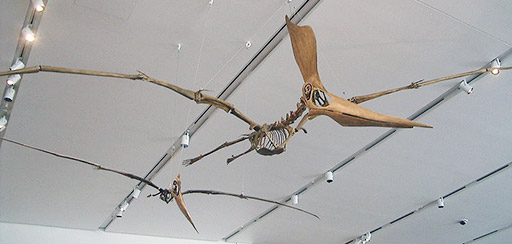
S01E005 – Dr. Dave Martill & Pterosaurs
🎙️ Blake Smith, Karen Stollznow and Ben Radford are joined by Dr. Dave Martill, reader in paleobiology at the University of Portsmouth, to discuss one of evolution’s most spectacular experiments in flight: the pterosaurs. The occasion is the MonsterQuest episode on the Ropen — a cryptid from Papua New Guinea described by proponents as a bioluminescent, still-living pterosaur — which brought Dr. Martill to PNG as the resident skeptical expert. What follows is one of the show’s most information-dense early conversations: part paleontology primer, part cryptid debunking, with a generous helping of geological deep time thrown in.
🦴 Pterosaurs 101: Not Dinosaurs, But Close
Dr. Martill clears up a persistent misconception: pterosaurs are emphatically not dinosaurs. Most current phylogenetic analysis places them as the sister group to dinosaurs within Ornithodira — a clade that sits inside the broader archosaur family tree alongside crocodilians. One distinguishing skeletal feature: in dinosaurs, sacral vertebrae are fused from early in evolution; in pterosaurs this fusion appears only later and is likely a convergence rather than a shared character. The smoking gun — the common ancestor that would clinch the relationship — remains missing, probably buried somewhere in Middle Triassic strata nobody has cracked open yet.
The group divides broadly into two camps: the long-tailed rhamphorhynchoids (sometimes sporting a diamond-shaped tail vane) and the short-tailed pterodactyloids. The last 20–30 years have produced more new pterosaur genera than the previous two centuries combined, revealing extraordinary diversity — especially in the elaborate head crests of pterodactyloids, which Dr. Martill suspects were primarily driven by sexual selection, much as ornate plumage is in modern birds.
🪶 The Fuzz Question: Were Pterosaurs Fuzzy?
Blake raises a then-recent New Scientist article about fossils from the Yixian Formation of China showing pterosaurs covered in downy fiber, implying we’d need to rethink all our pterosaur imagery. Dr. Martill is amused: the spectacular preservation quality is real, but the headline claim is not new. Fuzzy pterosaurs had already been documented from Solnhofen Limestone specimens described in the 1800s by researchers including Georg August Goldfuss. The covering isn’t hair (as in mammals) or feathers (as in birds) — it’s something unique to pterosaurs, best called “fuzz.” Its likely function: insulation for small-bodied animals that were probably endothermic and needed to conserve heat, though the large vascularized wing membranes would have made heat retention a complicated balancing act.
🥚 Eggs, Teeth, and What They Actually Ate
Only three pterosaur eggs have ever been found — two from China, one from Argentina — making pterosaur reproduction among the most poorly understood aspects of their biology. Crucially, the embryos inside are fully ossified with adult proportions, leading Dave Unwin to speculate that pterosaur hatchlings may have been capable of flight very shortly after hatching: an extreme form of precociality quite unlike any living bird.
Diet is similarly murky. Most inferences come from jaw and tooth morphology, and fish-eating (piscivory) is the default assumption. Tooth diversity, however, is remarkable: Pterodaustro, a filter-feeder with an upturned beak, may have had more teeth than any other tetrapod — hundreds of needle-fine structures. Other species sport heterodont dentitions, elongate fang-like fishing-net arrangements, or short triangular teeth that may have cracked mollusk shells. At least one specimen has now yielded gastroliths — small stones possibly used to grind hard-shelled crustaceans — though Dr. Martill notes that loading yourself with ballast is a poor strategy if you need to fly.
📏 Going Big: Quetzalcoatlus and the Giant Azhdarchids
Pterosaurs hold the record for largest flying animals in Earth’s history. Quetzalcoatlus, discovered in Big Bend, Texas, made headlines in the 1970s with speculative wingspans of 14–15 meters; current consensus puts it closer to 9 meters. A related form, Hatzegopteryx from Romania, may have been marginally larger. Both belong to the Azhdarchidae, characterized by enormously elongate neck vertebrae and found at end-Cretaceous sites from Texas to Jordan to Spain. Dr. Martill credits bone’s remarkable versatility — simultaneously light and strong, remodeling continuously without any need for the animal to “take a day off” — as the key to achieving such proportions.
British comparative anatomist Richard Owen (who also coined the word “dinosaur” around 1842) was already calculating pterosaur wingspans of six meters or more from fragmentary 19th-century specimens, before Pteranodon had even been described from North America in the 1870s.
On the ground, fossil trackways settle an old debate decisively: pterosaurs were quadrupedal, not bipedal. Their handprints are highly distinctive — three fingers folded sideways as the main flight finger folds back — and occur paired with equally distinctive five-toed footprints, leaving no ambiguity about trackmaker identity. Kevin Padian‘s once-popular bipedal hypothesis does not survive the trackway evidence.
🌿 The Ropen: Lights, Creationists, and PNG
Dr. Martill accompanied MonsterQuest to Papua New Guinea to investigate the Ropen — a creature described by local witnesses and championed by some Young Earth creationists as evidence that pterosaurs and humans co-existed within the last 10,000 years. He went in fully expecting to find nothing, told the producer exactly that, and was not surprised by the outcome.
The key “evidence” — lights emerging from a mountainside, traveling a fixed path, then returning in the morning — correlated neatly with commercial airline routes (Sydney to Tokyo and back). Witnesses were unaware that planes fly at night, a gap in knowledge that Dr. Martill found telling. A 2006 video cited on the program as possible Ropen footage showed unidentified lights; the physicist who pronounced it consistent with a Ropen offered no substantive evidence beyond the absence of an immediate alternative explanation.
On the bioluminescence claim specifically, Dr. Martill is characteristically blunt: bioluminescence in terrestrial vertebrates is essentially unknown (a claimed frog example remains unsubstantiated), and an airborne animal that glows would be advertising its location to every predator in the vicinity — an excellent strategy for rapid extinction. No known pterosaur lineage survived past the K-Pg boundary ~65 million years ago; the last confirmed specimens come from the Javelina Formation at Big Bend, just below the K-Pg boundary.
As for the creationist claim that discovering a living pterosaur would falsify evolution: Dr. Martill is dismissive. Living fossils — coelacanths, gar pike, Wollemi pines — are a normal feature of evolutionary history. A surviving pterosaur would be thrilling and scientifically illuminating; it would not disturb a single foundational principle of paleontology or evolutionary biology. What would be disturbing, he notes (paraphrasing a sentiment often attributed to J.B.S. Haldane), is finding a rabbit in the Ordovician.
📚 Further Reading
– 📚 The Crato Fossil Beds of Brazil: Window into an Ancient World 💵 edited by David Martill, Günter Bechly, and Robert Loveridge
– 📚 Pterosaurs: Natural History, Evolution, Anatomy 💵 by Mark Witton
– 📚 The Pterosaurs: From Deep Time 💵 by David Unwin
🔗 Related Links
– Pterosaur – Wikipedia overview
– Ropen – Smithsonian
– Quetzalcoatlus – Wikipedia
– Azhdarchidae – Wikipedia
– Pterodaustro – Wikipedia
– Cretaceous–Paleogene extinction event – Wikipedia
– Yixian Formation – Wikipedia
– Solnhofen Limestone – Wikipedia
– FreakyLinks (TV series) – Wikipedia (source of the “Civil War Thunderbird” photograph)
Note: ads inserted into the distributed audio alter the timestamps in unpredictable ways, so timing references in these notes are approximate.
SEO Transcript
This is not a fully accurate transcript, and was machine generated. It’s here for helping search engines find the episode but not intended to be a faithful transcript of the episode. (But it’s not AWFUL.) Some of the material in this transcript only exists in the Patreon/Premium edition of the show and was excised for the commercial version.
———————
Okay, so we’re going to talk about pterosaurs.
Our guest today is going to be Dr. David Martell.
He did an episode of MonsterQuest talking about an animal called the ropin, which is ostensibly a glow-in-the-dark pterosaur.
That sounds very dismissive, Blake.
You know what?
I do feel a little bit dismissive of this because it seems to be out of sync with what science tells us about these animals.
But I’m sure Dr. Martell will tell us more about that.
It’s actually quite unlike anything we’ve ever seen before.
A giant hairy creature.
Part ape, part man.
In Loch Ness, a 24 mile long bottomless lake in the highlands of Scotland.
It’s a creature known as the Loch Ness Monster.
Welcome to Monster Talk, the skeptical podcast about monsters.
I’m Blake Smith, and together with Ben Radford, managing editor of Skeptical Inquirer, and Dr. Karen Stolzno, linguist, skeptical investigator, blogger, and now skeptic, we examine stories about monsters and try to find out what science can tell us about the plausibility of such tales.
Today’s pre-show chat is a little shorter than usual.
Dr. Martell’s interview covers a lot of material and I wanted to leave in as much as possible.
On the episode of MonsterQuest dealing with the legendary Ropen, I saw yet another case where creationists were fervently searching for a cryptid in the belief that finding it would help falsify the theory of evolution.
We’ll talk with Dr. Martell about that, but this strange and I believe misguided quest by creationists to find these mystery animals keeps coming up again and again.
Hopefully today’s show will give you a much more detailed understanding of pterosaurs and the legendary ropin.
This animal, this roping animal, seems a lot like the American Thunderbird sightings in that there’s a few little videos, but in general, there’s not a lot to back it up except stories.
Some of the problems we have with this, as skeptics, I think, are that anecdotes are not really evidence, no matter how many of them there are.
Yeah, as you said, there are large animal bird sightings all over the place.
We have the thunderbirds, you’ve got the ropin, you’ve got the rock, the ROC in some traditions, and the Native Americans.
There’s no shortage of people where they’re seeing either mythical or quasi-mythical things in the sky.
In this particular case, I think with the ropin, it’s obviously not a bird because it has leathery wings.
And a tail and things like that is sort of a featherless tail.
So it’s a little more interesting than just sort of someone seeing a giant buzzard in Texas or something.
But as you pointed out, the bioluminescence is just – it’s hard to reconcile with anything.
Yeah, it’s a bit odd.
But you know, you reminded me of something there that is something we probably need to look into in a future episode.
I don’t think we can properly address it today.
But that is the relationship between native folklore and cryptozoology.
It seems to me that stories that might be legendary or mythic are being repurposed as evidence for cryptids.
For example, stories about giant apes in North America, stories about the thunderbird.
And here, this story about the ropin, this seems to be a folkloric animal in New Guinea, but it’s being treated by cryptozoology aficionados as a real animal.
And they’re using these – oh, and the same thing with lake monsters as well.
In fact, I’m not certain I can think of – well, I don’t think I can think of any of them that don’t have some – except for maybe the chupacabra.
Sure.
We haven’t had a folklore of that before 1995 that I’m aware of.
I would think they’d likely be the source for all of the cryptozoological sightings.
That’s how they would begin.
Yeah, you’re right.
They could become primed by the, oh, did you hear about the wild men of the woods?
Oh, he’s out there.
And then they go find one.
In the case of the Yowie, do you know if there is a pre-existing Aborigine tradition?
I don’t know of one in particular.
I mean, there are a lot of Aboriginal Dreamtime stories and many, many creatures, mythological creatures.
So I would say likely there would be some sort of similar creature in folklore and oral history.
Like with drop bears?
Yeah.
Vicious.
Bears, yeah, they’re koalas.
What?
They look like koalas, but with teeth.
Vampire teeth.
They’re so cute.
Yeah, until they land on you and sever your arteries.
Yeah.
They’re about nine feet tall as well.
Oh, wow.
I did not know that.
So I don’t know how you’d miss them in the trees.
Like tree alligators, it’s a…
Oh, that is also a big problem, yeah, for the alligators.
Yeah, we have those here.
Yeah.
Well, in Florida.
So, myth and or joke.
Monster Talk.
Would you like to introduce yourself and talk about your career and where you’re at?
Yeah, sure.
I’ll tell you now.
My name is Dave Martell.
I’m a reader in paleobiology at the University of Portsmouth on the south coast of England.
I work in a geology department with a whole bunch of people that mess around with volcanoes and earthquakes.
And also I’ve got a team of paleobiologists who work on dinosaurs, pterosaurs, and also on the stratigraphy of oil-bearing basins in North Africa.
So I’ve got a whole bunch of colleagues with lots and lots of different skills.
And one of the specializations that we have here at Portsmouth is on pterosaurs.
We’ve been doing a lot of work, particularly on the gigantic pterosaurs that were flying around during the Cretaceous period between around about 120 and 65 million years ago.
Neat.
One of my later questions I want to talk about is the size of those, so don’t let me forget that.
Okay, no, we can talk about that.
One or two other things.
We’ve also been working on dinosaurs down here and also on plesiosaurs.
and that’s bringing us into contact with a lot of the big marine reptiles and talks of things like Loch Ness monsters and what they might be if they exist at all.
We also have a big fieldwork program, and every year we go out to places like Brazil, to Africa, searching for fossil remains, and we’ve got a very active lab here and have had a lot of experience describing new species of dinosaurs.
Cool.
Well, that’s a good lead-in to that question.
Pterosaurs are not dinosaurs, but I assume they share some common ancestry?
Yeah, they do, in fact.
Although they’re not dinosaurs, most recent analysis seems to show…
that they’re, if you like, the sister group to dinosaurs.
There’s a kind of a group that fits in there with all the other archosaurs, like the crocodiles and things like that.
It’s called the Ornithodira.
And this is dinosaurs and pterosaurs together.
So there seems to be this close relationship.
But the problem is that…
If you were trying to find the ancestor of dinosaurs and pterosaurs, the common ancestor, the fossil just isn’t there.
It’s hiding somewhere in the Triassic, probably in the middle Triassic, and nobody has found it yet.
So although we think that there’s a relationship between pterosaurs and dinosaurs, it’s not absolutely proven.
There’s still a little bit to play for, but most of the evidence seems to indicate that they are close.
And why are they not dinosaurs?
Ah, right.
Well, there’s lots of reasons.
But it’s really to do with some of the shared characters that dinosaurs have.
There’s several things that make dinosaurs dinosaurs and exclude them from being pterosaurs.
One of the criteria is if you look at the skeleton, particularly if you look at the backbone in the region of the hips, in dinosaurs, all dinosaurs, there’s some of those vertebrae in the sacral region are fused together.
But this only happens later on in pterosaur evolution.
And so we think that the fused vertebrae in the sacrum of pterosaurs is actually a convergence with dinosaurs and not a shared character.
The early pterosaurs don’t seem to have that.
But like I say, there’s a lot to play for, and really we still need those sort of intermediary fossils that we would expect to find somewhere at the…
in the middle of the Triassic period, and we just haven’t found those fossils yet, the ones that are going to give us the real clues to what the relationship is between dinosaurs and pterosaurs.
There seems to be a lot of diversity in the morphology of the pterosaurs, including vast size differences, amazing crests, varying wing configurations.
Can you talk about some of the common and uncommon features of these animals that makes them so distinctive?
Yeah, good question there.
Pterosaurs really are very, very distinctive animals anyway.
I mean, they’re completely unlike birds.
They’re unlike bats and unlike any groups of dinosaurs, of course, that don’t fly.
Now, until fairly recently, pterosaurs were thought of to be rather conservative.
We always recognized from a very early stage that there were broadly two groups of pterosaurs, one group characterized by having…
very long tails, sometimes with a sort of a little fan or a little blade-like structure, a diamond-shaped blade-like structure at the end of the tail, and having a skull which has got some characteristics that it shares in common with some basic groups of reptiles, which we call diapsids.
Now, these pterosaurs have been known for 200 years or more.
Very distinctive, these long-tailed.
But the other group of pterosaurs, the so-called pterodactyloids, they have a short tail, and there are some modifications of their skull that make them very, very different from these long-tailed forms.
But until fairly recently, both groups were considered to be fairly conservative.
And although there were some forms with long head crests, most famous, of course, being Pteranodon from the Chalks of Kansas, and some forms were known to lack teeth in the jaws.
In the last 20 or 30 years, there have been more discoveries of pterosaurs, or genera of pterosaurs, than there were in the 200 years before then.
And what we’ve realized now is that this group of short-tailed pterosaurs, the so-called pterodactyloids, there’s much more diversity than we hitherto believe.
And this diversity is reflected mostly in the elaborate nature of head crests.
And we presume that this is related to…
sexual attraction.
Just as you get these ornate head crests and these beautiful tails of some species of birds, we believe that the head crests of pterosaurs, the great diversity that we see in form of pterosaur head crests, is related to sexual attraction.
I’m going to use that as a point to go ahead and ask that question I sent you an email about, the recent finding of downy fibers on some of the more detailed fossils.
Oh, yeah, yeah, yeah, yeah.
I’m having some trouble saying this.
The article implied that we would have to go back and revisit all of our imagery of pterosaurs.
But when I went back and looked at some of the previous findings, I found that there were already –
many depictions of pterosaurs as being somewhat… Yeah, that article made me laugh.
I mean, it was reported in a top journal.
Don’t let me sort of knock it too much, but it didn’t tell us anything that we didn’t already know.
The Yixiang deposits of China are fantastic.
I mean, they are…
yielding new pterosaurs with lots and lots of new information.
And the preservation, the quality of preservation is absolutely superb.
There’s no doubt about it.
But we already knew that pterosaurs were furry.
And although the specimens are spectacular, they’re actually not telling us really anything that we didn’t already know.
And in fact, pterosaurs with fur have been known…
from German deposits for getting on for 200 years.
Some of the earliest specimens described by people like Meyer, and particularly a guy called Goldfuss, had described feather-like structures.
I’m not calling them feathers.
I’m definitely not calling them feathers.
But feather-like structures and fur structures on the body and on the neck of pterosaurs.
These were specimens discovered in the 1800s from the Jurassic Solnhofen limestone.
And there have been subsequent discoveries.
These specimens have never been quite as extensively preserved as the specimens from Yixiang.
The Yixiang specimens really are spectacular.
But in fact, there’s nothing new in that paper.
So there’s a little bit of hype going on there, I believe.
Do you think the fur, I don’t even know if that’s the right word for it, fuzz.
Yeah, fuzz is a good word because it’s not hair in the sense of mammals.
It’s not feathers in the sense of birds.
It’s something that pterosaurs had and no other reptiles had.
So, yeah, let’s call it fuzz.
Let’s call it fuzz.
Do you think the fuzz is, well, does it tell us anything about whether they were endothermic, exothermic, or what do we think?
Yeah.
I think that it probably tells us that they were endotherms and that when they had small bodies that they had a problem about losing heat.
On the other hand, pterosaurs have got these big wing membranes which had a blood supply and so they also lost a lot of heat from there.
I think the consensus is that when they were small-bodied, they really did have to conserve any heat that they generated and this fur acted as an insulation layer.
But then there’s the likelihood that they’re going to lose an awful lot of heat through those wings.
So it’s not a cut and dry as to quite what the function of the fur was.
Well, speaking of that, some modern writers try to link modern-day giant bird or monster sightings to pterosaurs.
And I’m wondering if, you know, on the off chance that there was some extant population of them, other than the fact that they died out 65 million years ago, that minor point aside, what would be the climate?
Where would we go to find them?
Okay, well, apart from you say it’s a minor point, I think it’s actually a fairly major stumbling block over trying to discover extant pterosaurs.
But let’s assume that just a few did get through and that they made it
all the way through the Cenozoic, right up to the present day, where would we go to look for them?
Well, I think we’d have to go for somewhere that had been largely unexplored, where they could exist without mankind having come across them.
Because as volant animals, when they’re disturbed, anything that is volant has an ability to escape using flight.
It takes to the air, and in the air, you are visible.
And that is when a bird takes fright, a bird goes up into the air, and you see it.
You see it flying away.
And if pterosaurs were still around, hey, if you disturbed them, they would take flight, and you would see them flying away.
So if they were going to be around, they’re going to be somewhere where nobody’s ever been, nobody’s taken a camera, nobody’s ever managed to capture an image.
And there aren’t terribly many places left on the planet where that’s the case.
So you’d have to be going to the middle of the jungles of Brazil, the middle of the jungle of the Congo, or, dare I say, maybe even some remote place like the mountains regions of Papua New Guinea.
But, hey, even these unexplored regions have still had an awful lot of people going there.
And when scientists do go to these areas and they come back with newly discovered animals,
These new animals always fit into the broad groups of animals that we already know about.
So although people are going off to Borneo and Papua New Guinea and discovering new species, what they’re discovering are new species of animals that we already know about, like new species of deer, new species of lizards, new species of turtles.
What they’re not finding are new species of dinosaurs, new species of pterosaurs.
That’s just not on the cards.
Right.
Or you can go back to Conan Doyle’s Lost World in South America.
Yeah, let’s all go back there.
There’s a wonderful place.
I mean, there really is a lost world in South America.
There’s a place called the Chapada do Aripi in the northeast of Brazil.
And it’s one of these plateaus.
It’s made of sandstone at the top.
It’s got these beautiful, big, steep, precipitous pink cliffs.
It’s got a flat top.
It’s got jungle on the top.
And it’s got these flanks that you go up to the side.
And you know you find pterosaurs there and you find dinosaurs.
But in fact, you find them in the Cretaceous strata at the bottom.
as fossils, and it looks like an Arthur Conan Doyle-type lost world, but all of the dinosaurs there are all fossil remains, and there’s none of them alive.
This is sad, really.
Did you see a house with a bunch of balloons on top?
Several, several of them.
I think we were wanting to learn some of the characteristics of pterosaurs, so could you give us a bit of information about these characteristics, like where did they nest, and how did they move on the ground, what did they eat?
Yeah, actually, it’s great.
You were asking some of the questions that we’re still asking and are struggling to find the answers for.
Did you know that there’s only three pterosaur eggs ever been found?
Only three.
And yet we’re finding pterosaur fossils all over the world.
We haven’t found a pterosaur nest yet.
We’ve found dinosaur nests.
In fact, we’ve found thousands of dinosaur nests, and often with lots and lots of eggs in and even with babies inside.
But so far, just three…
Eggs from pterosaurs, two from China and one from Argentina.
These are accidental discoveries where an egg somehow has managed to drift out into a lake.
And we know that they’re pterosaur eggs because they actually have baby pterosaurs inside.
They’ve got these embryos.
And the embryos are, in fact…
Fully ossified, they’ve got complete skeletons with all of the proportions of the flying adults.
So Dave Unwin, who’s an expert on pterosaurs, has speculated that pterosaurs could fly very, very soon after hatching.
And if that’s the case, it means they have a very, very different growth strategy to birds.
Birds put on all of their growth…
in the nest.
They do not take to the air until they’re virtually fully grown, certainly around about 80% of total size is achieved before they take to the air.
Although some bird species are precocial, and the chicks will run around and go hunting for their own food after just a few hours of hatching, or even minutes after hatching from the eggs, it looks as though pterosaurs may have been extremely precocial.
and were often independent almost as soon as they’d hatched.
Now, the proof isn’t there yet.
This is just based on three little bits of evidence, three isolated pterosaur eggs, and, of course, the ecology of other pterosaurs may be different from that.
Wow, that’s interesting.
Yeah, I’ll tell you something else that’s also frustrating us, and that is that we’ve got hardly any data on what pterosaurs could eat, and mostly our knowledge of what pterosaurs could eat is actually based on looking at the morphology of the jaws…
morphology of the teeth when they have them and try to extrapolate sort of linking form and function, if you like, to see if we can guess what they could eat from the morphology of the jaws.
And nearly always it comes down to some sort of piscivory eating fish.
And there probably are much more diverse ecologies than that.
There are a few wide-mouthed forms which have filaments.
adjacent to their jaws, which might suggest that they were insect eaters, for example.
But there are very, very few specimens, despite all of the specimens from China and from the Sonhofen in Germany, that are complete specimens.
There’s hardly any which have got stomach contents.
There’s one or two with a few little bits of fish remains.
But the data set is very small.
So, to be honest, we don’t know much about the biology and the ecology of pterosaurs.
Did they use gastroliths?
That’s a very good question.
And if you’d have asked that about a year or so ago, you would have said no, nobody’s ever found.
But just recently, somebody has found some gastroliths, a very small gravelly material in the stomach of a pterosaur, suggesting, in fact, that they were using it to possibly grind down hard chitinous skeletons of small shrimps and animals like that.
So, yes, there now is at least one pterosaur known that has had gastroliths in the stomach.
But, hey, you don’t want too many gastroliths if you’re flying.
It’s best to keep them to a minimum because of the weight.
So they have their beaks or their jaws.
They have some teeth.
And do those teeth look like they are grinding teeth, cutting teeth?
No, the teeth of the one with the gas glyphs are actually extremely fine needle-like teeth from a filter-feeding pterosaur, one that’s been predicted to filter out tiny little shrimps, brine shrimps and things like that.
The tooth morphology of pterosaurs is actually quite variable.
You see some of the longest and thinnest teeth.
And I think…
The pterosaurs that belong to a group called the Tenocasmatids, and particularly famous is one with an upturned beak called Pterodaustro, probably has more teeth than any other tetrapod animal.
It really has got hundreds of things.
But they’re all as fine as a needle.
Very, very fine teeth indeed.
But the diversity of pterosaur teeth is quite high.
There are lots of pterosaurs with no teeth, but then there are those with teeth, and some of them have got very variable teeth.
Some of the early pterosaurs…
have got heterodont dentitions.
That is to say that the teeth at the front of the jaw are really markedly different from the teeth that are in the back of the jaw.
When you get into the Cretaceous, they’ve often simplified their teeth into rather elongate fang-like structures that probably formed a sort of an open fishing net type device.
But there are some with little short triangular teeth which may have worked a little bit like a cookie cutter.
And there are some which not particularly…
crushing teeth, but there’s a very strange pterosaur from the Jurassic of Germany, which has got some rather stubby little teeth in the front of the jaw that just might have been able to crack open the shells of mollusks.
For those listeners who only have the vaguest idea of what a pterosaur looks like, what would you say comes closest to films that people might have seen, Jurassic Park or Land of the Lost?
where would we go to see a really good, accurate depiction of a pterosaur?
I always like to think of that Walking with Dinosaurs series that the BBC put out a few years ago.
Excellent.
They’ve got some nice pterosaurs depicted in there.
In fact, several of the episodes show pterosaurs.
But also Jurassic Park, I forget which one it is now, not the first Jurassic Park, but two or three.
There’s a wonderful, wonderful big pterosaur in that one to have a look at.
But if you want to see something that is sort of reminiscent of pterosaurs, I always think that when you see a frigate bird flying over, the sort of crook of the wing that you see on frigate birds sort of has a pterosaur aspect about it.
I mean, it’s not a pterosaur.
It’s not even remotely related, but it always has that sort of…
primitive aspect that looks sort of pterosaurian.
What do we think was driving the size increase for pterosaurs at the end of their existence?
I don’t know that anything was driving it but something was kind of letting it happen and I think one of the most important things is that the skeleton is made of bone and bone is a wonderfully versatile, incredibly plastic material.
Bone can be engineered to be extremely light and extremely strong at the same time.
It really, really was a wonderful evolutionary invention, and it allowed animals to become incredibly large.
It equally allowed animals to become incredibly small, and it allowed animals to change their size and shape.
quite dramatically during their life whilst at the same time always being functional you never had to sort of take a day out and grow a bone you always could carry on doing whatever you wanted to whilst your bone was changing its size and shape in response to to your growth strategy but one thing that’s great fun about pterosaurs is that they really did achieve gigantic proportions
And we’ve known about this for quite a long time, even though, spectacularly, Quetzalcoatlus hit the news in the 1970s when its remains were found down in Texas, and there was some speculation that it might have achieved wingspans of 14, 15, or even larger meters in diameter.
The consensus today is that Quetzalcoatlus was probably around about 9 meter wingspan, and some related forms, something called Hatzogopteryx, might have been just marginally larger wingspans.
Nevertheless, wingspans of 9 and 10 meters makes them the largest ever flying animals and bigger than any fossil bird or indeed any extant bird that we know of.
So they really were achieving gigantic proportions.
But we’ve actually known about these fossils even in the 1800s.
There was a great British comparative anatomist, probably as good if not better than the French Baron von Cuvier, who was describing fragments of pterosaurs in the 1800s.
And although they were very tantalizing, these fragments, Richard Owen was able to calculate wingspans of certainly six meters, even before pteranodon had been discovered in North America in the 1870s.
There have been some fossil trackways found.
They seem to give us a little bit of information about how these animals might have moved on the ground.
I saw descriptions of that, but what is the current understanding of how their ground movement works?
Pterosaurs appear to have been quadrupedal.
When they were on the ground, they weren’t walking bipedally.
Pterosaurs have nearly always been depicted as quadrupedal animals.
That changed with sort of the dinosaur renaissance, when people were getting very excited about dinosaurs being endothermic or warm-blooded, an idea brought about by Bob Bakker in the 1970s.
There was also a sort of a little, if you like, a sort of pterosaur renaissance, although mostly the pterosaur renaissance followed a little bit later than the dinosaur renaissance.
Kevin Padian over in California was postulating that pterosaurs were bipedal animals.
But I’m afraid to say that the footprint evidence really doesn’t bear this out.
And one thing that’s really nice about pterosaur footprints…
is that you can be very confident when you’re dealing with pterosaur footprints.
With dinosaur footprints, okay, you can determine that they’re dinosaur, but it’s very difficult to determine which dinosaur made them.
But with pterosaur footprints, there isn’t any ambiguity.
Pterosaurs have got a hand which is very distinctive, completely different from the morphology of the foot.
So with a pterosaur foot, you’ve got four long toes sticking forward, and then you’ve got a fifth toe, a little toe which is sort of sticking out at the side.
So that leaves a very characteristic footprint.
If you were to just find the footprints, you might be a little concerned that you haven’t fully identified the animal.
But what you find with pterosaur tracks is you find a very distinctive three-toed handprint, or three-fingered handprint,
And these fingers are folded sideways.
And this is a configuration that occurs when the main flight wing finger is folded back and the other three fingers are kind of opened up and displayed on their sides.
And so the handprint of a pterosaur is very, very different from the footprint of a pterosaur.
But because the handprint and the footprint are both distinctive of pterosaurs, when you find a trackway, you find these handprints and footprints in unison.
And that leaves you no doubt that these trackways are made by pterosaurs.
And what we find is quadrupedal trackways.
We find pterosaurs were walking on their legs and on their feet and on their hands.
How widely distributed were the pterosaurs?
Pterosaurs now have been found all over the world.
I think there is now even a record from Antarctica.
But they’re certainly, they’re very, very abundant in the Cretaceous of, well, all over the world.
They’re found in Australia.
They’re found in South America, especially so, but also China, Europe, and North America.
Pterosaurs seem to get around the world pretty quickly.
The first pterosaurs that we find are of late Triassic age, and initially it was felt that they were probably restricted to Europe.
But we now know that that’s not the case, and we’ve got Triassic pterosaurs from Greenland and from North America as well.
So pterosaurs appear suddenly in the fossil record, and they suddenly get to be pretty global.
But on the other hand, they’re flying animals, so there aren’t terribly many barriers in the way.
between Europe and North America weren’t especially wide in the Triassic period.
It really didn’t take pterosaurs very long before they populated the globe.
When did pterosaurs disappear from the fossil record?
The last pterosaur in the fossil record is right at the very end of the Cretaceous, rocks of about 65 million years ago in North America.
If you go down to Big Bend, in Big Bend you actually have the boundary that marks the end of the Mesozoic era and the start of the Cenozoic.
And there’s a formation down there called the Javelina Formation.
And the very last and the very biggest pterosaurs are found in that formation down in Big Bend, Texas.
And is that concurrent with the K-T boundary?
Yeah, absolutely.
They’re just under the K-T boundary there.
And there’s also some from Europe as well, also in the very last part of the Cretaceous.
The last part of the Cretaceous is called the Maastrichtian, after Maastricht, the town in the Netherlands.
Wherever you go, you seem to find this group of very large pterosaurs.
They go under the name of Ashdarchids.
They’re usually characterized by being very large and having very, very elongate neck vertebrae.
And you can find their remains.
They’ve turned up in Jordan.
At the end, the Maastrichtian, they found up in Romania.
And there’s a few bits and pieces that have turned up in Spain and elsewhere.
But by far the best-known specimens are from Texas.
At that time of the world, how widely separated were the continents?
I mean, these things were global.
Well, by the time you get into the end of the Cretaceous, the Atlantic Ocean has become really quite wide, and it’s a significant ocean.
But during the earlier part of the Mesozoic, the Atlantic didn’t exist as an ocean.
It existed as some rather narrow seaways, comparable to the Red Sea today.
It was an ocean undergoing birth, and so there was no barrier to migration in the Jurassic, really.
There were certainly land bridges that allowed dinosaurs to get between the continents of North America, Asia, and Europe, right up into the early part of the Cretaceous.
But by the time you get into the Cretaceous, that mid-ocean ridge in the Atlantic is really spewing out magma, and the ocean is increasing at a heck of a rate.
And so by the time you get to the end of the Cretaceous, the Atlantic has become a significant ocean.
And by then it’s become a barrier.
And also sea levels were rising.
And so even if your ocean wasn’t that wide, sea levels in the middle part of the Cretaceous, part of the Cretaceous that we call the Cenomanian and the Turonian, estimated to be about 300 meters, 300 meters higher than
than present-day sea levels.
So if you’re worried about global warming and the sea level rise now, you’ve got nothing on the Cretaceous, I can tell you.
I guess that’s comforting.
Yeah, well, in North America, you had a massive seaway, which split your confidence in two.
You wouldn’t have been able to communicate with those in California during the Cretaceous.
There was a massive seaway there just simply because sea levels were high.
Do you think, if we talk about monsters for a minute, the modern sightings of what people think are pterosaurs, all the descriptions I’ve heard except for this weird bioluminescent thing in New Guinea,
have been describing the leathery kind of pterosaurs you would have seen in textbooks.
But since discoveries have shown us that pterosaurs were likely at least fuzzy and possibly colorful, that seems to discount the likelihood that whatever they’re seeing would be a pterosaur, right?
I think that the people, who knows what they’re seeing, but what they’re not seeing are pterosaurs.
It’s interesting to see that when people do these descriptions of the animals that they supposedly have seen,
they end up drawing something which is from a textbook.
I saw one beautiful example where this guy had drawn the pterosaur that he’d seen, and he said, oh, it looks exactly like the animal in the textbook.
I’ve seen this animal.
In fact, the animal in the textbook is completely erroneous from our ideas of what a pterosaur might have looked like.
And so you think to yourself, yeah, right.
So you really were conditioned by what you saw in the book there.
And you start to doubt the person’s integrity.
So you tend to think, well, maybe you’re not telling all the story there.
If you look at reconstructions of dinosaurs and pterosaurs over the years, what’s happened is that our knowledge of these animals is getting better and better and better.
And when you see a reconstruction from the early periods, these animals don’t look anything like what we now believe them to be like.
And so when people are absolutely adamant that they’ve seen this animal and it definitely looked like it did in the textbook, then I tend not to believe them.
So, David, could you tell us about your experience of going to Papua New Guinea with MonsterQuest and did you watch the final product?
I did watch the final product and I thought that the producer did an excellent job of putting the program together.
You can appreciate that trying to make a program, trying to hunt for an animal that, in fact,
in my opinion, doesn’t exist, is very difficult to do.
And although they investigated lots and lots of the phenomena that have been reported, because I suspect that a lot of people aren’t really telling the truth about these phenomena and what they saw, then putting a program like that together is going to be very, very difficult.
But let me tell you now, it was a wonderful experience going to Papua New Guinea.
And I can assure you that I really would have loved it if…
there was a pterosaur.
It would be so fantastic if just one colony of pterosaurs had survived somewhere.
Then I’d be able to assess just how wrong we are as paleontologists.
The great thing about my job is that the final proof that I’m wrong just doesn’t exist.
The pterosaur is not alive.
So I can say what I like about pterosaurs, and you can look at the fossil evidence to see if the story that I’m telling is at least partly true.
But the final proof, of course, would be if there was such a pterosaur.
And the seal account is known to exist.
It would be so, so nice if a pterosaur was to exist, too.
But the ocean is a great place to hide fossil fish.
But the surface of the Earth is our domain.
And we have been everywhere.
And we haven’t found a pterosaur.
And we haven’t found a fossil pterosaur in rocks younger than Cretaceous age.
The pterosaur doesn’t exist.
So I knew that we were on to a hiding for nothing.
But I really was absolutely delighted to be asked to go to Papua New Guinea.
It’s a place that I’ve always wanted to go to.
And so I was more than happy to go and help.
And I told the producer, it was my considered opinion, that they were not going to find a pterosaur.
But he wanted to have a pterosaur expert on the program, and I was happy to be that pterosaur expert.
If you listen to some of the monster enthusiasts and a lot of the cryptozoologist folks, they claim that scientists such as yourself actually don’t want to find these creatures because… No, I do.
I do.
No, no.
The story is that if you actually found these, that it would shake your worldview and it would undermine your science.
Why would it undermine my science?
Why would it undermine my science?
Well, the story goes that you are so vested in the scientific point of view that even – not you in particular, but scientists in general, that actually when scientists participate in these programs, that they’ll do it to help out a bit.
But that really – again, I’ve heard some people claim this, that really we don’t want to find out what’s there.
We don’t want to admit that there’s good evidence for Bigfoot.
We don’t want to admit – Oh, we have a saying in England that’s too rude to say on air.
I think that view is bollocks.
Most scientists that I know would be absolutely delighted if they found a trilobite or a graptolite or a pterosaur or a T-Rex.
Any of these animals that’s extinct, what we know about them from the fossil remains is that they’re fascinating.
And we actually would love to have, if you like, the proof of how fascinating they are because we would get the whole biology of these animals.
And it would be great to see just how wrong we had been.
No, I don’t think that discovering a pterosaur or a T-Rex would undermine any of our scientific philosophies.
What would undermine them?
is the other way around.
I forget, I think it was Meyer who said, what would shake his belief in evolution?
And he said a bunny rabbit in the Ordovician.
The other way around is much more problematic than if we find animals that have survived.
There are countless examples of what we might call living fossils.
There are trees that are known by only one genus that were incredibly abundant and diverse species.
In the Mesozoic, there are groups of fishes that were much, much more widespread and important in the Jurassic and in the Cretaceous.
In North America, you’ve got gar pike.
You’ve got gar pike.
We can push the fossil record of gar pike right back into the early part of the Cretaceous.
In Brazil, there is a fossil gar pike which looks really quite similar to modern-day gar pike.
And it’s about 105 million years old.
Now, that gar pike belongs to a group of fishes which are typified by very, very thick enamel-coated scales.
And they were the dominant fish group all during the Mesozoic, or certainly during the Triassic and the Jurassic.
And they declined in importance during the Cretaceous.
And the vast majority of them were extinct before the end of the Cretaceous.
But the gar pike got through.
and in the oceans, the coelacanth got through.
It would be really cool if a pterosaur got through.
But even if a pterosaur did get through, it wouldn’t alter a jot our perceptions about evolution or the age of the Earth or any of our scientific philosophies which paleontology has helped develop.
I think that actually is an excellent lead-in.
We were actually going to ask you about…
particular idea that somehow finding a living dinosaur would falsify evolution.
But it seems like in your trip to PNG you did have a lot of work with creationists based on the outcome of the episode.
Would you like to comment on the young earth creationist’s quest to disprove evolution?
I found it very bizarre.
The thing is that we have different approaches.
Creationists have a different philosophy.
They believe in something, whereas scientists
if they’re being proper scientists, they should have a hypothesis and they should try and test that hypothesis.
Now, in paleontology, it can be difficult.
It can be difficult to test hypotheses, but it isn’t impossible.
And there are methodologies by which we can test ideas.
And I find that the creationists come from a completely different point of view.
And what they have is they have something that is written in a holy book.
and they try to explain everything in terms of that holy book, and they take it quite literally.
I got into a little bit of a discussion about the fact that Noah’s Ark had dinosaurs on it, which I found odd, but the argument was that the dinosaurs weren’t mentioned in the Bible because we didn’t invent the word until, well, Owen invented it probably in 1840, but it didn’t get published until about 1842.
So the word dinosaur didn’t actually exist in the
in our vocabulary until 1842, so therefore it couldn’t exist in the Bible, and therefore, because the word couldn’t exist, there must therefore, by default, have been dinosaurs on Noah’s Ark.
Spurious logic, I fear.
But there you go.
But our handage is very difficult, because we’re looking at things from a different point of view.
And so we just agreed to differ.
And we got on really rather famously.
Did you notice the part in the video where they had the video from 2006 and the physicist said that he thought it must be a ropin?
Yes.
Yeah, I looked him up.
And his evidence was?
Well, right, exactly.
His evidence was nonexistent.
He had an image of some lights which he couldn’t say what they were and what they weren’t.
So somebody says, oh, well, we’ve got these things called ropens there.
By default, it must be a ropen.
I think not.
I think not.
Did you see anything or did you hear any of the stories there about this bioluminescent flying animal?
Yeah, well, we interviewed some guys.
And these guys were describing these lights that came out of the side of a mountain.
And then they went off in this direction and disappeared.
And then in the morning, some lights came back and went back into the mountain.
And they said it couldn’t be an aeroplane because they knew that aeroplanes didn’t fly at night.
So there was a little bit of misguiding there.
But the point is it seemed to correlate quite nicely with one of the flights which led Sydney for Tokyo and then the corresponding flight in the morning coming back.
So I think there was a few phenomena that had been ignored there.
Well, they left that bit out of the episode, too, that anybody saying that airplanes don’t fly at night.
That’s very similar to a UFO phenomenon, the Phoenix Lights, which skeptics, we believe it was flares falling behind a mountain.
So it appears they disappeared.
It’s a craft disappearing over a mountain range, but we think it was flares falling behind the mountain range.
So it kind of creates the same illusion.
Yeah, that’s all it is, an illusion.
Until you actually get that rope and in a net, I think they’re best as mysterious lights in the sky.
There’s loads and loads of mysterious lights in the sky.
There’s all sorts of ways of generating mysterious lights.
But I know of hardly any animal that farts balls of glowing gas out of its anus as it flies along.
In fact, I don’t know of any.
They are few and far between.
They are rare.
There’s a few insects which can eject quite hot fluid, the bombardier beetle, for example.
And there’s quite a few organisms with bioluminescence.
But bright sparks shooting out your ass is just not common.
I love it.
It’s not common.
Yeah.
We just need to look harder.
That’s the problem.
We’re not looking hard enough, are we?
No, we must try harder.
Well, I think there’s a squid or an octopus that ejects bioluminescent fluid instead of ink.
But I don’t think they can fly.
Bioluminescence is much, much more common in the marine realm than it is amongst terrestrial animals.
In fact, I don’t think there’s a single vertebrate animal on land.
that has bioluminescence there there was a claim for a frog i believe uh but that claim has not been substantiated but you do find bioluminescence in a whole lot of fishes especially in the deep ocean in the deepest darkest parts of the ocean bioluminescence is used as a lure and for signaling devices but otherwise it’s phenomenally rare and it occurs in some invertebrates so you know there’s plenty of glow worms and fireflies and things but um
It’s extremely rare outside of the deep marine realm for vertebrates.
I can’t imagine there would be a good evolutionary reason for bioluminescence, particularly something in the air.
It would be a good reason for being extinct, wouldn’t it?
It would be a great reason to become extinct.
It’s a bit of a giveaway, isn’t it?
It gives your presence away a bit.
It’s like, oh, there it is.
There’s that glowing thing.
I’m hungry.
Right.
Even if it’s the predator, it would be giving it away to the prey.
It’s very odd.
Very odd.
No, I think it’s make-believe myself.
I mean, okay, so some people claim that they’ve seen some sort of strange animal, and they decide that that’s going to be a pterosaur, and then somebody else decides they’ve seen some bright lights in the sky, and all of a sudden they’re adding the two and two together, and they say that the bright lights are the pterosaur.
Well, I think not.
Let’s have a little bit more substantive data before we start telling these big fairy stories.
We get the Thunderbird stories here in the U.S., and at least they’re daylight sightings.
We do know that in more recent times, there have been some pretty big birds.
Argentavis was a pretty big bird.
So we do know that there have been…
just a few million years ago some really rather large birds so I could probably cope more with finding a thunderbird than I could with finding a pterosaur although personally I know what birds look like I really much much prefer to find a pterosaur than a thunderbird
Well, you know, so many people are not really familiar with seeing, like, buzzards and condors up close.
So when they see one really close, it seems exceptionally large compared to what they would expect.
So I know we get a lot of buzzards down here in Georgia.
And up close, those are turkey vultures, for example.
Yeah, they’re impressive animals, aren’t they?
Yeah, they really are, and ugly.
Ugly as hell, but if you’ve ever seen an Andean condor, I’ve stood in the Andes and watched an Andean condor, and they start off a long, long way in the distance, and they just sort of drift towards you, and they just seem to get bigger and bigger and bigger, and eventually when they’re overhead, they’re absolutely enormous.
and then they drift off again in the other direction.
And by the time they’re about a couple of kilometers away, they’ve disappeared.
But they do that whole distance, and they don’t even flap their wings.
It’s absolutely magnificent, but they are enormous.
But it’s so hard to tell scale in the air.
Absolutely, absolutely.
You’ve got to have the thing down by your side sitting next to a meter scale bar.
Yeah, that would be the best way.
Karen, do you have any more questions?
No.
I’m overwhelmed with knowledge now.
Yeah, this has been very informative.
Thank you.
Okay.
Well, look, you guys, in about five minutes I’ve got to leave because we’ve got a boat trip around the harbor with our first-year students.
I’ve got a new crop of first-years at the University of Portsmouth.
They’re just starting their paleobiology degree pathway.
So hopefully I’m training the scientists that in the future are going to go out there, and just one of them may be the person who’s going to discover that ropanate.
I hope so.
Okay.
Ryan, nice to chat to you guys.
Thanks a lot.
Okay, I’m glad we finally managed to find a slot where we could all meet up and chat.
Monster Talk.
Thanks for listening to another episode of Monster Talk.
I’m Blake Smith, and together with Ben Radford and Karen Stolzno, we’ve been interviewing Dr. Dave Martell about pterosaurs and the legendary ropin of New Guinea.
Music for today’s episode was provided by Peach Stealing Monkeys.
We’ve got some interesting news coming up at the end of October, some big changes for our show, and we also have some really good guests lined up to discuss Darwin, werewolves, and genetics.
Oh, cool.
I got a Google voicemail.
Who’s this from?
Hello, this is Daniel Lockston.
We need to talk.