Regular Episode
#123 – THE ENFIELD POLTERGEIST — PART 1
This episode is the interview half of the coverage. Part two will go deeper into the case history and skeptical analyses.
👻 Setting the Scene: Enfield, 1977
The case began in September 1977 in a council house — government-subsidized housing — occupied by Peggy Hodgson, a single mother raising four children. Strange knocking sounds and moving furniture prompted a call to the police, who reportedly witnessed furniture move themselves. That police report attracted press attention, which in turn attracted the Society for Psychical Research.
Playfair recounts how he almost missed the whole thing — he met Grosse at an SPR lecture on poltergeists, tried to look the other way when Grosse asked for help, and only reversed course after hearing live BBC radio coverage of the case. Within days he had abandoned a planned holiday and committed to what became a 14-month investigation. The phenomena seemed to center on two of the Hodgson daughters: Janet (age 11) and Margaret (age 14).
🔬 The Society for Psychical Research
For listeners unfamiliar with the SPR, Playfair offers a brief history. Founded in 1882 by academics and (briefly) spiritualists, the organization has counted a former British Prime Minister (Arthur Balfour) and multiple Nobel laureates among its members — including, at the time of recording, physicist Brian Josephson. Playfair describes the SPR as deliberately non-corporate in its policies, with members ranging from committed skeptics to credulous believers, and says most fall somewhere sensibly in the middle. His own path to membership came partly through his mother, who was herself a member and experienced what she regarded as precognitive dreams.
🌎 Before Enfield: Brazil and the Poltergeist “Repertoire”
Playfair’s paranormal research began not in England but in São Paulo, Brazil, where he had relocated as a freelance journalist working for outlets including Time magazine and the U.S. Agency for International Development. After his department was shut down during the Nixon era, he encountered researcher Hernani Guimarães Andrade, who ran a small group studying poltergeist cases, reincarnation, and psychic surgeons. Playfair found this considerably more interesting than hydroelectric dam coverage.
From Andrade, Playfair developed the idea that poltergeist activity follows a recognizable sequence — roughly 15 to 20 distinct phenomena, from knockings and furniture movement through to fires and pools of liquid — and that this sequence tends to occur in the same order across cases. He draws an analogy to a performer with a fixed repertoire: a genuine case has a familiar shape, and a hoax or misidentification tends to deviate from it. (He offers a mundane example: an SPR case that turned out to be a newly built house creaking loudly in hot weather — solved without a site visit.)
He also investigated the Matthew Manning case, noting it was exceptional partly because Manning came from a prosperous family with an antique house — atypical, since poltergeist cases in his experience disproportionately affect lower-income households.
🔊 The Acoustic Evidence: Colvin’s Raps
One of Playfair’s stronger empirical claims involves audio recordings. He and SPR colleague Dr. Barry Colvin assembled recordings from roughly 15 poltergeist cases — some dating back to BBC recordings from the 1950s — and analyzed the acoustic waveforms. A normal impact sound (a knock on the floor, a piano key, a hand clap) starts at maximum amplitude and decays in a smooth curve. Colvin’s analysis, published in the Journal of the Society for Psychical Research in 2011, found that the poltergeist raps in the recordings reached peak amplitude in the middle of the event rather than at the onset — a profile that Playfair says cannot be replicated by normal means. A graph from the oscilloscope analysis was included in the reissued edition of This House is Haunted. (The paper is findable by searching “Colvin Enfield Raps.”)
The Enfield investigation itself generated over 200 hours of audio recordings. Grosse’s tapes are archived at Cambridge University Library; Playfair retains his own copies, which he reports are still playable. Access to the Cambridge archive is available to genuine researchers on request.
🎭 Hoaxing, Catching Tricks, and the Girls
Playfair is characteristically direct about the fact that Janet and Margaret did play tricks on the investigators — and that the investigators caught them. Janet has said publicly, on at least three occasions, that they played a few tricks “just to see if Mr. Grosse and Mr. Playfair would catch us” — and that they always did. The most entertaining example: the girls hid Playfair’s tape recorder and claimed the ghost had done it, not noticing that the recorder was still running and captured the whole operation.
Playfair’s test for distinguishing genuine phenomena from hoaxing was straightforward: whenever something anomalous happened, he and Grosse would immediately try to replicate it themselves. The glass marble that dropped at his feet on his very first visit — landing without bouncing or rolling — was one they could not reproduce consistently. The sofa that turned over in the recorded audio was another: he and Grosse each tried to overturn it single-handed and couldn’t.
On the question of the family’s motivation, Playfair notes that his first question to Peggy Hodgson was whether she wanted the council to rehouse the family — a standard test for fraudulent hauntings staged to secure a housing transfer. She declined firmly, saying the house was her home and she intended to stay. When the council did briefly rehouse them during a particularly difficult period, the family was eager to return.
🎬 The Warrens, the Films, and Ghostwatch
Ed and Lorraine Warren appear in the 🎬 The Conjuring 2 💵 as central figures in the Enfield case. Playfair’s recollection of Ed Warren is brief and not warm: Warren visited the house for perhaps a day and a half near the end of the active period, introduced himself by suggesting he could help Playfair make a lot of money, and was largely ignored. Playfair characterizes him as one of numerous people who turned up uninvited once the case became famous.
The 2015 Sky Living miniseries 🎬 The Enfield Haunting 💵 gets somewhat better marks for production values (“very well made and acted”) but is described as “almost 100% nonsense” in terms of factual accuracy. Playfair notes, with good humor, that the series sold more copies of his book than anything prior, so he has made his peace with it.
The BBC drama Ghostwatch (1992) drew so heavily on the Enfield case that Playfair pursued legal action — and settled satisfactorily the day before the matter was to go to court. He graciously gives Blake permission to continue enjoying it as a piece of television.
🕯️ How the Case Ended — and What Stopped It
The case wound down not with a dramatic confrontation but with an anticlimactic visit from a Dutch medium named Dono, arranged through a journalist colleague at the Amsterdam newspaper De Telegraaf. Dono spent about half an hour alone in the girls’ bedroom, came downstairs, said “It’s gone,” and it apparently had. Playfair suspects the mechanism was indirect positive suggestion — noting that properly directed suggestion has well-documented effects on physical symptoms — combined with the novelty and charm of an unknown visitor whom Playfair had carefully built up in the girls’ estimation beforehand (and who bought them ice cream).
Earlier attempts to interrupt the phenomena had partial success: separating family members across different households reliably paused the activity, but it resumed whenever the family reunited. Brazilian Spiritist colleagues visiting London during one particularly intense episode — in which Janet appeared to be experiencing fits resembling either epilepsy or dissociative states — conducted a session in Portuguese that Janet couldn’t understand, after which she slept for 14 hours without moving. Playfair found that outcome notable precisely because it stopped something that, if it were genuine possession, he would have expected to persist.
🤔 On Skepticism, the SPR, and Critics
Playfair is critical of what he calls “armchair skeptics” — those who dismiss cases without examining them — but draws a clear distinction between that posture and genuine inquiry. He endorses the etymological argument that skepticism (from the Greek skeptesthai, to examine) implies careful attention rather than prior rejection. He cites Chris French as an example of a skeptic he respects, and mentions cordial public debates over beer with another well-known skeptic he declines to name. His essays on organized skepticism remain available at SkepticalAboutSkeptics.com (formerly Skeptical Investigations), including his six-part series on CSICOP.
The internal SPR critic of the Enfield case was Anita Gregory, a historian who had written a well-regarded study of Austrian medium Rudi Schneider. She visited the house twice, saw nothing unusual in a combined total of perhaps eight or nine hours, and concluded the case was a hoax. Playfair finds this logic unpersuasive given that he and Grosse logged well over a thousand hours at the property between them.
📚 Further Reading
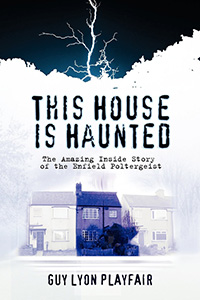
– 📚 This House is Haunted 💵 by Guy Lyon Playfair — the primary first-hand account of the investigation
– 📚 Twin Telepathy 💵 by Guy Lyon Playfair — his subsequent major research project
– 📚 The Geller Effect 💵 by Guy Lyon Playfair and Uri Geller
– 📚 Will Storr vs. the Supernatural 💵 by Will Storr — mentioned by Blake as background reading; includes an account of searching for Anita Gregory’s Enfield paper
– 📚 Would You Believe It? 💵 by Karen Stollznow — an anthology of strange events experienced by skeptical people
🔗 Related Links
– Enfield Poltergeist (Wikipedia)
– Society for Psychical Research
– Society for Psychical Research (Wikipedia)
– Allan Kardec and Spiritism — the Brazilian Spiritist tradition Playfair references
– Ghostwatch (1992 BBC drama, Wikipedia)
– SkepticalAboutSkeptics.com — hosts Playfair’s essays on organized skepticism
– Matthew Manning — British poltergeist / psychic phenomena case mentioned by Playfair
Note: ads inserted into the distributed audio alter the timestamps in unpredictable ways, so timing references in these notes are approximate.
In this episode of MonsterTalk we present an interview with Guy Lyon Playfair, one of the original investigators into perhaps the most famous British poltergeist case in modern times.
Author and researcher Guy Lyon Playfair was one of the two primary investigators into the alleged poltergeist activity in Enfield in the 1970s. His book This House is Haunted was the basis for multiple movies and television specials. Skeptics like Joe Nickell and Chris French have strongly suggested the case was a hoax. Playfair has maintained his position that the events were real, and has leveled strong criticism at skeptics.
Items of Interest
- Dr. Barry Colvin’s research paper on the sound recordings of poltergeist knocks.
- Playfair has written several essays criticizing skeptics.
- The Society for Psychical Research
- BBC Coverage of Enfield from 1977
- BBC Interview featuring Janet and The Voice
- BBC “Interview with a Poltergeist” 2007
- The Conjuring 2
- The Enfield Haunting
- Ghost Watch DVD
- Karen Stollznow’s Would You Believe It? — an anthology of odd events happening to very skeptical people.
Music
- Monstertalk Theme: Monster by Peach Stealing Monkeys
MTArchivist
0