Regular Episode
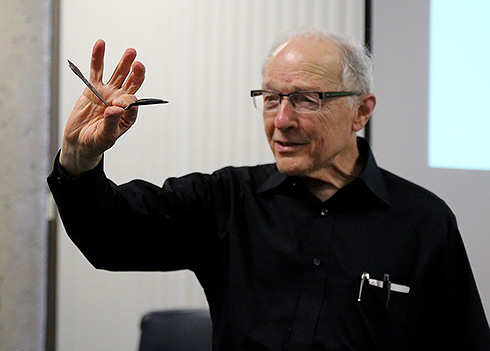
#122 – PSYCHIC SOLDIERS AND IMPERILLED SILVERWARE
Some of this story reached popular audiences through Jon Ronson‘s 📚 The Men Who Stare at Goats 💵, but Ray lived it from the inside — grading exams in Oregon one afternoon in 1972 and flying to Stanford Research Institute the next to eyeball a charismatic Israeli with a reputation for bending metal using nothing but concentration. The episode is also a minor technical adventure: a computer reboot mid-interview, a dropped reconnection, and a missing opening question all had to be reconstructed. Remarkably, it turned out okay.
🃏 From the Merry Mystic to the Skeptic’s Podium
Ray’s skepticism predates his career by decades. At age seven, a librarian handed him a children’s biography of Harry Houdini, and he took it as read that a proper magician’s job was to expose fakes. He began performing magic for money that same year — billing himself as the Merry Mystic after a printer on the Mystic River turned his $5 birthday-show fee into a run of business cards.
Needing fresh material to pitch to the same community groups year after year, he added mentalism, hypnosis demonstrations, and eventually cold reading attached to palm reading — the latter chosen because hands at least offered a plausible physical hook for inference. He never believed palmistry was literally true, but the reactions of audiences (and one memorable psychology department head who dressed him down for charlatanism, then quietly returned to ask for more) convinced him that cold reading was the master key to understanding why intelligent people can be profoundly misled. He performed his first televised cold reading on the DuMont Network around 1952 and, now in his late eighties, still hasn’t had a subject tell him he got it wrong.
🥄 Uri Geller and the Imperilled Silverware
In 1972, Colonel Austin Kibler — then acting head of ARPA (the forerunner of DARPA) and himself a PhD psychologist — called Ray out of the blue and asked him to drop everything and fly to Stanford Research Institute. An Israeli psychic named Uri Geller was being studied there by physicists Russell Targ and Harold Puthoff, and the Defense Department wanted an independent assessment. The urgency: Geller was temperamental and might leave for Broadway at any moment (there was apparently a musical in the works).
Geller had been brought to the U.S. by Andrija Puharich, a physician turned psychic talent scout. Ray was placed on a three-man committee alongside parapsychologist Robert Van de Castle from the University of Virginia and George Lawrence of the Advanced Research Agency. He was instructed not to identify himself as either a psychologist or a magician — Geller, Targ warned, would simply shut down.
The most dramatic claim Ray had been sent to verify — that Geller bent a ring into the letter S without touching it — dissolved under questioning. After persistent pressing, it emerged that no one at SRI had actually witnessed the contactless bending. The ring had been given to Geller, he’d taken it home overnight, and it came back shaped differently. Ray also noted that Geller’s in-person performances came with a running disclaimer: whatever he managed to do in front of you was always smaller and less impressive than what he allegedly did elsewhere. (James Randi’s term for Geller’s bathroom breaks during difficult bending attempts — “urinalysis” — gets an appreciative mention.)
Ray’s view of Geller is notably warmer than James Randi‘s: a charming, charismatic con artist rather than an avatar of evil. He also pushes back on Randi’s oft-stated belief that magicians are uniquely suited to spot psychic trickery — pointing out that Geller’s most ardent supporters have included many professional magicians, and that magicians fool each other routinely precisely because they know how each other’s attention works.
🔭 Project Stargate and the Remote Viewers
Separate from the Geller investigation — though also based at SRI, and using the same two physicists — the CIA funded a long-running program to develop remote viewing, a term Targ coined as a more scientific-sounding label for what had previously been called clairvoyance. The basic protocol: a remote viewer would enter a trance state and attempt to describe a target location, often inside the Soviet Union, from coordinates alone. Early results appeared impressive enough to persuade the CIA to fund years of further research, reportedly to the tune of around $7 million in the first phase.
After the CIA lost interest, the Defense Intelligence Agency took over, housing a unit of five to ten military remote viewers at a fort near Washington, D.C. The program ran until around 1995 under the umbrella now known as Project Stargate. A dispute between a commanding general (who wanted the psychics to provide quantitative intelligence on North Korean nuclear installations) and the remote viewers (who insisted they only dealt in images, not numbers) escalated to the Senate oversight committee, which passed the problem back to a reluctant CIA. The CIA’s solution: commission a blue-ribbon evaluation panel.
That panel turned out to be Ray and statistician Jessica Utts (then at UC Davis, later UC Irvine). Ray arrived with three large cartons of two decades’ worth of classified data. His co-reviewer, a capable statistician and sympathetic parapsychologist, felt the numbers were sound; Ray’s counter was the classic “garbage in, garbage out” — statistical sophistication applied to compromised protocols yields nothing useful.
The methodological rot had already been exposed by psychologist David Marks, who had traveled from New Zealand to SRI specifically to examine the raw remote-viewing transcripts. After a prolonged struggle to access the data, Marks obtained the protocols from a former judge on the experiments and discovered that the transcripts contained embedded cues — references in one session to targets from previous sessions — that allowed judges to match descriptions to locations at above-chance rates without any psychic ability required. When those cues were removed, the effect vanished. Ray credits Marks’s book 📚 The Psychology of the Psychic 💵 as the most thorough demolition of the remote-viewing literature.
Ray also recounts a side note that illustrates how psychic research money percolated through the military’s unofficial channels: a lieutenant colonel who ran a munitions program was quietly funneling $10,000 per month — just under the documentation threshold — to the researcher who had sparked the 1960s craze of attaching lie detectors to houseplants and interpreting the results as evidence of plant sentience.
🧠 Why Smart People Go Wrong
The conversation broadens into Ray’s work on the psychology of belief and rational failure. His core argument: intelligence measures cognitive capacity, not how that capacity is deployed. High-IQ individuals are just as susceptible to motivated reasoning and cognitive shortcuts as anyone else — they simply have more horsepower available to rationalize conclusions they’ve already reached.
Ray highlights several interconnected mechanisms discussed in his contribution to 📚 Why Smart People Can Be So Stupid 💵, edited by Robert Sternberg:
– Default belief: Following the philosopher Spinoza, Ray notes that the mind’s factory setting is acceptance — we believe incoming information first and interrogate it later, if at all.
– The misinformation effect: Repeated exposure to a claim increases perceived truth value even when the claim was initially judged false — illusory truth driven by processing fluency.
– Source amnesia: We forget where we heard something but retain the feeling of familiarity, which the brain misreads as evidence of validity.
– The backfire effect: Debunking a false claim can inadvertently reinforce it by increasing the claim’s cognitive availability — a particular hazard for skeptics.
Ray also credits his friend and colleague Jim Alcock, who at the time of recording was completing a major book on the psychology of belief.
📚 Further Reading
– 📚 The Psychology of the Psychic 💵 by David Marks
– 📚 The Elusive Quarry 💵 by Ray Hyman
– 📚 Why Smart People Can Be So Stupid 💵 edited by Robert Sternberg
– 📚 The Men Who Stare at Goats 💵 by Jon Ronson
– 📚 Water Witching U.S.A. 💵 by Evon Vogt and Ray Hyman
🔗 Related Links
– Ray Hyman — Wikipedia
– Stargate Project — Wikipedia
– Remote Viewing — Wikipedia
– Uri Geller — Wikipedia
– Russell Targ — Wikipedia
– Cold Reading — Wikipedia
– Ideomotor Effect — Wikipedia (relevant to dowsing, Ouija boards, and other ostensibly paranormal phenomena Ray discusses in his broader work)
– Senator William Proxmire and his Golden Fleece Awards — Wikipedia
– University of Virginia Division of Perceptual Studies (formerly the parapsychology department referenced by Ray) — Wikipedia
– Illusory Truth Effect — Wikipedia
– Ray Hyman’s Skeptic’s Toolbox Workshop
Note: ads inserted into the distributed audio alter the timestamps in unpredictable ways, so timing references in these notes are approximate.
In this MonsterTalk, we’re pleased to bring you an interview with psychologist Ray Hyman, a long time skeptical activist and educator, a founding member of CSICOP (now CSI) and one of the key investigators into the US government’s program to develop psychic soldiers. Some of this story was revealed in Jon Ronson’s The Men Who Stare at Goats, but in this interview you’ll hear Ray’s personal recollections about magic, skepticism and the mysterious claims of a famous psychic named Uri Geller.
Items of Interest
- The DuMont TV Network
- Senator William Proxmire’s Golden Fleece Awards
- Ray Hyman’s Skeptic’s Toolbox workshop (and Wiki article )
- University of Virginia Division of Perceptual Studies (formerly parapsychology dept referenced in story by Ray) and here.
- Uri Geller
- Russell Targ
- The Stargate Project
- Remote Viewing
- Ideomotor Effect (related to water witching, ouija boards and many other “paranormal” phenomena)
- The Psychology of the Psychic, by David Marks
- The Elusive Quarry, by Ray Hyman
- Why Smart People Can Be So Stupid, edited by Robert Sternberg
- The Men Who Stare at Goats, by Jon Ronson
- Water Witching (USA), by Evon Vogt and Ray Hyman
- How People are Fooled by Ideomotor Action
Music
- Intro music: Dark Walk Kevin MacLeod (incompetech.com)
Licensed under [CC BY 3.0] - Monstertalk Theme: Monster by Peach Stealing Monkeys
MTArchivist
0