#081 – A TIGER BY THE TALE
In cryptozoology, out-of-place predatory cats are known as Alien Big Cats (ABCs) — a category that spans reports from the UK, the US, and, as this episode explores in depth, Australia. What makes the Australian case compelling is its deep historical paper trail, the real economic stakes for livestock farmers, and the genuinely tangled web of folklore, misidentification, hoax, and plausible exotic-animal escapes that David has spent years carefully unpicking.
🐾 Three Eras of Big Cat Panic in Victoria
David divides the history of Australian big cat reports into three rough periods:
– Early colonisation (1790s–1870s): Settlers arrived with mental frameworks built in Africa and Asia, and Australia’s unfamiliar fauna confounded them entirely. Quolls were called “tiger cats,” thylacines were labelled marsupial wolves or marsupial tigers depending on the observer, and dingoes were sometimes called hyenas. The colonists weren’t being careless — they genuinely had no reference points for what they were seeing.
– Settlement and industrialisation (1860s onward): The Acclimatisation Society was actively importing and releasing animals — deer, rabbits, mongooses, carp, and at one point very nearly Burmese pythons — in hopes of “improving” the Australian environment. Travelling menageries also began touring the country, raising public anxiety about what would happen if a leopard or tiger got loose.
– Post–World War II to the present: The dominant origin myth shifts to American (and Australian) servicemen releasing exotic mascots. Sightings and stock-kill panics continue to the present day, with the Victorian government as recently as 2013 funding a formal big cat research project under pressure from rural MPs.
🐅 The Tantanoola Tiger and the Pattern of Panic
The Tantanoola Tiger panic of the 1880s, centred around the Mount Gambier region on the South Australia–Victoria border, established what David identifies as the template for every subsequent big cat scare. Two tigers were said to have escaped from St. Leon’s Circus; stock losses were real and severe; fifty constables armed with Martini-Henry rifles were deployed; a pair of Afghan shikaris were offered £100 each to capture the animal; and a ship went down offshore while rescue personnel were unavailable — because they were out hunting tigers.
The panic wound down when a man named Tom O’Donovan shot a dog and presented it as the culprit. Experts today identify it as an alpine dingo; the taxidermied animal is still on display at the Tantanoola Hotel. That wasn’t the end of it, though — the story mutated in the press until it became a claim that the Melbourne Zoological Gardens had been deliberately releasing predators across the border to sabotage the South Australian wool industry. The newly established telegraph network spread the panic nationally and, David argues, set the interpretive mold for big cat scares for the next century.
🐑 Stock Kills, Dog Behaviour, and the Cattle Mutilation Parallel
Much of the conversation focuses on what is actually killing the livestock. David draws an explicit parallel with the American cattle mutilation panics: in both cases, the most likely explanation is sequential predation — a staghound breaks a sheep’s neck, foxes move in, then birds, and by morning the carcass looks inexplicable to a distressed farmer.
Complicating matters is breed-specific kill behaviour in dogs: a staghound typically goes for the neck and nose; a pack of border collies or kelpies shreds and runs. Dogs also learn — Simon Townsend discovered that one of his own dogs had independently invented the technique of shoulder-charging a sheep to knock it over before going for the throat. David also notes that livestock rustling historically exploited big cat lore: a documented 1911 case near Mount Gambier involved a man who killed sheep, faked big cat attack signatures, then skinned the animals and shipped their pelts to confederates in Melbourne and Adelaide.
🪖 Military Mascots and the Blame Game
The most popular contemporary explanation for Australian big cats — that American servicemen released pumas during World War II — gets a thorough historical examination. The 22nd Bombardment Group stationed near the Grampians is most often cited. David traces the story to the Ngarri Lion panic of 1947, where a circus expert suggested that the kill pattern looked more like a puma than a lion, and the American unit became the obvious suspect.
What the historical record actually shows, however, is that the primary concern of Australian customs was Australian servicemen returning from North Africa and New Guinea with exotic pets. A 1942 incident in Fremantle, where Polish troops arrived with yellow-fever-carrying monkeys, prompted the government to ban all non-regimental mascots — a rule that did not apply to American forces. David’s hypothesis: the Americans get the blame partly because they were the ones legally allowed to keep mascots, and partly because it is always easier to blame the foreigner. One customs unit reported destroying over 220 animals in a single month. The Sydney command even ordered the preemptive destruction of all big-cat mascots and circus animals in the city, fearing that a Japanese bombing raid might release predators onto army bases.
🦘 Bunyips, Yowies, and the Misapplication of Indigenous Folklore
David broadens the discussion to other Australian cryptids and the complicated way settler culture appropriated and distorted Indigenous knowledge. The word bunyip was applied indiscriminately to water monsters across the entire continent, even in regions where it was not an Indigenous term — by the time settlers were asking Aboriginal people in Arnhem Land about “bunyips,” the Aborigines assumed it was a white word for a white monster. David’s working hypothesis is that the description given by Aboriginal people near Geelong in 1845 — a riverbank creature that hugs victims to death underwater, slides in without making a ripple, lays inedible eggs, and has a serrated bill — reflects secondhand knowledge of crocodiles passed along through inter-community contact, applied to unfamiliar megafauna bones.
A celebrated episode involved Aboriginal people presenting a supposed bunyip skull to scientists near the Murrumbidgee River — which turned out to be the deformed head of a foal. David is confident this was a deliberate practical joke. The Yowie follows a similarly convoluted path: early reports describe a humanoid water monster; the term also doubled as a high-pitched call (a “cooee”); over time it morphed first into “Australia’s gorilla” and eventually into a straightforward Bigfoot analogue — despite the complete absence of any primate fossil record in Australia.
🔬 What the Evidence Actually Shows
David’s bottom-line assessment is carefully hedged: individual exotic cats have demonstrably gotten loose in the Australian bush — that is well-documented. A self-sustaining breeding population is a different matter, and he is sceptical. Simon Townsend has been collecting DNA samples from suspected big-cat kills and submitting them for analysis; results so far have returned mixtures of fox, bird, and other native species, though DNA degradation in Australia’s humid conditions makes clean results difficult to obtain.
The Victorian Government Big Cat Report of 2013, which David was peripherally involved with, concluded that individual escapes had occurred and that the kills warranted further veterinary investigation — a position David endorses, noting that even if the answer turns out to be feral dogs, understanding that behaviour is genuinely useful for farmers. He proposes a “Gestalt effect” as a unifying explanation for persistent sightings: multiple data points — a distant feral cat at dusk, unidentified screams (often a fox or koala), and an unexplained carcass — are unconsciously integrated into a single coherent narrative shaped by 150 years of big cat folklore.
📚 Further Reading
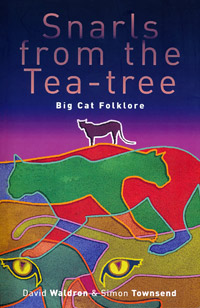
– 📚 Snarls from the Tea Tree: Victoria’s Big Cat Folklore 💵 by David Waldron and Simon Townsend
– 🎬 Razorback 💵 (1984 film) — the giant-feral-pig folklore of the late 19th century found its cinematic apotheosis here
🔗 Related Links
– Alien Big Cats (Wikipedia)
– Tantanoola Tiger (Wikipedia)
– Thylacine (Wikipedia)
– Dingo (Wikipedia)
– Bunyip (Wikipedia)
– Yowie (Wikipedia)
– Acclimatisation Society (Wikipedia)
– Cattle Mutilation (Wikipedia)
Note: ads inserted into the distributed audio alter the timestamps in unpredictable ways, so timing references in these notes are approximate.
ARE MYSTERIOUS LARGE CATS killing livestock and stalking the wilds of Australia? Dr. David Waldron returns to MonsterTalk to discuss his research on alien big cats down under: Snarls from the Tea-Tree: Big Cat Folklore, co-written with Simon Townsend.
David Waldron and Simon Townsend describe the history and evidence for strange misplaced large cats reported in Australia. Farm animals are being killed — but what is the culprit? Zoo escapees? Unknown native cats? Giant feral cats? From folklore to fact, Snarls from the Tea Tree gives a meticulous historical timeline of reports of these animals. In cryptozoology, these kinds of reports are often called “Alien Big Cats” or “ABCs.” Waldron was previously on MonsterTalk to discuss black dog legends of England.
Sound bites
- bugs and frogs (listen to MP3)
- fox howl (listen to MP3)
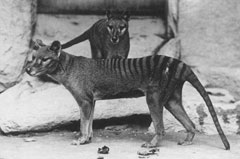
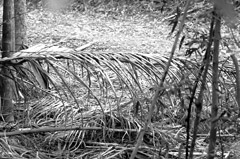
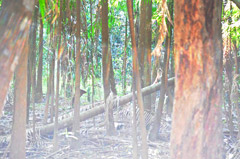
Palm trees similar to Thylacine coat patterns

Music
- Monstertalk Theme: Monster by Peach Stealing Monkeys